Quantitative Universal Approximation for Noisy Quantum Neural Networks
Pith reviewed 2026-05-21 09:42 UTC · model grok-4.3
The pith
Noisy quantum neural networks approximate continuous functions with explicit error bounds.
A machine-rendered reading of the paper's core claim, the machinery that carries it, and where it could break.
Core claim
We provide a universal approximation theorem with precise quantitative error bounds for noisy quantum neural networks, focusing on target functions given as expectations and validating the results through detailed numerical analysis on real noisy quantum hardware.
What carries the argument
The quantitative universal approximation theorem that supplies explicit error bounds for noisy quantum neural networks.
If this is right
- The approximation error can be bounded explicitly and made arbitrarily small despite the presence of noise.
- The result applies directly when the target is an expectation, as is common in quantitative finance.
- Numerical tests on real hardware confirm that the derived bounds remain relevant in practice.
Where Pith is reading between the lines
- The explicit bounds could be used to select circuit depth or qubit number needed for a target accuracy level.
- The same quantitative approach might extend to other noisy quantum algorithms that approximate expectations.
Load-bearing premise
The theorem holds under a specific noise model and a particular quantum neural network architecture.
What would settle it
Computing the approximation error for a simple expectation target on noisy quantum hardware and finding that it exceeds the theorem's predicted bound would falsify the result.
Figures




read the original abstract
We provide here a universal approximation theorem with precise quantitative error bounds for noisy quantum neural networks. We focus on applications to Quantitative Finance, where target functions are often given as expectations. We further provide a detailed numerical analysis, testing our results on actual noisy quantum hardware.
Editorial analysis
A structured set of objections, weighed in public.
Referee Report
Summary. The manuscript establishes a universal approximation theorem supplying explicit quantitative error bounds for noisy quantum neural networks. The bounds are derived for expectation-value targets, with emphasis on quantitative-finance applications, and are supported by numerical simulations together with experiments executed on actual noisy quantum hardware.
Significance. If the stated bounds hold under the paper's noise model and circuit ansatz, the result would be a useful advance: it moves beyond purely asymptotic universal-approximation statements by furnishing concrete, noise-aware error estimates that are directly relevant to NISQ hardware. The inclusion of hardware experiments and the focus on expectation values in finance constitute clear strengths, providing both theoretical control and empirical grounding that many related works lack.
major comments (2)
- [§3.2, Theorem 2] §3.2, Theorem 2 and Eq. (12): the quantitative bound is derived under the assumption of layer-wise independent depolarizing noise; the proof sketch does not address how the bound degrades under spatially or temporally correlated noise, which is the dominant error source on current hardware and directly affects the tightness claimed for the central approximation result.
- [§4.3, Table 2] §4.3, Table 2: the reported mean-squared errors for the option-pricing examples are obtained after post-selection on measurement outcomes; the manuscript does not quantify how the post-selection overhead scales with system size, leaving open whether the observed accuracy remains practical once the full sampling cost is included.
minor comments (3)
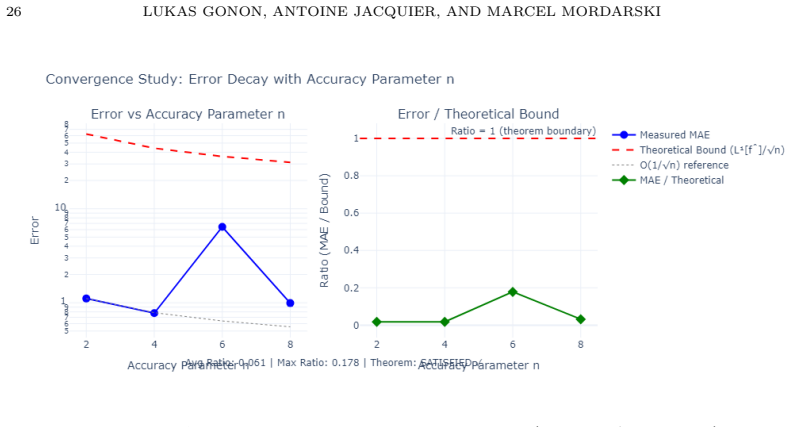
- [Figure 4] Figure 4: the error bars are plotted but the number of shots and the number of independent circuit executions used to compute them are not stated in the caption or the surrounding text.
- [Notation] Notation: the symbol N is used both for the number of qubits and for the number of training samples; a single consistent symbol or explicit disambiguation would improve readability.
- [§5] §5: the discussion of related classical approximation results cites only a subset of the relevant literature; adding references to quantitative bounds for noisy classical neural networks would strengthen the positioning of the quantum result.
Simulated Author's Rebuttal
We thank the referee for their careful reading of the manuscript and for highlighting these important points regarding the noise model and experimental overhead. We address each major comment below and have revised the manuscript to strengthen the presentation of our assumptions and results.
read point-by-point responses
-
Referee: [§3.2, Theorem 2] §3.2, Theorem 2 and Eq. (12): the quantitative bound is derived under the assumption of layer-wise independent depolarizing noise; the proof sketch does not address how the bound degrades under spatially or temporally correlated noise, which is the dominant error source on current hardware and directly affects the tightness claimed for the central approximation result.
Authors: We agree that Theorem 2 and the bound in Eq. (12) are derived under the explicit assumption of layer-wise independent depolarizing noise, which is stated in Section 3.2 and used throughout the proof in the appendix. This assumption enables a straightforward inductive bound on the accumulated channel distance by treating each layer's noise as an independent completely positive trace-preserving map. Under spatially or temporally correlated noise the error propagation is no longer additive in the same way, and the bound can become looser depending on the correlation length and strength. We have added a clarifying paragraph in the revised Section 3.2 that states this modeling choice, notes that the independent-noise bound provides a useful reference point for many NISQ devices when correlations are moderate, and acknowledges that a general treatment of arbitrary correlations would require device-specific noise tomography and is beyond the scope of the present work. revision: partial
-
Referee: [§4.3, Table 2] §4.3, Table 2: the reported mean-squared errors for the option-pricing examples are obtained after post-selection on measurement outcomes; the manuscript does not quantify how the post-selection overhead scales with system size, leaving open whether the observed accuracy remains practical once the full sampling cost is included.
Authors: We thank the referee for pointing this out. Post-selection is applied in the hardware runs reported in Section 4.3 to retain only shots consistent with the expected parity or stabilizer checks, thereby reducing the effective noise in the estimated expectation values. The mean-squared errors in Table 2 are computed on these post-selected data. In the revised manuscript we have inserted a new paragraph and an accompanying estimate in Section 4.3 that quantifies the overhead: for the 4-qubit and 6-qubit circuits the measured acceptance probabilities were approximately 0.72 and 0.48, respectively, corresponding to sampling overhead factors of roughly 1.4 and 2.1. We further provide a simple scaling argument showing that, under a per-qubit depolarizing error rate p, the acceptance probability decays as (1-p)^m where m is the number of measured qubits; this makes the overhead exponential in system size when no additional mitigation is employed. The added discussion makes clear that the reported accuracies are practical for the demonstrated circuit sizes but would require improved error mitigation for substantially larger instances. revision: yes
Circularity Check
No significant circularity; derivation self-contained against external benchmarks
full rationale
The paper presents a universal approximation theorem supplying explicit quantitative error bounds for noisy quantum neural networks, with focus on expectation-value targets. No load-bearing step reduces by construction to its own inputs: the central result is a theorem with stated assumptions on noise model and architecture that are not defined circularly in terms of the target bounds, and no self-citation chain or fitted parameter is invoked as the sole justification for the quantitative estimates. The derivation remains independent of the specific numerical hardware tests, which serve as validation rather than input. This is the most common honest finding for a theorem-style paper whose assumptions are externally falsifiable.
Axiom & Free-Parameter Ledger
Lean theorems connected to this paper
-
IndisputableMonolith/Cost/FunctionalEquation.leanwashburn_uniqueness_aczel unclear?
unclearRelation between the paper passage and the cited Recognition theorem.
Theorem 3.6 … ≤ L1[bf]√n + 4R √(1-Fmin²) … depolarising noise … αL1[bf]√n + (1-α)‖f‖L2(μ) + …
What do these tags mean?
- matches
- The paper's claim is directly supported by a theorem in the formal canon.
- supports
- The theorem supports part of the paper's argument, but the paper may add assumptions or extra steps.
- extends
- The paper goes beyond the formal theorem; the theorem is a base layer rather than the whole result.
- uses
- The paper appears to rely on the theorem as machinery.
- contradicts
- The paper's claim conflicts with a theorem or certificate in the canon.
- unclear
- Pith found a possible connection, but the passage is too broad, indirect, or ambiguous to say the theorem truly supports the claim.
Reference graph
Works this paper leans on
-
[1]
M. AbuGhanem , IBM Quantum computers: Evolution, performance, and future directions , arXiv:2410.00916, (2024)
-
[2]
J. Aftab and H. Yang , Approximating Korobov functions via quantum circuits , arXiv:2404.14570, (2024)
-
[3]
I. Agarwal, T. L. Patti, R. A. Bravo, S. F. Yelin, and A. Anandkumar , Extending quantum perceptrons: Rydberg devices, multi-class classification, and error tolerance , arXiv:2411.09093, (2024)
-
[4]
A. R. Barron , Universal approximation bounds for superpositions of a sigmoidal function , IEEE Transactions on Information theory, 39 (2002), pp. 930–945
work page 2002
- [5]
-
[6]
G. Cybenko , Approximation by superpositions of a sigmoidal function , Mathematics of control, signals and systems, 2 (1989), pp. 303–314
work page 1989
-
[7]
Glasserman , Monte Carlo Methods in Financial Engineering , vol
P. Glasserman , Monte Carlo Methods in Financial Engineering , vol. 53, Springer, 2003
work page 2003
-
[8]
L. Gonon , Random feature neural networks learn Black-Scholes type PDEs without curse of dimen- sionality, Journal of Machine Learning Research, 24 (2023), pp. 1–51
work page 2023
-
[9]
L. Gonon and A. Jacquier , Universal approximation theorem and error bounds for quantum neu- ral networks and quantum reservoirs , IEEE Transactions on Neural Networks and Learning Systems, (2025)
work page 2025
- [10]
-
[11]
K. Hornik , Approximation capabilities of multilayer feedforward networks , Neural networks, 4 (1991), pp. 251–257
work page 1991
- [12]
-
[13]
IBM Quantum , IBM Quantum platform – compute resources
-
[14]
A. N. Kolmogorov , On the representations of continuous functions of many variables by superposition of continuous functions of one variable and addition , in Dokl. Akad. Nauk USSR, vol. 114, 1957, pp. 953–956
work page 1957
-
[15]
Kraus , General state changes in quantum theory , Annals of Physics, 64 (1971), pp
K. Kraus , General state changes in quantum theory , Annals of Physics, 64 (1971), pp. 311–335
work page 1971
-
[16]
S. Kumar and C. M. Wilmott , Simulating the non-Hermitian dynamics of financial option pricing with quantum computers , arXiv:2407.01147, (2024)
-
[17]
M. Larocca, S. Thanasilp, S. W ang, K. Sharma, J. Biamonte, P. J. Coles, L. Cincio, J. R. McClean, Z. Holmes, and M. Cerezo , Barren plateaus in variational quantum computing , Nature Reviews Physics, (2025), pp. 1–16
work page 2025
- [18]
-
[19]
R. J. LeVeque , Finite Difference Methods for Ordinary and Partial Differential Equations: steady- state and time-dependent problems , SIAM, 2007
work page 2007
-
[20]
A. Manzano, D. Dechant, J. Tura, and V. Dunjko , Approximation and generalization capacities of parametrized quantum circuits for functions in Sobolev spaces , Quantum, 9 (2025), p. 1658
work page 2025
-
[21]
V. Martinez, A. Angrisani, E. Pankovets, O. F awzi, and D. Stilck França , Efficient simulation of parametrized quantum circuits under non-unital noise through Pauli backpropagation, arXiv:2501.13050, (2025)
- [22]
-
[23]
M. Möttönen, J. J. V artiainen, V. Bergholm, and M. M. Salomaa , Quantum circuits for general multiqubit gates , Physical Review Letters, 93 (2004), p. 130502
work page 2004
-
[24]
M. A. Nielsen and I. L. Chuang , Quantum Computation and Quantum Information , CUP, 2010
work page 2010
-
[25]
A. Pérez-Salinas, A. Cervera-Lierta, E. Gil-Fuster, and J. I. Latorre , Data re-uploading for a universal quantum classifier , Quantum, 4 (2020), p. 226
work page 2020
-
[26]
A. Pérez-Salinas, D. López-Núñez, A. García-Sáez, P. Forn-Díaz, and J. I. Latorre , One qubit as a universal approximant , Physical Review A, 104 (2021), p. 012405
work page 2021
-
[27]
Quantinuum, Quantinuum system model h2 product data sheet , tech. rep., Quantinuum, 2025
work page 2025
-
[28]
M. Rahman and J. Zhuang , NQNN: Noise-aware quantum neural network for medical image analysis , in Medical Image Computing and Computer Assisted Intervention – MICCAI 2025, 2025. 30 LUKAS GONON, ANTOINE JACQUIER, AND MARCEL MORDARSKI
work page 2025
-
[29]
S. Ramos-Calderer, A. Pérez-Salinas, D. García-Martín, C. Bravo-Prieto, J. Cortada, J. Planaguma, and J. I. Latorre , Quantum unary approach to option pricing , Physical Review A, 103 (2021), p. 032414
work page 2021
-
[30]
Rigetti Computing , Rigetti computing reports on its Q2 2025 financial results , August 2025
work page 2025
-
[31]
, Rigetti reports it halves two-qubit gate error rate , July 2025
work page 2025
-
[32]
Sato , Lévy Processes and Infinitely Divisible Distributions , vol
K.-I. Sato , Lévy Processes and Infinitely Divisible Distributions , vol. 68, CUP, 1999
work page 1999
-
[33]
Scherer , Mathematics of Quantum Computing , vol
W. Scherer , Mathematics of Quantum Computing , vol. 11, Springer, 2019
work page 2019
- [34]
-
[35]
N. Stamatopoulos, D. J. Egger, Y. Sun, C. Zoufal, R. Iten, S. Woerner, and W. Braine , Option pricing using quantum computers , Quantum, 4 (2020), p. 291
work page 2020
- [36]
- [37]
- [38]
-
[39]
Yarotsky, Error bounds for approximations with deep ReLU networks , Neural networks, 94 (2017), pp
D. Yarotsky, Error bounds for approximations with deep ReLU networks , Neural networks, 94 (2017), pp. 103–114
work page 2017
-
[40]
Z. Yu, Q. Chen, Y. Jiao, Y. Li, X. Lu, X. W ang, and J. Yang , Non-asymptotic approximation error bounds of parameterized quantum circuits , Advances in NeurIPS, 37 (2024), pp. 99089–99127. School of Computer Science, University of St. Gallen and Department of Mathematics, Imperial College London Email address : l.gonon@imperial.ac.uk Department of Mathem...
work page 2024
discussion (0)
Sign in with ORCID, Apple, or X to comment. Anyone can read and Pith papers without signing in.