Beam-energy dependence of correlations between mean transverse momentum and anisotropic flow of charged particles in Au+Au collisions at RHIC
Pith reviewed 2026-05-23 16:44 UTC · model grok-4.3
The pith
Measurements reveal energy-dependent variances but similar dimensionless ratios for mean transverse momentum and anisotropic flow across RHIC beam energies.
A machine-rendered reading of the paper's core claim, the machinery that carries it, and where it could break.
Core claim
Our measurements reveal a distinct energy-dependent behavior in the variances and covariances. In addition, the dimensionless ratio displays a similar behavior across different beam energies.
What carries the argument
The dimensionless ratio of the variances and covariance of [pT] and v_n^2, which isolates effects from initial conditions and shear viscosity.
If this is right
- These measurements can differentiate between different initial-state models in heavy-ion collisions.
- The findings provide insights into the beam energy dependence of the specific shear viscosity eta/s.
- Similar behavior of the ratio across energies suggests universal aspects in the correlation mechanism.
- Comparisons with Pb+Pb at LHC help understand the energy evolution of these effects.
Where Pith is reading between the lines
- The consistent ratio might indicate that initial-state fluctuations scale in a particular way with energy that compensates for changes in viscosity.
- Future measurements at even lower or higher energies could test if this similarity persists or breaks at phase transition points.
- Improved hydrodynamic simulations without parameter tuning could be validated against these data points.
Load-bearing premise
Hydrodynamic models correctly capture the beam-energy dependence of both initial-state fluctuations and the specific shear viscosity without additional free parameters tuned to these observables.
What would settle it
A hydrodynamic model prediction that matches the energy dependence of variances but fails to reproduce the similar ratio across energies, or vice versa, would challenge the interpretation.
Figures


read the original abstract
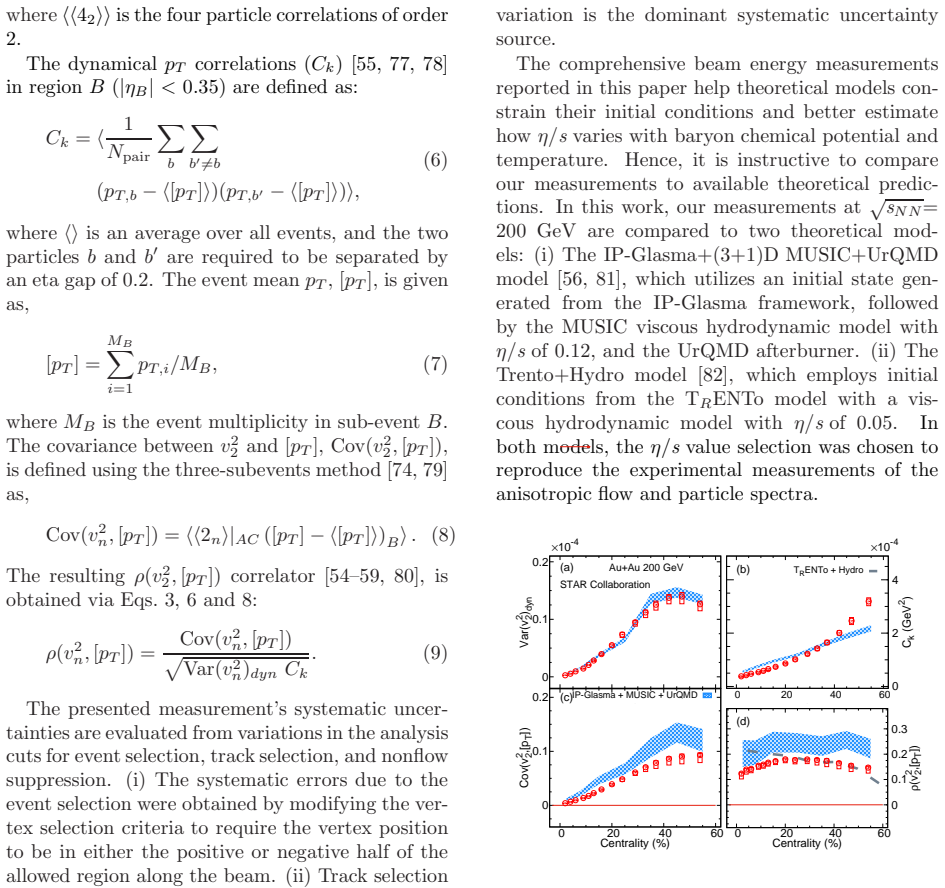
The correlation between the mean transverse momentum, $[p_{\mathrm{T}}]$, and the squared anisotropic flow, $v^{2}_{n}$, on an event-by-event basis has been suggested to be influenced by the initial conditions in heavy-ion collisions. We present measurements of the variances and covariance of $[p_{\mathrm{T}}]$ and $v^{2}_{n}$, along with their dimensionless ratio, for Au+Au collisions at various beam energies: $\sqrt{\textit{s}_{NN}}$ $=$ 14.6, 19.6, 27, 54.4, and 200~GeV. Our measurements reveal a distinct energy-dependent behavior in the variances and covariances. In addition, the dimensionless ratio displays a similar behavior across different beam energies. We compare our measurements with hydrodynamic models and similar measurements from Pb+Pb collisions at the Large Hadron Collider (LHC). These findings provide valuable insights into the beam energy dependence of the specific shear viscosity ($\eta/s$) and initial-state effects, allowing for differentiating between different initial-state models.
Editorial analysis
A structured set of objections, weighed in public.
Referee Report
Summary. The paper reports measurements of the variances and covariance of event-by-event mean transverse momentum [p_T] and squared anisotropic flow v_n^2, along with their dimensionless ratio, for Au+Au collisions at RHIC beam energies √s_NN = 14.6, 19.6, 27, 54.4, and 200 GeV. It finds distinct energy dependence in the variances and covariances but similar behavior in the ratio across energies, and compares the results to hydrodynamic models and LHC Pb+Pb data to constrain η/s and initial-state effects.
Significance. If the measurements are robust, they supply new experimental constraints on the beam-energy evolution of initial-state fluctuations and specific shear viscosity in heavy-ion collisions, helping discriminate among initial-state models.
minor comments (2)
- [Abstract] The abstract does not specify the centrality range or the method used to define centrality; adding this would clarify the kinematic domain of the reported energy dependence.
- Notation for the dimensionless ratio is introduced without an explicit equation; including its definition (e.g., as cov([p_T],v_n^2)/sqrt(var([p_T])var(v_n^2))) in the main text would improve readability.
Simulated Author's Rebuttal
We thank the referee for the careful reading and positive assessment of our manuscript, including the recommendation for minor revision. The referee's summary accurately reflects the scope and findings of the work. No specific major comments were raised in the report.
Circularity Check
No significant circularity identified
full rationale
The paper reports direct experimental measurements of variances, covariances, and the dimensionless ratio of [p_T] and v_n^2 from Au+Au collision data at multiple RHIC energies. No derivation chain, first-principles prediction, or ansatz is claimed that reduces by construction to fitted inputs or self-citations. Model comparisons are external and interpretive only; the central claims are observational statements from data analysis and remain self-contained against external benchmarks.
Axiom & Free-Parameter Ledger
Reference graph
Works this paper leans on
-
[1]
J. Adams, et al., Experimental and theoretical chal- lenges in the search for the quark gluon plasma: The STAR Collaboration’s critical assessment of the evidence from RHIC collisions, Nucl. Phys. A 757 (2005) 102–183. arXiv:nucl-ex/0501009, doi:10.1016/j.nuclphysa.2005.03.085
work page internal anchor Pith review Pith/arXiv arXiv doi:10.1016/j.nuclphysa.2005.03.085 2005
-
[2]
K. Adcox, et al., Formation of dense partonic matter in relativistic nucleus-nucleus collisions at RHIC: Experi- mental evaluation by the PHENIX collaboration, Nucl. Phys. A 757 (2005) 184–283. arXiv:nucl-ex/0410003, doi:10.1016/j.nuclphysa.2005.03.086
work page internal anchor Pith review Pith/arXiv arXiv doi:10.1016/j.nuclphysa.2005.03.086 2005
-
[3]
I. Arsene, et al., Quark gluon plasma and color glass condensate at RHIC? The Perspective from the BRAHMS experiment, Nucl. Phys. A 757 (2005) 1–27. arXiv:nucl-ex/0410020, doi:10.1016/j.nuclphysa.2005.02.130
-
[4]
B. B. Back, et al., The PHOBOS perspec- tive on discoveries at RHIC, Nucl. Phys. A 757 (2005) 28–101. arXiv:nucl-ex/0410022, doi:10.1016/j.nuclphysa.2005.03.084
work page internal anchor Pith review Pith/arXiv arXiv doi:10.1016/j.nuclphysa.2005.03.084 2005
-
[5]
First Results from Pb+Pb collisions at the LHC
B. Muller, J. Schukraft, B. Wyslouch, First Re- sults from Pb+Pb collisions at the LHC, Ann. Rev. Nucl. Part. Sci. 62 (2012) 361–386. arXiv:1202.3233, doi:10.1146/annurev-nucl-102711-094910
work page internal anchor Pith review Pith/arXiv arXiv doi:10.1146/annurev-nucl-102711-094910 2012
-
[6]
E. V. Shuryak, Quark-Gluon Plasma and Hadronic Production of Leptons, Photons and Psions, Sov. J. Nucl. Phys. 28 (1978) 408. doi:10.1016/0370-2693(78)90370-2
-
[7]
E. V. Shuryak, Quantum Chromodynamics and the Theory of Superdense Matter, Phys. Rept. 61 (1980) 71–158. doi:10.1016/0370-1573(80)90105-2
-
[8]
Why does the Quark-Gluon Plasma at RHIC behave as a nearly ideal fluid ?
E. Shuryak, Why does the quark gluon plasma at RHIC behave as a nearly ideal fluid?, Prog. Part. Nucl. Phys. 53 (2004) 273–303. arXiv:hep-ph/0312227, doi:10.1016/j.ppnp.2004.02.025
work page internal anchor Pith review Pith/arXiv arXiv doi:10.1016/j.ppnp.2004.02.025 2004
-
[9]
Conformal Relativistic Viscous Hydrodynamics: Applications to RHIC results at sqrt(s_NN) = 200 GeV
M. Luzum, P. Romatschke, Conformal Rel- ativistic Viscous Hydrodynamics: Applica- tions to RHIC results at √ SN N = 200-GeV, Phys.Rev. C78 (2008) 034915. arXiv:0804.4015, doi:10.1103/PhysRevC.78.034915,10.1103/PhysRevC.79.039903
work page internal anchor Pith review Pith/arXiv arXiv doi:10.1103/physrevc.78.034915 2008
-
[10]
Bulk and shear viscosities of matter created in relativistic heavy-ion collisions
P. Bozek, Bulk and shear viscosities of matter created in relativistic heavy-ion collisions, Phys. Rev. C 81 (2010) 034909. arXiv:0911.2397, doi:10.1103/PhysRevC.81.034909
work page internal anchor Pith review Pith/arXiv arXiv doi:10.1103/physrevc.81.034909 2010
-
[11]
Disappearance of Elliptic Flow: A New Probe for the Nuclear Equation of State
P. Danielewicz, R. A. Lacey, P. Gossiaux, C. Pinken- burg, P. Chung, J. Alexander, R. McGrath, Dis- appearance of elliptic flow: a new probe for 5 the nuclear equation of state, Phys. Rev. Lett. 81 (1998) 2438–2441. arXiv:nucl-th/9803047, doi:10.1103/PhysRevLett.81.2438
work page internal anchor Pith review Pith/arXiv arXiv doi:10.1103/physrevlett.81.2438 1998
-
[12]
U. W. Heinz, P. F. Kolb, Early ther- malization at RHIC, Nucl. Phys. A702 (2002) 269–280. arXiv:hep-ph/0111075, doi:10.1016/S0375-9474(02)00714-5
work page internal anchor Pith review Pith/arXiv arXiv doi:10.1016/s0375-9474(02)00714-5 2002
-
[13]
Hadronic dissipative effects on elliptic flow in ultrarelativistic heavy-ion collisions
T. Hirano, U. W. Heinz, D. Kharzeev, R. Lacey, Y. Nara, Hadronic dissipative effects on elliptic flow in ultrarelativistic heavy-ion collisions, Phys.Lett. B636 (2006) 299–304. arXiv:nucl-th/0511046, doi:10.1016/j.physletb.2006.03.060
work page internal anchor Pith review Pith/arXiv arXiv doi:10.1016/j.physletb.2006.03.060 2006
-
[14]
P. Huovinen, P. F. Kolb, U. W. Heinz, P. V. Ruuskanen, S. A. Voloshin, Radial and elliptic flow at rhic: Further predictions, Phys. Lett. B503 (2001) 58–64
work page 2001
-
[15]
T. Hirano, K. Tsuda, Collective flow and two pion correlations from a relativistic hydrodynamic model with early chemical freeze out, Phys. Rev. C66 (2002) 054905. arXiv:nucl-th/0205043, doi:10.1103/PhysRevC.66.054905
work page internal anchor Pith review Pith/arXiv arXiv doi:10.1103/physrevc.66.054905 2002
-
[16]
P. Romatschke, U. Romatschke, Viscosity In- formation from Relativistic Nuclear Collisions: How Perfect is the Fluid Observed at RHIC?, Phys.Rev.Lett. 99 (2007) 172301. arXiv:0706.1522, doi:10.1103/PhysRevLett.99.172301
work page internal anchor Pith review Pith/arXiv arXiv doi:10.1103/physrevlett.99.172301 2007
-
[17]
Flow fluctuations and long-range correlations: elliptic flow and beyond
M. Luzum, Flow fluctuations and long-range correlations: elliptic flow and beyond, J. Phys. G38 (2011) 124026. arXiv:1107.0592, doi:10.1088/0954-3899/38/12/124026
work page internal anchor Pith review Pith/arXiv arXiv doi:10.1088/0954-3899/38/12/124026 2011
-
[18]
H. Song, S. A. Bass, U. Heinz, T. Hirano, C. Shen, 200 A GeV Au+Au collisions serve a nearly perfect quark-gluon liquid, Phys. Rev. Lett. 106 (2011) 192301, [Erratum: Phys. Rev. Lett.109,139904(2012)]. arXiv:1011.2783, doi:10.1103/PhysRevLett.106.192301,10.1103/PhysRevLett.109.139904
work page internal anchor Pith review Pith/arXiv arXiv doi:10.1103/physrevlett.106.192301 2011
-
[19]
J. Qian, U. W. Heinz, J. Liu, Mode-coupling ef- fects in anisotropic flow in heavy-ion collisions, Phys. Rev. C93 (6) (2016) 064901. arXiv:1602.02813, doi:10.1103/PhysRevC.93.064901
work page internal anchor Pith review Pith/arXiv arXiv doi:10.1103/physrevc.93.064901 2016
-
[20]
Anisotropic flow in sqrt(s)=2.76 TeV Pb+Pb collisions at the LHC
B. Schenke, S. Jeon, C. Gale, Anisotropic flow in√ s = 2 .76 TeV Pb+Pb collisions at the LHC, Phys.Lett. B702 (2011) 59–63. arXiv:1102.0575, doi:10.1016/j.physletb.2011.06.065
work page internal anchor Pith review Pith/arXiv arXiv doi:10.1016/j.physletb.2011.06.065 2011
-
[21]
N. Magdy, X. Sun, Z. Ye, O. Evdokimov, R. Lacey, Investigation of the Elliptic Flow Fluctuations of the Identified Particles Using the a Multi-Phase Transport Model, Universe 6 (9) (2020) 146. arXiv:2009.02734, doi:10.3390/universe6090146
-
[22]
Magdy, Characterizing initial- and final-state ef- fects of relativistic nuclear collisions, Phys
N. Magdy, Characterizing initial- and final-state ef- fects of relativistic nuclear collisions, Phys. Rev. C 107 (2) (2023) 024905. arXiv:2210.14091, doi:10.1103/PhysRevC.107.024905
-
[23]
S. Voloshin, Y. Zhang, Flow study in relativistic nu- clear collisions by Fourier expansion of Azimuthal par- ticle distributions, Z. Phys. C 70 (1996) 665–672. arXiv:hep-ph/9407282, doi:10.1007/s002880050141
work page internal anchor Pith review Pith/arXiv arXiv doi:10.1007/s002880050141 1996
-
[24]
A. M. Poskanzer, S. A. Voloshin, Methods for analyzing anisotropic flow in relativistic nuclear collisions, Phys. Rev. C58 (1998) 1671–1678. arXiv:nucl-ex/9805001, doi:10.1103/PhysRevC.58.1671
work page internal anchor Pith review Pith/arXiv arXiv doi:10.1103/physrevc.58.1671 1998
-
[25]
B. Alver, et al., System size, energy, pseudorapid- ity, and centrality dependence of elliptic flow, Phys. Rev. Lett. 98 (2007) 242302. arXiv:nucl-ex/0610037, doi:10.1103/PhysRevLett.98.242302
-
[26]
C. Adler, et al., Elliptic flow from two and four particle correlations in Au+Au collisions at √ SN N = 130-GeV, Phys. Rev. C 66 (2002) 034904. doi:10.1103/PhysRevC.66.034904
-
[27]
Adams, et al., Azimuthal anisotropy at RHIC: The First and fourth harmonics, Phys
J. Adams, et al., Azimuthal anisotropy at RHIC: The First and fourth harmonics, Phys. Rev. Lett. 92 (2004) 062301, [Erratum: Phys.Rev.Lett. 127, 069901 (2021)]. doi:10.1103/PhysRevLett.127.069901
-
[28]
A. Adare, et al., Measurement of two-particle corre- lations with respect to second- and third-order event planes in Au+Au collisions at √ sN N = 200 GeV, Phys. Rev. C 99 (5) (2019) 054903. arXiv:1803.01749, doi:10.1103/PhysRevC.99.054903
-
[29]
K. Aamodt, et al., Higher harmonic anisotropic flow measurements of charged particles in Pb-Pb collisions at √ sN N=2.76 TeV, Phys. Rev. Lett. 107 (2011) 032301. doi:10.1103/PhysRevLett.107.032301
-
[30]
M. Aaboud, et al., Measurement of the azimuthal anisotropy of charged particles produced in √sNN = 5.02 TeV Pb+Pb collisions with the ATLAS detector, Eur. Phys. J. C 78 (12) (2018) 997. doi:10.1140/epjc/s10052-018-6468-7
-
[31]
S. Chatrchyan, et al., Azimuthal anisotropy of charged particles at high transverse momenta in PbPb collisions at √ sN N = 2 .76 TeV, Phys. Rev. Lett. 109 (2012) 022301. doi:10.1103/PhysRevLett.109.022301
-
[32]
S. Chatrchyan, et al., Measurement of the el- liptic anisotropy of charged particles produced in PbPb collisions at √ sN N=2.76 TeV, Phys. Rev. C 87 (1) (2013) 014902. arXiv:1204.1409, doi:10.1103/PhysRevC.87.014902
work page internal anchor Pith review Pith/arXiv arXiv doi:10.1103/physrevc.87.014902 2013
-
[33]
N. Magdy, Characterizing the initial- and final-state effects in isobaric collisions at energies available at the BNL Relativistic Heavy Ion Collider, Phys. Rev. C 109 (2) (2024) 024906. arXiv:2401.04083, doi:10.1103/PhysRevC.109.024906
-
[34]
Magdy, Beam-energy dependence of the azimuthal anisotropic flow from RHIC (2019)
N. Magdy, Beam-energy dependence of the azimuthal anisotropic flow from RHIC (2019). arXiv:1909.09640
-
[35]
Azimuthal harmonics in small and large collision systems at RHIC top energies
J. Adam, et al., Azimuthal Harmonics in Small and Large Collision Systems at RHIC Top Energies, Phys. Rev. Lett. 122 (17) (2019) 172301. arXiv:1901.08155, doi:10.1103/PhysRevLett.122.172301
work page internal anchor Pith review Pith/arXiv arXiv doi:10.1103/physrevlett.122.172301 2019
-
[36]
Collision system and beam energy dependence of anisotropic flow fluctuations
N. Magdy, Collision system and beam energy de- pendence of anisotropic flow fluctuations, Nucl. Phys. A982 (2019) 255–258. arXiv:1807.07638, doi:10.1016/j.nuclphysa.2018.09.027
work page internal anchor Pith review Pith/arXiv arXiv doi:10.1016/j.nuclphysa.2018.09.027 2019
-
[37]
N. Magdy, Beam Energy Dependence of the Linear and Mode-Coupled Flow Harmonics Using the a Multi- Phase Transport Model, Universe 9 (2) (2023) 107. arXiv:2302.10373, doi:10.3390/universe9020107
-
[38]
Azimuthal anisotropy in Cu+Au collisions at $\sqrt{s_{_{NN}}}$ = 200 GeV
L. Adamczyk, et al., Azimuthal anisotropy in Cu+Au collisions at √ sN N = 200 GeV, Phys. Rev. C98 (1) (2018) 014915. arXiv:1712.01332, doi:10.1103/PhysRevC.98.014915
work page internal anchor Pith review Pith/arXiv arXiv doi:10.1103/physrevc.98.014915 2018
-
[39]
Magdy, Viscous Damping of Anisotropic Flow in 7 .7 − 200 GeV Au+Au Collisions, J
N. Magdy, Viscous Damping of Anisotropic Flow in 7 .7 − 200 GeV Au+Au Collisions, J. Phys. Conf. Ser. 779 (1) (2017) 012060. doi:10.1088/1742-6596/779/1/012060
-
[40]
Correlation Measurements Between Flow Harmonics in Au+Au Collisions at RHIC
J. Adam, et al., Correlation Measurements Between Flow Harmonics in Au+Au Collisions at RHIC, Phys. Lett. B783 (2018) 459–465. arXiv:1803.03876, doi:10.1016/j.physletb.2018.05.076
work page internal anchor Pith review Pith/arXiv arXiv doi:10.1016/j.physletb.2018.05.076 2018
-
[41]
J. Adam, et al., Correlated event-by-event fluctuations of flow harmonics in Pb-Pb col- lisions at √ sNN = 2 .76 TeV, Phys. Rev. Lett. 117 (2016) 182301. arXiv:1604.07663, 6 doi:10.1103/PhysRevLett.117.182301
work page internal anchor Pith review Pith/arXiv arXiv doi:10.1103/physrevlett.117.182301 2016
-
[42]
G. Aad, et al., Measurement of the correlation be- tween flow harmonics of different order in lead-lead col- lisions at √ sN N=2.76 TeV with the ATLAS detector, Phys. Rev. C92 (3) (2015) 034903. arXiv:1504.01289, doi:10.1103/PhysRevC.92.034903
work page internal anchor Pith review Pith/arXiv arXiv doi:10.1103/physrevc.92.034903 2015
-
[43]
Z. Qiu, U. W. Heinz, Event-by-event shape and flow fluctuations of relativistic heavy-ion collision fireballs , Phys. Rev. C84 (2011) 024911. arXiv:1104.0650, doi:10.1103/PhysRevC.84.024911
work page internal anchor Pith review Pith/arXiv arXiv doi:10.1103/physrevc.84.024911 2011
-
[44]
A. Adare, et al., Measurements of Higher-Order Flow Harmonics in Au+Au Collisions at √sN N = 200 GeV, Phys. Rev. Lett. 107 (2011) 252301. arXiv:1105.3928, doi:10.1103/PhysRevLett.107.252301
-
[45]
G. Aad, et al., Measurement of event-plane correla- tions in √sN N = 2.76 TeV lead-lead collisions with the ATLAS detector, Phys. Rev. C90 (2) (2014) 024905. arXiv:1403.0489, doi:10.1103/PhysRevC.90.024905
work page internal anchor Pith review Pith/arXiv arXiv doi:10.1103/physrevc.90.024905 2014
-
[46]
B. Alver, et al., Importance of correlations and fluctuations on the initial source eccentricity in high-energy nucleus-nucleus collisions, Phys. Rev. C77 (2008) 014906. arXiv:0711.3724, doi:10.1103/PhysRevC.77.014906
work page internal anchor Pith review Pith/arXiv arXiv doi:10.1103/physrevc.77.014906 2008
-
[47]
B. Alver, et al., Non-flow correlations and elliptic flow fluctuations in gold-gold collisions at √ sN N = 200 GeV, Phys. Rev. C81 (2010) 034915. arXiv:1002.0534, doi:10.1103/PhysRevC.81.034915
-
[48]
Effect of flow fluctuations and nonflow on elliptic flow methods
J.-Y. Ollitrault, A. M. Poskanzer, S. A. Voloshin, Effec t of flow fluctuations and nonflow on elliptic flow meth- ods, Phys. Rev. C80 (2009) 014904. arXiv:0904.2315, doi:10.1103/PhysRevC.80.014904
work page internal anchor Pith review Pith/arXiv arXiv doi:10.1103/physrevc.80.014904 2009
-
[49]
Constraining models of initial conditions with elliptic and triangular flow data
E. Retinskaya, M. Luzum, J.-Y. Ollitrault, Constrain- ing models of initial conditions with elliptic and trian- gular flow data, Phys. Rev. C 89 (1) (2014) 014902. arXiv:1311.5339, doi:10.1103/PhysRevC.89.014902
work page internal anchor Pith review Pith/arXiv arXiv doi:10.1103/physrevc.89.014902 2014
-
[50]
J. S. Moreland, J. E. Bernhard, S. A. Bass, Alter- native ansatz to wounded nucleon and binary colli- sion scaling in high-energy nuclear collisions, Phys. Rev. C 92 (1) (2015) 011901. arXiv:1412.4708, doi:10.1103/PhysRevC.92.011901
work page internal anchor Pith review Pith/arXiv arXiv doi:10.1103/physrevc.92.011901 2015
-
[51]
The Effect of Shear Viscosity on Spectra, Elliptic Flow, and HBT Radii
D. Teaney, The Effects of viscosity on spec- tra, elliptic flow, and HBT radii, Phys.Rev. C68 (2003) 034913. arXiv:nucl-th/0301099, doi:10.1103/PhysRevC.68.034913
work page internal anchor Pith review Pith/arXiv arXiv doi:10.1103/physrevc.68.034913 2003
-
[52]
H. Song, S. A. Bass, U. Heinz, Elliptic flow in 200 A GeV Au+Au collisions and 2.76 A TeV Pb+Pb collisions: insights from viscous hy- drodynamics + hadron cascade hybrid model, Phys.Rev. C83 (2011) 054912. arXiv:1103.2380, doi:10.1103/PhysRevC.83.054912,10.1103/PhysRevC.87.019902
work page internal anchor Pith review Pith/arXiv arXiv doi:10.1103/physrevc.83.054912 2011
-
[53]
C. Shen, U. Heinz, P. Huovinen, H. Song, Ra- dial and elliptic flow in Pb+Pb collisions at the Large Hadron Collider from viscous hydrodynamic, Phys. Rev. C 84 (2011) 044903. arXiv:1105.3226, doi:10.1103/PhysRevC.84.044903
work page internal anchor Pith review Pith/arXiv arXiv doi:10.1103/physrevc.84.044903 2011
-
[54]
G. Giacalone, B. Schenke, C. Shen, Observ- able signatures of initial state momentum anisotropies in nuclear collisions, Phys. Rev. Lett. 125 (19) (2020) 192301. arXiv:2006.15721, doi:10.1103/PhysRevLett.125.192301
-
[55]
Transverse momentum-flow correlations in relativistic heavy-ion collisions
P. Bozek, Transverse-momentum–flow correla- tions in relativistic heavy-ion collisions, Phys. Rev. C 93 (4) (2016) 044908. arXiv:1601.04513, doi:10.1103/PhysRevC.93.044908
work page internal anchor Pith review Pith/arXiv arXiv doi:10.1103/physrevc.93.044908 2016
-
[56]
B. Schenke, C. Shen, D. Teaney, Transverse mo- mentum fluctuations and their correlation with elliptic flow in nuclear collision, Phys. Rev. C 102 (3) (2020) 034905. arXiv:2004.00690, doi:10.1103/PhysRevC.102.034905
-
[57]
G. Giacalone, F. G. Gardim, J. Noronha-Hostler, J.- Y. Ollitrault, Correlation between mean transverse mo- mentum and anisotropic flow in heavy-ion collisions, Phys. Rev. C 103 (2) (2021) 024909. arXiv:2004.01765, doi:10.1103/PhysRevC.103.024909
- [58]
-
[59]
Measurement of flow and transverse momentum corre- lations in Pb+Pb collisions at √ sNN = 5 .02 TeV and Xe+Xe collisions at √sNN = 5.44 TeV with the ATLAS detector (1 2021)
work page 2021
-
[60]
P. Bozek, W. Broniowski, Transverse-momentum fluctuations in relativistic heavy-ion collisions from event-by-event viscous hydrodynamics, Phys. Rev. C 85 (2012) 044910. arXiv:1203.1810, doi:10.1103/PhysRevC.85.044910
work page internal anchor Pith review Pith/arXiv arXiv doi:10.1103/physrevc.85.044910 2012
-
[61]
Giacalone, Observing the deformation of nu- clei with relativistic nuclear collisions, Phys
G. Giacalone, Observing the deformation of nu- clei with relativistic nuclear collisions, Phys. Rev. Lett. 124 (20) (2020) 202301. arXiv:1910.04673, doi:10.1103/PhysRevLett.124.202301
-
[62]
G. Giacalone, Constraining the quadrupole deforma- tion of atomic nuclei with relativistic nuclear collisions , Phys. Rev. C 102 (2) (2020) 024901. arXiv:2004.14463, doi:10.1103/PhysRevC.102.024901
-
[63]
N. Magdy, Impact of nuclear deformation on collec- tive flow observables in relativistic U+U collisions, Eur. Phys. J. A 59 (3) (2023) 64. arXiv:2206.05332, doi:10.1140/epja/s10050-023-00982-0
-
[64]
Imaging Shapes of Atomic Nuclei in High-Energy Nu- clear Collisions (1 2024). arXiv:2401.06625
-
[65]
M. E. Beddo, et al., STAR: Conceptual design report for the Solenoidal Tracker at RHIC (6 1992)
work page 1992
-
[66]
The STAR Time Projection Chamber: A Unique Tool for Studying High Multiplicity Events at RHIC
M. Anderson, et al., The Star time projection chamber: A Unique tool for studying high mul- tiplicity events at RHIC, Nucl. Instrum. Meth. A499 (2003) 659–678. arXiv:nucl-ex/0301015, doi:10.1016/S0168-9002(02)01964-2
work page internal anchor Pith review Pith/arXiv arXiv doi:10.1016/s0168-9002(02)01964-2 2003
-
[67]
L. Adamczyk, et al., Inclusive charged hadron el- liptic flow in Au + Au collisions at √ sN N = 7.7 - 39 GeV, Phys. Rev. C 86 (2012) 054908. doi:10.1103/PhysRevC.86.054908
-
[68]
B. I. Abelev, et al., Identified particle pro- duction, azimuthal anisotropy, and interferome- try measurements in Au+Au collisions at √ SN N = 9.2- GeV, Phys. Rev. C 81 (2010) 024911. doi:10.1103/PhysRevC.81.024911
-
[69]
J. Jia, S. Mohapatra, Disentangling flow and non- flow correlations via Bayesian unfolding of the event-by-event distributions of harmonic coeffi- cients in ultrarelativistic heavy-ion collisions, Phys. Rev. C 88 (1) (2013) 014907. arXiv:1304.1471, doi:10.1103/PhysRevC.88.014907
work page internal anchor Pith review Pith/arXiv arXiv doi:10.1103/physrevc.88.014907 2013
-
[70]
J. Jia, M. Zhou, A. Trzupek, Revealing long-range multiparticle collectivity in small collision systems via subevent cumulants, Phys. Rev. C96 (3) (2017) 034906. arXiv:1701.03830, doi:10.1103/PhysRevC.96.034906
work page internal anchor Pith review Pith/arXiv arXiv doi:10.1103/physrevc.96.034906 2017
-
[71]
P. Huo, K. Gajdoˇ sov´ a, J. Jia, Y. Zhou, Im- portance of non-flow in mixed-harmonic multi- particle correlations in small collision systems, Phys. 7 Lett. B 777 (2018) 201–206. arXiv:1710.07567, doi:10.1016/j.physletb.2017.12.035
work page internal anchor Pith review Pith/arXiv arXiv doi:10.1016/j.physletb.2017.12.035 2018
-
[72]
Non-flow effects in three-particle mixed-harmonic azimuthal correlations in small collision systems
C. Zhang, J. Jia, J. Xu, Non-flow effects in three-particle mixed-harmonic azimuthal corre- lations in small collision systems, Phys. Lett. B792 (2019) 138–141. arXiv:1812.03536, doi:10.1016/j.physletb.2019.03.035
work page internal anchor Pith review Pith/arXiv arXiv doi:10.1016/j.physletb.2019.03.035 2019
-
[73]
N. Magdy, O. Evdokimov, R. A. Lacey, A method to test the coupling strength of the linear and nonlinear contributions to higher-order flow harmonics via Event Shape Engineering, J. Phys. G 48 (2) (2020) 025101. arXiv:2002.04583, doi:10.1088/1361-6471/abcb59
- [74]
-
[75]
Magdy, Measuring differential flow angle fluctu- ations in relativistic nuclear collisions, Phys
N. Magdy, Measuring differential flow angle fluctu- ations in relativistic nuclear collisions, Phys. Rev. C 106 (4) (2022) 044911. arXiv:2207.04530, doi:10.1103/PhysRevC.106.044911
-
[76]
P. Bozek, R. Samanta, Higher order cumulants of transverse momentum and harmonic flow in relativistic heavy ion collisions, Phys. Rev. C 104 (1) (2021) 014905. arXiv:2103.15338, doi:10.1103/PhysRevC.104.014905
-
[78]
B. B. Abelev, et al., Event-by-event mean pT fluctu- ations in pp and Pb-Pb collisions at the LHC, Eur. Phys. J. C 74 (10) (2014) 3077. arXiv:1407.5530, doi:10.1140/epjc/s10052-014-3077-y
work page internal anchor Pith review Pith/arXiv arXiv doi:10.1140/epjc/s10052-014-3077-y 2014
-
[79]
G. Aad, et al., Measurement of flow harmon- ics correlations with mean transverse momentum in lead-lead and proton-lead collisions at √ sN N = 5.02 TeV with the ATLAS detector, Eur. Phys. J. C 79 (12) (2019) 985. arXiv:1907.05176, doi:10.1140/epjc/s10052-019-7489-6
-
[80]
P. Bozek, H. Mehrabpour, Correlation coef- ficient between harmonic flow and transverse momentum in heavy-ion collisions, Phys. Rev. C 101 (6) (2020) 064902. arXiv:2002.08832, doi:10.1103/PhysRevC.101.064902
-
[81]
B. Schenke, C. Shen, P. Tribedy, Multi-particle and charge-dependent azimuthal correlations in heavy-ion collisions at the Relativistic Heavy-Ion Collider, Phys. Rev. C 99 (4) (2019) 044908. arXiv:1901.04378, doi:10.1103/PhysRevC.99.044908
work page internal anchor Pith review Pith/arXiv arXiv doi:10.1103/physrevc.99.044908 2019
discussion (0)
Sign in with ORCID, Apple, or X to comment. Anyone can read and Pith papers without signing in.