Polarization, Maximal Concurrence, and Pure States in High-Energy Collisions
Pith reviewed 2026-05-25 06:27 UTC · model grok-4.3
The pith
Local spin polarization imposes an upper bound on concurrence in two-qubit systems.
A machine-rendered reading of the paper's core claim, the machinery that carries it, and where it could break.
Core claim
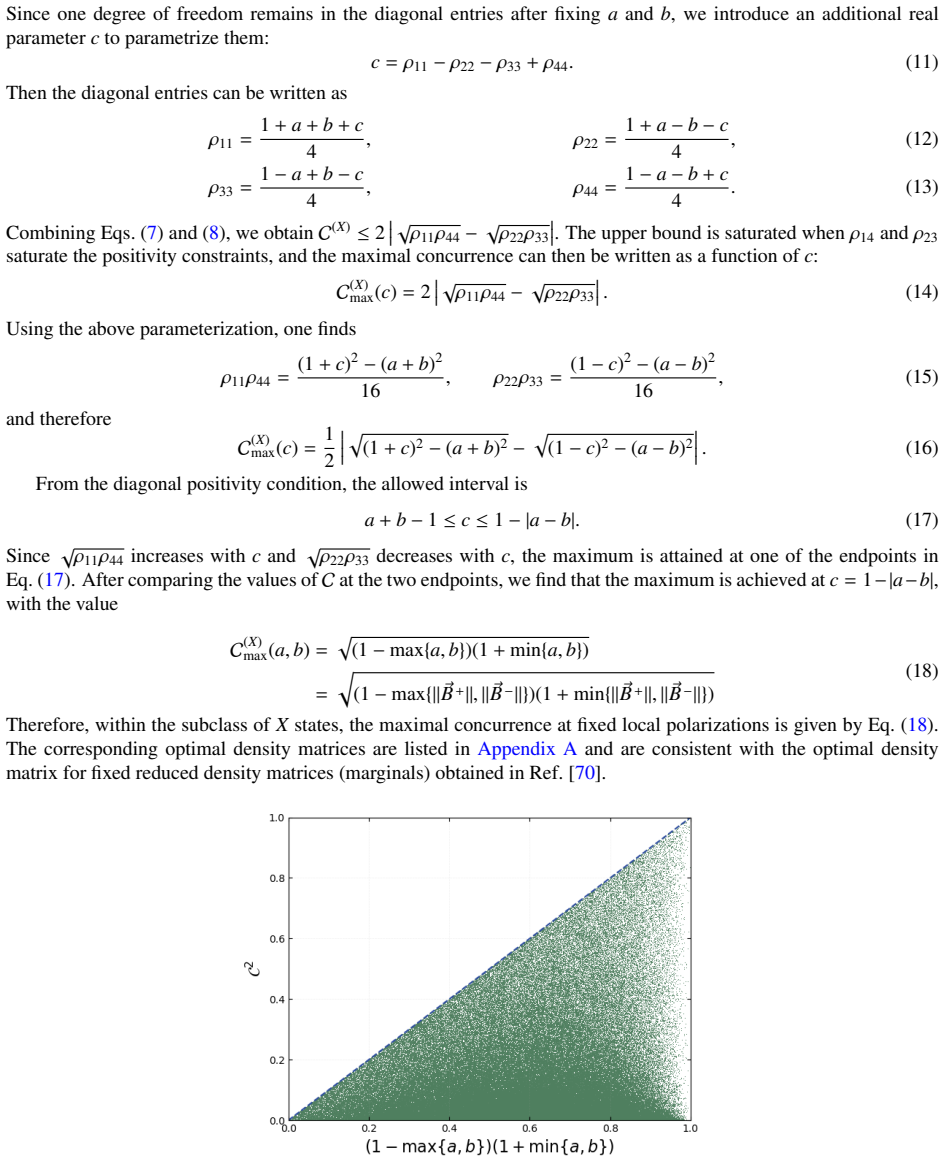
We establish a quantitative relation between local spin polarization and quantum entanglement in two-qubit systems by deriving an upper bound on the concurrence at fixed local polarizations, showing that increasing polarization constrains the maximum achievable entanglement. We further demonstrate that this bound is saturated by pure states in certain cases with identical polarizations. As a concrete physical application, we consider the parity-violating process e+e− → Z0 → q q-bar, which generates final-state spin polarization. We show that the maximal concurrence is attained in specific kinematic regions and is significantly reduced relative to the unpolarized case.
What carries the argument
Upper bound on concurrence expressed in terms of the two local polarization vectors of a two-qubit density matrix.
If this is right
- Higher local polarization forces a lower ceiling on achievable concurrence.
- Pure states saturate the bound when the two polarization vectors are identical.
- In Z-boson decays the maximum concurrence occurs only inside limited kinematic windows.
- Entanglement is suppressed relative to the unpolarized baseline once polarization is present.
Where Pith is reading between the lines
- The same polarization-concurrence relation could be tested in other two-body final states such as Higgs decays or top-pair production.
- Collider analyses aiming to detect entanglement might preferentially select events with small measured polarization.
- Extension of the bound to mixed states or to higher-dimensional systems would require new calculations but follows the same logic.
Load-bearing premise
The two particles form a two-qubit system whose joint state is captured by a density matrix with well-defined local polarization vectors.
What would settle it
Observation of concurrence values exceeding the derived upper bound at measured polarization vectors in e+e− → Z0 → q q-bar events would falsify the bound.
Figures


read the original abstract
We establish a quantitative relation between local spin polarization and quantum entanglement in two-qubit systems by deriving an upper bound on the concurrence at fixed local polarizations, showing that increasing polarization constrains the maximum achievable entanglement. We further demonstrate that this bound is saturated by pure states in certain cases with identical polarizations. As a concrete physical application, we consider the parity-violating process $e^+e^- \to Z^0 \to q\bar{q}$, which generates final-state spin polarization. We show that the maximal concurrence is attained in specific kinematic regions and is significantly reduced relative to the unpolarized case. These results establish a general, process-independent framework connecting local polarization, maximal entanglement, and the role of pure states.
Editorial analysis
A structured set of objections, weighed in public.
Referee Report
Summary. The paper derives an upper bound on the concurrence C of a two-qubit density matrix given fixed local polarization (Bloch) vectors P1 and P2, shows that the bound is saturated by certain pure states when the polarizations are identical, and applies the result to the parity-violating process e+e−→Z0→qq¯, finding that the maximal attainable concurrence occurs in specific kinematic regions and is reduced relative to the unpolarized case. The framework is presented as process-independent.
Significance. If the derivation is correct, the work supplies a concrete, quantitative link between local polarization and an entanglement monotone that is directly applicable to collider processes whose spin density matrices are known from the Standard Model. The explicit saturation by pure states and the collider example provide falsifiable predictions that could be tested with spin-correlation observables.
minor comments (2)
- The abstract states that an upper bound is derived and saturated by pure states, but the main text should include the explicit functional form of the bound (e.g., C_max(P1,P2)) and the conditions under which saturation occurs, preferably with the relevant equation number referenced in the abstract.
- In the collider application, the kinematic regions where maximal concurrence is attained should be stated quantitatively (e.g., ranges of cosθ or s) rather than qualitatively, so that the reduction relative to the unpolarized case can be compared directly with experimental cuts.
Simulated Author's Rebuttal
We thank the referee for the positive summary, significance assessment, and recommendation of minor revision. No specific major comments were provided in the report.
Circularity Check
No significant circularity
full rationale
The central derivation is an upper bound on concurrence C for a two-qubit density matrix at fixed Bloch vectors P1, P2, obtained from the standard parametrization of two-qubit states and the definition of concurrence; this is a direct mathematical consequence of the two-qubit formalism and does not reduce to any fitted parameter or self-citation. The collider application invokes the known spin density matrix for the parity-violating process e+e−→Z→q q-bar, which is an external standard result independent of the present work. No load-bearing step relies on self-definition, renaming, or an ansatz imported via the authors' prior papers; the bound and its saturation by pure states are self-contained within standard quantum information.
Axiom & Free-Parameter Ledger
axioms (1)
- standard math Concurrence is a valid entanglement monotone for two-qubit mixed states and local polarization is given by the Bloch vector of each reduced density matrix.
Lean theorems connected to this paper
-
IndisputableMonolith/Cost/FunctionalEquation.leanwashburn_uniqueness_aczel unclear?
unclearRelation between the paper passage and the cited Recognition theorem.
We establish a quantitative relation between local spin polarization and quantum entanglement in two-qubit systems by deriving an upper bound on the concurrence at fixed local polarizations... C(X)_max(a,b) = sqrt((1-max{a,b})(1+min{a,b}))
-
IndisputableMonolith/Foundation/RealityFromDistinction.leanreality_from_one_distinction unclear?
unclearRelation between the paper passage and the cited Recognition theorem.
maximal concurrence is attained... pure states... rho_opt_f is a pure state
What do these tags mean?
- matches
- The paper's claim is directly supported by a theorem in the formal canon.
- supports
- The theorem supports part of the paper's argument, but the paper may add assumptions or extra steps.
- extends
- The paper goes beyond the formal theorem; the theorem is a base layer rather than the whole result.
- uses
- The paper appears to rely on the theorem as machinery.
- contradicts
- The paper's claim conflicts with a theorem or certificate in the canon.
- unclear
- Pith found a possible connection, but the passage is too broad, indirect, or ambiguous to say the theorem truly supports the claim.
Forward citations
Cited by 1 Pith paper
-
Controlling Quantum discord and steering in Electron-Positron Annihilation Using Polarized Beams
Polarized lepton beams control quantum discord and steering in hyperon-antihyperon pairs from e+e- annihilation, with discord persisting in separable states via transverse polarization.
Reference graph
Works this paper leans on
-
[1]
Ashmanet al.[European Muon], Phys
J. Ashmanet al.[European Muon], Phys. Lett. B206(1988), 364 doi:10.1016/0370-2693(88)91523-7
-
[2]
Airapetianet al.[HERMES], Phys
A. Airapetianet al.[HERMES], Phys. Rev. D75(2007), 012007 doi:10.1103/PhysRevD.75.012007 [arXiv:hep- ex/0609039 [hep-ex]]
-
[3]
Precision Electroweak Measurements on the Z Resonance
S. Schaelet al.[ALEPH, DELPHI, L3, OPAL, SLD, LEP Electroweak Working Group, SLD Electroweak Group and SLD Heavy Flavour Group], Phys. Rept.427(2006), 257-454 doi:10.1016/j.physrep.2005.12.006 [arXiv:hep-ex/0509008 [hep-ex]]
work page internal anchor Pith review Pith/arXiv arXiv doi:10.1016/j.physrep.2005.12.006 2006
-
[4]
G. Bunce, R. Handler, R. March, P. Martin, L. Pondrom, M. Sheaff, K. J. Heller, O. Overseth, P. Skubic and T. Devlin,et al.Phys. Rev. Lett.36(1976), 1113-1116 doi:10.1103/PhysRevLett.36.1113
-
[5]
Z. T. Liang and X. N. Wang, Phys. Rev. Lett.94(2005), 102301 [erratum: Phys. Rev. Lett.96(2006), 039901] doi:10.1103/PhysRevLett.94.102301 [arXiv:nucl-th/0410079 [nucl-th]]. 10
work page internal anchor Pith review Pith/arXiv arXiv doi:10.1103/physrevlett.94.102301 2005
-
[6]
Global $\Lambda$ hyperon polarization in nuclear collisions: evidence for the most vortical fluid
L. Adamczyket al.[STAR], Nature548(2017), 62-65 doi:10.1038/nature23004 [arXiv:1701.06657 [nucl-ex]]
work page internal anchor Pith review Pith/arXiv arXiv doi:10.1038/nature23004 2017
-
[7]
Global polarization of $\Lambda$ hyperons in Au+Au collisions at $\sqrt{s_{_{NN}}}$ = 200 GeV
J. Adamet al.[STAR], Phys. Rev. C98(2018), 014910 doi:10.1103/PhysRevC.98.014910 [arXiv:1805.04400 [nucl-ex]]
work page internal anchor Pith review Pith/arXiv arXiv doi:10.1103/physrevc.98.014910 2018
-
[8]
Maximizing the spin correlation of top quark pairs produced at the LHC
P. Uwer, Phys. Lett. B609(2005), 271-276 doi:10.1016/j.physletb.2005.01.005 [arXiv:hep-ph/0412097 [hep- ph]]
work page internal anchor Pith review Pith/arXiv arXiv doi:10.1016/j.physletb.2005.01.005 2005
-
[9]
M. Hentschinski, D. E. Kharzeev, K. Kutak and Z. Tu, Phys. Rev. Lett.131(2023) no.24, 241901 doi:10.1103/PhysRevLett.131.241901 [arXiv:2305.03069 [hep-ph]]
-
[10]
Y . Afik and J. R. M. de Nova, Eur. Phys. J. Plus136(2021) no.9, 907 doi:10.1140/epjp/s13360-021-01902-1 [arXiv:2003.02280 [quant-ph]]
-
[11]
Y . Afik and J. R. M. de Nova, Phys. Rev. Lett.130(2023) no.22, 221801 doi:10.1103/PhysRevLett.130.221801 [arXiv:2209.03969 [quant-ph]]
-
[12]
Y . Afik and J. R. M. de Nova, Quantum6(2022), 820 doi:10.22331/q-2022-09-29-820 [arXiv:2203.05582 [quant-ph]]
-
[13]
K. Cheng, T. Han and M. Low, Phys. Rev. D111(2025) no.3, 033004 doi:10.1103/PhysRevD.111.033004 [arXiv:2407.01672 [hep-ph]]
-
[14]
S. Wu, C. Qian, Y . G. Yang and Q. Wang, Chin. Phys. Lett.41(2024) no.11, 110301 doi:10.1088/0256- 307X/41/11/110301 [arXiv:2402.16574 [hep-ph]]
-
[15]
A. J. Barr, M. Fabbrichesi, R. Floreanini, E. Gabrielli and L. Marzola, Prog. Part. Nucl. Phys.139(2024), 104134 doi:10.1016/j.ppnp.2024.104134 [arXiv:2402.07972 [hep-ph]]
-
[16]
K. Ehatäht, M. Fabbrichesi, L. Marzola and C. Veelken, Phys. Rev. D109(2024) no.3, 032005 doi:10.1103/PhysRevD.109.032005 [arXiv:2311.17555 [hep-ph]]
-
[17]
Y . Guo, X. Liu, F. Yuan and H. X. Zhu, Research2025(2025), 0552 doi:10.34133/research.0552 [arXiv:2406.05880 [hep-ph]]
-
[18]
R. A. Morales, Eur. Phys. J. Plus138(2023) no.12, 1157 doi:10.1140/epjp/s13360-023-04784-7 [arXiv:2306.17247 [hep-ph]]
-
[19]
S. J. Parke and Y . Shadmi, Phys. Lett. B387(1996), 199-206 doi:10.1016/0370-2693(96)00998-7 [arXiv:hep- ph/9606419 [hep-ph]]
-
[20]
M. M. Altakach, P. Lamba, F. Maltoni, K. Mawatari and K. Sakurai, Phys. Rev. D107(2023) no.9, 093002 doi:10.1103/PhysRevD.107.093002 [arXiv:2211.10513 [hep-ph]]
-
[21]
Positivity in Amplitudes and Quantum Entanglement
R. Aoude, G. Elor, G. N. Remmen and O. Sumensari, [arXiv:2402.16956 [hep-th]]
work page internal anchor Pith review Pith/arXiv arXiv
-
[22]
A. Bernal, Phys. Rev. D109(2024) no.11, 116007 doi:10.1103/PhysRevD.109.116007 [arXiv:2310.10838 [hep- ph]]
-
[23]
QCD-corrected spin analysing power of jets in decays of polarized top quarks
A. Brandenburg, Z. G. Si and P. Uwer, Phys. Lett. B539(2002), 235-241 doi:10.1016/S0370-2693(02)02098-1 [arXiv:hep-ph/0205023 [hep-ph]]
work page internal anchor Pith review Pith/arXiv arXiv doi:10.1016/s0370-2693(02)02098-1 2002
-
[24]
M. Hentschinski, D. E. Kharzeev, K. Kutak and Z. Tu, Rept. Prog. Phys.87(2024) no.12, 120501 doi:10.1088/1361-6633/ad910b [arXiv:2408.01259 [hep-ph]]
-
[25]
D. F. V . James, P. G. Kwiat, W. J. Munro and A. G. White, Phys. Rev. A64(2001) no.5, 052312 doi:10.1103/PhysRevA.64.052312 [arXiv:quant-ph/0103121 [quant-ph]]. 11
work page internal anchor Pith review Pith/arXiv arXiv doi:10.1103/physreva.64.052312 2001
-
[26]
K. Kowalska and E. M. Sessolo, JHEP07(2024), 156 doi:10.1007/JHEP07(2024)156 [arXiv:2404.13743 [hep- ph]]
-
[27]
X. L. Li, X. Liu, F. Yuan and H. X. Zhu, Phys. Rev. D108(2023) no.9, L091502 doi:10.1103/PhysRevD.108.L091502 [arXiv:2308.10942 [hep-ph]]
-
[28]
F. Maltoni, C. Severi, S. Tentori and E. Vryonidou, JHEP09(2024), 001 doi:10.1007/JHEP09(2024)001 [arXiv:2404.08049 [hep-ph]]
-
[29]
C. Severi and E. Vryonidou, JHEP01(2023), 148 doi:10.1007/JHEP01(2023)148 [arXiv:2210.09330 [hep-ph]]
- [30]
-
[31]
C. Severi, C. D. Boschi, F. Maltoni and M. Sioli, Eur. Phys. J. C82(2022) no.4, 285 doi:10.1140/epjc/s10052- 022-10245-9 [arXiv:2110.10112 [hep-ph]]
-
[32]
S. Wu, C. Qian, Q. Wang and X. R. Zhou, Phys. Rev. D110(2024) no.5, 054012 doi:10.1103/PhysRevD.110.054012 [arXiv:2406.16298 [hep-ph]]
-
[33]
S. Li, W. Shen and J. M. Yang, Eur. Phys. J. C84(2024) no.11, 1195 doi:10.1140/epjc/s10052-024-13584-x [arXiv:2401.01162 [hep-th]]
-
[34]
G. Mahlon and S. J. Parke, Phys. Rev. D53(1996), 4886-4896 doi:10.1103/PhysRevD.53.4886 [arXiv:hep- ph/9512264 [hep-ph]]
-
[35]
Z. Dong, D. Gonçalves, K. Kong and A. Navarro, Phys. Rev. D109(2024) no.11, 115023 doi:10.1103/PhysRevD.109.115023 [arXiv:2305.07075 [hep-ph]]
-
[36]
J. A. Aguilar-Saavedra and J. A. Casas, Eur. Phys. J. C82(2022) no.8, 666 doi:10.1140/epjc/s10052-022-10630- 4 [arXiv:2205.00542 [hep-ph]]
-
[37]
M. Fabbrichesi, R. Floreanini, E. Gabrielli and L. Marzola, Eur. Phys. J. C83(2023) no.9, 823 doi:10.1140/epjc/s10052-023-11935-8 [arXiv:2302.00683 [hep-ph]]
-
[38]
D. Ghosh and R. Sharma, JHEP08(2023), 146 doi:10.1007/JHEP08(2023)146 [arXiv:2303.03375 [hep-th]]
-
[39]
C. D. White and M. J. White, Phys. Rev. D110(2024) no.11, 116016 doi:10.1103/PhysRevD.110.116016 [arXiv:2406.07321 [hep-ph]]
-
[40]
T. Han, M. Low and T. A. Wu, JHEP07(2024), 192 doi:10.1007/JHEP07(2024)192 [arXiv:2310.17696 [hep- ph]]
-
[41]
Y . Du, X. G. He, C. W. Liu and J. P. Ma, Eur. Phys. J. C85(2025) no.11, 1255 doi:10.1140/epjc/s10052-025- 15003-1 [arXiv:2409.15418 [hep-ph]]
-
[42]
R. A. Morales, Eur. Phys. J. C84(2024) no.6, 581 doi:10.1140/epjc/s10052-024-12921-4 [arXiv:2403.18023 [hep-ph]]
-
[43]
L. Yang, Y . K. Song and S. Y . Wei, Phys. Rev. D111(2025) no.5, 054035 doi:10.1103/PhysRevD.111.054035 [arXiv:2410.20917 [hep-ph]]
-
[44]
M. Fabbrichesi, R. Floreanini and G. Panizzo, Phys. Rev. Lett.127(2021) no.16, 16 doi:10.1103/PhysRevLett.127.161801 [arXiv:2102.11883 [hep-ph]]
-
[45]
R. Aoude, E. Madge, F. Maltoni and L. Mantani, Phys. Rev. D106(2022) no.5, 055007 doi:10.1103/PhysRevD.106.055007 [arXiv:2203.05619 [hep-ph]]. 12
-
[46]
Y . Afik, F. Fabbri, M. Low, L. Marzola, J. A. Aguilar-Saavedra, M. M. Altakach, N. A. Asbah, Y . Bai, H. Banks and A. J. Barr,et al.Eur. Phys. J. Plus140(2025) no.9, 855 doi:10.1140/epjp/s13360-025-06752- 9 [arXiv:2504.00086 [hep-ph]]
-
[47]
M. Fabbrichesi, R. Floreanini and L. Marzola, JHEP11(2025), 005 doi:10.1007/JHEP11(2025)005 [arXiv:2505.02902 [hep-ph]]
-
[48]
K. Cheng and B. Yan, Phys. Rev. Lett.135(2025) no.1, 1 doi:10.1103/gmqz-v4cl [arXiv:2501.03321 [hep-ph]]
-
[49]
W. Qi, Z. Guo and B. W. Xiao, Phys. Rev. D113(2026) no.5, 054048 doi:10.1103/6ycn-x3yj [arXiv:2506.12889 [hep-ph]]
- [50]
-
[51]
S. J. Lin, M. J. Liu, D. Y . Shao and S. Y . Wei, JHEP11(2025), 082 doi:10.1007/JHEP11(2025)082 [arXiv:2507.15387 [hep-ph]]
-
[52]
M. Low, Phys. Rev. D112(2025) no.9, 096008 doi:10.1103/15c3-mg5l [arXiv:2508.10979 [hep-ph]]
- [53]
-
[54]
X. Q. Xi, K. B. Chen, X. B. Tong, S. Y . Wei and J. Wu, Eur. Phys. J. C85(2025) no.12, 1458 doi:10.1140/epjc/s10052-025-15193-8 [arXiv:2510.06103 [hep-ph]]
- [55]
- [56]
-
[57]
M. Fucilla and Y . Hatta, Phys. Rev. D113(2026) no.3, L031504 doi:10.1103/gbk8-z3dd [arXiv:2509.05267 [hep-ph]]
-
[58]
Quantum entanglement between partons in a strongly coupled quantum field theory
W. Zhang, W. Qian, Y . Zhou, Y . Li and Q. Wang, [arXiv:2512.21228 [hep-ph]]
work page internal anchor Pith review Pith/arXiv arXiv
-
[59]
H. W. Zhang, X. Cao and T. F. Feng, [arXiv:2602.10389 [hep-ph]]
work page internal anchor Pith review arXiv
-
[60]
M. Fucilla, Y . Hatta and B. W. Xiao, [arXiv:2604.11697 [hep-ph]]
work page internal anchor Pith review Pith/arXiv arXiv
-
[61]
G. Aadet al.[ATLAS], Nature633(2024) no.8030, 542-547 doi:10.1038/s41586-024-07824-z [arXiv:2311.07288 [hep-ex]]
-
[62]
A. Hayrapetyanet al.[CMS], Rept. Prog. Phys.87(2024) no.11, 117801 doi:10.1088/1361-6633/ad7e4d [arXiv:2406.03976 [hep-ex]]
-
[63]
B. E. Aboonaet al.[STAR], Nature650(2026) no.8100, 65-71 doi:10.1038/s41586-025-09920-0 [arXiv:2506.05499 [hep-ex]]
-
[64]
W. K. Wootters, Phys. Rev. Lett.80(1998), 2245-2248 doi:10.1103/PhysRevLett.80.2245 [arXiv:quant- ph/9709029 [quant-ph]]
-
[65]
Entanglement of a Pair of Quantum Bits
S. Hill and W. K. Wootters, Phys. Rev. Lett.78(1997), 5022-5025 doi:10.1103/PhysRevLett.78.5022 [arXiv:quant-ph/9703041 [quant-ph]]
work page internal anchor Pith review Pith/arXiv arXiv doi:10.1103/physrevlett.78.5022 1997
-
[66]
Universal state inversion and concurrence in arbitrary dimensions
P. Rungta, V . Bužek, C. M. Caves, M. Hillery and G. J. Milburn, Phys. Rev. A64(2001) no.4, 042315 doi:10.1103/PhysRevA.64.042315 [arXiv:quant-ph/0102040 [quant-ph]]
work page internal anchor Pith review Pith/arXiv arXiv doi:10.1103/physreva.64.042315 2001
-
[67]
M. Ali, A. R. P. Rau and G. Alber, Phys. Rev. A81(2010) no.4, 042105 doi:10.1103/PhysRevA.81.042105 [arXiv:1002.3429 [quant-ph]]
work page internal anchor Pith review Pith/arXiv arXiv doi:10.1103/physreva.81.042105 2010
-
[68]
J. Wang, H. Batelaan, J. Podany and A. F. Starace, J. Phys. B39(2006), 4343-4353 doi:10.1088/0953- 4075/39/21/001 [arXiv:quant-ph/0503116 [quant-ph]]. 13
work page internal anchor Pith review Pith/arXiv arXiv doi:10.1088/0953- 2006
-
[69]
W. J. Munro, D. F. V . James, A. G. White and P. G. Kwiat, Phys. Rev. A64(2001) no.3, 030302 doi:10.1103/PhysRevA.64.030302 [arXiv:quant-ph/0103113 [quant-ph]]
work page internal anchor Pith review Pith/arXiv arXiv doi:10.1103/physreva.64.030302 2001
-
[70]
G. Baio, D. Chruscinski, P. Horodecki, A. Messina and G. Sarbicki, Phys. Rev. A99(2019), 062312 doi:10.1103/PhysRevA.99.062312 [arXiv:1904.07650 [quant-ph]]
work page internal anchor Pith review Pith/arXiv arXiv doi:10.1103/physreva.99.062312 2019
-
[71]
C. J. Zhang, Y . X. Gong, Y . S. Zhang and G. C. Guo, Phys. Rev. A78(2008), 042308 doi:10.1103/PhysRevA.78.042308 [arXiv:0806.2598 [quant-ph]]
work page internal anchor Pith review Pith/arXiv arXiv doi:10.1103/physreva.78.042308 2008
-
[72]
Tracing CP violation in the production of top quark pairs by multiple TeV proton-proton collisions
W. Bernreuther and A. Brandenburg, Phys. Rev. D49(1994), 4481-4492 doi:10.1103/PhysRevD.49.4481 [arXiv:hep-ph/9312210 [hep-ph]]
work page internal anchor Pith review Pith/arXiv arXiv doi:10.1103/physrevd.49.4481 1994
-
[73]
Signatures of Higgs Bosons in the Top Quark Decay Channel at Hadron Colliders
W. Bernreuther, M. Flesch and P. Haberl, Phys. Rev. D58(1998), 114031 doi:10.1103/PhysRevD.58.114031 [arXiv:hep-ph/9709284 [hep-ph]]
work page internal anchor Pith review Pith/arXiv arXiv doi:10.1103/physrevd.58.114031 1998
-
[74]
A. Brandenburg, M. Flesch and P. Uwer, Phys. Rev. D59(1999), 014001 doi:10.1103/PhysRevD.59.014001 [arXiv:hep-ph/9806306 [hep-ph]]
work page internal anchor Pith review Pith/arXiv arXiv doi:10.1103/physrevd.59.014001 1999
-
[75]
A New Twist on Top Quark Spin Correlations
M. Baumgart and B. Tweedie, JHEP03(2013), 117 doi:10.1007/JHEP03(2013)117 [arXiv:1212.4888 [hep-ph]]
work page internal anchor Pith review Pith/arXiv arXiv doi:10.1007/jhep03(2013)117 2013
-
[76]
W. Bernreuther, D. Heisler and Z. G. Si, JHEP12(2015), 026 doi:10.1007/JHEP12(2015)026 [arXiv:1508.05271 [hep-ph]]. 14
work page internal anchor Pith review Pith/arXiv arXiv doi:10.1007/jhep12(2015)026 2015
discussion (0)
Sign in with ORCID, Apple, or X to comment. Anyone can read and Pith papers without signing in.