Cut Your Losses! Learning to Prune Paths Early for Efficient Parallel Reasoning
Pith reviewed 2026-05-10 08:48 UTC · model grok-4.3
The pith
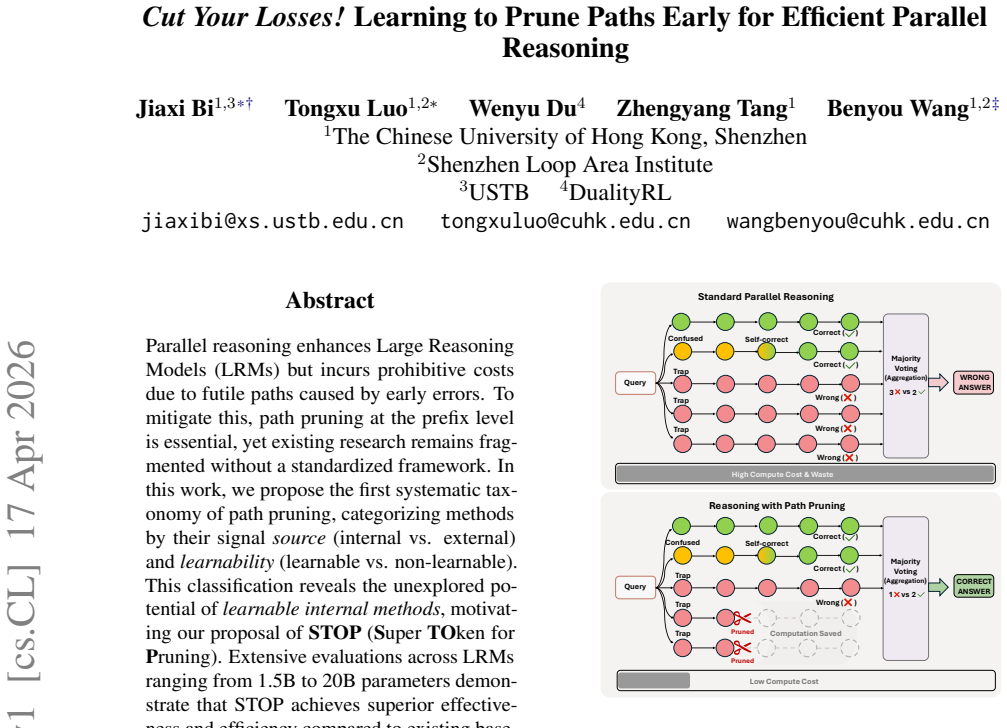
STOP is a new learnable internal path-pruning technique that improves efficiency and accuracy of parallel reasoning in LRMs under fixed compute budgets.
A machine-rendered reading of the paper's core claim, the machinery that carries it, and where it could break.
Core claim
STOP achieves superior effectiveness and efficiency compared to existing baselines, for instance boosting GPT-OSS-20B accuracy on AIME25 from 84% to nearly 90% under fixed compute budgets.
Load-bearing premise
That the proposed taxonomy is exhaustive and that learnable internal pruning signals can be trained reliably without introducing new failure modes or overfitting to the evaluation tasks.
Figures


read the original abstract
Parallel reasoning enhances Large Reasoning Models (LRMs) but incurs prohibitive costs due to futile paths caused by early errors. To mitigate this, path pruning at the prefix level is essential, yet existing research remains fragmented without a standardized framework. In this work, we propose the first systematic taxonomy of path pruning, categorizing methods by their signal source (internal vs. external) and learnability (learnable vs. non-learnable). This classification reveals the unexplored potential of learnable internal methods, motivating our proposal of STOP (Super TOken for Pruning). Extensive evaluations across LRMs ranging from 1.5B to 20B parameters demonstrate that STOP achieves superior effectiveness and efficiency compared to existing baselines. Furthermore, we rigorously validate the scalability of STOP under varying compute budgets - for instance, boosting GPT-OSS-20B accuracy on AIME25 from 84% to nearly 90% under fixed compute budgets. Finally, we distill our findings into formalized empirical guidelines to facilitate optimal real-world deployment. Code, data and models are available at https://bijiaxihh.github.io/STOP
Editorial analysis
A structured set of objections, weighed in public.
Referee Report
Summary. The paper introduces a systematic taxonomy for path pruning in parallel reasoning with large reasoning models (LRMs), classifying methods by signal source (internal vs. external) and learnability (learnable vs. non-learnable). It proposes STOP, a learnable internal pruning method that trains a 'super token' predictor to discard futile reasoning paths early. Across LRMs from 1.5B to 20B parameters, STOP is shown to improve accuracy and efficiency over baselines under fixed compute budgets, with a reported lift from 84% to nearly 90% on AIME25 for GPT-OSS-20B; the work also distills empirical guidelines and releases code, data, and models.
Significance. If the central results hold under broader conditions, STOP could meaningfully advance efficient parallel reasoning by enabling more paths within a fixed token budget without external verifiers. The taxonomy provides a useful organizing framework, and the open release of code and models supports reproducibility and follow-up work.
major comments (2)
- [§5.2] §5.2 (Experiments on AIME25 and related benchmarks): The reported accuracy gains (e.g., 84% to ~90% for the 20B model) rely on a learned pruning classifier trained on the same narrow distribution of math problems used for evaluation. No cross-domain (e.g., coding or science) or cross-model transfer results are presented, leaving the claim that the internal signal reliably discards only futile prefixes vulnerable to distribution shift; this directly affects whether the fixed-budget superiority generalizes.
- [§4.2] §4.2 (STOP training procedure): The method trains the super-token predictor on labels derived from path success/failure, yet no ablation or analysis is given on sensitivity to label noise, early path errors, or the choice of training data mixture. This is load-bearing because any overfitting here would undermine the efficiency claims under varying compute budgets.
minor comments (2)
- [Figure 1] Figure 1 (taxonomy diagram): Adding one concrete example method per quadrant would improve clarity for readers unfamiliar with the fragmented prior literature.
- [§6] §6 (Empirical guidelines): The formalized guidelines are useful but would benefit from explicit pseudocode or a decision tree showing how to choose the pruning threshold for a new model size.
Simulated Author's Rebuttal
We thank the referee for the insightful comments on generalization and training robustness. We address each major point below and commit to revisions that strengthen the manuscript without overstating current results.
read point-by-point responses
-
Referee: [§5.2] §5.2 (Experiments on AIME25 and related benchmarks): The reported accuracy gains (e.g., 84% to ~90% for the 20B model) rely on a learned pruning classifier trained on the same narrow distribution of math problems used for evaluation. No cross-domain (e.g., coding or science) or cross-model transfer results are presented, leaving the claim that the internal signal reliably discards only futile prefixes vulnerable to distribution shift; this directly affects whether the fixed-budget superiority generalizes.
Authors: We agree that the primary evaluation is on mathematical reasoning benchmarks, which is the standard setting for parallel reasoning in LRMs. The taxonomy and STOP are designed to be domain-agnostic, but the absence of cross-domain or cross-model transfer experiments is a genuine limitation that leaves generalization claims under-supported. In revision we will add a limitations subsection explicitly discussing distribution shift risks and include preliminary transfer results on a coding task (e.g., a subset of HumanEval) using the released code and models. This will directly test whether the internal pruning signal remains effective outside the training distribution. revision: yes
-
Referee: [§4.2] §4.2 (STOP training procedure): The method trains the super-token predictor on labels derived from path success/failure, yet no ablation or analysis is given on sensitivity to label noise, early path errors, or the choice of training data mixture. This is load-bearing because any overfitting here would undermine the efficiency claims under varying compute budgets.
Authors: We acknowledge that the manuscript does not report ablations on label noise, early-path error sensitivity, or training-mixture composition, even though these factors are central to the reliability of the learned predictor. During development we performed internal checks on label quality, but these were not included. In the revised version we will add a new subsection with controlled ablations: (1) varying the proportion of successful vs. failed paths in the training mixture, (2) injecting synthetic label noise at different rates, and (3) measuring pruning accuracy as a function of prefix length to quantify early-error effects. These results will be presented alongside the existing efficiency curves to substantiate robustness under varying compute budgets. revision: yes
Circularity Check
No circularity: taxonomy and STOP method are proposed and evaluated empirically without reducing to fitted inputs or self-citations.
full rationale
The paper introduces a new taxonomy of path pruning methods (internal/external, learnable/non-learnable) and proposes STOP as a learnable internal pruner. It then reports empirical results on LRMs from 1.5B to 20B parameters showing accuracy gains under fixed compute. No equations, parameter fits, or derivations are described that would make any claimed prediction equivalent to its inputs by construction. No load-bearing self-citations appear in the provided text; the central claims rest on new experiments rather than prior author results invoked as uniqueness theorems. The derivation chain is therefore self-contained and non-circular.
discussion (0)
Sign in with ORCID, Apple, or X to comment. Anyone can read and Pith papers without signing in.