Bogoliubov sum rules and the Knight-shift ellipsoid in noncentrosymmetric superconductors
Pith reviewed 2026-05-19 18:37 UTC · model grok-4.3
The pith
The zero-temperature Knight shift tensor in noncentrosymmetric superconductors equals the normal-state susceptibility times the identity minus the Fermi-surface projector of the spin-locking direction.
A machine-rendered reading of the paper's core claim, the machinery that carries it, and where it could break.
Core claim
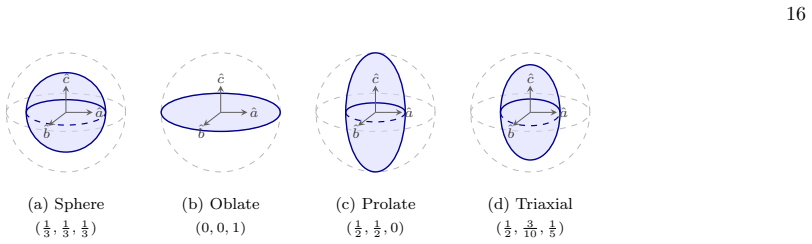
A Bogoliubov sum rule states that for any Hermitian single-particle operator O the sum of squared particle-hole matrix elements plus the sum of squared particle-particle matrix elements equals the spin trace of O squared. When O is taken to be the spin operator and the system is placed in the strong-locking regime, this identity collapses the zero-temperature spin susceptibility tensor to χ_μν(0) = χ_N [δ_μν − Π_μν], where Π_μν is the Fermi-surface average of the outer product of the local spin-locking direction n̂_k. Because the trace of Π is identically one, the three principal Knight shifts at T=0 are constrained to lie inside a two-dimensional simplex (the Knight-shift ellipsoid) whose 2
What carries the argument
The Fermi-surface projector Π_μν = ⟨n̂_μ n̂_ν⟩_FS of the spin-locking direction, which enters the tensor identity for the residual Knight shift via the Bogoliubov sum rule.
If this is right
- The three principal Knight shifts at T=0 must lie on a two-dimensional simplex whose vertices label pure axial, oblate, and prolate locking textures.
- Any canonical pairing symmetry maps to a unique location on the Knight-shift ellipsoid, allowing classification by NMR alone.
- The dynamical counterpart implies that 1/T1 vanishes for directions perpendicular to the locking axis when spin fluctuations are strictly ferromagnetic.
- A decoupled-pocket baseline is ruled out once the measured ellipsoid saturates the trace bound.
Where Pith is reading between the lines
- The same projector that fixes the static Knight shift also controls the anisotropy of the spin relaxation rate through the vanishing-projection theorem.
- If the ellipsoid vertex is found to be material-independent across a family of compounds, the locking texture is likely fixed by crystal symmetry rather than by details of the gap function.
- Extending the sum rule to finite momentum would connect the Knight-shift ellipsoid directly to the q-dependence of the spin susceptibility measured by neutron scattering.
Load-bearing premise
The material sits deep inside the strong-locking regime so that the residual zero-temperature Knight shift is fixed solely by the Fermi-surface average of the local spin-locking direction.
What would settle it
A measurement in which the three principal zero-temperature Knight shifts fail to satisfy Tr(χ(0)/χ_N) = 2 while the normal-state susceptibility remains isotropic would directly contradict the identity.
Figures



read the original abstract
We show that the residual $T=0$ Knight shift of a noncentrosymmetric superconductor in the strong-locking regime is completely determined by a single Fermi-surface average -- the projector $\Pi_{\mu\nu}=\langle\hat n_{\mu}\hat n_{\nu}\rangle_{\rm FS}$ of the spin-locking direction $\hat n_{\mathbf{k}}$ -- giving the tensor identity $\chi_{\mu\nu}(0)=\chi_{N}[\delta_{\mu\nu}-\Pi_{\mu\nu}]$ independently of pairing symmetry, gap magnitude, and Fermi-surface shape. Because $\mathrm{Tr}\,\Pi=1$, the three principal Knight shifts at $T=0$ lie on a two-dimensional simplex of locking textures, the \emph{Knight-shift ellipsoid}, whose vertices, edges, and interior classify every canonical pairing class. The identity follows from a Bogoliubov sum rule, $\sum|M_{ph,O}|^{2}+\sum|M_{pp,O}|^{2}=\mathrm{Tr}_{s}(O^{2})$, valid at every momentum for every Hermitian single-particle operator $O$ as the BdG-doubled form of unitary invariance. Around the central theorem we develop controlled departures (a closed-form $s$-wave SOC interpolation, a finite-field strong-locking identity), a dynamical counterpart (a spin Ferrell--Glover--Tinkham sum rule and a rigorous vanishing-projection theorem for $1/T_{1}$), and a decoupled-pocket multiband baseline, packaged into six experimental protocols. Applied to the $^{75}$As NMR data on K$_{2}$Cr$_{3}$As$_{3}$, the observed ellipsoid sits at the oblate-axial vertex $(0,0,1)$ and saturates the trace bound; the decoupled-pocket SOC-texture baseline is excluded by $\sim 0.5$ in normalized units, requiring a common $\hat c$-axis locking on all three pockets, and the suppression of $1/T_{1}\parallel\hat c$ is identified, via the vanishing-projection theorem, as a fingerprint of finite-$\mathbf{q}$ ferromagnetic spin-fluctuation gap formation.
Editorial analysis
A structured set of objections, weighed in public.
Referee Report
Summary. The manuscript derives a Bogoliubov sum rule from BdG-doubled unitary invariance that holds for any Hermitian operator at each momentum, yielding the central tensor identity χ_μν(0)=χ_N[δ_μν−Π_μν] for the residual T=0 Knight shift in noncentrosymmetric superconductors under the strong-locking condition. Here Π_μν is the Fermi-surface average of the spin-locking direction projector n̂_kμ n̂_kν. Because Tr Π=1 the three principal shifts lie on a two-dimensional simplex (the Knight-shift ellipsoid) whose geometry classifies canonical pairing classes. The work develops controlled extensions including an s-wave SOC interpolation formula and a finite-field identity, a dynamical spin Ferrell–Glover–Tinkham sum rule together with a vanishing-projection theorem for 1/T1, a decoupled-pocket baseline, and six experimental protocols; it applies the framework to 75As NMR data on K2Cr3As3, placing the observed ellipsoid at the oblate-axial vertex and excluding the decoupled-pocket SOC-texture model.
Significance. If the central identity holds, the result supplies a parameter-free, structurally protected relation between the Knight-shift tensor and the spin-orbit texture that is independent of gap magnitude and pairing symmetry. This offers a clean classification scheme via the Knight-shift ellipsoid and a set of falsifiable predictions (including the vanishing-projection theorem for 1/T1) that can be tested directly against NMR data. The derivation from unitarity rather than microscopic fitting constitutes a genuine advance for the analysis of noncentrosymmetric superconductors.
minor comments (3)
- [Central theorem paragraph] The precise definition and quantitative criterion for the “strong-locking regime” should be stated explicitly in the main text (currently referenced only in the abstract and the paragraph on the central theorem) so that readers can judge when the projection onto Π_μν is justified.
- A schematic figure of the Knight-shift ellipsoid (with vertices, edges, and interior labeled by representative pairing classes) would greatly improve readability of the classification claim.
- [Application to K2Cr3As3] In the K2Cr3As3 application, the normalized distance of 0.5 that excludes the decoupled-pocket baseline should be accompanied by the explicit definition of the normalization and the error bars on the experimental ellipsoid coordinates.
Simulated Author's Rebuttal
We thank the referee for the careful and accurate summary of our work, as well as for recognizing the significance of the Bogoliubov sum rule, the resulting Knight-shift ellipsoid, and the falsifiable predictions such as the vanishing-projection theorem. The recommendation for minor revision is noted. No specific major comments appear in the report, so we have no point-by-point revisions to propose at this stage. Any minor editorial or presentational suggestions will be incorporated in the revised version.
Circularity Check
Derivation self-contained from BdG unitarity sum rule
full rationale
The central tensor identity χ_μν(0)=χ_N[δ_μν−Π_μν] is obtained from the Bogoliubov sum rule ∑|M_ph,O|^2 + ∑|M_pp,O|^2 = Tr_s(O^2), which the paper states holds at every momentum for any Hermitian single-particle operator O as the BdG-doubled form of unitary invariance. This is an independent structural property of the doubled Hamiltonian, not fitted to Knight-shift data, not dependent on gap magnitude or pairing symmetry (provided the state is gapped at T=0), and not reliant on self-citation for its validity. The strong-locking projection onto the FS-averaged spin texture Π then yields the result without circular reduction. No steps match the enumerated circularity patterns; the trace property Tr Π=1 is a direct algebraic consequence of the projector definition and classifies textures without smuggling in the target observables.
Axiom & Free-Parameter Ledger
axioms (1)
- domain assumption The Bogoliubov sum rule ∑|M_ph,O|^2 + ∑|M_pp,O|^2 = Tr_s(O^2) holds at every momentum for every Hermitian single-particle operator O as the BdG-doubled form of unitary invariance.
invented entities (1)
-
Knight-shift ellipsoid
no independent evidence
Lean theorems connected to this paper
-
IndisputableMonolith/Cost/FunctionalEquation.leanwashburn_uniqueness_aczel unclear?
unclearRelation between the paper passage and the cited Recognition theorem.
The identity follows from a Bogoliubov sum rule, ∑|M_ph,O|² + ∑|M_pp,O|² = Tr_s(O²), valid at every momentum for every Hermitian single-particle operator O as the BdG-doubled form of unitary invariance.
-
IndisputableMonolith/Foundation/AlexanderDuality.leanalexander_duality_circle_linking unclear?
unclearRelation between the paper passage and the cited Recognition theorem.
Because Tr Π = 1, the three principal Knight shifts at T=0 lie on a two-dimensional simplex of locking textures, the Knight-shift ellipsoid.
What do these tags mean?
- matches
- The paper's claim is directly supported by a theorem in the formal canon.
- supports
- The theorem supports part of the paper's argument, but the paper may add assumptions or extra steps.
- extends
- The paper goes beyond the formal theorem; the theorem is a base layer rather than the whole result.
- uses
- The paper appears to rely on the theorem as machinery.
- contradicts
- The paper's claim conflicts with a theorem or certificate in the canon.
- unclear
- Pith found a possible connection, but the passage is too broad, indirect, or ambiguous to say the theorem truly supports the claim.
Reference graph
Works this paper leans on
-
[1]
to the vertex (0,0,1) of the simplex in Fig. 3. This one-parameter curve is the explicit base- line tested later by Protocol F and by the worked example of Sec. XIV. XI. CORE DIAGNOSTIC: KNIGHT-SHIFT ELLIPSOID The preceding theory sections produced four kinds of input: a scalar bound, a tensor geometry, controlled de- partures from the ideal strong-lockin...
-
[2]
Step 1: simplex location to pairing class Table VI maps each canonical simplex location to its first-pass diagnosis and to the look-alikes that share the sameT= 0 ellipsoid. The middle column is what is directly measured (eigenvalues of Π, equivalently 1−K i(0)/KN); the right column lists the microscopic candidates that must be disambiguated by the tools ...
-
[3]
For each, we list the smallest additional measurement or dataset that breaks the degeneracy
Step 2: disambiguating look-alikes Four ambiguities recur in practice. For each, we list the smallest additional measurement or dataset that breaks the degeneracy. (a) Singlet with strong SOC vs. isotropic- ˆdtriplet at the barycenter.Both produce the sameT= 0 Knight shift. Distinguishing handles: (i) the temperature depen- dence ofK(T) approachesK N via ...
-
[4]
Whenever the simplex location implies Παα = 0 for some axisα, the vanishing-projection theorem Eq
Aggregate diagnostic: combining static and dynamic data The 1/T 1 cross-check (Protocol D) provides one fur- ther diagnostic axis that the static Knight shift alone cannot give: a fingerprint for finite-qspin fluctuations. Whenever the simplex location implies Παα = 0 for some axisα, the vanishing-projection theorem Eq. (73) forbids anyq= 0 contribution t...
-
[5]
XIV runs this diagnos- tic explicitly:
Worked example The K2Cr3As3 analysis of Sec. XIV runs this diagnos- tic explicitly:
-
[6]
Step 1 identifies the (0,0,1) vertex, with first-pass diagnosis OSP tripletd∥ˆcand look-alikes (S1)– (S3) of Sec. XIV C
-
[7]
XIV B) by the∼ 0.5 tension with the orbital-diagonal baseline
Step 2: Protocol F rules out the decoupled-pocket SOC-texture interpretation (Sec. XIV B) by the∼ 0.5 tension with the orbital-diagonal baseline. The Hebel–Slichter peak’s absence and theE ′ symmetry analysis remain consistent with both unitary (S1) and non-unitary (S3) triplets
-
[8]
(73), a rigorous finite-qfingerprint
Aggregate: 1/T 1 ∥ˆcsuppression belowT c is, by Eq. (73), a rigorous finite-qfingerprint. Combined with the normal-state Curie–Weiss enhancement, this identifies the finite-qFM spin fluctuations as the relevant spin-fluctuation channel. The remaining open question—unitary (S1) vs. helicity- diagonal admixture (S2) vs. non-unitary (S3) common- ˆctriplet—is...
-
[9]
MeasureK α(T) forα=a, b, c; extractχ αα(T) via the hyperfine tensor
-
[10]
Formr α ≡χ αα(0)/χαα(T + c )
-
[11]
ComputeR= 1 3 P α rα
-
[12]
Compare againstR≤2/3 [Eq. (27)] on a 3D isotropic FS. Outside that setting, use Protocol B rather than a three-axis scalar reduction
-
[13]
Compare the observed triple (r a, rb, rc) against Ta- ble III to discriminate singlet vs OSP vs ESP and infer thed-vector orientation. A violationR >2/3 signals breakdown of at least one assumption (multi-orbital physics, non-unitary triplet, first-order transition, mixed-parity pairing outside the helicity-diagonal fully gapped limit, FFLO, PDW, or stron...
-
[14]
AtT > T c, measureK( ˆH, T+ c ) along independent directions prescribed by crystal symmetry (see be- low) to extractK µν(Tc); for cubic or isotropic hy- perfine, this is simplyK N
-
[15]
Cool toT≪T c; repeat to extractK µν(0)
-
[16]
DiagonalizeK µν(0) and extract principal axes and principal valuesK i(0)
-
[17]
In the strong-locking scalar-hyperfine case,π i = 1−K i(0)/KN; for diagonal anisotropic hyperfine, πi = 1−K i(0)/Ki(T + c ) axis by axis
-
[18]
For intermediate-SOCs-wave data, computeS= 1 2 P i Ki(0)/KN andp i =S−K i(0)/KN, the eigen- values of Πeff
-
[19]
Plot (π 1, π2, π3) on the simplex of Fig. 3 (strong locking) or the contracted point (p 1, p2, p3) on the corresponding radial trajectory (intermediate SOC)
-
[20]
3-axisK” means Knight shift measured withHalong each of three orthogonal crystal axes; “rotation
Verify P i πi = 1 [Eq. (86)] or P i pi =S≤1 [Eq. (91)]. The number of rotation angles required matches the num- ber of independent components ofK µν(T) permitted by crystal symmetry: two for uniaxial (tetragonal, hexag- onal, trigonal), three for orthorhombic, four for mon- oclinic, six for triclinic. The protocol is information- theoretically minimal at ...
-
[21]
Confirm the strong-locking regime by checking |gkF −µ BHNMR| ≫∆ using an independent SOC estimate, or by observing no anomaly inK(T) at- tributable to a Bogoliubov Fermi surface
-
[22]
MeasureK( ˆH, T→0, H NMR) along independent directions; formK µν(0, H) and diagonalize
-
[23]
Extractπ i(H) = 1−K i(0, H)/KN and the eigen- vector frame
-
[24]
Verify P i πi(H)≈1; deviations quantify the ∆2/b2 min corrections and diagnose proximity toH ∗
-
[25]
Rotate ˆHat fixedH: the family Π(H ˆH) directly probes the SOC textureg k via Eq. (62). In crystals with a single well-defined SOC texture, the rotation curve is predicted without free parameters
-
[26]
Across a pressure/composition sweep, the drift of Π(H) on the simplex encodes the SOC-texture evo- lution;P i πi <1 signals breakdown of strong lock- ing and BFS formation. D. Protocol D:1/T 1 cross-check and finite-q diagnosis Protocol D is a cross-check rather than a standalone classifier: it asks whether the dynamical spectral-weight loss seen in 1/T 1...
-
[27]
(73) (when any Π αα = 0) and the parametric esti- mate Eq
From Protocol B, extract (π a, πb, πc); this fixes both the vanishing-projection theorem Eq. (73) (when any Π αα = 0) and the parametric esti- mate Eq. (75) (when Π αα >0) component-by- component
-
[28]
Evaluate the integral R Tc 0 (dT /T)[1/T N 1 −1/T SC 1 ] along axisα
Measure 1/T 1(T) withHalong each principal axis. Evaluate the integral R Tc 0 (dT /T)[1/T N 1 −1/T SC 1 ] along axisα
-
[29]
(73) forces theq= 0 contribution to van- ish on both sides of the transition
Compare the integrated deficit against the projec- tion eigenvalue Παα: •If Π αα = 0, the vanishing-projection theorem Eq. (73) forces theq= 0 contribution to van- ish on both sides of the transition. Any ob- served change in 1/T 1 ∥ˆeα is then a rigorous finite-qfingerprint. •If Π αα >0, compare the deficit to the para- metric estimate Eq. (75); agreemen...
-
[30]
Note the presence/absence of a Hebel–Slichter peak as an independent check: a vanishing peak is con- sistent with spectral weight transfer to frequencies ≳2∆ rather than pile-up at the gap edge
-
[31]
In an intermediate-SOC regime, the⟨F s(λk)⟩FS fac- tor modifies the RHS by a common factor; the ra- tio of 1/T 1 deficits across a pressure/composition sweep isolates this SOC-dependent rescaling. 23 E. Protocol E: Site-resolved consistency across NMR nuclei Protocol E tests whether the same geometric kernel is seen by different nuclei. The site-resolved ...
-
[32]
Identify all NMR-active nuclei with resolvableK and acceptable signal-to-noise
-
[33]
Run Protocol B at each nucleus independently; form (π1, π2, π3)(R)
-
[34]
Compare across nuclei. Agreement to≲5% in ev- ery component (typicalT→0 extrapolation res- olution) is consistent with the single-band unitary BdG framework
-
[35]
A systematic discrepancy at the 10–20% level indi- cates a subleading correction: inter-band structure or non-helicity-diagonal parity mixing [17, 19, 21], a non-unitary triplet component with smallm∝ id×d ∗, or a site-specific orbital contribution not captured by the common geometric kernel
-
[36]
A discrepancy≳50% in any component is quanti- tative evidence that the single-band unitary BdG framework does not apply and a multi-orbital or multi-d-vector extension is required. F. Protocol F: Multi-band pocket decomposition Protocol F is the last layer. It interprets the observed ellipsoid within the decoupled-pocket baseline of Sec. X and is meaningf...
-
[37]
From Protocols A/B, extractχ xx(0)−χ zz(0) = w∥χN; this reads off the pocket weight directly
-
[38]
Verify the trace bound P χµµ(0) = 2χN
-
[39]
Apply pressure or composition tuning that shifts w∥; trackχ zz(0)/χN along the one-parameter fam- ily Eq. (80)
-
[40]
Co-Authoring with AI: How I Wrote a Physics Paper About AI, Using AI
Agreement of the observed trajectory with Eq. (78) tests the band-resolved SOC-texture hypothesis of Sec. X C. Disagreement (as in K2Cr3As3, Sec. XIV) favors a different mechanism—most simply, a com- mon locking texture across all bands, with a com- mondvector as the simplest orbital-diagonal real- ization. In materials with significant inter-band pairing...
work page internal anchor Pith review Pith/arXiv arXiv
-
[41]
3 Extracting theT= 0 intercepts of the fives-wave curves in Fig
Numerical cross-check against published Fig. 3 Extracting theT= 0 intercepts of the fives-wave curves in Fig. 3 of Ref. [25], labeled bygk F /(kBTc0) = 0,1,2,4,30, and converting via BCS ∆ 0/(kBTc0) = π/eγE = 1.7638769. . ., χ(0)/χN = 2 3 Fs(gkF /(kBTc0)·e γE /π),(A1) yields the overlay in Fig. 4: maximum deviation 1.5× 10⁻³ inχ/χ N and root-mean-square (...
-
[42]
Heuristic extension to unitary triplet with anisotropic gap Replacing ∆→ |d(k)|in theξ-integration suggests the ansatzF t(λk)≈F s(|gk|/|d(k)|), withF t →1 at nodes. This captures the gap-magnitude dependence ex- actly when the pairing amplitude is spatially constant across the FS, but misses corrections from the ˆd-vector angular structure and from intra-...
- [43]
-
[44]
G. M. Androes and W. D. Knight, Phys. Rev. Lett.2, 386 (1959)
work page 1959
-
[45]
J. Bardeen, L. N. Cooper, and J. R. Schrieffer, Phys. Rev. 108, 1175 (1957)
work page 1957
- [46]
-
[47]
R. A. Ferrell, Phys. Rev. Lett.3, 262 (1959)
work page 1959
-
[48]
P. W. Anderson, Phys. Rev. Lett.3, 325 (1959)
work page 1959
-
[49]
P. C. Martin and L. P. Kadanoff, Phys. Rev. Lett.3, 322 (1959)
work page 1959
-
[50]
J. R. Schrieffer, Phys. Rev. Lett.3, 323 (1959)
work page 1959
- [51]
-
[52]
Shiba, Journal of Low Temperature Physics22, 105 (1976)
H. Shiba, Journal of Low Temperature Physics22, 105 (1976)
work page 1976
-
[53]
D. A. Zhogolev and M. L. Glasser, Journal of Low Tem- perature Physics9, 347 (1972)
work page 1972
-
[54]
P. W. Anderson, Journal of Physics and Chemistry of Solids11, 26 (1959)
work page 1959
-
[55]
C. P. Slichter,Principles of Magnetic Resonance, 3rd ed., Springer Series in Solid-State Sciences (Springer, Berlin, 1990)
work page 1990
-
[56]
Tinkham,Introduction to Superconductivity, 2nd ed
M. Tinkham,Introduction to Superconductivity, 2nd ed. (Dover Publications, 2004)
work page 2004
-
[57]
E. I. Rashba, Sov. Phys. Solid State2, 1109 (1960)
work page 1960
- [58]
-
[59]
P. A. Frigeri, D. F. Agterberg, A. Koga, and M. Sigrist, Phys. Rev. Lett.92, 097001 (2004)
work page 2004
-
[60]
P. A. Frigeri, D. F. Agterberg, and M. Sigrist, New Jour- nal of Physics6, 115 (2004)
work page 2004
-
[61]
K. V. Samokhin, Phys. Rev. B76, 094516 (2007)
work page 2007
-
[62]
V. M. Edelstein, Phys. Rev. B78, 094514 (2008)
work page 2008
-
[63]
E. Bauer and M. Sigrist,Non-Centrosymmetric Super- conductors: Introduction and Overview, Lecture Notes in Physics (Springer Berlin Heidelberg, 2012)
work page 2012
-
[64]
Yip, Annual Review of Condensed Matter Physics5, 15 (2014)
S. Yip, Annual Review of Condensed Matter Physics5, 15 (2014)
work page 2014
-
[65]
K. V. Samokhin, Annals of Physics359, 385 (2015)
work page 2015
-
[66]
M. Smidman, M. B. Salamon, H. Q. Yuan, and D. F. Agterberg, Reports on Progress in Physics80, 036501 (2017)
work page 2017
- [67]
-
[68]
C. Pang and Y. Zhou, Science China Physics, Mechanics & Astronomy68, 277411 (2025)
work page 2025
-
[69]
J. Yang, J. Luo, C. Yi, Y. Shi, Y. Zhou, and G. qing Zheng, Science Advances7, eabl4432 (2021)
work page 2021
-
[70]
P. G. De Gennes,Superconductivity of Metals and Alloys (CRC Press, 1999)
work page 1999
- [71]
- [72]
-
[73]
A. J. Leggett, Rev. Mod. Phys.47, 331 (1975)
work page 1975
-
[74]
J. H. Van Vleck, Phys. Rev.31, 587 (1928)
work page 1928
- [75]
-
[76]
A. M. Clogston, Phys. Rev. Lett.9, 266 (1962)
work page 1962
-
[77]
B. S. Chandrasekhar, Applied Physics Letters1, 7 (1962)
work page 1962
-
[78]
P. Fulde and R. A. Ferrell, Phys. Rev.135, A550 (1964). 27 0 0.1 0.2 0.3 0.4 0.5 0.6 χ(0)/χN closed form digitized endpoints 0 5 10 15 20 25 30 −2 −1 0 1 2 ·10−3 max|∆|= 1.50×10⁻³ rms = 7.69×10⁻⁴ gk F kBTc0 digitized−theory FIG. 4. Cross-check of Eq. (54) against theT= 0 endpoints of thes-wave curves in Fig. 3 of Ref. [25]. Solid line: Eq. (A1). Symbols: ...
work page 1964
-
[79]
A. I. Larkin and Y. N. Ovchinnikov, Sov. Phys. JETP 28, 1200 (1969)
work page 1969
-
[80]
D. F. Agterberg, J. C. S. Davis, S. D. Edkins, E. Fradkin, D. J. Van Harlingen, S. A. Kivelson, P. A. Lee, L. Radz- ihovsky, J. M. Tranquada, and Y. Wang, Annual Review of Condensed Matter Physics11, 231 (2020)
work page 2020
discussion (0)
Sign in with ORCID, Apple, or X to comment. Anyone can read and Pith papers without signing in.