Terrestrial readiness campaign for space-to-ground quantum communications with a space-qualified entangled photon-pair system
Pith reviewed 2026-05-20 06:22 UTC · model grok-4.3
The pith
A 1.8 km terrestrial test with a space-qualified entangled photon source achieves 7.56 kbps secret key rate at 4.78 percent error, validating the payload for satellite quantum links.
A machine-rendered reading of the paper's core claim, the machinery that carries it, and where it could break.
Core claim
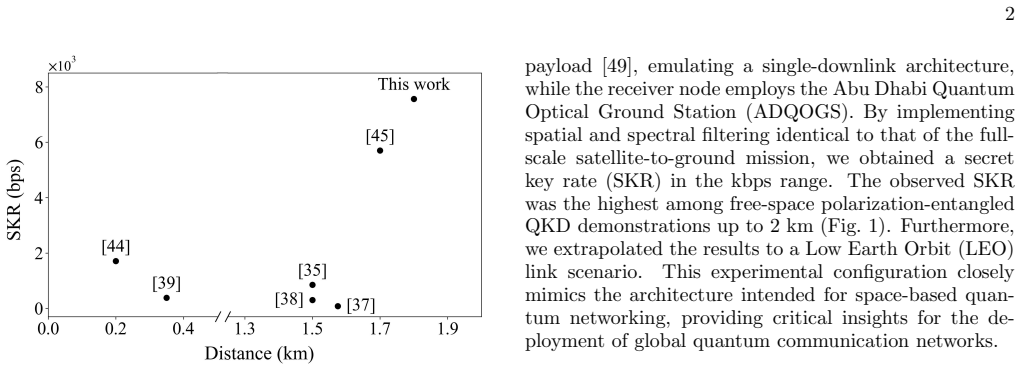
Using an engineering model of the space-qualified entangled photon-pair system, the team demonstrated BBM92 quantum key distribution over 1.8 km of free space with the Abu Dhabi Quantum Optical Ground Station, yielding a secret key rate of approximately 7.56 kbps and a mean quantum bit error rate of 4.78 percent plus or minus 0.24 percent. The experiment employed identical filtering approaches to the space segment, thereby validating the link budget and background rejection under realistic atmospheric conditions.
What carries the argument
BBM92 protocol with polarization-entangled photons from the engineering-model payload, using spectral and spatial filtering identical to the space segment.
If this is right
- Operational compatibility between ground and space segments is confirmed.
- A performance baseline is established for the SpeQtre mission.
- The filtering approach supports background rejection in real atmospheric conditions.
- The architecture can serve as a foundation for future large-scale space-based quantum networks.
Where Pith is reading between the lines
- Ground stations with matching filters could be prepared in advance for other upcoming satellite quantum payloads.
- The demonstrated key rate suggests that entanglement distribution links could be integrated into existing optical ground networks.
- Repeated terrestrial campaigns at varying distances and weather conditions could further refine predictions for space performance.
- If scaled, this validation method might shorten the time between payload development and operational satellite quantum services.
Load-bearing premise
The 1.8 km terrestrial path with its atmospheric turbulence, background light, and weather statistics represents the conditions of the actual space-to-ground channel.
What would settle it
Actual space-to-ground links from the SpeQtre satellite that produce markedly higher quantum bit error rates or lower secret key rates than the 1.8 km terrestrial results would show the test path is not representative.
Figures


read the original abstract
Realizing a global quantum internet relies on the deployment of robust satellite-based entanglement distribution links. While pioneering demonstrations have established the feasibility of such links, the transition to operational infrastructure demands the validation of robust, integrated space-to-ground architectures. Here, we report on a free-space Quantum Key Distribution experiment conducted over a 1.8 km free-space link using an engineering model of the quantum payload onboard the SpeQtre satellite and the Abu Dhabi Quantum Optical Ground Station. By implementing a BBM92 protocol with polarization-entangled photons, a secret key rate of approximately 7.56 kbps with a mean quantum bit error rate of 4.78%+-0.24% was produced. The deployed system featured spectral and spatial filtering approaches identical to those in the space segment, thus validating the link budget and background rejection capabilities under realistic atmospheric conditions. These results confirm the operational compatibility between the ground and space segments, establishing a critical performance baseline for the SpeQtre mission and future space-based, large-scale quantum networks.
Editorial analysis
A structured set of objections, weighed in public.
Referee Report
Summary. The manuscript reports results from a terrestrial free-space QKD experiment over a 1.8 km link using an engineering model of the SpeQtre satellite entangled photon-pair payload and the Abu Dhabi Quantum Optical Ground Station. Implementing the BBM92 protocol with polarization-entangled photons and employing spectral/spatial filtering identical to the space segment, the authors measure a secret key rate of approximately 7.56 kbps and mean QBER of 4.78% ± 0.24%. They present these outcomes as validating link budget and background rejection under realistic atmospheric conditions, confirming operational compatibility between ground and space segments, and establishing a critical performance baseline for the SpeQtre mission and future space-based quantum networks.
Significance. If the measured performance is robust, the work provides a useful pre-flight demonstration of hardware integration and positive key generation in a free-space link with space-qualified components. The identical filtering strategy is a clear strength for validating background rejection. The results contribute to the body of terrestrial test campaigns that precede satellite quantum links. However, the claimed significance as a 'critical performance baseline' for the actual SpeQtre space-to-ground channel is tempered by the differences between the tested horizontal path and orbital slant-range conditions.
major comments (1)
- [Abstract] Abstract: The headline claim that the terrestrial results 'establish a critical performance baseline for the SpeQtre mission' is load-bearing yet rests on an unquantified assumption that the 1.8 km horizontal link replicates the link budget and background-rejection performance of the orbital space-to-ground channel. The space-to-ground path traverses an altitude-dependent atmospheric column (Cn² profile, aerosol scattering, Earth-albedo background) with different total loss and pointing jitter; identical filters do not automatically guarantee translation of the reported 7.56 kbps / 4.78 % QBER without additional modeling or comparison. The manuscript should either supply such an assessment or qualify the baseline claim.
minor comments (2)
- The manuscript should explicitly state the raw coincidence rates, the precise formula and efficiency assumptions used to extract the secret key rate from the BBM92 coincidences, and the data-selection cuts applied before computing the reported 7.56 kbps value.
- Clarify how the QBER uncertainty of ±0.24% was obtained (statistical only, or including systematic contributions from polarization drift, timing jitter, or detector dark counts) and whether it reflects the full error budget.
Simulated Author's Rebuttal
We thank the referee for their constructive and detailed review. We address the single major comment below and have revised the manuscript to qualify the relevant claim while preserving the scientific value of the terrestrial demonstration.
read point-by-point responses
-
Referee: [Abstract] Abstract: The headline claim that the terrestrial results 'establish a critical performance baseline for the SpeQtre mission' is load-bearing yet rests on an unquantified assumption that the 1.8 km horizontal link replicates the link budget and background-rejection performance of the orbital space-to-ground channel. The space-to-ground path traverses an altitude-dependent atmospheric column (Cn² profile, aerosol scattering, Earth-albedo background) with different total loss and pointing jitter; identical filters do not automatically guarantee translation of the reported 7.56 kbps / 4.78 % QBER without additional modeling or comparison. The manuscript should either supply such an assessment or qualify the baseline claim.
Authors: We agree that a 1.8 km horizontal path does not replicate the full space-to-ground slant-range conditions, including the altitude-dependent Cn² profile, aerosol scattering, Earth-albedo background, total loss, and pointing jitter. The experiment was designed to validate the space-qualified entangled-photon payload operating together with the Abu Dhabi ground station under realistic atmospheric turbulence and background light, using exactly the same spectral and spatial filtering planned for flight. This directly confirms hardware integration, background-rejection performance, and operational compatibility between the flight-model payload and the ground segment—elements that cannot be tested on the ground without the actual hardware. We do not claim numerical equivalence of the 7.56 kbps / 4.78 % QBER to the eventual orbital link. To address the referee’s concern, we have revised the abstract to qualify the baseline statement, now emphasizing that the results establish a critical performance baseline for ground–space segment compatibility and payload readiness rather than direct replication of the orbital link budget. We have also added a short discussion paragraph comparing the terrestrial and space-to-ground scenarios and noting that full end-to-end link modeling for the SpeQtre orbit is underway as part of mission preparation. revision: yes
Circularity Check
No circularity; results are direct experimental measurements
full rationale
The manuscript reports measured secret key rate (~7.56 kbps) and QBER (4.78% ± 0.24%) from a BBM92 protocol executed over a 1.8 km terrestrial free-space link using the SpeQtre engineering model and identical spectral/spatial filters. These figures are obtained from raw coincidence counts and error rates under actual atmospheric conditions; no equations, fitted parameters, or self-citations are invoked to derive or normalize them. The claim of operational compatibility follows from the factual identity of hardware filters and the observed performance, without reducing to a self-referential construction or renaming of prior results. The representativeness of the horizontal path for orbital links is an external physical assumption, not a circular step within the paper's reporting.
Axiom & Free-Parameter Ledger
axioms (1)
- standard math Polarization-entangled photon pairs can be used to implement the BBM92 QKD protocol with measurable secret key rate and QBER.
Lean theorems connected to this paper
-
IndisputableMonolith/Cost/FunctionalEquation.leanwashburn_uniqueness_aczel unclear?
unclearRelation between the paper passage and the cited Recognition theorem.
By implementing a BBM92 protocol with polarization-entangled photons, a secret key rate of approximately 7.56 kbps with a mean quantum bit error rate of 4.78%±0.24% was produced. The deployed system featured spectral and spatial filtering approaches identical to those in the space segment
-
IndisputableMonolith/Foundation/RealityFromDistinction.leanreality_from_one_distinction unclear?
unclearRelation between the paper passage and the cited Recognition theorem.
we extrapolated the results to a Low Earth Orbit (LEO) link scenario
What do these tags mean?
- matches
- The paper's claim is directly supported by a theorem in the formal canon.
- supports
- The theorem supports part of the paper's argument, but the paper may add assumptions or extra steps.
- extends
- The paper goes beyond the formal theorem; the theorem is a base layer rather than the whole result.
- uses
- The paper appears to rely on the theorem as machinery.
- contradicts
- The paper's claim conflicts with a theorem or certificate in the canon.
- unclear
- Pith found a possible connection, but the passage is too broad, indirect, or ambiguous to say the theorem truly supports the claim.
Reference graph
Works this paper leans on
-
[1]
S.-H. Wei, B. Jing, X.-Y. Zhang, J.-Y. Liao, C.-Z. Yuan, B.-Y. Fan, C. Lyu, D.-L. Zhou, Y. Wang, G.-W. Deng, et al., Laser & Photonics Reviews16, 2100219 (2022)
work page 2022
-
[2]
H. J. Kimble, Nature453, 1023 (2008)
work page 2008
- [3]
- [4]
-
[5]
A. Broadbent, J. Fitzsimons, and E. Kashefi, in2009 50th annual IEEE symposium on foundations of com- puter science(IEEE, 2009) pp. 517–526
work page 2009
-
[6]
A. Yimsiriwattana and S. J. Lomonaco Jr, inQuantum information and computation II, Vol. 5436 (SPIE, 2004) pp. 360–372
work page 2004
-
[7]
Z. Zhang and Q. Zhuang, Quantum Science and Technol- 7 ogy6, 043001 (2021)
work page 2021
- [8]
- [9]
- [10]
-
[11]
B. Fr¨ ohlich, J. F. Dynes, M. Lucamarini, A. W. Sharpe, S. W.-B. Tam, Z. Yuan, and A. J. Shields, Scientific reports5, 18121 (2015)
work page 2015
-
[12]
Z. Yuan, A. Plews, R. Takahashi, K. Doi, W. Tam, A. Sharpe, A. Dixon, E. Lavelle, J. Dynes, A. Murakami, et al., Journal of Lightwave Technology36, 3427 (2018)
work page 2018
-
[13]
W. Li, L. Zhang, H. Tan, Y. Lu, S.-K. Liao, J. Huang, H. Li, Z. Wang, H.-K. Mao, B. Yan,et al., Nature pho- tonics17, 416 (2023)
work page 2023
-
[14]
V. Zapatero, T. van Leent, R. Arnon-Friedman, W.-Z. Liu, Q. Zhang, H. Weinfurter, and M. Curty, npj quan- tum information9, 10 (2023)
work page 2023
-
[15]
A. Acin, N. Gisin, and L. Masanes, Physical review let- ters97, 120405 (2006)
work page 2006
-
[16]
J.-W. Pan, D. Bouwmeester, H. Weinfurter, and A. Zeilinger, Physical review letters80, 3891 (1998)
work page 1998
- [17]
-
[18]
L. de Forges de Parny, O. Alibart, J. Debaud, S. Gres- sani, A. Lagarrigue, A. Martin, A. Metrat, M. Schiavon, T. Troisi, E. Diamanti,et al., Communications Physics 6, 12 (2023)
work page 2023
-
[19]
S. Pirandola, R. Laurenza, C. Ottaviani, and L. Banchi, Nature communications8, 15043 (2017)
work page 2017
-
[20]
OECD,Public Rights of Way for Fibre Deployment to the Home, Tech. Rep. (OECD, 2008) accessed 2026-01-13
work page 2008
-
[21]
Cross border and interconnection poli- cies,
African Union, “Cross border and interconnection poli- cies,” PDF, accessed 2026-01-13
work page 2026
-
[22]
R. Bedington, J. M. Arrazola, and A. Ling, npj Quantum Information3, 30 (2017)
work page 2017
-
[23]
J. S. Sidhu, S. K. Joshi, M. G¨ undo˘ gan, T. Brougham, D. Lowndes, L. Mazzarella, M. Krutzik, S. Mohapatra, D. Dequal, G. Vallone,et al., IET Quantum Communi- cation2, 182 (2021)
work page 2021
-
[24]
S.-K. Liao, W.-Q. Cai, W.-Y. Liu, L. Zhang, Y. Li, J.-G. Ren, J. Yin, Q. Shen, Y. Cao, Z.-P. Li,et al., Nature 549, 43 (2017)
work page 2017
-
[25]
S.-K. Liao, J. Lin, J.-G. Ren, W.-Y. Liu, J. Qiang, J. Yin, Y. Li, Q. Shen, L. Zhang, X.-F. Liang,et al., Chinese Physics Letters34, 090302 (2017)
work page 2017
-
[26]
S.-K. Liao, W.-Q. Cai, J. Handsteiner, B. Liu, J. Yin, L. Zhang, D. Rauch, M. Fink, J.-G. Ren, W.-Y. Liu, et al., Physical review letters120, 030501 (2018)
work page 2018
- [27]
-
[28]
A. Khmelev, A. Duplinsky, R. Bakhshaliev, E. Ivchenko, L. Pismeniuk, V. Mayboroda, I. Nesterov, A. Chernov, A. Trushechkin, E. Kiktenko,et al., Optics Express32, 11964 (2024)
work page 2024
- [29]
-
[30]
J. Yin, Y. Cao, Y.-H. Li, S.-K. Liao, L. Zhang, J.-G. Ren, W.-Q. Cai, W.-Y. Liu, B. Li, H. Dai,et al., Science356, 1140 (2017)
work page 2017
- [31]
-
[32]
J. Yin, Y. Cao, Y.-H. Li, J.-G. Ren, S.-K. Liao, L. Zhang, W.-Q. Cai, W.-Y. Liu, B. Li, H. Dai,et al., Physical review letters119, 200501 (2017)
work page 2017
- [33]
-
[34]
C.-Z. Peng, T. Yang, X.-H. Bao, J. Zhang, X.-M. Jin, F.-Y. Feng, B. Yang, J. Yang, J. Yin, Q. Zhang,et al., Physical review letters94, 150501 (2005)
work page 2005
-
[35]
I. Marcikic, A. Lamas-Linares, and C. Kurtsiefer, Ap- plied Physics Letters89(2006)
work page 2006
- [36]
- [37]
-
[38]
A. Ling, M. P. Peloso, I. Marcikic, V. Scarani, A. Lamas- Linares, and C. Kurtsiefer, Physical Review A—Atomic, Molecular, and Optical Physics78, 020301 (2008)
work page 2008
-
[39]
M. P. Peloso, I. Gerhardt, C. Ho, A. Lamas-Linares, and C. Kurtsiefer, New Journal of Physics11, 045007 (2009)
work page 2009
-
[40]
T. Scheidl, R. Ursin, A. Fedrizzi, S. Ramelow, X.-S. Ma, T. Herbst, R. Prevedel, L. Ratschbacher, J. Kofler, T. Jennewein,et al., New Journal of Physics11, 085002 (2009)
work page 2009
- [41]
-
[42]
Y. Cao, H. Liang, J. Yin, H.-L. Yong, F. Zhou, Y.-P. Wu, J.-G. Ren, Y.-H. Li, G.-S. Pan, T. Yang,et al., Optics express21, 27260 (2013)
work page 2013
- [43]
- [44]
-
[45]
A. Krˇ ziˇ c, S. Sharma, C. Spiess, U. Chandrashekara, S. T¨ opfer, G. Sauer, L. J. Gonz´ alez-Mart´ ın del Campo, T. Kopf, S. Petscharnig, T. Grafenauer,et al., npj Quan- tum Information9, 95 (2023)
work page 2023
-
[46]
Free-space and satellite-based quantum commu- nication: Principles, implementations, and challenges,
G. G. Rozenman, A. Maslennikov, S. P. Gandelman, Y. Reches, S. Delfan, N. K. Kundu, L. Zhang, and R. Liu, “Free-space and satellite-based quantum commu- nication: Principles, implementations, and challenges,” (2026)
work page 2026
-
[47]
P. V. Trinh, A. T. Pham, A. Carrasco-Casado, and M. Toyoshima, in2018 Progress in Electromagnetics Re- search Symposium (PIERS-Toyama)(IEEE, 2018) pp. 1672–1679
work page 2018
- [48]
-
[49]
Villar, inQuantum Computing, Communication, and Simulation VI(SPIE, 2026) p
A. Villar, inQuantum Computing, Communication, and Simulation VI(SPIE, 2026) p. PC1391907
work page 2026
-
[50]
G. De Santis, K. Kravtsov, O. Kara, S. Amairi Pyka, and J. A. Grieve, inIAF Space Communications and Naviga- 8 tion Symposium(International Astronautical Federation (IAF), 2025) pp. 318–326
work page 2025
-
[51]
A. Lohrmann, C. Perumangatt, A. Villar, and A. Ling, Appl. Phys. Lett.116, 021101 (2020)
work page 2020
-
[52]
S. Amairi-Pyka, C. Fischer, K. Kravtsov, G. De Santis, A. Grosso, E. Fischer, K. Kudielka, and J. A. Grieve, inInternational Conference on Space Optics — ICSO 2024, Vol. 13699, International Society for Optics and Photonics (SPIE, 2025) p. 136993N
work page 2024
-
[54]
V. Mannalath, V. Zapatero, and M. Curty, Physical Re- view Letters135, 020803 (2025)
work page 2025
- [55]
-
[56]
A. Fitzpatrick, R. Harwin, H. Robarts, W. Brzozowski, S. Todd, S. Vallapureddy, L. Saraff, O. Chang, W. Li, D. Pearson, M. Salter, and A. Vick, inInternational Conference on Space Optics — ICSO 2024, edited by F. Bernard, N. Karafolas, P. Kubik, and K. Minoglou (SPIE, 2025) p. 241
work page 2024
-
[57]
Czerwinski, Optical and Quantum Electronics57, 577 (2025)
A. Czerwinski, Optical and Quantum Electronics57, 577 (2025)
work page 2025
-
[58]
C.-Y. Lu, Y. Cao, C.-Z. Peng, and J.-W. Pan, Reviews of Modern Physics94, 035001 (2022)
work page 2022
-
[59]
V. Marulanda Acosta, D. Dequal, M. Schiavon, A. Montmerle-Bonnefois, C. B. Lim, J.-M. Conan, and E. Diamanti, New Journal of Physics26, 023039 (2024)
work page 2024
- [60]
-
[61]
G. De Santis, K. Kravtsov, S. Amairi-Pyka, and J. A. Grieve, EPJ Quantum Technology12, 50 (2025)
work page 2025
-
[62]
C. C.-W. Lim, F. Xu, J.-W. Pan, and A. Ekert, Physical Review Letters126, 100501 (2021)
work page 2021
- [63]
-
[64]
F. Xu, X. Ma, Q. Zhang, H.-K. Lo, and J.-W. Pan, Reviews of Modern Physics92, 025002 (2020). Supplementary Material I. KEY-RA TE ANAL YSIS We summarize the procedure used to estimate the secret key rate for the BBM92 protocol. Two cases are considered: the asymptotic limit and the finite-key analysis using the sharp statistical bound. A. Preliminaries For...
work page 2020
- [65]
-
[66]
V. Mannalath, V. Zapatero, and M. Curty, Physical Review Letters135, 020803 (2025)
work page 2025
discussion (0)
Sign in with ORCID, Apple, or X to comment. Anyone can read and Pith papers without signing in.