Macroscopic Particle Transport in Dissipative Long-Range Bosonic Systems
Pith reviewed 2026-05-22 23:31 UTC · model grok-4.3
The pith
Decoherence-free subspaces enable perfect long-distance boson transport in dissipative long-range systems.
A machine-rendered reading of the paper's core claim, the machinery that carries it, and where it could break.
Core claim
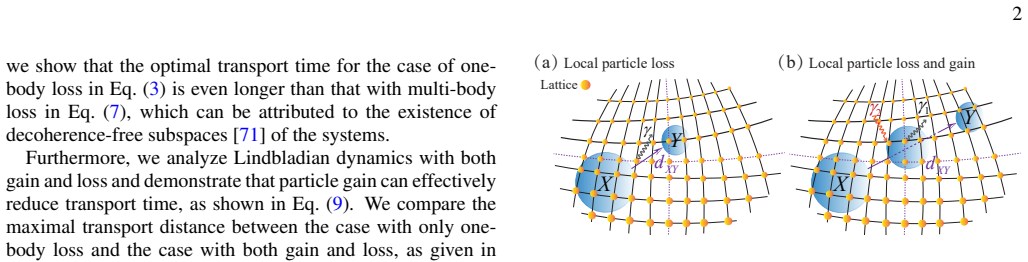
By developing a generalized optimal transport theory for open quantum systems, the authors establish rigorous relationships between minimum transport time and source-target distance for bosons subject to long-range hopping and interactions. Optimal transport exhibits a fundamental distinction between one-body loss and multi-body loss. The emergence of decoherence-free subspaces facilitates long-distance and perfect transport, while even arbitrarily small gain rates enable long-distance transport in dilute lattice gases. An upper bound is also derived for the probability of transporting a given number of particles in fixed time under loss.
What carries the argument
generalized optimal transport theory for open quantum systems with long-range hopping and interactions
If this is right
- Minimum transport time scales with source-target distance according to loss type.
- Maximal transportable distance remains finite under pure loss but becomes arbitrary with decoherence-free subspaces or added gain.
- Transport probability for a fixed particle number in fixed time is bounded from above under particle loss.
- Small gain rates suffice for long-distance transport when the lattice gas is dilute.
Where Pith is reading between the lines
- Engineering decoherence-free subspaces may become a practical route to reliable transport in noisy quantum devices.
- The one-body versus multi-body loss distinction could guide experimental choices of trapping or interaction regimes to optimize transport range.
- Similar bounds might apply to other open many-body systems if comparable loss symmetries are present.
- Dilute regimes with weak gain could be tested first in current cold-atom setups to check the predicted long-distance threshold.
Load-bearing premise
Applying a generalized optimal transport theory to these dissipative long-range bosonic systems produces rigorous, non-circular bounds on transport time and distance that hold for the dynamics considered.
What would settle it
An experiment in a long-range bosonic lattice that measures transport times under one-body loss and finds no scaling distinction from multi-body loss cases, or that fails to achieve perfect transport despite the presence of a decoherence-free subspace.
Figures
read the original abstract
Dissipation in quantum many-body systems provides a more general and experimentally realistic perspective on particle transport than closed quantum systems. In this work, we determine the maximal speed of macroscopic particle transport in dissipative bosonic systems featuring both long-range hopping and long-range interactions. By developing a generalized optimal transport theory for open quantum systems, we rigorously establish the relationship between the minimum transport time and the source-target distance, and investigate the maximal transportable distance of bosons. We demonstrate that optimal transport exhibits a fundamental distinction depending on whether the system experiences one-body loss or multi-body loss. Moreover, we present the minimal transport time and the maximal transport distance for systems with both gain and loss. We observe that even an arbitrarily small gain rate enables transport over long distances if the lattice gas is dilute. Importantly, we generally reveal that the emergence of decoherence-free subspaces facilitates the long-distance and perfect transport process. Additionally, we derive an upper bound for the probability of transporting a given number of particles during a fixed period in the presence of particle loss. Possible experimental protocols for observing our theoretical predictions are also discussed.
Editorial analysis
A structured set of objections, weighed in public.
Referee Report
Summary. The manuscript develops a generalized optimal transport theory for dissipative bosonic systems with long-range hopping and interactions. It claims to rigorously relate the minimum transport time to source-target distance, determine maximal transportable distances of bosons, demonstrate a fundamental distinction in optimal transport between one-body loss and multi-body loss, analyze minimal transport time and maximal distance in systems with both gain and loss (including that arbitrarily small gain enables long-distance transport in dilute lattices), reveal that decoherence-free subspaces facilitate long-distance perfect transport, derive an upper bound on the probability of transporting a given number of particles under loss, and discuss experimental protocols.
Significance. If the central derivations in the generalized optimal transport framework are non-circular and the distinctions hold under the stated dynamics, the work would advance understanding of dissipative quantum transport by providing rigorous speed limits and distance bounds that account for long-range effects and different loss mechanisms. The identification of decoherence-free subspaces as enabling perfect long-distance transport and the observation on dilute systems with small gain rates represent potentially useful insights for open quantum many-body physics. No machine-checked proofs or parameter-free derivations are highlighted in the abstract, but the focus on falsifiable relationships between time, distance, and loss type would be a strength if substantiated.
Simulated Author's Rebuttal
We thank the referee for their summary of our manuscript and for highlighting its potential significance in advancing understanding of dissipative quantum transport. We address the referee's concerns regarding the validity and substantiation of our central derivations below.
read point-by-point responses
-
Referee: If the central derivations in the generalized optimal transport framework are non-circular and the distinctions hold under the stated dynamics, the work would advance understanding of dissipative quantum transport by providing rigorous speed limits and distance bounds that account for long-range effects and different loss mechanisms. The identification of decoherence-free subspaces as enabling perfect long-distance transport and the observation on dilute systems with small gain rates represent potentially useful insights for open quantum many-body physics. No machine-checked proofs or parameter-free derivations are highlighted in the abstract, but the focus on falsifiable relationships between time, distance, and loss type would be a strength if substantiated.
Authors: We confirm that the derivations are non-circular. The generalized optimal transport framework is constructed directly from the Lindblad master equation governing the dissipative long-range bosonic dynamics, with bounds obtained via operator inequalities and distance measures that follow from the Hamiltonian and dissipator terms without circular assumptions. The distinction between one-body and multi-body loss emerges from the differing particle-number scaling in the respective Lindblad operators and their effects on coherence and particle number conservation. Proofs are provided analytically in the main text and appendices; while not machine-checked (as is common for such theoretical works), they are fully explicit and falsifiable through the stated relationships. We can add a clarifying sentence on the proof structure if requested. revision: no
Circularity Check
No significant circularity identified
full rationale
The paper develops a generalized optimal transport theory for open quantum systems within the manuscript itself and uses it to establish relationships between minimum transport time and source-target distance. No load-bearing steps are exhibited in the abstract or available text that reduce by construction to self-definitions, fitted inputs renamed as predictions, or self-citation chains. The central claims about distinctions between loss types and decoherence-free subspaces are presented as derived results from the new framework, with no quoted equations showing equivalence to inputs. The derivation is therefore treated as self-contained against external benchmarks.
Axiom & Free-Parameter Ledger
Lean theorems connected to this paper
-
IndisputableMonolith/Cost/FunctionalEquation.leanwashburn_uniqueness_aczel unclear?
unclearRelation between the paper passage and the cited Recognition theorem.
By defining the cost function and generalized Wasserstein distance in open quantum systems, we have rigorously obtained the lower bound for the transport time...
-
IndisputableMonolith/Foundation/AlexanderDuality.leanalexander_duality_circle_linking unclear?
unclearRelation between the paper passage and the cited Recognition theorem.
the emergence of decoherence-free subspaces facilitates the long-distance and perfect transport process
What do these tags mean?
- matches
- The paper's claim is directly supported by a theorem in the formal canon.
- supports
- The theorem supports part of the paper's argument, but the paper may add assumptions or extra steps.
- extends
- The paper goes beyond the formal theorem; the theorem is a base layer rather than the whole result.
- uses
- The paper appears to rely on the theorem as machinery.
- contradicts
- The paper's claim conflicts with a theorem or certificate in the canon.
- unclear
- Pith found a possible connection, but the passage is too broad, indirect, or ambiguous to say the theorem truly supports the claim.
Reference graph
Works this paper leans on
-
[1]
E. H. Lieb and D. W. Robinson, Commun. Math. Phys. 28, 251 (1972)
work page 1972
-
[2]
M. B. Hastings, Locality in quantum systems, arXiv:1008.5137 (2010)
work page internal anchor Pith review Pith/arXiv arXiv 2010
-
[3]
M. B. Hastings and T. Koma, Commun. Math. Phys. 265, 781 (2006)
work page 2006
- [4]
-
[5]
L. Cevolani, G. Carleo, and L. Sanchez-Palencia, New J. Phys. 18, 093002 (2016)
work page 2016
-
[6]
M. C. Tran, A. Y . Guo, Y . Su, J. R. Garrison, Z. Eldredge, M. Foss-Feig, A. M. Childs, and A. V . Gorshkov, Phys. Rev. X 9, 031006 (2019)
work page 2019
- [7]
-
[8]
A. Y . Guo, M. C. Tran, A. M. Childs, A. V . Gorshkov, and Z.-X. Gong, Phys. Rev. A 102, 010401 (2020)
work page 2020
- [9]
- [10]
- [11]
- [13]
- [14]
-
[15]
M. Lemm, C. Rubiliani, I. M. Sigal, and J. Zhang, Phys. Rev. A 108, L060401 (2023)
work page 2023
- [16]
- [17]
- [18]
- [19]
-
[20]
R. Trivedi and M. Rudner, A lieb-robinson bound for open quantum systems with memory, arXiv:2410.15481 (2024)
- [21]
-
[22]
S. Bachmann, W. De Roeck, and M. Fraas, Phys. Rev. Lett. 119, 060201 (2017)
work page 2017
- [23]
- [24]
- [25]
-
[26]
M. B. Hastings, Phys. Rev. B 69, 104431 (2004)
work page 2004
- [27]
-
[28]
M. B. Hastings, J. Stat. Mech. 2007, P08024 (2007)
work page 2007
- [29]
- [30]
- [31]
-
[32]
K. Shiraishi, M. Nakagawa, T. Mori, and M. Ueda, Quantum master equation for many-body systems: Derivation based on the lieb-robinson bound, arXiv:2404.14067 (2024)
-
[33]
D. A. Roberts and B. Swingle, Phys. Rev. Lett. 117, 091602 (2016)
work page 2016
-
[34]
J. Maldacena, S. H. Shenker, and D. Stanford, J. High Energy Phys. 2016 (8), 106
work page 2016
- [35]
- [36]
- [37]
- [38]
- [39]
- [40]
-
[41]
K.-K. Ni, S. Ospelkaus, M. H. G. de Miranda, A. Pe’er, B. Neyenhuis, J. J. Zirbel, S. Kotochigova, P. S. Julienne, D. S. Jin, and J. Ye, Science 322, 231 (2008)
work page 2008
-
[42]
K. K. Ni, S. Ospelkaus, D. Wang, G. Qu´em´ener, B. Neyenhuis, M. H. G. de Miranda, J. L. Bohn, J. Ye, and D. S. Jin, Nature 464, 1324 (2010)
work page 2010
- [43]
- [44]
- [45]
-
[46]
I. Stevenson, A. Z. Lam, N. Bigagli, C. Warner, W. Yuan, S. Zhang, and S. Will, Phys. Rev. Lett. 130, 113002 (2023)
work page 2023
-
[47]
T. Takekoshi, L. Reichs ¨ollner, A. Schindewolf, J. M. Hutson, C. R. Le Sueur, O. Dulieu, F. Ferlaino, R. Grimm, and H.-C. N¨agerl, Phys. Rev. Lett. 113, 205301 (2014)
work page 2014
-
[48]
P. K. Molony, P. D. Gregory, Z. Ji, B. Lu, M. P. K ¨oppinger, C. R. Le Sueur, C. L. Blackley, J. M. Hutson, and S. L. Cor- nish, Phys. Rev. Lett. 113, 255301 (2014)
work page 2014
-
[49]
S. A. Will, J. W. Park, Z. Z. Yan, H. Loh, and M. W. Zwierlein, Phys. Rev. Lett. 116, 225306 (2016)
work page 2016
-
[50]
N. Bigagli, W. Yuan, S. Zhang, B. Bulatovic, T. Karman, I. Stevenson, and S. Will, Nature 631, 289 (2024)
work page 2024
-
[51]
Y . E. Kim and A. L. Zubarev, Phys. Rev. A69, 023602 (2004)
work page 2004
-
[52]
T. Kraemer, M. Mark, P. Waldburger, J. G. Danzl, C. Chin, B. Engeser, A. D. Lange, K. Pilch, A. Jaakkola, H. C. N¨agerl, and R. Grimm, Nature 440, 315 (2006)
work page 2006
-
[53]
A. Schindewolf, R. Bause, X.-Y . Chen, M. Duda, T. Karman, I. Bloch, and X.-Y . Luo, Nature607, 677 (2022)
work page 2022
-
[54]
M. Lecomte, A. Journeaux, L. Renaud, J. Dalibard, and R. Lopes, Phys. Rev. A 109, 023319 (2024)
work page 2024
-
[55]
B.-Y . Wang, Y .-F. Wang, Z.-H. An, L.-Y . Xie, Z.-X. Ye, Y . Zhang, and M. K. Tey, Measurement of three-body recom- bination coefficient of ultracold lithium and strontium atoms, arXiv:2404.01098 (2024)
- [56]
- [57]
-
[58]
A. Christianen, M. W. Zwierlein, G. C. Groenenboom, and T. Karman, Phys. Rev. Lett.123, 123402 (2019)
work page 2019
-
[59]
C. McKenzie, J. Hecker Denschlag, H. H ¨affner, A. Browaeys, L. E. E. de Araujo, F. K. Fatemi, K. M. Jones, J. E. Simsarian, D. Cho, A. Simoni, E. Tiesinga, P. S. Julienne, K. Helmerson, 11 P. D. Lett, S. L. Rolston, and W. D. Phillips, Phys. Rev. Lett. 88, 120403 (2002)
work page 2002
- [60]
- [61]
- [62]
-
[63]
H.-P. Breuer and F. P, The Theory of Open Quantum Systems (Oxford University Press, 2007)
work page 2007
- [64]
- [65]
-
[66]
C. Shang, Coupling enhancement and symmetrization of single-photon optomechanics in open quantum systems, arXiv:2302.04897 (2023)
-
[67]
H.-P. Breuer, E.-M. Laine, J. Piilo, and B. Vacchini, Rev. Mod. Phys. 88, 021002 (2016)
work page 2016
-
[68]
A. Rivas and S. F. H,Open Quantum Systems: An Introduction (Springer Berlin Heidelberg, 2012)
work page 2012
-
[69]
Weiss, Quantum Dissipative Systems (World Scientific, 2012)
U. Weiss, Quantum Dissipative Systems (World Scientific, 2012)
work page 2012
- [70]
-
[71]
D. A. Lidar, I. L. Chuang, and K. B. Whaley, Phys. Rev. Lett. 81, 2594 (1998)
work page 1998
-
[72]
We note that the dephasing operatorLi = b† i bi commutes with the number operator and hence does not influence the particle transport
- [73]
- [74]
- [75]
- [76]
- [77]
- [78]
- [79]
-
[80]
B. Yan, S. A. Moses, B. Gadway, J. P. Covey, K. R. A. Haz- zard, D. S. Jin, and J. Ye, Nature 501, 521 (2013)
work page 2013
-
[81]
L. D. Carr, D. DeMille, R. V . Krems, and J. Ye, New J. Phys. 11, 055049 (2009)
work page 2009
discussion (0)
Sign in with ORCID, Apple, or X to comment. Anyone can read and Pith papers without signing in.