Physics-Informed Generative Solver: Bridging Data-Driven Priors and Conservation Laws for Stable Spatiotemporal Field Reconstruction
Pith reviewed 2026-05-22 07:13 UTC · model grok-4.3
The pith
A generative solver learns stable priors from data then enforces conservation laws at inference time to reconstruct consistent spatiotemporal fields from sparse measurements.
A machine-rendered reading of the paper's core claim, the machinery that carries it, and where it could break.
Core claim
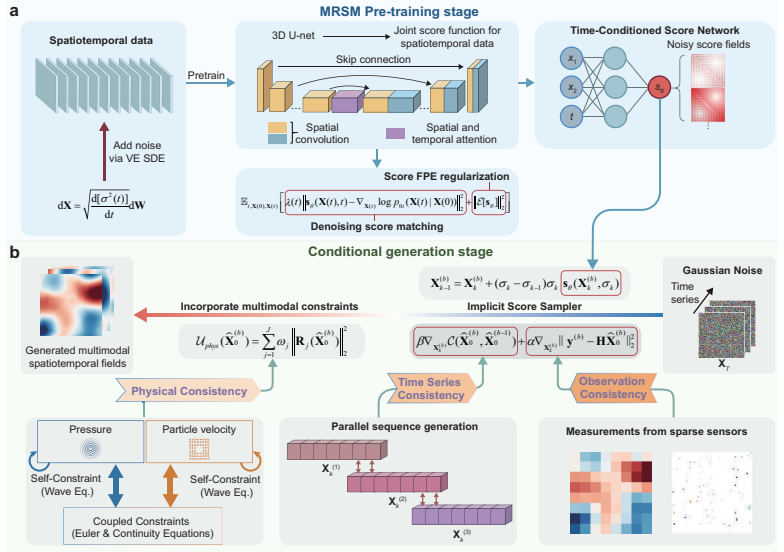
The central claim is that Martingale-Regularized Score Matching, which adds a Score Fokker-Planck constraint during pretraining, yields a dynamically stable prior, while Physics-Informed Implicit Score Sampling projects generated samples onto admissible physical manifolds by following gradients of physical residuals at inference time, enabling stable reconstruction without retraining.
What carries the argument
Martingale-Regularized Score Matching for stable prior learning together with Physics-Informed Implicit Score Sampling that steers denoising trajectories using gradients of physical residuals.
If this is right
- In acoustics the method co-generates pressure and particle velocity from sparse sensors to create dense virtual arrays that suppress spatial aliasing.
- The same procedure reconstructs real-world ERA5 meteorological fields under conditions of extreme sparsity.
- Physical constraints can be swapped at inference time without retraining the generative model.
- The framework supplies a general route to high-dimensional inverse problems that combines data-driven priors with first-principles conservation laws.
Where Pith is reading between the lines
- The two-stage separation could be tested in other domains such as fluid flow or electromagnetic field reconstruction where governing equations are known but measurements remain sparse.
- One could examine whether the method remains stable when the underlying physics itself changes over time, for example in non-stationary meteorological scenarios.
- Extending the residual-gradient guidance to multi-physics couplings might allow joint reconstruction of interacting fields without additional model training.
Load-bearing premise
Martingale-Regularized Score Matching produces a dynamically stable prior and Physics-Informed Implicit Score Sampling can project samples onto admissible manifolds by gradients of physical residuals without retraining the model.
What would settle it
Measure conservation-law violations or physical residual norms on the acoustic pressure-velocity co-generation task or the sparse ERA5 fields; markedly lower violations compared with standard generative baselines would confirm the projection step works as claimed.
Figures



read the original abstract
Reconstructing continuous physical fields from sparse measurements is a central inverse problem, but data-driven generative models can produce states that violate governing dynamics. We introduce a physics-informed generative solver that separates stable prior learning from inference-time enforcement of conservation laws. Martingale-Regularized Score Matching regularizes score pretraining with a Score Fokker-Planck constraint, yielding a dynamically stable prior. Physics-Informed Implicit Score Sampling then guides denoising trajectories by gradients of physical residuals, projecting samples toward admissible manifolds without retraining. In acoustics, the method co-generates pressure and particle velocity from sparse sensors, enabling dense virtual arrays that suppress spatial aliasing. The same framework generalizes to real-world ERA5 meteorological fields under extreme sparsity. Together, this work establishes a rigorous and generalizable paradigm for solving high-dimensional inverse problems, bridging the gap between generative artificial intelligence and first-principles science.
Editorial analysis
A structured set of objections, weighed in public.
Referee Report
Summary. The paper introduces a Physics-Informed Generative Solver for reconstructing continuous spatiotemporal physical fields from sparse measurements. It separates stable prior learning via Martingale-Regularized Score Matching (which adds a Score Fokker-Planck constraint to the score-matching objective) from inference-time enforcement of conservation laws using Physics-Informed Implicit Score Sampling (which guides denoising by gradients of physical residuals). The framework is demonstrated on co-generating pressure and particle velocity fields in acoustics from sparse sensors (enabling dense virtual arrays to suppress aliasing) and on real-world ERA5 meteorological data under extreme sparsity, with the claim that this establishes a generalizable paradigm bridging generative AI and first-principles physics.
Significance. If the central separation of a dynamically stable data-driven prior from subsequent physical projection holds, the approach could offer a useful template for incorporating conservation laws into generative models for high-dimensional inverse problems. The applications to acoustics and ERA5 data illustrate potential for handling sparsity while maintaining physical admissibility, which is relevant to fields like fluid dynamics, meteorology, and wave propagation. The explicit regularization of the score field with a Fokker-Planck term is a concrete technical choice that merits further exploration if empirically validated.
major comments (1)
- [Martingale-Regularized Score Matching and Score Fokker-Planck constraint] The central claim rests on Martingale-Regularized Score Matching producing a prior whose trajectories remain consistent with the underlying PDE even before the inference-time correction. However, the construction assumes that the discrete Score Fokker-Planck constraint on the sparse sensor grid preserves the martingale property. Under the extreme sparsity levels reported for the ERA5 and acoustic experiments, truncation errors in the discrete Fokker-Planck operator could allow the learned prior to drift, forcing Physics-Informed Implicit Score Sampling to compensate for both prior instability and measurement noise. This would weaken the claimed separation of stable prior learning from conservation-law enforcement. An explicit error analysis, ablation on grid sparsity, or numerical check of the martingale residual on the learned score field is needed to support the claim.
minor comments (2)
- [Physics-Informed Implicit Score Sampling] The abstract states that the method 'co-generates pressure and particle velocity' and 'suppresses spatial aliasing,' but the precise definition of the physical residual used in the gradient projection step is not immediately clear from the high-level description; a short explicit equation for the residual would improve readability.
- The claim of a 'rigorous and generalizable paradigm' would be strengthened by a brief discussion of limitations, such as the computational cost of the implicit sampling step or sensitivity to the choice of physical residual weighting.
Simulated Author's Rebuttal
We thank the referee for the constructive and detailed review of our manuscript. The major comment identifies a potential limitation in the discretization of the Score Fokker-Planck constraint under sparsity, which merits careful consideration. We address this point directly below and will strengthen the manuscript accordingly.
read point-by-point responses
-
Referee: [Martingale-Regularized Score Matching and Score Fokker-Planck constraint] The central claim rests on Martingale-Regularized Score Matching producing a prior whose trajectories remain consistent with the underlying PDE even before the inference-time correction. However, the construction assumes that the discrete Score Fokker-Planck constraint on the sparse sensor grid preserves the martingale property. Under the extreme sparsity levels reported for the ERA5 and acoustic experiments, truncation errors in the discrete Fokker-Planck operator could allow the learned prior to drift, forcing Physics-Informed Implicit Score Sampling to compensate for both prior instability and measurement noise. This would weaken the claimed separation of stable prior learning from conservation-law enforcement. An explicit error analysis, ablation on grid sparsity, or numerical check of the martingale residual
Authors: We appreciate the referee's careful analysis of the discretization assumptions underlying Martingale-Regularized Score Matching. The constraint is applied on the discrete sensor grid, and we agree that truncation errors under extreme sparsity represent a valid concern that could, in principle, introduce drift in the learned prior. Our current experiments show low physical residuals prior to physics-informed sampling, suggesting the prior remains sufficiently stable for the reported tasks, but this does not fully quantify the martingale residual or isolate discretization effects. To strengthen the claim of separation, we will add to the revised manuscript: (i) a direct numerical computation of the martingale residual on the learned score field for the acoustic and ERA5 cases, and (ii) an ablation varying sensor density to measure both residual drift and reconstruction quality. These additions will provide the requested quantitative support. revision: yes
Circularity Check
No significant circularity; derivation chain is self-contained
full rationale
The abstract and method description introduce Martingale-Regularized Score Matching as the addition of a Score Fokker-Planck constraint to the standard score-matching objective, which produces a dynamically stable prior as a direct consequence of the added term rather than by definitional equivalence or renaming. Physics-Informed Implicit Score Sampling is presented as a separate inference-time procedure that projects samples using gradients of physical residuals without retraining. No equations or steps reduce a claimed prediction or result to a fitted input by construction, no self-citation is invoked as a load-bearing uniqueness theorem, and no ansatz is smuggled via prior work. The framework combines existing score-based and physics-informed techniques in a novel separation of concerns, remaining externally falsifiable against benchmarks like ERA5 and acoustics data.
Axiom & Free-Parameter Ledger
axioms (1)
- domain assumption Martingale-Regularized Score Matching with a Score Fokker-Planck constraint produces a dynamically stable prior.
Lean theorems connected to this paper
-
IndisputableMonolith/Cost/FunctionalEquation.leanwashburn_uniqueness_aczel unclear?
unclearRelation between the paper passage and the cited Recognition theorem.
Martingale-Regularized Score Matching (MRSM) couples denoising score matching (DSM) with Score Fokker–Planck Equation (Score FPE) regularization to enforce a reverse martingale property
-
IndisputableMonolith/Foundation/RealityFromDistinction.leanreality_from_one_distinction unclear?
unclearRelation between the paper passage and the cited Recognition theorem.
PI-ISS projects samples toward the physical manifold by back-propagating conservation-law residuals
What do these tags mean?
- matches
- The paper's claim is directly supported by a theorem in the formal canon.
- supports
- The theorem supports part of the paper's argument, but the paper may add assumptions or extra steps.
- extends
- The paper goes beyond the formal theorem; the theorem is a base layer rather than the whole result.
- uses
- The paper appears to rely on the theorem as machinery.
- contradicts
- The paper's claim conflicts with a theorem or certificate in the canon.
- unclear
- Pith found a possible connection, but the passage is too broad, indirect, or ambiguous to say the theorem truly supports the claim.
Reference graph
Works this paper leans on
-
[1]
Arridge, S., Maass, P., ¨Oktem, O. & Sch¨ onlieb, C.-B. Solving inverse problems using data-driven models.Acta Numerica28, 1–174 (2019)
work page 2019
-
[2]
Donoho, D. L. Compressed sensing.IEEE Transactions on Information Theory52, 1289–1306 (2006)
work page 2006
-
[3]
Cand` es, E. J., Romberg, J. & Tao, T. Robust uncertainty principles: Exact signal reconstruction from highly incomplete frequency information.IEEE Transactions on Information Theory52, 489–509 (2006)
work page 2006
-
[4]
Pfau, D., Axelrod, S., Sutterud, H., Von Glehn, I. & Spencer, J. S. Accurate computation of quantum excited states with neural networks.Science385, eadn0137 (2024)
work page 2024
-
[5]
Gong, X.et al.General framework for E(3)-equivariant neural network representation of density functional theory Hamiltonian.Nature Communications14, 2848 (2023)
work page 2023
-
[6]
Nature Computational Science3, 321–327 (2023)
Li, H.et al.Deep-learning electronic-structure calculation of magnetic superstructures. Nature Computational Science3, 321–327 (2023)
work page 2023
-
[7]
Chmiela, S.et al.Accurate global machine learning force fields for molecules with hundreds of atoms.Science Advances9, eadf0873 (2023)
work page 2023
-
[8]
Musaelian, A.et al.Learning local equivariant representations for large-scale atomistic dynamics.Nature Communications14, 579 (2023)
work page 2023
-
[9]
Nature Computational Science3, 957–964 (2023)
Zou, Z.et al.A deep learning model for predicting selected organic molecular spectra. Nature Computational Science3, 957–964 (2023)
work page 2023
-
[10]
Choi, S. Prediction of transition state structures of gas-phase chemical reactions via machine learning.Nature Communications14, 1168 (2023)
work page 2023
-
[11]
Cui, H.et al.Enzyme specificity prediction using cross-attention graph neural networks.Nature647, 639–647 (2025)
work page 2025
-
[12]
Abramson, J.et al.Accurate structure prediction of biomolecular interactions with AlphaFold 3.Nature630, 493–500 (2024)
work page 2024
-
[13]
L.et al.De novo design of protein structure and function with RFdiffusion
Watson, J. L.et al.De novo design of protein structure and function with RFdiffusion. Nature620, 1089–1100 (2023)
work page 2023
-
[14]
Madani, A.et al.Large language models generate functional protein sequences across diverse families.Nature Biotechnology41, 1099–1106 (2023). 26
work page 2023
-
[15]
Moor, M.et al.Foundation models for generalist medical artificial intelligence.Nature 616, 259–265 (2023)
work page 2023
-
[16]
Zeni, C.et al.A generative model for inorganic materials design.Nature639, 624–632 (2025)
work page 2025
-
[17]
Szymanski, N. J.et al.An autonomous laboratory for the accelerated synthesis of novel materials.Nature624, 86–91 (2023)
work page 2023
-
[18]
Merchant, A.et al.Scaling deep learning for materials discovery.Nature624, 80–85 (2023)
work page 2023
-
[19]
Bastek, J.-H. & Kochmann, D. M. Inverse-design of nonlinear mechanical metamate- rials via video denoising diffusion models.Nature Machine Intelligence5, 1466–1475 (2023).2305.19836
-
[20]
Deng, B.et al.CHGNet as a pretrained universal neural network potential for charge-informed atomistic modelling.Nature Machine Intelligence5, 1031–1041 (2023)
work page 2023
-
[21]
Quek, Y., Fort, S. & Ng, H. K. Adaptive quantum state tomography with neural networks.npj Quantum Information7, 105 (2021)
work page 2021
-
[22]
Xin, T.et al.Local-measurement-based quantum state tomography via neural networks.npj Quantum Information5, 109 (2019)
work page 2019
-
[23]
Torlai, G.et al.Quantum process tomography with unsupervised learning and tensor networks.Nature Communications14, 2858 (2023)
work page 2023
-
[24]
Nature Communications12, 5441 (2021)
Zhang, M.et al.Quantum state tomography of molecules by ultrafast diffraction. Nature Communications12, 5441 (2021)
work page 2021
-
[25]
Raissi, M., Perdikaris, P. & Karniadakis, G. E. Physics Informed Deep Learning (Part I): Data-driven Solutions of Nonlinear Partial Differential Equations (2017). 1711.10561
work page internal anchor Pith review Pith/arXiv arXiv 2017
-
[26]
Raissi, M., Perdikaris, P. & Karniadakis, G. E. Physics Informed Deep Learning (Part II): Data-driven Discovery of Nonlinear Partial Differential Equations (2017). 1711.10566
work page internal anchor Pith review Pith/arXiv arXiv 2017
-
[27]
Lu, L., Jin, P. & Karniadakis, G. E. DeepONet: Learning nonlinear operators for identifying differential equations based on the universal approximation theorem of operators.Nature Machine Intelligence3, 218–229 (2021).1910.03193
work page internal anchor Pith review Pith/arXiv arXiv 2021
-
[28]
Li, Z.et al.Fourier Neural Operator for Parametric Partial Differential Equations (2021).2010.08895
work page internal anchor Pith review Pith/arXiv arXiv 2021
-
[29]
LNO: Laplace Neural Operator for Solving Differential Equations, May 2023
Cao, Q., Goswami, S. & Karniadakis, G. E. LNO: Laplace Neural Operator for Solving Differential Equations (2023).2303.10528
-
[30]
Ongie, G.et al.Deep Learning Techniques for Inverse Problems in Imaging.IEEE Journal on Selected Areas in Information Theory1, 39–56 (2020). 27
work page 2020
-
[31]
Wang, S., Wang, H. & Perdikaris, P. On the eigenvector bias of Fourier feature networks: From regression to solving multi-scale PDEs with physics-informed neural networks.Computer Methods in Applied Mechanics and Engineering384, 113938 (2021)
work page 2021
-
[32]
Wang, S., Teng, Y. & Perdikaris, P. Understanding and mitigating gradient pathologies in physics-informed neural networks (2020).2001.04536
-
[33]
Generative Modeling by Estimating Gradients of the Data Distribution
Song, Y. & Ermon, S. Generative Modeling by Estimating Gradients of the Data Distribution (2020).1907.05600
work page internal anchor Pith review Pith/arXiv arXiv 2020
-
[34]
Song, Y.et al.Score-Based Generative Modeling through Stochastic Differential Equations (2021).2011.13456
work page internal anchor Pith review Pith/arXiv arXiv 2021
-
[35]
Denoising Diffusion Probabilistic Models
Ho, J., Jain, A. & Abbeel, P. Denoising Diffusion Probabilistic Models (2020). 2006.11239
work page internal anchor Pith review Pith/arXiv arXiv 2020
-
[36]
Kingma, D. P., Salimans, T., Poole, B. & Ho, J. Variational Diffusion Models (2023). 2107.00630
-
[37]
Song, J., Meng, C. & Ermon, S. Denoising Diffusion Implicit Models (2022). 2010. 02502
work page 2022
-
[38]
Flow Straight and Fast: Learning to Generate and Transfer Data with Rectified Flow
Liu, X., Gong, C. & Liu, Q. Flow Straight and Fast: Learning to Generate and Transfer Data with Rectified Flow (2022).2209.03003
work page internal anchor Pith review Pith/arXiv arXiv 2022
-
[39]
Lipman, Y., Chen, R. T. Q., Ben-Hamu, H., Nickel, M. & Le, M. Flow Matching for Generative Modeling (2023).2210.02747
work page internal anchor Pith review Pith/arXiv arXiv 2023
-
[40]
Stochastic Interpolants: A Unifying Framework for Flows and Diffusions
Albergo, M. S., Boffi, N. M. & Vanden-Eijnden, E. Stochastic Interpolants: A Unifying Framework for Flows and Diffusions (2023).2303.08797
work page internal anchor Pith review Pith/arXiv arXiv 2023
- [41]
- [42]
-
[43]
Chung, H., Kim, J., Mccann, M. T., Klasky, M. L. & Ye, J. C. Diffusion Poste- rior Sampling for General Noisy Inverse Problems. InThe Eleventh International Conference on Learning Representations(2022)
work page 2022
-
[44]
Nature Machine Intelligence6, 1566–1579 (2024)
Li, Z.et al.Learning spatiotemporal dynamics with a pretrained generative model. Nature Machine Intelligence6, 1566–1579 (2024)
work page 2024
- [45]
-
[46]
Lai, C.-H.et al.On the Equivalence of Consistency-Type Models: Consistency Models, Consistent Diffusion Models, and Fokker-Planck Regularization (2023). 2306.00367. 28
-
[47]
Hersbach, H.et al.The era5 global reanalysis.Quarterly Journal of the Royal Meteorological Society146, 1999–2049 (2020)
work page 1999
-
[48]
Anderson, B. D. O. Reverse-time diffusion equation models.Stochastic Processes and their Applications12, 313–326 (1982)
work page 1982
-
[49]
Efron, B. Tweedie’s Formula and Selection Bias.Journal of the American Statistical Association106, 1602–1614 (2011). 29 Standing wave tube Power amplifier Signal collector Signal conditioning circuit board PC a b c Pt Hot-wires Interface Interface Multi-channel PU Sensor Inputs Multi-channel PU Sensor Inputs d PU-integrated sensor chip Speaker Plug End ca...
work page 2011
discussion (0)
Sign in with ORCID, Apple, or X to comment. Anyone can read and Pith papers without signing in.