Convergence Analysis of Two Alternating Iterative Schemes for Tucker Decomposition
Pith reviewed 2026-05-20 01:11 UTC · model grok-4.3
The pith
Two alternating methods for Tucker decomposition converge globally to stationary points for complex tensors while the objective increases monotonically at each step.
A machine-rendered reading of the paper's core claim, the machinery that carries it, and where it could break.
Core claim
Both the higher-order orthogonal iteration (including its greedy variant) and the alternating subspace iteration converge globally to stationary points of the Tucker objective for complex tensors under mild conditions, with the objective function strictly increasing throughout the iterations; real tensors are recovered as a special case.
What carries the argument
Monotonic increase of the objective function paired with a global convergence argument that tracks the iterates across the orthogonal constraints of the Tucker factors.
If this is right
- Users can apply these schemes to complex-valued data with the assurance that the objective will rise and the process will stop at a stationary point.
- The same monotonicity property supplies a practical stopping criterion based on objective change.
- The analysis covers both real and complex tensors without requiring separate proofs.
- Earlier gaps in the 1980 analysis of ASI are now filled.
Where Pith is reading between the lines
- Similar monotonicity-plus-global-convergence arguments might apply to other alternating least-squares schemes for tensor factorizations if the objective is bounded above and the factors remain on compact sets.
- The mild conditions could be made explicit in future work to identify the largest class of tensors for which the guarantees hold.
- Numerical monitoring of the objective increase offers a simple diagnostic that the iteration is behaving as predicted.
Load-bearing premise
The convergence holds only under mild but unspecified conditions on the input tensor and the iteration parameters.
What would settle it
A concrete complex tensor together with iteration parameters satisfying the stated mild conditions for which either method produces a non-monotonic objective sequence or fails to approach a stationary point.
Figures


read the original abstract
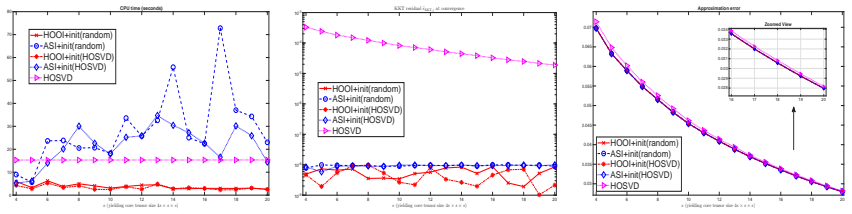
The higher-order orthogonal iteration (HOOI) and the alternating subspace iteration (ASI) are two popular numerical methods for computing the Tucker decomposition of a multiple-mode tensor. Xu [Linear and Multilinear Algebra, 66(11):2247--2265, 2018] proposed a variation of HOOI, called the greedy HOOI, which has an extra alignment action between consecutive approximations. Kroonenberg and De Leeuw [Psychometrika, 45(1):69--97, 1980] analyzed the convergence of ASI but their analysis has gaps. These analysis were for a real tensor only. In this paper, we present detailed convergence analysis of the two methods that is applicable to a complex tensor with a real tensor being a special case, and it is shown both methods are globally convergent to stationary points under mild conditions while the objective function monotonically increases. Numerical examples are presented to demonstrate the convergence behavior of the methods.
Editorial analysis
A structured set of objections, weighed in public.
Referee Report
Summary. The manuscript analyzes the convergence of the higher-order orthogonal iteration (HOOI) and alternating subspace iteration (ASI) for computing the Tucker decomposition of complex tensors (with real tensors as a special case). It supplies detailed proofs that both methods converge globally to stationary points under explicitly stated mild conditions (boundedness of the iterates plus a non-degeneracy condition on the singular values of the mode-unfoldings), while the objective function increases monotonically; the proofs close gaps in the 1980 Kroonenberg–De Leeuw analysis of ASI and reduce the complex case to the real case via real/imaginary splitting. Numerical examples illustrate the observed convergence behavior.
Significance. If the proofs are correct, the work supplies a rigorous theoretical justification for two widely used alternating schemes in tensor decomposition, extending them reliably to complex data that arise in signal processing and quantum applications. The Lyapunov-style arguments and explicit handling of the complex case constitute a clear advance over prior incomplete analyses.
major comments (2)
- [Theorem 3.1] Theorem 3.1: the non-degeneracy assumption on the singular values of the mode-unfoldings is stated as part of the mild conditions, yet the manuscript does not discuss how restrictive this assumption is for generic or noisy tensors; a short remark on its genericity would strengthen the claim that the result applies broadly.
- [§4.2] §4.2, proof of Theorem 4.2: the Lyapunov function is introduced to establish monotonicity, but the precise expression and the verification that it is bounded below are only sketched; an expanded paragraph confirming that the argument carries over without additional hidden assumptions for the complex case would remove any remaining doubt.
minor comments (4)
- [Abstract] The abstract contains a minor grammatical issue: 'These analysis were' should read 'These analyses were'.
- [Throughout] Notation: the manuscript occasionally uses both 'X' and bold 'X' for the same tensor; a single consistent convention (e.g., calligraphic or bold) would improve readability.
- [Numerical examples] Numerical section: the tensor dimensions and noise levels used in the examples should be stated explicitly in the text rather than only in figure captions.
- [Introduction] A reference to the original Xu (2018) greedy-HOOI paper is present, but the manuscript would benefit from citing one or two recent works on complex Tucker decomposition for context.
Simulated Author's Rebuttal
We thank the referee for the positive recommendation of minor revision and for the constructive comments. We address each major comment below and will incorporate revisions to strengthen the manuscript.
read point-by-point responses
-
Referee: [Theorem 3.1] Theorem 3.1: the non-degeneracy assumption on the singular values of the mode-unfoldings is stated as part of the mild conditions, yet the manuscript does not discuss how restrictive this assumption is for generic or noisy tensors; a short remark on its genericity would strengthen the claim that the result applies broadly.
Authors: We agree that a brief discussion of the assumption's genericity would be helpful. In the revised manuscript we will add a short remark after Theorem 3.1 noting that the non-degeneracy condition holds for generic tensors: the set of tensors for which any mode-unfolding has repeated singular values is a lower-dimensional algebraic variety and hence has Lebesgue measure zero. Consequently the assumption is satisfied almost everywhere, including for generic noisy tensors whose perturbations generically separate the singular values. revision: yes
-
Referee: [§4.2] §4.2, proof of Theorem 4.2: the Lyapunov function is introduced to establish monotonicity, but the precise expression and the verification that it is bounded below are only sketched; an expanded paragraph confirming that the argument carries over without additional hidden assumptions for the complex case would remove any remaining doubt.
Authors: We thank the referee for this observation. In the revised version we will expand the relevant paragraph in §4.2 to state the precise Lyapunov function explicitly and to verify that it is bounded from below. We will also add a short confirmation that the real/imaginary splitting reduces the complex case to the real case without introducing extra assumptions, since the monotonicity and lower-boundedness properties are preserved under this embedding. revision: yes
Circularity Check
No significant circularity identified
full rationale
The paper's central results are global convergence proofs for the HOOI and ASI algorithms applied to Tucker decomposition of complex tensors (with real tensors as a special case). These rest on explicit mild conditions stated in Theorems 3.1 and 4.2 (boundedness of the sequence and non-degeneracy of singular values of mode-unfoldings), a Lyapunov argument that establishes monotonic increase of the objective, and a real/imaginary splitting reduction from the complex to the real case. No derivation step reduces by construction to a fitted parameter, self-definition, or load-bearing self-citation whose validity is presupposed inside the paper; the proofs close documented gaps in prior real-tensor analyses (Kroonenberg-De Leeuw) using standard iterative-method techniques that are independently verifiable. The manuscript is therefore self-contained against external mathematical benchmarks.
Axiom & Free-Parameter Ledger
axioms (1)
- domain assumption Mild conditions on the tensor and iteration suffice for global convergence
Lean theorems connected to this paper
-
IndisputableMonolith/Foundation/RealityFromDistinction.leanreality_from_one_distinction unclear?
unclearRelation between the paper passage and the cited Recognition theorem.
It is shown both methods are globally convergent to stationary points under mild conditions while the objective function monotonically increases.
What do these tags mean?
- matches
- The paper's claim is directly supported by a theorem in the formal canon.
- supports
- The theorem supports part of the paper's argument, but the paper may add assumptions or extra steps.
- extends
- The paper goes beyond the formal theorem; the theorem is a base layer rather than the whole result.
- uses
- The paper appears to rely on the theorem as machinery.
- contradicts
- The paper's claim conflicts with a theorem or certificate in the canon.
- unclear
- Pith found a possible connection, but the passage is too broad, indirect, or ambiguous to say the theorem truly supports the claim.
Reference graph
Works this paper leans on
-
[1]
G. Ballard and . G. Kolda. Tensor Decompositions for Data Science . Cambridge University Press, 2025
work page 2025
- [2]
-
[3]
L. De Lathauwer, B. De Moor, and J. Vandewalle. On the best ran k-1 and rank-( r1, r 2, . . . , r n) approximation of higher-order tensors. SIAM J. Matrix Anal. Appl. , 21(4):1324–1342, 2000
work page 2000
-
[4]
De Lathauwer, Bart De Moor, and Joos Vandewalle
L. De Lathauwer, Bart De Moor, and Joos Vandewalle. A multilinear singular value decom- position. SIAM J. Matrix Anal. Appl. , 21(4):1253–1278, 2000
work page 2000
-
[5]
J. Demmel. Applied Numerical Linear Algebra . SIAM, Philadelphia, PA, 1997
work page 1997
-
[6]
D. A. d’Esopo. A convex programming procedure. Naval Research Logistics Quarterly , 6(1):33–42, 1959
work page 1959
-
[7]
L. Eld´ en. Matrix Methods in Data Mining and Pattern Recognition . SIAM, Philadelphia, 2007. 26
work page 2007
-
[8]
G. H. Golub and C. F. Van Loan. Matrix Computations . Johns Hopkins University Press, Baltimore, Maryland, 4th edition, 2013
work page 2013
-
[9]
C. Kanzow and H.-D. Qi. A QP-free constrained Newton-type met hod for variational inequal- ity problems. Math. Program., 85:81–106, 1999
work page 1999
-
[10]
H. A. L. Kiers and A. Der Kinderen. A fast method for choosing t he numbers of components in Tucker3 analysis. British J. Math. Stat. Psychology , 56(1):119–125, 2003
work page 2003
-
[11]
T. G. Kolda and B. W. Bader. Tensor decompositions and applicat ions. SIAM Rev., 51(3):455– 500, 2009
work page 2009
-
[12]
J. Kovaˇ c-Striko and K. Veseli´ c. Some remarks on the spect ra of Hermitian matrices. Linear Algebra Appl., 145:221–229, 1991
work page 1991
-
[13]
P. M. Kroonenberg and J. De Leeuw. Principal component analy sis of three-mode data by means of alternating least squares algorithms. Psychometrika, 45(1):69–97, 1980
work page 1980
-
[14]
R.-C. Li. A perturbation bound for the generalized polar decomp osition. BIT, 33:304–308, 1993
work page 1993
-
[15]
R.-C. Li. New perturbation bounds for the unitary polar factor . SIAM J. Matrix Anal. Appl. , 16:327–332, 1995
work page 1995
-
[16]
R.-C. Li. Accuracy of computed eigenvectors via optimizing a Ray leigh quotient. BIT, 44(3):585–593, 2004
work page 2004
-
[17]
R.-C. Li. Matrix perturbation theory. In L. Hogben, R. Brualdi, and G. W. Stewart, editors, Handbook of Linear Algebra, page Chapter 21. CRC Press, Boca Raton, FL, 2nd edition, 2014
work page 2014
-
[18]
R.-C. Li. Approximations of extremal eigenspace and orthonor mal polar factor. Linear Algebra Appl., 2026. Appeared online January 22, 2026
work page 2026
-
[19]
R.-C. Li. A theory of the NEPv approach for optimization on the S tiefel manifold. Found. Comput. Math. , 26:179–244, 2026
work page 2026
-
[20]
R.-C. Li, L. Wang, and M. Yang. An NPDo approach for tensor blo ck-diagonalization, August
-
[21]
J. Mor´ e and D. Sorensen. Computing a trust region step. SIAM J. Sci. Statist. Comput. , 4(3):553–572, 1983
work page 1983
-
[22]
G. W. Stewart. Matrix Algorithms, Vol. II: Eigensystems . SIAM, Philadelphia, 2001
work page 2001
-
[23]
G. W. Stewart and J.-G. Sun. Matrix Perturbation Theory . Academic Press, Boston, 1990
work page 1990
-
[24]
L. R. Tucker. Implications of factor analysis of three-way mat rices for measurement of change. In C. W. Harris, editor, Problems in Measuring Change , volume 15, pages 122–137. University of Wisconsin Press, 1963
work page 1963
-
[25]
L. R. Tucker. The extension of factor analysis to three-dimen sional matrices. In H. Gulliksen and N. Frederiksen, editors, Contributions to Mathematical Psychology , volume 110119, pages 110–182. Holt, Rinehart and Winston New York, 1964
work page 1964
-
[26]
L. R. Tucker. Some mathematical notes on three-mode facto r analysis. Psychometrika, 31(3):279–311, 1966
work page 1966
-
[27]
L. R. Tucker. Relations between multidimensional scaling and thr ee-mode factor analysis. Psychometrika, 37(1):3–27, 1972. 27
work page 1972
-
[28]
L. Wang, J. Wang, and R.-C. Li. Sparse PCA via matrix (21)-norm regularization with an application to feature selection. Resul. Appl. Math. , 28(100676):16 pages, 2025
work page 2025
-
[29]
L. Wang, L.-H. Zhang, and R.-C. Li. Maximizing sum of coupled trac es with applications. Numer. Math. , 152:587–629, 2022
work page 2022
-
[30]
H. F. Weinberger. Variational Methods for Eigenvalue Approximation , volume 15 of CBMS- NSF Regional Conference Series in Applied Mathematics . SIAM, Philadelphia, 1974
work page 1974
-
[31]
Y. Xu. On the convergence of higher-order orthogonal itera tion. Lin. Multilin. Alg. , 66(11):2247–2265, 2018
work page 2018
-
[32]
T. Zhang and G. H. Golub. Rank-one approximation to high order tensors. SIAM J. Matrix Anal. Appl. , 23(2):534–550, 2001. 28 η = 2 − 3 η = 2 − 4 η = 2 − 5 real 0 1000 2000 3000 4000 5000 6000 iteration j 10-8 10-7 10-6 10-5 10-4 KKT residual KKT =2-3 ASI HOOI 0 5 10 15 20 25 iteration j 10-10 10-9 10-8 10-7 10-6 10-5 10-4 10-3 KKT residual KKT =2-4 ASI HO...
work page 2001
discussion (0)
Sign in with ORCID, Apple, or X to comment. Anyone can read and Pith papers without signing in.