Mechanisms of Artistic Creativity in Deep Learning Neural Networks
Pith reviewed 2026-05-25 12:17 UTC · model grok-4.3
The pith
Five behavioral characteristics of artistic creativity in generative DNNs all emerge from mechanisms built for classification and perceptual tasks.
A machine-rendered reading of the paper's core claim, the machinery that carries it, and where it could break.
Core claim
The generative capabilities of deep learning neural networks exhibit five creativity-associated behaviors that all emerge from machinery built for purposes other than the creative characteristics they exhibit, mostly classification. These mechanisms demonstrate a deep kinship to computational perceptual processes.
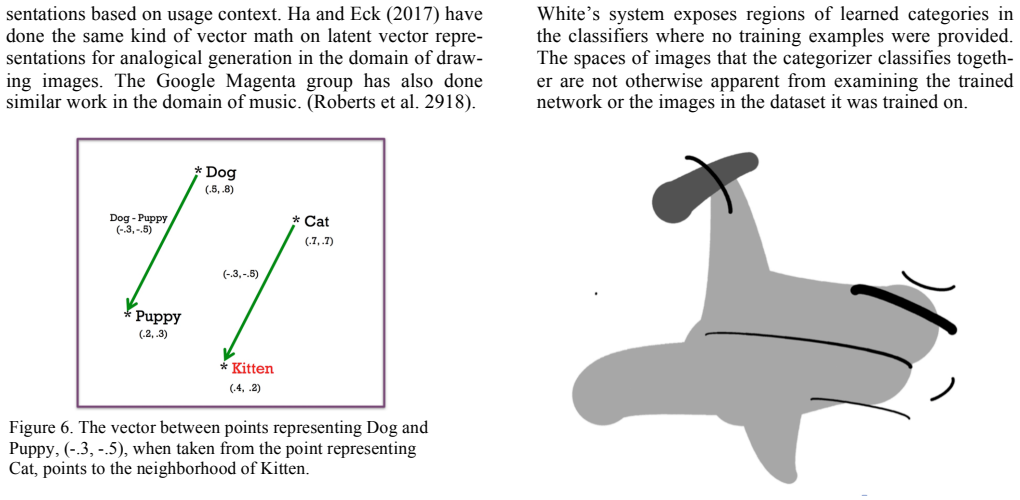
What carries the argument
Architectural mechanisms in generative DNNs, such as those developed for classification tasks, that produce the observed creative behaviors.
If this is right
- Creative generation in DNNs can be understood as a byproduct of perceptual and classification computations.
- Further development of machinic creativity can target enhancements to the shared perceptual mechanisms.
- Anthropomorphic language around DNN creativity can be replaced by explanations based on the underlying computational elements.
- The kinship between generation and perception suggests training approaches that strengthen perceptual components will also improve creative outputs.
Where Pith is reading between the lines
- The same emergence pattern may appear in non-artistic generative tasks such as scientific hypothesis generation.
- Architectures optimized solely for classification accuracy could be evaluated for latent creative capacity without additional creative training objectives.
- The framework could guide experiments that disable specific classification components to test whether particular creative behaviors disappear.
Load-bearing premise
The five listed behavioral characteristics are valid and sufficient descriptors of artistic creativity in the context of generative DNNs.
What would settle it
An instance of one of the five creative characteristics appearing in a generative DNN where no underlying classification or perceptual mechanism can be identified.
Figures
read the original abstract
The generative capabilities of deep learning neural networks (DNNs) have been attracting increasing attention for both the remarkable artifacts they produce, but also because of the vast conceptual difference between how they are programmed and what they do. DNNs are 'black boxes' where high-level behavior is not explicitly programmed, but emerges from the complex interactions of thousands or millions of simple computational elements. Their behavior is often described in anthropomorphic terms that can be misleading, seem magical, or stoke fears of an imminent singularity in which machines become 'more' than human. In this paper, we examine 5 distinct behavioral characteristics associated with creativity, and provide an example of a mechanisms from generative deep learning architectures that give rise to each these characteristics. All 5 emerge from machinery built for purposes other than the creative characteristics they exhibit, mostly classification. These mechanisms of creative generative capabilities thus demonstrate a deep kinship to computational perceptual processes. By understanding how these different behaviors arise, we hope to on one hand take the magic out of anthropomorphic descriptions, but on the other, to build a deeper appreciation of machinic forms of creativity on their own terms that will allow us to nurture their further development.
Editorial analysis
A structured set of objections, weighed in public.
Referee Report
Summary. The manuscript is an interpretive essay that identifies five behavioral characteristics of artistic creativity in generative DNNs and maps each to mechanisms originally developed for classification or perceptual tasks. It argues that these creative behaviors emerge from non-creative machinery, highlighting a kinship between generative capabilities and computational perception while aiming to demystify anthropomorphic descriptions of DNNs.
Significance. If the mappings are persuasive, the work provides a conceptual lens for appreciating machinic creativity on its own terms and could inform more grounded discussions of generative AI. As an essay without quantitative predictions, formal derivations, or empirical tests, its value is interpretive rather than technical; no machine-checked proofs or reproducible artifacts are present to strengthen the assessment.
major comments (1)
- The central claim depends on the five behavioral characteristics being valid and sufficient descriptors of artistic creativity in generative DNNs, yet the manuscript provides no explicit justification, literature grounding, or discussion of why these five (rather than alternatives) were selected; this assumption is load-bearing for the interpretive mapping.
minor comments (1)
- [Abstract] The abstract is lengthy and could be condensed while retaining the core argument about emergence from classification machinery.
Simulated Author's Rebuttal
We thank the referee for their careful reading and constructive feedback on our interpretive essay. We address the single major comment below and will make revisions to strengthen the manuscript's grounding.
read point-by-point responses
-
Referee: The central claim depends on the five behavioral characteristics being valid and sufficient descriptors of artistic creativity in generative DNNs, yet the manuscript provides no explicit justification, literature grounding, or discussion of why these five (rather than alternatives) were selected; this assumption is load-bearing for the interpretive mapping.
Authors: We acknowledge that the manuscript does not contain an explicit discussion or literature-based justification for selecting precisely these five characteristics over alternatives. The paper frames them as 'distinct behavioral characteristics associated with creativity' observed in generative DNNs, with the primary contribution being the mapping to underlying mechanisms originally developed for classification. As an interpretive essay rather than a systematic review, the selection was intended to be illustrative of behaviors commonly attributed to machine creativity. To address the concern, we will add a short subsection to the introduction that (1) briefly motivates the five characteristics by reference to recurring themes in computational creativity literature (e.g., novelty generation, constraint satisfaction, and emergent expressiveness) and (2) explicitly states that the list is not claimed to be exhaustive or uniquely sufficient, but serves to demonstrate the kinship between generative and perceptual mechanisms. This revision will make the interpretive framework more transparent without changing the core argument. revision: yes
Circularity Check
No significant circularity: interpretive essay with no derivations or fitted quantities
full rationale
The paper presents a conceptual mapping of five behavioral characteristics of creativity in generative DNNs to mechanisms originally developed for classification or perceptual tasks. No equations, parameter fitting, predictions, uniqueness theorems, or self-citations appear as load-bearing elements. The central claim is interpretive and internal to the chosen descriptors; it does not reduce to any input by construction or self-reference. This is the expected honest non-finding for a non-quantitative essay.
Axiom & Free-Parameter Ledger
axioms (1)
- domain assumption Creativity can be decomposed into five distinct behavioral characteristics that are observable in generative DNN outputs.
Reference graph
Works this paper leans on
-
[1]
Mechanisms of Artistic Creativity in Deep Learning Neural Networks Lonce Wyse Communication and New Media Department National University of Singapore Singapore lonce.wyse@nus.edu.sg Abstract The generative capabilities of deep learning neural net-works (DNNs) have been attracting increasing attention for both the remarkable artifacts they produce, but als...
work page 2018
-
[2]
argue that understanding the process by which an artifact in generated is important for an assessment of creativity. With neural networks, complex behaviors emerge out of the simple interaction between potentially millions of units. The architectures and unit-level learning algorithms in combination with exposure to data for training allow the networks to...
work page 2018
-
[3]
sub-models of no-tions used to describe creativity
sponse to particular stimuli. Similarly, learning mecha-nisms that support generalization from scant evidence might enable taking reasonable novel action under unseen conditions in one context, but be recognized as biased de-cision making when deployed in an inappropriate context. In this paper, mechanisms in deep learning architectures that give rise to ...
work page 2011
-
[4]
and individual artists. A renaissance painter from Florence and an early 20th century Spaniard might both paint a por-trait, but each brings a unique perspective to the subject matter through their different styles. Content and style are independent in the sense that any style can be combined with any content, and thus their combination can be considered ...
work page 1988
-
[5]
Similar architectures have been shown to work on audio represented as a 2D spectrogram image (Ulyonov and Leb-edev 2016), although the results are not as compelling in the audio domain (Shahrin and Wyse 2019). Both Ustyuzhaninov et al. (2016) and Ulyonov and Lebedev (2016) have reported a fascinating aspect of this technique of cross-domain synthesis: tha...
work page 2016
-
[6]
(Image from Gatys, Ecker, and Bethge (2016) used with permission.) This story starts with a Recurrent Neural Network trained to generate natural language reviews of products. Recurrent neural networks lend themselves to learning and generating sequential data such as speech, music, and text. Data is typically streamed as input to the network one to-ken at...
work page 2016
-
[7]
The activation of a single unit in the penultimate layer of a predictive RNN shows a clear binmodal activation pattern corresponding to the sentiment of the review. (Image from Radford, Jozefowicz, and Stskever (2017) used with permission). words based only on the context (consisting of other words) in which they appear. Some sort of vector representation...
work page 2017
-
[8]
Training a compact distributed representation (the hidden layer) of the word “scaring” using contexts in which the target word appears. sentations based on usage context. Ha and Eck (2017) have done the same kind of vector math on latent vector repre-sentations for analogical generation in the domain of draw-ing images. The Google Magenta group has also d...
work page 2017
-
[9]
A Neural Representation of Sketch Drawings
A neural representation of sketch drawings. arXiv preprint arXiv:1704.03477. Karpathy, A
work page internal anchor Pith review Pith/arXiv arXiv
-
[10]
Rectrieved from http://karpathy.github.io/2015/05/21/rnn-effectiveness/ Livingstone, S
The Unreasonable Effectiveness of Recurrent Neural Networks [Blog post]. Rectrieved from http://karpathy.github.io/2015/05/21/rnn-effectiveness/ Livingstone, S. R., Mühlberger, R., Brown, A. R., and Loch, A
work page 2015
-
[11]
Efficient Estimation of Word Representations in Vector Space
Efficient estimation of word representations in vector space. arXiv preprint arXiv:1301.3781. Mordvintsev, A., Olah, C., Tyka, M
work page internal anchor Pith review Pith/arXiv arXiv
-
[12]
Retrieved from https://ai.googleblog.com/2015/06/inceptionism-going-deeper-into-neural.html
Inceptionism: Going Deeper into Neural Networks [Blog post]. Retrieved from https://ai.googleblog.com/2015/06/inceptionism-going-deeper-into-neural.html. Nguyen, A., Dosovitskiy, A., Yosinski, J., Brox, T., and Clune, J
work page 2015
-
[13]
A Hierarchical Latent Vector Model for Learning Long-Term Structure in Music
A hierarchical latent vector model for learning long-term structure in music. arXiv preprint arXiv:1803.05428. Shahrin, M. H., and Wyse, L
-
[14]
Very Deep Convolutional Networks for Large-Scale Image Recognition
Very deep convolutional networks for large-scale image recognition. arXiv preprint arXiv:1409.1556. Steyerl, H
work page internal anchor Pith review Pith/arXiv arXiv
-
[15]
Intriguing properties of neural networks
Intriguing properties of neural networks. arXiv preprint arXiv:1312.6199. Su, J., Vargas, D. V., and Sakurai, K
work page internal anchor Pith review Pith/arXiv arXiv
discussion (0)
Sign in with ORCID, Apple, or X to comment. Anyone can read and Pith papers without signing in.