On k-rainbow domination in regular graphs
Pith reviewed 2026-05-24 19:09 UTC · model grok-4.3
The pith
For a d-regular graph on n vertices the k-rainbow domination number is at least ceil(kn/2d) whenever d ≤ k ≤ 2d.
A machine-rendered reading of the paper's core claim, the machinery that carries it, and where it could break.
Core claim
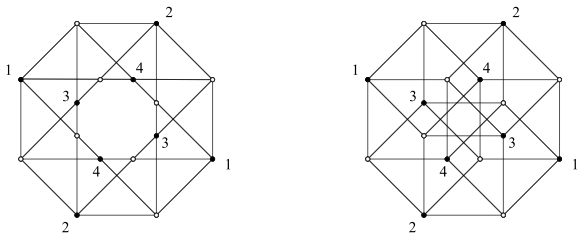
We prove that the k-rainbow domination number γ_rk(G) of a d-regular graph for d≤k≤2d is bounded below by ⌈kn/2d⌉, where n is the order of a graph. We determine necessary conditions for regular graphs to attain this bound and find several examples. As an application, we determine exact k-rainbow domination numbers for all cubic Cayley graphs over abelian groups.
What carries the argument
A double-counting argument on the total number of distinct color incidences delivered to non-support vertices by a k-rainbow dominating function in a d-regular graph.
If this is right
- Equality holds only when the color-incidence count saturates every available neighbor contribution.
- Exact k-rainbow domination numbers are obtained for the infinite family of all cubic Cayley graphs over abelian groups.
- The bound supplies a uniform estimate that applies uniformly across all regular graphs of a given degree and order in the stated k-range.
Where Pith is reading between the lines
- The same counting technique might yield analogous ceilings when the graph is only nearly regular, with maximum and minimum degrees differing by a small constant.
- The bound could be used to test conjectures about the relation between rainbow domination and ordinary domination numbers in regular graphs.
- It remains open whether a similar linear lower bound continues to hold when k falls outside the interval [d,2d].
Load-bearing premise
The graph must be exactly d-regular and k must lie between d and 2d so that each non-support vertex demands exactly k colors while each vertex has exactly d possible neighbor contributions.
What would settle it
Any single d-regular graph on n vertices with d ≤ k ≤ 2d whose minimum k-rainbow dominating set has size strictly less than ceil(kn/2d).
Figures

read the original abstract
The $k$-rainbow domination problem is studied for regular graphs. We prove that the $k$-rainbow domination number $\gamma_{rk}(G)$ of a $d$-regular graph for $d\leq k\leq 2d$ is bounded below by $\displaystyle{\left\lceil kn/2d\right\rceil}$, where $n$ is the order of a graph. We determine necessary conditions for regular graphs to attain this bound and find several examples. As an application, we determine exact $k$-rainbow domination numbers for all cubic Cayley graphs over abelian groups.
Editorial analysis
A structured set of objections, weighed in public.
Referee Report
Summary. The paper establishes a lower bound γ_rk(G) ≥ ⌈k n / (2d)⌉ on the k-rainbow domination number of any d-regular graph G when d ≤ k ≤ 2d. It derives necessary conditions for equality, exhibits several attaining graphs, and applies the bound to compute exact values of γ_rk for every cubic Cayley graph on an abelian group.
Significance. The counting argument yields a simple, closed-form lower bound that is attained by explicit constructions; the application to an infinite family of cubic graphs demonstrates concrete utility. The result is internally consistent with the definition of k-rainbow domination and the regularity hypothesis.
minor comments (3)
- [§2] §2, after Definition 2.1: the phrase 'a vertex v is dominated by color i' is used before the formal definition of the function f; a forward reference or inline clarification would prevent momentary ambiguity.
- [Theorem 3.2] Theorem 3.2: the equality case is stated for connected graphs, yet the proof sketch in the preceding paragraph applies verbatim to disconnected graphs; either extend the statement or add a parenthetical remark.
- [Table 1] Table 1: the column header 'Attains bound?' should be aligned with the data rows; the current formatting makes the last two entries hard to read at a glance.
Simulated Author's Rebuttal
We thank the referee for their positive evaluation of the manuscript, the accurate summary of our results, and the recommendation to accept. No major comments were provided for us to address.
Circularity Check
No significant circularity identified
full rationale
The central result is a lower bound γ_rk(G) ≥ ⌈kn/2d⌉ obtained via direct double-counting on label assignments in a d-regular graph (d ≤ k ≤ 2d). The argument starts from the standard definition of k-rainbow domination and the handshaking lemma implied by regularity; neither the bound nor any intermediate quantity is defined in terms of itself, fitted to data, or justified solely by prior self-citation. No equations reduce to the target expression by construction, and the paper supplies explicit constructions showing the bound is tight rather than tautological. The derivation is therefore self-contained against the given assumptions.
Axiom & Free-Parameter Ledger
axioms (1)
- standard math Standard definitions and counting properties of graphs and k-rainbow domination
Lean theorems connected to this paper
-
IndisputableMonolith/Foundation/AbsoluteFloorClosure.leanreality_from_one_distinction unclear?
unclearRelation between the paper passage and the cited Recognition theorem.
We prove that the k-rainbow domination number γ_rk(G) of a d-regular graph for d≤k≤2d is bounded below by ⌈kn/2d⌉
-
IndisputableMonolith/Cost/FunctionalEquation.leanwashburn_uniqueness_aczel unclear?
unclearRelation between the paper passage and the cited Recognition theorem.
Lemma 2.2 … w(f) ≥ (k-d)/d n + (2d-k)/d c … Proposition 2.3 … w(f) ≥ ⌈kn/2d⌉
What do these tags mean?
- matches
- The paper's claim is directly supported by a theorem in the formal canon.
- supports
- The theorem supports part of the paper's argument, but the paper may add assumptions or extra steps.
- extends
- The paper goes beyond the formal theorem; the theorem is a base layer rather than the whole result.
- uses
- The paper appears to rely on the theorem as machinery.
- contradicts
- The paper's claim conflicts with a theorem or certificate in the canon.
- unclear
- Pith found a possible connection, but the passage is too broad, indirect, or ambiguous to say the theorem truly supports the claim.
Reference graph
Works this paper leans on
-
[1]
N. Bray, E. W. Weisstein, Domination Number, from MathWorld–A Wolfram Web Resource. http://mathworld.wolfram.com/DominationNumber.html
-
[2]
B. Breˇ sar, M.A. Henning, D.F. Rall, Rainbow domination in graphs, Taiwanese J. Math. 12 (2008), 213–225
work page 2008
-
[3]
B. Breˇ sar, T. KranerˇSumenjak, On 2-rainbow domination in graphs, Discrete Applied Mathematics 155 (2007), 2394 – 2400
work page 2007
-
[4]
G. J. Chang, J. Wu, X. Zhu, Rainbow domination on trees, Discrete Applied Mathematics, Volume 158 (2010), 8 – 12
work page 2010
- [5]
-
[6]
M. Furuya, M Koyanagi, M. Yokota, Upper bound on 3-rainbow domination in graphs with minimum degree 2, Discrete Optimization 29 (2018), 45–76
work page 2018
-
[7]
B. Hartnell, D.F. Rall, On dominating the Cartesian product of a graph and K2, Discuss. Math. Graph Theory 24 (2004) 389–402
work page 2004
-
[8]
T. Kraner ˇSumenjak, D. F. Rall, A. Tepeh, Rainbow domination in the lexicographic product of graphs, Discrete Applied Mathematics 161 (2013), 2133 – 2141
work page 2013
-
[9]
Z. Shao, M. Liang, C. Yin, X.Xu, P. Pavliˇ c, J.ˇZerovnik, On rainbow domination numbers of graphs, Information Sciences 254 (2014), 225 – 234
work page 2014
-
[10]
Z. Shao, H. Jiang, P. Wu, S. Wang, J. ˇZerovnik, X. Zhang, J.B. Liu, On 2-rainbow domination of generalized Petersen graphs, Discrete Applied Mathematics 257 (2019), 370 – 384. 10
work page 2019
-
[11]
Z. Stepien, A. Szymaszkiewicz, L. Szymaszkiewicz, M. Zwierzchowski, 2-Rainbow domination num- ber of Cn□C5, Discrete Appl. Math., 170 (2014), 113 – 116
work page 2014
-
[12]
Math., 161 (2013), 2178 – 2188
Wang Y., Wu K., A tight upper bound for 2-rainbow domination in generalized Petersen graphs, Discrete Appl. Math., 161 (2013), 2178 – 2188. 11
work page 2013
discussion (0)
Sign in with ORCID, Apple, or X to comment. Anyone can read and Pith papers without signing in.