Motion-Robust Deep Reconstruction for Free-Breathing Cardiac Cine MRI
Pith reviewed 2026-05-21 02:24 UTC · model grok-4.3
The pith
Cine-DL reconstructs high-quality cardiac cine images from free-breathing radial data by combining targeted preprocessing with an unrolled deep network.
A machine-rendered reading of the paper's core claim, the machinery that carries it, and where it could break.
Core claim
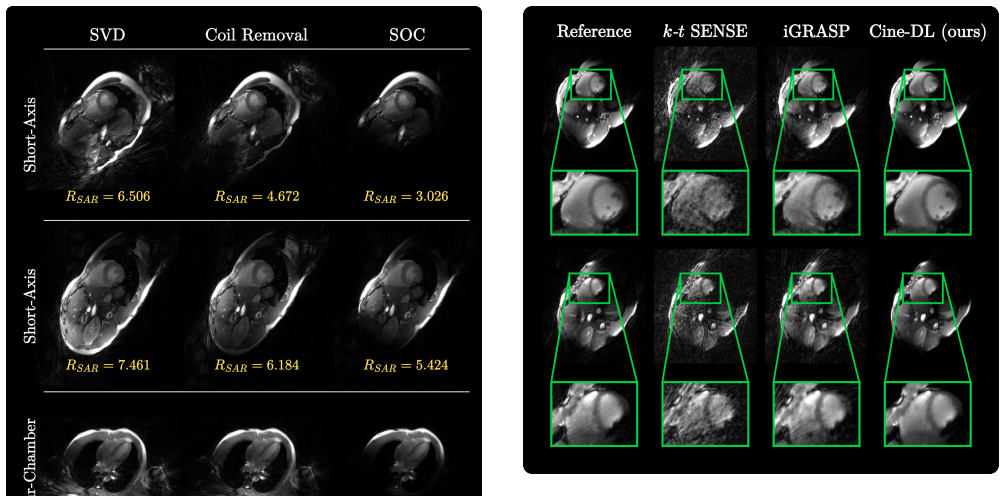
Cine-DL couples retrospective cardiac binning and respiratory gating with Streak Optimized Coil Compression to suppress streak artifacts while preserving cardiac signal, followed by reconstruction via an unrolled network that alternates ResNet proximal operators with physics-based data consistency solved by conjugate gradient; this pipeline consistently improves metrics and visual fidelity over k-t SENSE and iGRASP on free-breathing volunteer data and translates directly to clinical patient scans via hospital deployment.
What carries the argument
Streak Optimized Coil Compression (SOC) that preserves cardiac signals while suppressing peripheral interference driving streaks, paired with the memory-efficient unrolled network alternating ResNet proximal operators and conjugate-gradient physics updates.
If this is right
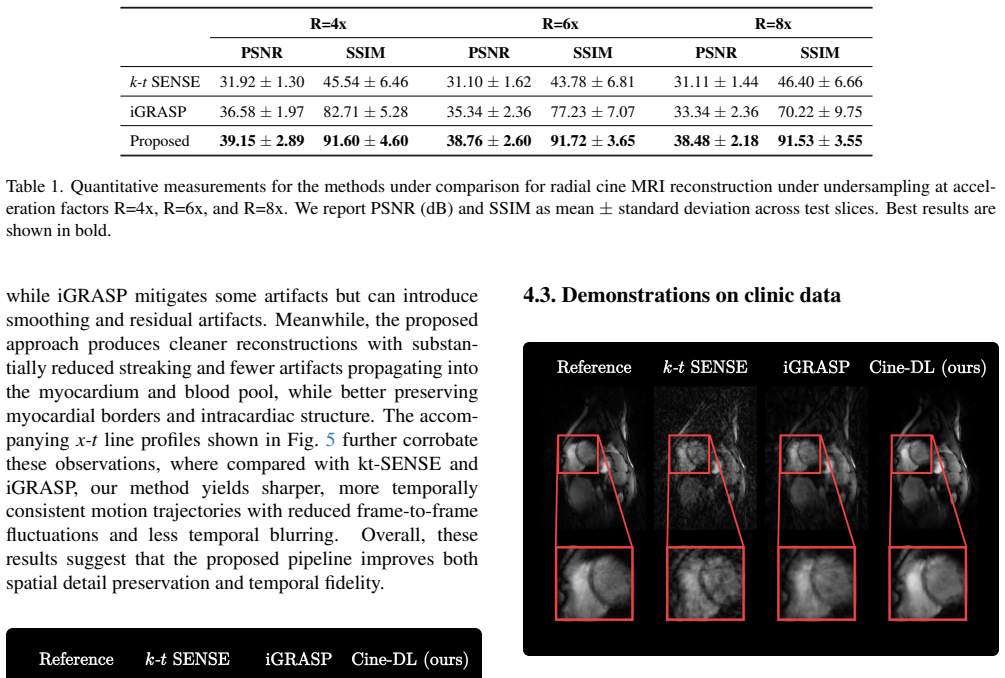
- Quantitative metrics and visual fidelity improve over k-t SENSE and iGRASP on free-breathing data.
- The pipeline supports direct clinical translation through hospital deployment on patient scans.
- Free-breathing acquisitions become viable for pediatric and noncompliant patients who cannot hold their breath.
- Memory-efficient training lowers peak GPU usage while maintaining reconstruction speed.
Where Pith is reading between the lines
- The same preprocessing and unrolling pattern could be tested on other dynamic MRI exams such as abdominal or fetal imaging where motion is also an issue.
- If the method tolerates higher acceleration factors, total scan duration might be shortened further without sacrificing quality.
- Adaptations that remove the need for retrospective binning could open the door to truly real-time free-breathing cine.
Load-bearing premise
Retrospective cardiac binning and respiratory gating can accurately resolve cardiac phases and discard motion-corrupted spokes without leaving substantial residual motion or signal loss that would degrade the later reconstruction.
What would settle it
New free-breathing patient scans in which Cine-DL shows no metric gains or visible residual motion artifacts compared with k-t SENSE and iGRASP would falsify the claim of consistent improvement.
Figures



read the original abstract
Conventional cardiac cine MRI relies on breath-hold Cartesian acquisitions, which are vulnerable to motion artifacts and can be uncomfortable or infeasible, particularly for pediatric and other noncompliant patients who cannot reliably hold their breath. Free-breathing radial acquisitions can alleviate these limitations, but robust reconstruction at high acceleration remains challenging due to prominent streak artifacts. To address these limitations, we propose Cine-DL, a clinically oriented framework that couples targeted k-space preprocessing with fast, model-based deep reconstruction. In this pipeline, raw free-breathing radial data undergo retrospective cardiac binning and respiratory gating to resolve cardiac phases and discard motion-corrupted spokes. We then introduce Streak Optimized Coil Compression (SOC), which explicitly preserves cardiac signals while suppressing peripheral interference that typically drives the streak artifacts. The resulting 2D+t cine series is reconstructed with an unrolled network that alternates a ResNet proximal operator with physics-based data consistency updates solved via conjugate gradient. We further employ a memory-efficient training strategy that reduces peak memory usage. We evaluate Cine-DL on free-breathing volunteer data against established baselines (k-t SENSE and iGRASP) and demonstrate clinical translation via hospital deployment on newly acquired patient data. Our experiments show that Cine-DL consistently improves quantitative metrics and visual fidelity, supporting a practical route toward routine, time-sensitive clinical adoption of free-breathing cine MRI.
Editorial analysis
A structured set of objections, weighed in public.
Referee Report
Summary. The manuscript describes Cine-DL, a clinically oriented framework for free-breathing cardiac cine MRI reconstruction. It preprocesses raw radial data with retrospective cardiac binning and respiratory gating, applies Streak Optimized Coil Compression (SOC) to preserve cardiac signals while suppressing streak-driving interference, and reconstructs using an unrolled network with ResNet proximal operators and conjugate gradient data consistency. Evaluations on volunteer data show improvements over k-t SENSE and iGRASP, with clinical deployment on patient data supporting practical adoption.
Significance. Should the central claims hold upon addressing the noted concerns, this could represent a meaningful step toward motion-robust, high-acceleration free-breathing cine MRI suitable for routine clinical use, especially benefiting populations unable to comply with breath-hold protocols.
major comments (2)
- [Methods section describing the preprocessing pipeline] The assumption that retrospective cardiac binning and respiratory gating can accurately resolve cardiac phases and discard motion-corrupted spokes without substantial residual motion or signal loss is load-bearing for the superiority claims. The manuscript does not provide quantitative validation such as residual motion estimates or spoke-retention statistics on the patient cohort, raising the risk that unaddressed motion artifacts propagate through SOC and the ResNet+CG unrolled network.
- [Results and Experiments] The reported consistent improvements in quantitative metrics lack accompanying specific values, error bars, or ablation studies in the abstract and summary description, which weakens the ability to assess the magnitude of gains and the contribution of each pipeline component (e.g., SOC vs. the unrolled network).
minor comments (1)
- [Abstract] The description of the memory-efficient training strategy is vague; providing details on memory reduction achieved would aid reproducibility.
Simulated Author's Rebuttal
We thank the referee for the constructive and detailed feedback. We address each major comment point by point below, indicating where revisions will be made to strengthen the manuscript.
read point-by-point responses
-
Referee: [Methods section describing the preprocessing pipeline] The assumption that retrospective cardiac binning and respiratory gating can accurately resolve cardiac phases and discard motion-corrupted spokes without substantial residual motion or signal loss is load-bearing for the superiority claims. The manuscript does not provide quantitative validation such as residual motion estimates or spoke-retention statistics on the patient cohort, raising the risk that unaddressed motion artifacts propagate through SOC and the ResNet+CG unrolled network.
Authors: We agree that quantitative validation of the binning and gating pipeline strengthens the claims. Volunteer data include spoke-retention rates and motion analysis in the Methods and Results sections. For the patient cohort acquired during clinical deployment, the focus was on visual assessment and workflow integration. In the revised manuscript we will add spoke-retention statistics and any available residual-motion estimates for the patient data to address this concern directly. revision: yes
-
Referee: [Results and Experiments] The reported consistent improvements in quantitative metrics lack accompanying specific values, error bars, or ablation studies in the abstract and summary description, which weakens the ability to assess the magnitude of gains and the contribution of each pipeline component (e.g., SOC vs. the unrolled network).
Authors: We acknowledge that the abstract and high-level summary would benefit from explicit numerical values. The full Results section already reports metric improvements with comparisons to k-t SENSE and iGRASP, but we will expand the text to include representative values with error bars and add a dedicated ablation study clarifying the individual contributions of SOC and the unrolled network. The abstract will be updated with key quantitative gains where space permits. revision: partial
Circularity Check
No significant circularity in the Cine-DL pipeline
full rationale
The paper describes an empirical reconstruction framework that applies retrospective cardiac binning and respiratory gating to free-breathing radial data, followed by Streak Optimized Coil Compression and an unrolled ResNet+CG network. Quantitative improvements are demonstrated via direct comparison to k-t SENSE and iGRASP on volunteer and patient datasets. No load-bearing step reduces by the paper's own equations or self-citations to a quantity defined solely by fitted parameters or prior outputs; the central claims rest on external data evaluation rather than self-referential construction.
Axiom & Free-Parameter Ledger
axioms (1)
- domain assumption Retrospective binning and respiratory gating from free-breathing radial spokes can isolate cardiac phases with minimal residual motion
invented entities (1)
-
Streak Optimized Coil Compression (SOC)
no independent evidence
Lean theorems connected to this paper
-
IndisputableMonolith/Foundation/RealityFromDistinction.leanreality_from_one_distinction unclear?
unclearRelation between the paper passage and the cited Recognition theorem.
raw free-breathing radial data undergo retrospective cardiac binning and respiratory gating to resolve cardiac phases and discard motion-corrupted spokes... Streak Optimized Coil Compression (SOC)... unrolled network that alternates a ResNet proximal operator with physics-based data consistency updates solved via conjugate gradient
-
IndisputableMonolith/Cost/FunctionalEquation.leanwashburn_uniqueness_aczel unclear?
unclearRelation between the paper passage and the cited Recognition theorem.
SIR-optimized compression... maximizing SIR(w) = wH A w / wH B w
What do these tags mean?
- matches
- The paper's claim is directly supported by a theorem in the formal canon.
- supports
- The theorem supports part of the paper's argument, but the paper may add assumptions or extra steps.
- extends
- The paper goes beyond the formal theorem; the theorem is a base layer rather than the whole result.
- uses
- The paper appears to rely on the theorem as machinery.
- contradicts
- The paper's claim conflicts with a theorem or certificate in the canon.
- unclear
- Pith found a possible connection, but the passage is too broad, indirect, or ambiguous to say the theorem truly supports the claim.
Reference graph
Works this paper leans on
-
[1]
Hemant K Aggarwal, Merry P Mani, and Mathews Jacob. Modl: Model-based deep learning architecture for inverse problems.IEEE transactions on medical imaging, 38(2): 394–405, 2018. 2
work page 2018
-
[2]
Li Feng. Golden-angle radial mri: basics, advances, and ap- plications.Journal of Magnetic Resonance Imaging, 56(1): 45–62, 2022. 1
work page 2022
-
[3]
Li Feng, Robert Grimm, Kai Tobias Block, Hersh Chan- darana, Sungheon Kim, Jian Xu, Leon Axel, Daniel K Sod- ickson, and Ricardo Otazo. Golden-angle radial sparse paral- lel mri: combination of compressed sensing, parallel imag- ing, and golden-angle radial sampling for fast and flexible dynamic volumetric mri.Magnetic resonance in medicine, 72(3):707–717...
work page 2014
-
[4]
On nufft-based gridding for non-cartesian mri.Journal of magnetic resonance, 188(2):191–195, 2007
Jeffrey A Fessler. On nufft-based gridding for non-cartesian mri.Journal of magnetic resonance, 188(2):191–195, 2007. 4
work page 2007
-
[5]
On optimality in rovir.arXiv preprint arXiv:2307.11258, 2023
Justin P Haldar. On optimality in rovir.arXiv preprint arXiv:2307.11258, 2023. 2
-
[6]
Deep residual learning for image recognition
Kaiming He, Xiangyu Zhang, Shaoqing Ren, and Jian Sun. Deep residual learning for image recognition. InProceed- ings of the IEEE conference on computer vision and pattern recognition, pages 770–778, 2016. 4
work page 2016
-
[7]
Cardiac mr: from theory to practice.Frontiers in cardiovascular medicine, 9: 826283, 2022
Tevfik F Ismail, Wendy Strugnell, Chiara Coletti, Ma ˇsa Boˇzi´c-Iven, Sebastian Weingaertner, Kerstin Hammernik, Teresa Correia, and Thomas Kuestner. Cardiac mr: from theory to practice.Frontiers in cardiovascular medicine, 9: 826283, 2022. 1
work page 2022
-
[8]
Daeun Kim, Stephen F Cauley, Krishna S Nayak, Richard M Leahy, and Justin P Haldar. Region-optimized virtual (rovir) coils: localization and/or suppression of spatial regions us- ing sensor-domain beamforming.Magnetic Resonance in Medicine, 86(1):197–212, 2021. 2
work page 2021
-
[9]
Dmitrij Kravchenko, Alexander Isaak, Shuo Zhang, Christoph Katemann, Narine Mesropyan, Leon M Bischoff, Claus C Pieper, Daniel Kuetting, Ulrike Attenberger, Oliver Weber, et al. Free-breathing pseudo-golden-angle bssfp cine cardiac mri for biventricular functional assessment in con- genital heart disease.European Journal of Radiology, 163: 110831, 2023. 1
work page 2023
-
[10]
Free-breathing cine mri.Magnetic resonance in medicine, 60(3):709–717, 2008
Angela O Leung, Ian Paterson, and Richard B Thompson. Free-breathing cine mri.Magnetic resonance in medicine, 60(3):709–717, 2008. 1
work page 2008
-
[11]
Authors/Task Force Members, John JV McMurray, Stamatis Adamopoulos, Stefan D Anker, Angelo Auricchio, Michael B¨ohm, Kenneth Dickstein, V olkmar Falk, Gerasimos Filip- patos, C ˆandida Fonseca, et al. Esc guidelines for the diag- nosis and treatment of acute and chronic heart failure 2012: The task force for the diagnosis and treatment of acute and chroni...
work page 2012
-
[12]
Batu Ozturkler, Arda Sahiner, Tolga Ergen, Arjun D Desai, Christopher M Sandino, Shreyas Vasanawala, John M Pauly, Morteza Mardani, and Mert Pilanci. Gleam: greedy learning for large-scale accelerated mri reconstruction.arXiv preprint arXiv:2207.08393, 2022. 2
-
[13]
Klaas P Pruessmann, Markus Weiger, Markus B Scheideg- ger, and Peter Boesiger. Sense: sensitivity encoding for fast mri.Magnetic Resonance in Medicine: An Official Jour- nal of the International Society for Magnetic Resonance in Medicine, 42(5):952–962, 1999. 4
work page 1999
-
[14]
Christopher M Sandino, Peng Lai, Shreyas S Vasanawala, and Joseph Y Cheng. Accelerating cardiac cine mri using a deep learning-based espirit reconstruction.Magnetic Reso- nance in Medicine, 85(1):152–167, 2021. 2
work page 2021
-
[15]
Udo Sechtem, Peter W Pflugfelder, Richard D White, Robert G Gould, William Holt, Martin J Lipton, and Charles B Higgins. Cine mr imaging: potential for the evaluation of cardiovascular function.American Journal of Roentgenology, 148(2):239–246, 1987. 1
work page 1987
-
[16]
Jeffrey Tsao, Peter Boesiger, and Klaas P Pruessmann. k-t blast and k-t sense: dynamic mri with high frame rate ex- ploiting spatiotemporal correlations.Magnetic Resonance 8 in Medicine: An Official Journal of the International Soci- ety for Magnetic Resonance in Medicine, 50(5):1031–1042,
-
[17]
Martin Uecker, Peng Lai, Mark J Murphy, Patrick Virtue, Michael Elad, John M Pauly, Shreyas S Vasanawala, and Michael Lustig. Espirit—an eigenvalue approach to autocal- ibrating parallel mri: where sense meets grappa.Magnetic resonance in medicine, 71(3):990–1001, 2014. 2
work page 2014
-
[18]
Im- proved pediatric mr imaging with compressed sensing.Ra- diology, 256(2):607–616, 2010
Shreyas S Vasanawala, Marcus T Alley, Brian A Hargreaves, Richard A Barth, John M Pauly, and Michael Lustig. Im- proved pediatric mr imaging with compressed sensing.Ra- diology, 256(2):607–616, 2010. 1
work page 2010
-
[19]
Memory-efficient learning for high- dimensional mri reconstruction
Ke Wang, Michael Kellman, Christopher M Sandino, Kevin Zhang, Shreyas S Vasanawala, Jonathan I Tamir, Stella X Yu, and Michael Lustig. Memory-efficient learning for high- dimensional mri reconstruction. InInternational Conference on Medical Image Computing and Computer-Assisted Inter- vention, pages 461–470. Springer, 2021. 2, 4
work page 2021
-
[20]
Yiqun Xue, Jiangsheng Yu, Hyun Seon Kang, Sarah Englan- der, Mark A Rosen, and Hee Kwon Song. Automatic coil selection for streak artifact reduction in radial mri.Magnetic resonance in medicine, 67(2):470–476, 2012. 2, 5, 6
work page 2012
-
[21]
Leslie Ying and Jinhua Sheng. Joint image reconstruction and sensitivity estimation in sense (jsense).Magnetic Reso- nance in Medicine: An Official Journal of the International Society for Magnetic Resonance in Medicine, 57(6):1196– 1202, 2007. 4
work page 2007
-
[22]
Maxim Zaitsev, Julian Maclaren, and Michael Herbst. Mo- tion artifacts in mri: A complex problem with many partial solutions.Journal of Magnetic Resonance Imaging, 42(4): 887–901, 2015. 1
work page 2015
-
[23]
Tao Zhang, John M Pauly, Shreyas S Vasanawala, and Michael Lustig. Coil compression for accelerated imaging with cartesian sampling.Magnetic resonance in medicine, 69(2):571–582, 2013. 3 9
work page 2013
discussion (0)
Sign in with ORCID, Apple, or X to comment. Anyone can read and Pith papers without signing in.