Prospects for detecting surface color heterogeneity on asteroid surfaces from sparse multiband photometric survey data
Pith reviewed 2026-05-22 02:31 UTC · model grok-4.3
The pith
Asteroid surface color heterogeneity can be detected by comparing multiband light curve shapes to uniform-color models in sparse survey data.
A machine-rendered reading of the paper's core claim, the machinery that carries it, and where it could break.
Core claim
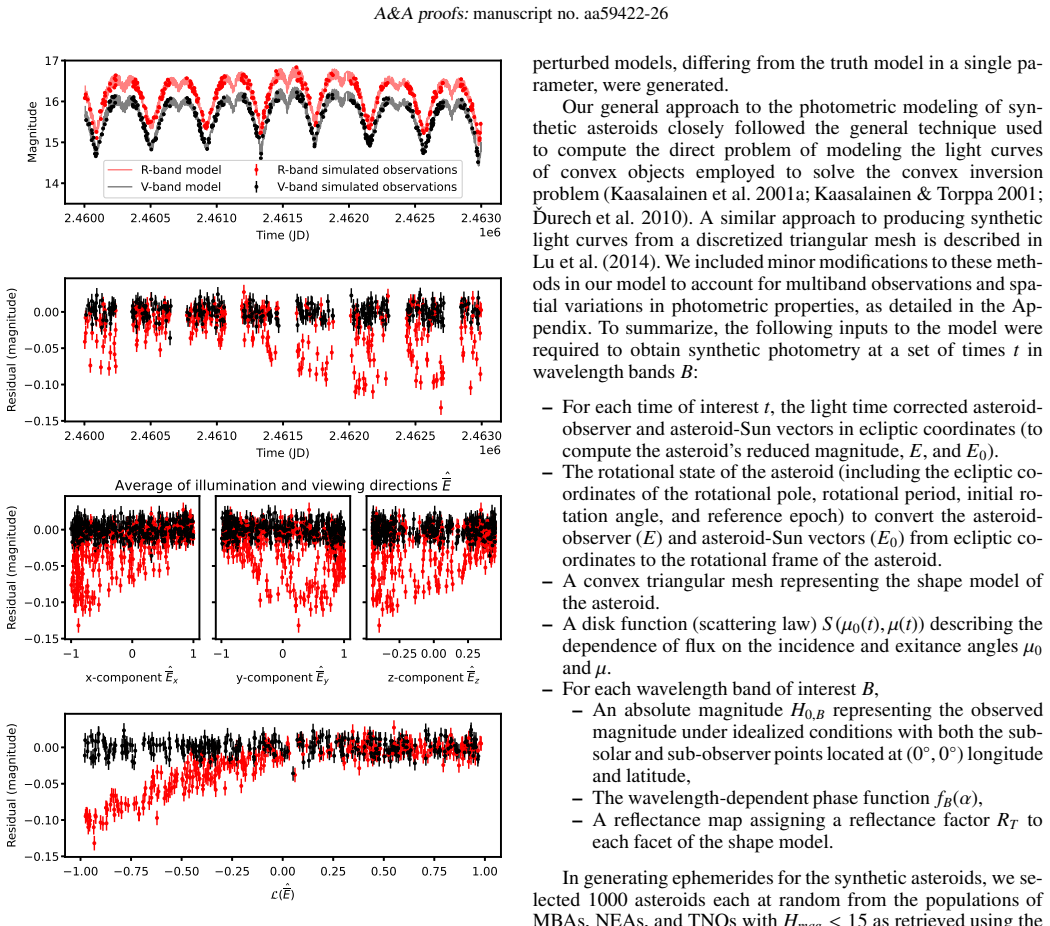
Regional-scale surface color heterogeneity can be detected by examining differences in the shape of an asteroid's light curve as a function of viewing geometry across multiple bandpasses, with statistically significant deviations from a uniformly colored photometric model taken as evidence.
What carries the argument
Statistical test that flags surface color heterogeneity through significant deviations between observed multiband photometry and predictions of a well-fitting uniformly colored photometric model.
If this is right
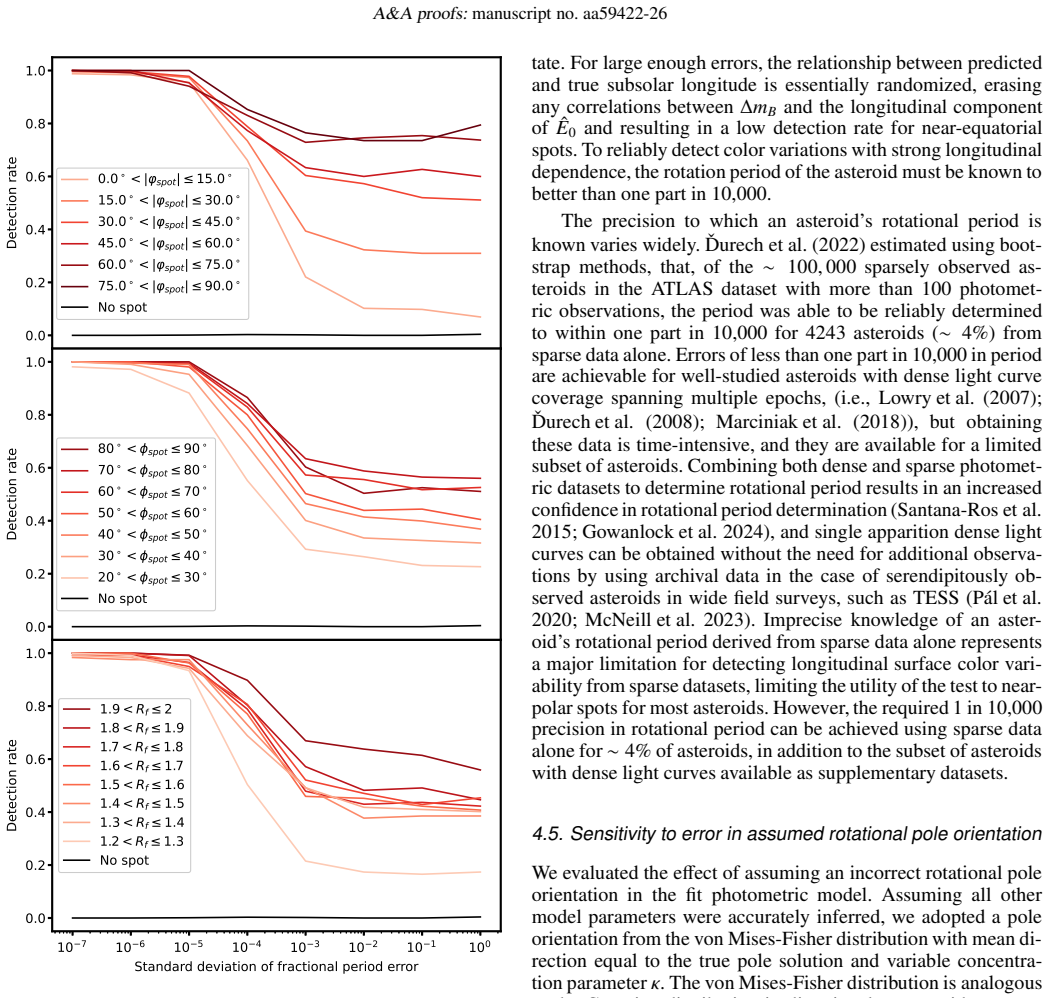
- Detection rates improve with more observations but remain most sensitive to errors in the assumed rotational period.
- False-positive rates are driven primarily by inaccuracies in the band-dependent phase functions.
- The test becomes feasible for realistic survey datasets once parameter accuracies reach thresholds evaluated in the Monte Carlo trials.
- Thousands of asteroids with existing multiband photometry could be screened for heterogeneity without additional observations.
Where Pith is reading between the lines
- The same framework could be applied to search for color heterogeneity within dynamical families to test links with collisional history.
- Jointly fitting the period while testing for color deviations might reduce sensitivity to period errors.
- Future surveys with higher cadence or more filters would likely raise overall detection sensitivity.
- Analogous tests could be explored for other wavelength-dependent surface properties such as roughness variations.
Load-bearing premise
The rotational period and band-dependent phase functions must be known with sufficient accuracy that their uncertainties do not dominate detection or false-positive rates.
What would settle it
Running the test on sparse multiband photometry of an asteroid whose regional color variations have already been confirmed by spacecraft imaging and checking whether the test returns a positive detection at the rate predicted by the simulations.
Figures




read the original abstract
Automated sky surveys frequently report sparse-in-time multiband photometric observations of asteroids passing through their fields of view. Photometric data are currently available for tens of thousands of asteroids, and new data collection is ongoing. We aim to describe and characterize the performance of a statistical test for identifying asteroids that display surface color heterogeneity based on sparse-in-time multiband photometric survey data. Using simulated photometry for a set of synthetic asteroids with predetermined physical properties, we estimated the sensitivity of the statistical test for surface color heterogeneity to errors in assumed model properties using a Monte Carlo approach. We evaluated the detection and false positive rates as a function of the number of observations, measurement noise, error in assumed period, pole orientation, shape, and phase function. We examined the required accuracy in various parameters of the photometric model needed to obtain reliable results to evaluate the feasibility of applying the test to realistic datasets. Regional-scale surface color heterogeneity can be detected by examining differences in the shape of an asteroid's light curve as a function of viewing geometry across multiple bandpasses. Differences in light curve shapes as a function of wavelength are highlighted in this work through comparison of the observed photometric measurements to the predictions of a well-fitting, uniformly colored photometric model. Statistically significant deviations from the prediction of the uniformly colored model are taken as evidence of surface color heterogeneity. The performance of this test depends on the accuracy of model assumptions, with the detection rate being most sensitive to errors in the assumed rotational period, while the false positive rate is most sensitive to errors in the assumed band-dependent phase functions.
Editorial analysis
A structured set of objections, weighed in public.
Referee Report
Summary. The manuscript presents a statistical test for detecting regional-scale surface color heterogeneity on asteroid surfaces using sparse-in-time multiband photometric survey data. The test identifies heterogeneity by comparing observed photometry across bandpasses to predictions from a well-fitting uniformly colored photometric model and flagging statistically significant deviations in light-curve shapes as a function of viewing geometry. Performance is characterized via Monte Carlo simulations on synthetic asteroids with predetermined properties, evaluating detection and false-positive rates as functions of observation count, measurement noise, and errors in assumed rotational period, pole orientation, shape, and band-dependent phase functions. The abstract notes that detection rates are most sensitive to period errors while false-positive rates are most sensitive to phase-function errors.
Significance. If the central performance claims hold under realistic conditions, the approach could enable systematic searches for color heterogeneity across tens of thousands of asteroids in existing and upcoming survey datasets without requiring dense photometry or targeted spectroscopy. The forward-simulation framework with predetermined asteroid properties provides a clean, non-circular quantification of sensitivity to model errors, which is a methodological strength. The resulting guidance on required parameter accuracies offers a practical foundation for applying the test to real data, though the absence of explicit numerical curves in the abstract reduces immediate assessability of effect sizes.
major comments (2)
- [Monte Carlo evaluation] Monte Carlo evaluation (Section describing simulations): The analysis adds independent Gaussian errors to a predetermined rotational period but does not simulate the joint optimization of period, pole, and phase-function parameters from the multiband observations under the uniform-color model. When heterogeneity is present, light-curve shape differences can bias the fitted period, potentially absorbing part of the residual signal that the detection test relies upon; the reported rates therefore may not bound performance on actual survey data where the period must be derived from the same observations.
- [Abstract] Abstract and results summary: The claim that 'the detection rate is most sensitive to errors in the assumed rotational period' while 'the false positive rate is most sensitive to errors in the assumed band-dependent phase functions' is stated without accompanying quantitative detection/false-positive curves, exact simulation parameters (e.g., number of Monte Carlo trials, specific error standard deviations, or observation counts), or tabulated values. This omission makes it difficult to judge the magnitude of the sensitivities or the feasibility thresholds for realistic datasets.
minor comments (1)
- [Figure captions] Ensure that all simulation parameters (noise levels, error magnitudes, number of observations, etc.) are explicitly tabulated or listed in figure captions to support reproducibility of the Monte Carlo results.
Simulated Author's Rebuttal
We are grateful to the referee for their insightful and constructive review of our manuscript on detecting surface color heterogeneity from sparse multiband photometry. We address each major comment in turn below, with a focus on improving the robustness and clarity of the presented analysis.
read point-by-point responses
-
Referee: [Monte Carlo evaluation] Monte Carlo evaluation (Section describing simulations): The analysis adds independent Gaussian errors to a predetermined rotational period but does not simulate the joint optimization of period, pole, and phase-function parameters from the multiband observations under the uniform-color model. When heterogeneity is present, light-curve shape differences can bias the fitted period, potentially absorbing part of the residual signal that the detection test relies upon; the reported rates therefore may not bound performance on actual survey data where the period must be derived from the same observations.
Authors: We agree that our Monte Carlo framework, which applies independent errors to predetermined parameter values, does not replicate the joint optimization of period, pole, shape, and phase-function parameters that would be performed when fitting a uniform-color model to real observations. Heterogeneity could indeed bias the recovered period and thereby reduce the residuals available to the detection test. In the revised manuscript we will add a new set of simulations in which all model parameters are jointly optimized from the synthetic multiband data under the uniform-color assumption before the heterogeneity test is applied. This will yield more realistic detection and false-positive rates for survey-data applications. revision: yes
-
Referee: [Abstract] Abstract and results summary: The claim that 'the detection rate is most sensitive to errors in the assumed rotational period' while 'the false positive rate is most sensitive to errors in the assumed band-dependent phase functions' is stated without accompanying quantitative detection/false-positive curves, exact simulation parameters (e.g., number of Monte Carlo trials, specific error standard deviations, or observation counts), or tabulated values. This omission makes it difficult to judge the magnitude of the sensitivities or the feasibility thresholds for realistic datasets.
Authors: We acknowledge that the abstract and summary statements would be strengthened by explicit quantitative support. In the revision we will augment the abstract with representative numerical results, including the number of Monte Carlo trials performed, the ranges of error standard deviations examined, and example detection and false-positive rates for selected observation counts and noise levels. We will also add a concise summary of these simulation parameters in the results section and ensure that the relevant figures and tables are clearly referenced. revision: yes
Circularity Check
No circularity; forward simulation with predetermined inputs evaluates test performance independently
full rationale
The paper's core evaluation uses Monte Carlo simulations on synthetic asteroids with predetermined physical properties to assess detection and false-positive rates under controlled errors in period, pole, shape, and phase functions. The statistical test compares multiband data to a uniformly colored photometric model and flags significant deviations, but the reported rates derive from these independent forward simulations rather than any fit that recovers or reuses the input heterogeneity parameters. No self-definitional steps, fitted inputs renamed as predictions, or load-bearing self-citations appear in the described chain. The methodology remains self-contained against external benchmarks via simulation, consistent with a non-circular assessment of prospects for real survey data.
Axiom & Free-Parameter Ledger
free parameters (2)
- assumed rotational period
- band-dependent phase functions
axioms (2)
- domain assumption Synthetic asteroids possess predetermined physical properties (shape, pole, period, surface color distribution) that can be used to generate ground-truth photometry.
- domain assumption A uniformly colored photometric model can be fitted to the multiband data and used as a reliable null hypothesis.
Lean theorems connected to this paper
-
IndisputableMonolith/Foundation/RealityFromDistinction.leanreality_from_one_distinction unclear?
unclearRelation between the paper passage and the cited Recognition theorem.
Statistically significant deviations from the prediction of the uniformly colored model are taken as evidence of surface color heterogeneity... detection rate being most sensitive to errors in the assumed rotational period, while the false positive rate is most sensitive to errors in the assumed band-dependent phase functions.
-
IndisputableMonolith/Cost/FunctionalEquation.leanwashburn_uniqueness_aczel unclear?
unclearRelation between the paper passage and the cited Recognition theorem.
We computed the residuals Δm_B(t) ... applied multiple linear regression ... Spearman rank correlation coefficient ρ_B ... z_B1,B2 = (z_B1 − z_B2) / sqrt(1/(n_B1−3) + 1/(n_B2−3))
What do these tags mean?
- matches
- The paper's claim is directly supported by a theorem in the formal canon.
- supports
- The theorem supports part of the paper's argument, but the paper may add assumptions or extra steps.
- extends
- The paper goes beyond the formal theorem; the theorem is a base layer rather than the whole result.
- uses
- The paper appears to rely on the theorem as machinery.
- contradicts
- The paper's claim conflicts with a theorem or certificate in the canon.
- unclear
- Pith found a possible connection, but the passage is too broad, indirect, or ambiguous to say the theorem truly supports the claim.
Reference graph
Works this paper leans on
-
[1]
The Astropy Project: Building an inclusive, open-science project and status of the v2.0 core package
The Astropy Project: Building an Open-science Project and Status of the v2.0 Core Package. , keywords =. doi:10.3847/1538-3881/aabc4f , archivePrefix =. 1801.02634 , primaryClass =
work page internal anchor Pith review Pith/arXiv arXiv doi:10.3847/1538-3881/aabc4f
-
[2]
The Astropy Project: Sustaining and Growing a Community-oriented Open-source Project and the Latest Major Release (v5.0) of the Core Package. , keywords =. doi:10.3847/1538-4357/ac7c74 , archivePrefix =. 2206.14220 , primaryClass =
work page internal anchor Pith review Pith/arXiv arXiv doi:10.3847/1538-4357/ac7c74
-
[3]
Optimization Methods for Asteroid Lightcurve Inversion. I. Shape Determination. , year = 2001, month = sep, volume =. doi:10.1006/icar.2001.6673 , adsurl =
-
[4]
Optimization Methods for Asteroid Lightcurve Inversion. II. The Complete Inverse Problem. , year = 2001, month = sep, volume =. doi:10.1006/icar.2001.6674 , adsurl =
-
[5]
Combined spin orientation and phase function of asteroids. , keywords =. doi:10.1051/0004-6361/202449789 , archivePrefix =. 2403.20179 , primaryClass =
-
[6]
DAMIT: a database of asteroid models. , keywords =. doi:10.1051/0004-6361/200912693 , adsurl =
-
[7]
, year = 2010, month = oct, volume =
A three-parameter magnitude phase function for asteroids. , year = 2010, month = oct, volume =. doi:10.1016/j.icarus.2010.04.003 , adsurl =
-
[8]
Asteroids II , year = 1989, editor =
Application of photometric models to asteroids. Asteroids II , year = 1989, editor =
work page 1989
-
[9]
H, G _ 1 , G _ 2 photometric phase function extended to low-accuracy data. , keywords =. doi:10.1016/j.pss.2015.08.010 , adsurl =
-
[10]
Asteroid observations at low phase angles. IV. Average parameters for the new H, G _ 1 , G _ 2 magnitude system. , keywords =. doi:10.1016/j.pss.2015.11.007 , adsurl =
-
[11]
, year = 2001, month = aug, volume =
Comparative study on opposition effect of icy solar system objects. , year = 2001, month = aug, volume =. doi:10.1016/S0022-4073(01)00027-9 , adsurl =
-
[12]
The multiwavelength phase curves of small bodies. Phase coloring. , keywords =. doi:10.1051/0004-6361/202348287 , archivePrefix =. 2402.11113 , primaryClass =
-
[13]
, year = 2024, month = jun, volume =
Phase curve wavelength dependency as revealed by shape- and geometry- corrected asteroid phase curves. , year = 2024, month = jun, volume =. doi:10.1093/mnras/stae1282 , adsurl =
-
[14]
Asteroid phase curves from ATLAS dual-band photometry. , keywords =. doi:10.1016/j.icarus.2020.114094 , archivePrefix =. 2009.05129 , primaryClass =
-
[15]
VizieR Online Data Catalog: Asteroid phase curve coefficients from ATLAS observations (Mahlke+ 2020)
work page 2020
-
[16]
Asteroid rotational properties from sparse photometric data
Inversion of HIPPARCOS and Gaia photometric data for asteroids. Asteroid rotational properties from sparse photometric data. , keywords =. doi:10.1051/0004-6361/201936059 , adsurl =
-
[17]
Cellinoid shape model for Hipparcos data. , keywords =. doi:10.1016/j.icarus.2015.12.006 , adsurl =
-
[18]
A study of asteroid pole-latitude distribution based on an extended set of shape models derived by the lightcurve inversion method. , keywords =. doi:10.1051/0004-6361/201116738 , archivePrefix =. 1104.4114 , primaryClass =
work page internal anchor Pith review Pith/arXiv arXiv doi:10.1051/0004-6361/201116738
-
[19]
sbpy: A Python module for small-body planetary astronomy. The Journal of Open Source Software , keywords =. doi:10.21105/joss.01426 , adsurl =
-
[20]
Kete: Predicting Known Minor Bodies in Images. , submitted , keywords =. doi:10.48550/arXiv.2509.04666 , archivePrefix =. 2509.04666 , primaryClass =
-
[21]
Pedregosa, F. and Varoquaux, G. and Gramfort, A. and Michel, V. and Thirion, B. and Grisel, O. and Blondel, M. and Prettenhofer, P. and Weiss, R. and Dubourg, V. and Vanderplas, J. and Passos, A. and Cournapeau, D. and Brucher, M. and Perrot, M. and Duchesnay, E. , journal=. Scikit-learn: Machine Learning in
- [22]
-
[23]
Relations Between Two Sets of Variates , urldate =
Harold Hotelling , journal =. Relations Between Two Sets of Variates , urldate =
-
[24]
Earth Moon and Planets , keywords =
Cellinoid Shape Model for Asteroids. Earth Moon and Planets , keywords =. doi:10.1007/s11038-014-9439-5 , adsurl =
-
[25]
Gary C. Ramseyer , journal =. Testing the Difference between Dependent Correlations Using the Fisher Z , urldate =
-
[26]
Confined tumbling state as the origin of the excess of slowly rotating asteroids. Nature Astronomy , keywords =. doi:10.1038/s41550-025-02489-8 , archivePrefix =. 2502.19631 , primaryClass =
-
[27]
, year = 2009, month = jul, volume =
The asteroid lightcurve database. , year = 2009, month = jul, volume =. doi:10.1016/j.icarus.2009.02.003 , adsurl =
-
[28]
Asteroid shapes and lightcurve morphology. , keywords =. doi:10.1016/0019-1035(89)90178-4 , adsurl =
-
[29]
Disk-integrated brightness of a Lommel-Seeliger scattering ellipsoidal asteroid. , keywords =. doi:10.1051/0004-6361/201526456 , adsurl =
-
[30]
Proceedings of the Royal Society of London
Fisher, Ronald Aylmer , title =. Proceedings of the Royal Society of London. Series A. Mathematical and Physical Sciences , volume =. 1953 , doi =. https://royalsocietypublishing.org/doi/pdf/10.1098/rspa.1953.0064 , abstract =
-
[31]
LSST: from Science Drivers to Reference Design and Anticipated Data Products
LSST: From Science Drivers to Reference Design and Anticipated Data Products. , keywords =. doi:10.3847/1538-4357/ab042c , archivePrefix =. 0805.2366 , primaryClass =
work page internal anchor Pith review Pith/arXiv arXiv doi:10.3847/1538-4357/ab042c
-
[32]
Photometric survey, modelling, and scaling of long-period and low-amplitude asteroids
Photometric survey, modelling, and scaling of long-period and low-amplitude asteroids. , keywords =. doi:10.1051/0004-6361/201731479 , archivePrefix =. 1711.01893 , primaryClass =
work page internal anchor Pith review Pith/arXiv arXiv doi:10.1051/0004-6361/201731479
-
[33]
ATLAS: A High-Cadence All-Sky Survey System
ATLAS: A High-cadence All-sky Survey System. , keywords =. doi:10.1088/1538-3873/aabadf , archivePrefix =. 1802.00879 , primaryClass =
work page internal anchor Pith review Pith/arXiv arXiv doi:10.1088/1538-3873/aabadf
-
[34]
Direct Detection of the Asteroidal YORP Effect. Science , keywords =. doi:10.1126/science.1139040 , adsurl =
-
[35]
Detection of the YORP effect in asteroid (1620) Geographos. , keywords =. doi:10.1051/0004-6361:200810672 , adsurl =
-
[36]
Asteroid Period Solutions from Combined Dense and Sparse Photometry. , keywords =. doi:10.3847/1538-3881/ad6cdd , archivePrefix =. 2408.04096 , primaryClass =
-
[37]
Rotation periods of asteroids from light curves of TESS data. , keywords =. doi:10.1051/0004-6361/202348940 , archivePrefix =. 2501.07189 , primaryClass =
-
[38]
An Untargeted Survey of the Rotational Properties of Main-belt Asteroids using the Transiting Exoplanet Survey Satellite (TESS). , keywords =. doi:10.3847/1538-3881/acf194 , adsurl =
-
[39]
arXiv , author =:2001.05822 , journal =
Solar System Objects Observed with TESS First Data Release: Bright Main-belt and Trojan Asteroids from the Southern Survey. , keywords =. doi:10.3847/1538-4365/ab64f0 , archivePrefix =. 2001.05822 , primaryClass =
-
[40]
Testing the inversion of asteroids' Gaia photometry combined with ground-based observations
Testing the inversion of asteroids' Gaia photometry combined with ground-based observations. , keywords =. doi:10.1093/mnras/stv631 , archivePrefix =. 1504.02809 , primaryClass =
work page internal anchor Pith review Pith/arXiv arXiv doi:10.1093/mnras/stv631
-
[41]
Asteroid models from combined sparse and dense photometric data. , keywords =. doi:10.1051/0004-6361:200810393 , adsurl =
-
[42]
Frontiers in Astronomy and Space Sciences , year = 2022, month = feb, volume =
Rotation Periods of Asteroids Determined With Bootstrap Convex Inversion From ATLAS Photometry. Frontiers in Astronomy and Space Sciences , year = 2022, month = feb, volume =. doi:10.3389/fspas.2022.809771 , adsurl =
-
[43]
Asteroid models reconstructed from ATLAS photometry. , keywords =. doi:10.1051/0004-6361/202037729 , archivePrefix =. 2010.01820 , primaryClass =
-
[44]
, year = 2002, month = oct, volume =
Models of Twenty Asteroids from Photometric Data. , year = 2002, month = oct, volume =. doi:10.1006/icar.2002.6907 , adsurl =
-
[45]
Asteroid lightcurve inversion with Bayesian inference. , keywords =. doi:10.1051/0004-6361/202038036 , adsurl =
-
[46]
FINK, a new generation of broker for the LSST community. , keywords =. doi:10.1093/mnras/staa3602 , archivePrefix =. 2009.10185 , primaryClass =
-
[47]
, year = 2003, month = aug, volume =
Shapes and rotational properties of thirty asteroids from photometric data. , year = 2003, month = aug, volume =. doi:10.1016/S0019-1035(03)00146-5 , adsurl =
-
[48]
Asteroid phase curve modeling with empirical correction for shape and viewing geometry. , keywords =. doi:10.1016/j.icarus.2025.116886 , archivePrefix =. 2511.16237 , primaryClass =
-
[49]
Global Mapping of Earth-like Exoplanets from Scattered Light Curves
Global Mapping of Earth-like Exoplanets From Scattered Light Curves. , keywords =. doi:10.1088/0004-637X/720/2/1333 , archivePrefix =. 1004.5152 , primaryClass =
work page internal anchor Pith review Pith/arXiv arXiv doi:10.1088/0004-637x/720/2/1333
-
[50]
Mapping Earth Analogs from Photometric Variability: Spin-Orbit Tomography for Planets in Inclined Orbits. , keywords =. doi:10.1088/0004-637X/755/2/101 , archivePrefix =. 1204.3504 , primaryClass =
work page internal anchor Pith review Pith/arXiv arXiv doi:10.1088/0004-637x/755/2/101
-
[51]
A Study of Differential Rotation on II Pegasi via Photometric Starspot Imaging
A Study of Differential Rotation on II Pegasi via Photometric Starspot Imaging. , keywords =. doi:10.1088/0004-6256/141/4/138 , archivePrefix =. 1009.2308 , primaryClass =
work page internal anchor Pith review Pith/arXiv arXiv doi:10.1088/0004-6256/141/4/138
-
[52]
Contemporaneous Imaging Comparisons of the Spotted Giant Geminorum Using Interferometric, Spectroscopic, and Photometric Data. , keywords =. doi:10.3847/1538-4357/aa8ef7 , archivePrefix =. 1709.10109 , primaryClass =
work page internal anchor Pith review Pith/arXiv arXiv doi:10.3847/1538-4357/aa8ef7
-
[53]
, year = 1995, month = feb, volume =
Images of Pluto generated by matrix light curve inversion. , year = 1995, month = feb, volume =. doi:10.1006/icar.1995.1028 , adsurl =
-
[54]
, year = 2001, month = oct, volume =
Distribution and Evolution of CH _ 4 , N _ 2 , and CO Ices on Pluto's Surface: 1995 to 1998. , year = 2001, month = oct, volume =. doi:10.1006/icar.2001.6684 , adsurl =
-
[55]
The Two Faces of Iapetus. , keywords =. doi:10.1016/0019-1035(75)90093-7 , adsurl =
-
[56]
Time-Resolved Near-Infrared Photometry of Extreme Kuiper Belt Object Haumea
Time-Resolved Near-Infrared Photometry of Extreme Kuiper Belt Object Haumea. , keywords =. doi:10.1088/0004-6256/137/2/3404 , archivePrefix =. 0811.3732 , primaryClass =
work page internal anchor Pith review Pith/arXiv arXiv doi:10.1088/0004-6256/137/2/3404
-
[57]
Asteroids IV , year = 2015, editor =
Early Impact History and Dynamical Origin of Differentiated Meteorites and Asteroids. Asteroids IV , year = 2015, editor =. doi:10.2458/azu_uapress_9780816532131-ch030 , adsurl =
-
[58]
, year = 2007, month = apr, volume =
Iron meteorite evidence for early formation and catastrophic disruption of protoplanets. , year = 2007, month = apr, volume =. doi:10.1038/nature05735 , adsurl =
-
[59]
Geophysical evolution of the Themis family parent body. , keywords =. doi:10.1029/2009GL042353 , adsurl =
-
[60]
, year = 2004, month = apr, volume =
Catastrophic disruption of pre-shattered parent bodies. , year = 2004, month = apr, volume =. doi:10.1016/j.icarus.2003.12.011 , adsurl =
-
[61]
Journal of Geophysical Research (Planets) , keywords =
Observations, Meteorites, and Models: A Preflight Assessment of the Composition and Formation of (16) Psyche. Journal of Geophysical Research (Planets) , keywords =. doi:10.1029/2019JE006296 , adsurl =
-
[62]
The Main-Belt Comets: The Pan-STARRS1 Perspective
The main-belt comets: The Pan-STARRS1 perspective. , keywords =. doi:10.1016/j.icarus.2014.10.031 , archivePrefix =. 1410.5084 , primaryClass =
work page internal anchor Pith review Pith/arXiv arXiv doi:10.1016/j.icarus.2014.10.031 2014
-
[63]
Evidence for asteroid space weathering from the Sloan Digital Sky Survey. , keywords =. doi:10.1016/j.icarus.2004.07.026 , adsurl =
-
[64]
Journal of Geophysical Research (Planets) , keywords =
Space weathering on airless bodies. Journal of Geophysical Research (Planets) , keywords =. doi:10.1002/2016JE005128 , adsurl =
-
[65]
Meteoritics and Planetary Sciences , year = 2007, month = jan, volume =
Global mapping of the degree of space weathering on asteroid 25143 Itokawa by Hayabusa/AMICA observations. Meteoritics and Planetary Sciences , year = 2007, month = jan, volume =. doi:10.1111/j.1945-5100.2007.tb00538.x , adsurl =
-
[66]
Variations in color and reflectance on the surface of asteroid (101955) Bennu. Science , keywords =. doi:10.1126/science.abc3660 , adsurl =
discussion (0)
Sign in with ORCID, Apple, or X to comment. Anyone can read and Pith papers without signing in.