GPU acceleration of plane-wave density functional theory calculations in Abinit
Pith reviewed 2026-05-10 15:00 UTC · model grok-4.3
The pith
Abinit achieves GPU speedups for plane-wave DFT by revising the Kohn-Sham iterative diagonalizer.
A machine-rendered reading of the paper's core claim, the machinery that carries it, and where it could break.
Core claim
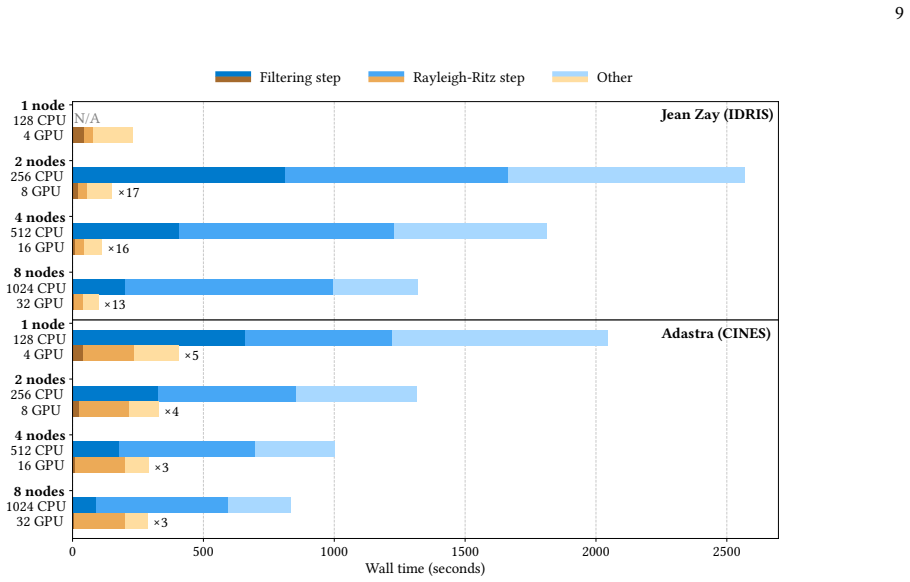
The Abinit implementation on multi-GPU architectures relies on algorithmic revisions of the iterative diagonalization procedure in the resolution of the Kohn-Sham problem to identify GPU-efficient mathematical operations (linear algebra, FFTs) applied to wave functions distributed in memory, and supplies detailed performance results comparing CPU nodes versus heterogeneous CPU-GPU nodes together with a comparison of LOBPCG and Chebyshev polynomial filtering in terms of GPU efficiency.
What carries the argument
Revised iterative diagonalization procedure that selects and applies GPU-efficient linear algebra and FFT operations to distributed wave functions.
If this is right
- Heterogeneous CPU-GPU nodes deliver higher throughput than CPU-only nodes for the same plane-wave DFT workloads.
- Chebyshev polynomial filtering exploits GPU resources more effectively than LOBPCG in this setting.
- Vendor library calls for linear algebra and FFTs become the dominant computational kernels after the revisions.
- Large-scale electronic structure runs become feasible on GPU-equipped supercomputers without changing the underlying physics model.
Where Pith is reading between the lines
- The same pattern of favoring linear algebra and FFT operations could be applied to accelerate other plane-wave DFT packages.
- Further gains may appear when the number of GPU nodes grows into the hundreds for systems containing thousands of atoms.
- The reported speedups assume that data movement between CPU and GPU remains a minor fraction of total time.
- Verification on a broader set of materials and properties would strengthen that accuracy is preserved.
Load-bearing premise
The algorithmic revisions to the iterative diagonalization preserve numerical accuracy and convergence properties of the original CPU implementation.
What would settle it
Identical input system yields total energies or forces that differ beyond floating-point tolerance when the same calculation is run on the original CPU version versus the GPU version.
Figures




read the original abstract
We report on the GPU port of the Abinit high-performance simulation code for plane-wave DFT calculations. Large-scale electronic structure calculations require computing the electronic wave function by solving the Kohn-Sham equations discretized over a large number of plane waves. Porting such calculations to GPU nodes relies not only on extensive usage of vendor libraries from a development perspective, but also on algorithmic revisions of the iterative diagonalization procedure in the resolution of the Kohn-Sham equations to identify GPU-efficient mathematical operations (linear algebra, FFTs) applied to the wave function distributed in memory. The present contribution discusses the Abinit implementation on multi-GPU architectures, providing detailed performance results for heterogeneous CPU-GPU nodes versus CPU nodes. Particular attention is given to comparing two diagonalization algorithms -- Locally Optimal Block Preconditioned Conjugate Gradient and Chebyshev polynomial filtering -- in terms of GPU efficiency.
Editorial analysis
A structured set of objections, weighed in public.
Referee Report
Summary. The manuscript reports the GPU porting of the Abinit plane-wave DFT code, emphasizing algorithmic revisions to the LOBPCG and Chebyshev polynomial filtering iterative diagonalization procedures to identify GPU-efficient operations (linear algebra and FFTs) on distributed wave functions. It provides performance benchmarks comparing CPU-only nodes to heterogeneous CPU-GPU nodes, with particular focus on the relative GPU efficiency of the two diagonalization algorithms.
Significance. If the central claims hold, this contribution would be significant for enabling scalable large-scale electronic structure calculations on modern GPU-accelerated HPC systems. The explicit comparison of LOBPCG versus Chebyshev filtering on GPUs offers practical guidance for algorithm selection in similar codes, and the reliance on vendor libraries plus distributed-memory considerations addresses key implementation challenges in the field.
major comments (2)
- [§5] §5 (Performance results), Tables 1-3: The reported timings for LOBPCG and Chebyshev filtering on CPU versus CPU-GPU nodes do not include any side-by-side numerical equivalence metrics (e.g., total energy differences, eigenvalue residuals, or iteration counts to convergence) for identical inputs and systems. This is load-bearing for the claim that the algorithmic revisions preserve the original numerical accuracy and convergence properties while delivering the speedups.
- [Implementation section] Implementation section (preceding the benchmarks): The description of the revisions to the iterative diagonalization does not specify how the GPU paths maintain mathematical equivalence to the CPU versions (e.g., identical preconditioning, filtering polynomials, or convergence criteria). Without this, it is unclear whether observed speedups reflect true acceleration or altered iteration behavior.
minor comments (2)
- [Abstract] The abstract states that 'detailed performance results' are provided yet contains no quantitative values, error bars, or system sizes; moving a representative timing or speedup figure into the abstract would improve immediate readability.
- [Figures] Figure captions for the performance plots should explicitly state the number of nodes, basis-set sizes, and whether single- or double-precision arithmetic was used.
Simulated Author's Rebuttal
We thank the referee for their thorough review and constructive comments on our manuscript describing the GPU porting of Abinit's plane-wave DFT solver. The feedback correctly identifies the need for explicit numerical validation and clearer description of algorithmic equivalence, both of which we will address in the revision. Our point-by-point responses follow.
read point-by-point responses
-
Referee: [§5] §5 (Performance results), Tables 1-3: The reported timings for LOBPCG and Chebyshev filtering on CPU versus CPU-GPU nodes do not include any side-by-side numerical equivalence metrics (e.g., total energy differences, eigenvalue residuals, or iteration counts to convergence) for identical inputs and systems. This is load-bearing for the claim that the algorithmic revisions preserve the original numerical accuracy and convergence properties while delivering the speedups.
Authors: We agree that side-by-side numerical equivalence metrics are necessary to substantiate that the GPU ports preserve accuracy and convergence behavior. In the revised manuscript we will add a dedicated subsection (or supplementary table) in §5 that reports, for each benchmark system and both diagonalization methods, the total energy, maximum eigenvalue residual, and number of iterations to convergence on CPU-only versus CPU-GPU nodes using identical input parameters. These quantities will be shown to agree to within double-precision round-off, confirming that the observed speedups arise from hardware acceleration rather than altered numerics. revision: yes
-
Referee: [Implementation section] Implementation section (preceding the benchmarks): The description of the revisions to the iterative diagonalization does not specify how the GPU paths maintain mathematical equivalence to the CPU versions (e.g., identical preconditioning, filtering polynomials, or convergence criteria). Without this, it is unclear whether observed speedups reflect true acceleration or altered iteration behavior.
Authors: We accept that the implementation section would benefit from greater explicitness on mathematical equivalence. We will revise the text to state that the GPU paths employ exactly the same preconditioning operators, the same Chebyshev polynomial degrees and filtering coefficients, and the identical convergence thresholds and stopping criteria as the CPU implementations. The algorithmic changes are limited to reordering and offloading linear-algebra and FFT kernels to vendor libraries while preserving the mathematical structure of both LOBPCG and Chebyshev filtering; iteration counts and residual histories therefore remain unchanged. revision: yes
Circularity Check
No circularity: empirical implementation and benchmarking report
full rationale
The paper is a porting and performance benchmarking study of Abinit on GPUs. It describes algorithmic revisions to iterative diagonalization (LOBPCG and Chebyshev filtering) for GPU efficiency and reports timing comparisons between CPU and heterogeneous nodes. No derivation chain, first-principles predictions, fitted parameters renamed as outputs, or self-citation load-bearing arguments exist. Central claims rest on measured wall-clock times and GPU utilization, which are direct empirical observations rather than quantities constructed from the paper's own inputs. The absence of any claimed mathematical equivalence or predictive derivation precludes circularity by the defined criteria.
Axiom & Free-Parameter Ledger
axioms (1)
- domain assumption Standard Kohn-Sham equations discretized in a plane-wave basis
discussion (0)
Sign in with ORCID, Apple, or X to comment. Anyone can read and Pith papers without signing in.