A Stable SBP-SAT FDTD Subgridding Method Without Region Split
Pith reviewed 2026-05-10 09:32 UTC · model grok-4.3
The pith
Projection SBP operators enable stable FDTD subgridding with direct coarse-fine coupling and no domain split.
A machine-rendered reading of the paper's core claim, the machinery that carries it, and where it could break.
Core claim
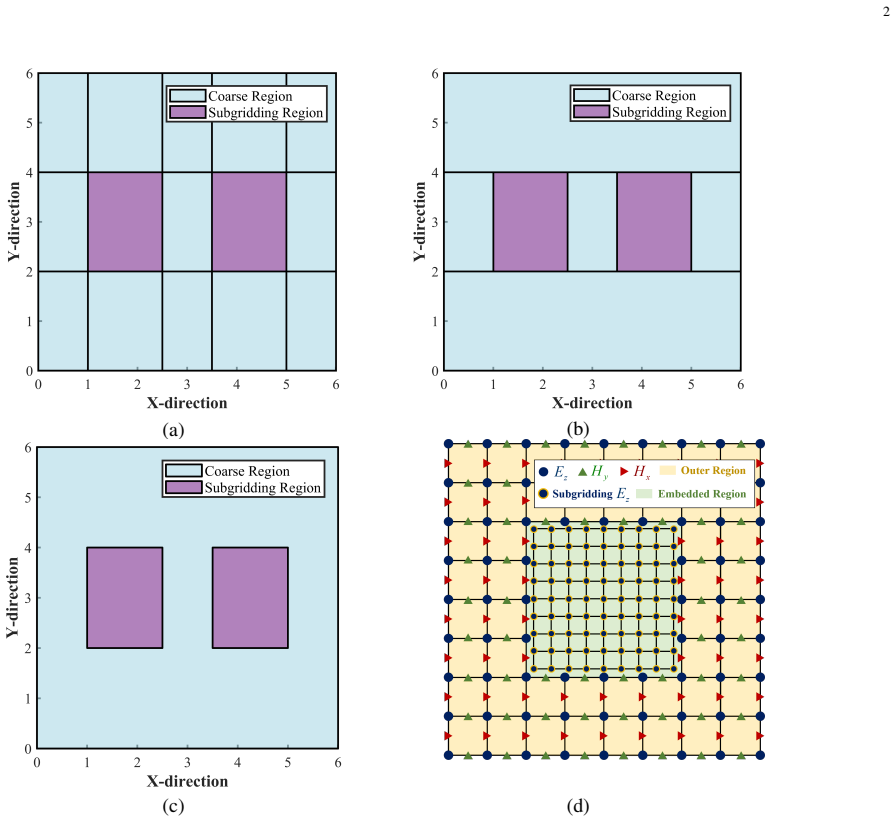
By designing projection SBP operators tailored for embedded topological features and deriving the corresponding SAT boundary conditions, this approach guarantees long-time stability through discrete energy analysis. The method enables direct coupling between an internal refined region and a single surrounding coarse-grid domain without introducing auxiliary blocks or causing domain fragmentation.
What carries the argument
Projection SBP operators constructed for embedded topological features, together with the SAT boundary conditions they induce, which together preserve the summation-by-parts property and deliver an energy-stable interface.
If this is right
- Direct coupling of one refined interior region to one outer coarse domain eliminates the extra SAT surfaces required by multi-block decompositions.
- Long-time stability follows from a single discrete energy estimate rather than from grid alignment assumptions.
- Fewer interface conditions and no domain fragmentation reduce overall computational complexity.
- Accuracy near the grid interface improves because the projection operators are designed specifically for the embedded topology.
Where Pith is reading between the lines
- The same operator-construction strategy may apply to other hyperbolic systems that admit SBP discretizations.
- Dynamic insertion or removal of refined patches could become feasible if the projection operators can be updated locally.
- Large-scale electromagnetic problems with irregular material boundaries might adopt this subgridding pattern to avoid global grid refinement.
Load-bearing premise
Projection SBP operators can be built for any embedded topological feature while still satisfying the summation-by-parts identity and admitting stable SAT coupling.
What would settle it
A long-time simulation on an arbitrarily shaped embedded refinement that exhibits growing energy or instability would disprove the stability guarantee.
Figures


read the original abstract
A provably stable summation-by-parts simultaneous approximation term (SBP-SAT) finite-difference time-domain (FDTD) subgridding method without region split is proposed. By designing projection SBP operators tailored for embedded topological features and deriving the corresponding SAT boundary conditions, this approach guarantees long-time stability through discrete energy analysis. Unlike conventional SBP-SAT FDTD subgridding techniques that rely on aligned or multi-block configurations, the proposed method enables a direct coupling between an internal refined region and a single surrounding coarse-grid domain without introducing auxiliary blocks or causing domain fragmentation. Numerical results validate the efficiency, accuracy, and topological flexibility of the proposed method. Compared with existing multi-block SBP-SAT methods, this method effectively reduces computational complexity by minimizing SAT boundary conditions and improves calculation accuracy near grid interfaces.
Editorial analysis
A structured set of objections, weighed in public.
Referee Report
Summary. The manuscript proposes a summation-by-parts simultaneous approximation term (SBP-SAT) finite-difference time-domain (FDTD) subgridding method that enables direct coupling of an internal refined region to a single surrounding coarse-grid domain without region splitting or auxiliary blocks. It designs projection SBP operators tailored to embedded topological features, derives corresponding SAT boundary conditions, and claims to prove long-time stability via discrete energy analysis. Numerical experiments are presented to demonstrate efficiency, accuracy, and flexibility compared to conventional multi-block SBP-SAT approaches.
Significance. If the stability result holds without hidden alignment assumptions, the method would meaningfully simplify subgridding in FDTD simulations of complex geometries, reducing the number of SAT interfaces and computational overhead while maintaining accuracy near grid transitions. This addresses a practical limitation in existing multi-block techniques and could enable more flexible mesh refinement in computational electromagnetics.
major comments (1)
- [§3.2 and §4] §3.2 (Projection Operator Construction) and §4 (Discrete Energy Analysis): The central stability claim rests on the projection SBP operators preserving the exact summation-by-parts identity when coupling grids of differing spacing and arbitrary embedded topology. The energy estimate in §4 cancels interface terms only if the projection is norm-consistent and satisfies a discrete integration-by-parts relation at the interface; for non-rectangular or non-aligned topologies this is not automatic. Please supply the explicit verification that the telescoping property holds (e.g., the inner-product identity after projection) or state the precise topological restrictions under which it is guaranteed.
minor comments (2)
- [Abstract] Abstract: The phrase 'numerical results validate the efficiency, accuracy, and topological flexibility' is vague; a single sentence listing the specific test geometries and error norms used would improve readability.
- [§5] §5 (Numerical Results): The comparison tables would benefit from an additional column reporting the L2 error against a reference uniform fine-grid solution, rather than only against the multi-block baseline.
Simulated Author's Rebuttal
We thank the referee for the careful reading and constructive feedback on our manuscript. The major comment is addressed in detail below. We believe the requested clarifications can be incorporated without altering the core contributions.
read point-by-point responses
-
Referee: [§3.2 and §4] §3.2 (Projection Operator Construction) and §4 (Discrete Energy Analysis): The central stability claim rests on the projection SBP operators preserving the exact summation-by-parts identity when coupling grids of differing spacing and arbitrary embedded topology. The energy estimate in §4 cancels interface terms only if the projection is norm-consistent and satisfies a discrete integration-by-parts relation at the interface; for non-rectangular or non-aligned topologies this is not automatic. Please supply the explicit verification that the telescoping property holds (e.g., the inner-product identity after projection) or state the precise topological restrictions under which it is guaranteed.
Authors: We agree that an explicit verification strengthens the presentation. In §3.2 the projection SBP operators are constructed precisely so that the discrete integration-by-parts identity is preserved after projection onto the embedded interface; this is achieved by enforcing both the SBP property on each grid and norm-consistency of the projection operator at the coarse-fine transition. Section 4 then uses this identity to cancel the interface contributions in the energy estimate, yielding unconditional stability. The construction does not impose rectangular or alignment restrictions beyond the topological embedding itself. To make the telescoping property fully transparent, we will add a short lemma (with the inner-product identity after projection) in the revised §3.2 or as an appendix, together with a statement of the precise topological class (simply-connected embedded regions with piecewise-smooth boundaries) for which the operators are defined. revision: yes
Circularity Check
No circularity: stability follows from standard energy analysis on explicitly constructed operators
full rationale
The derivation chain consists of (1) constructing projection SBP operators tailored to embedded topologies, (2) deriving compatible SAT terms, and (3) applying the standard discrete energy method to obtain a stability bound. None of these steps reduces to a tautology, a fitted parameter renamed as prediction, or a self-citation whose content is the target result. The energy analysis is an independent, well-established technique whose telescoping property is verified once the operators satisfy the SBP identity by design; the construction itself is not claimed to be forced by prior self-referential theorems. Numerical experiments supply external validation outside the analytic steps. No load-bearing self-citation or ansatz smuggling is present in the abstract or described chain.
Axiom & Free-Parameter Ledger
axioms (1)
- domain assumption Discrete energy analysis suffices to prove long-time stability once the SBP property and SAT terms are satisfied.
discussion (0)
Sign in with ORCID, Apple, or X to comment. Anyone can read and Pith papers without signing in.