Peakon solutions and analytical properties for the Camassa-Holm type equations with quadratic nonlinearities
Pith reviewed 2026-05-21 03:56 UTC · model grok-4.3
The pith
Camassa-Holm-type equations with quadratic nonlinearities admit a closed dynamical system for multi-peakon solutions and are ill-posed in the Besov space B_{2,∞}^{3/2}.
A machine-rendered reading of the paper's core claim, the machinery that carries it, and where it could break.
Core claim
The central claim is that for Camassa-Holm-type equations with quadratic nonlinearities, the multi-peakon ansatz reduces the PDE to an explicit finite-dimensional dynamical system, local well-posedness holds in Besov spaces, global existence or blow-up occurs under suitable initial-data conditions, and the Cauchy problem is ill-posed in B_{2,∞}^{3/2} because non-traveling wave solutions demonstrate discontinuity of the solution map.
What carries the argument
The multi-peakon ansatz expressing the solution as a finite sum of peaked traveling waves with time-dependent amplitudes and positions, which converts the original PDE into a closed system of ODEs for those parameters.
If this is right
- Under the stated initial-data conditions, every solution either exists for all positive times or blows up in finite time.
- The multi-peakon solutions satisfy a finite system of ordinary differential equations that can be integrated or analyzed for collisions and scattering.
- Local well-posedness in Besov spaces guarantees short-time existence, uniqueness, and continuous dependence for sufficiently regular initial data.
- Ill-posedness in B_{2,∞}^{3/2} means that arbitrarily small changes in initial data measured in that norm can produce arbitrarily large changes in the corresponding solutions.
Where Pith is reading between the lines
- The ODE system for peakon parameters could be used to approximate long-time wave breaking in related quadratic models without solving the full PDE.
- The ill-posedness result may indicate that slightly stronger Besov or Sobolev regularity is required for continuous dependence in similar integrable equations.
- Numerical integration of the derived peakon ODEs could test whether collisions produce new peakons or lead to blow-up, providing a concrete check on the analytic blow-up criteria.
Load-bearing premise
The quadratic nonlinearities must be of a specific integrable form that permits an explicit multi-peakon ansatz to close into ODEs.
What would settle it
An explicit counterexample in which a non-traveling wave solution in B_{2,∞}^{3/2} varies continuously with initial data, or a quadratic nonlinearity outside the assumed integrable class whose peakon interactions fail to satisfy the derived ODE system.
Figures


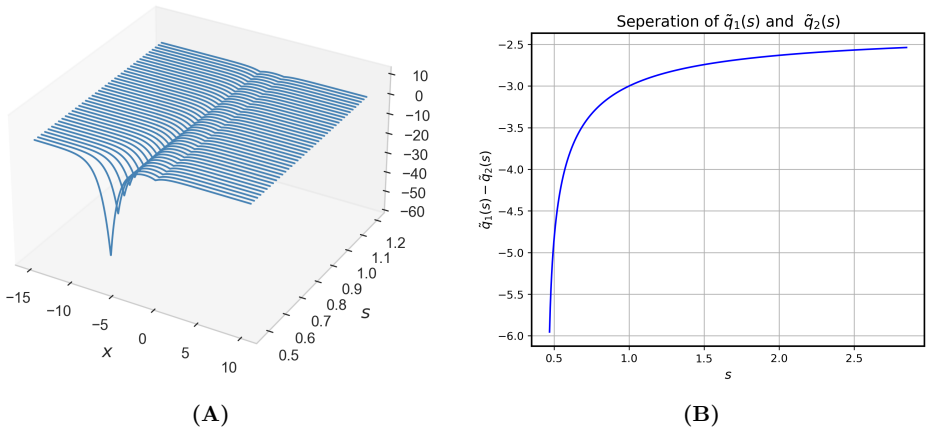
read the original abstract
In this paper, we derive the multi-peakon dynamical system of a class of Camassa-Holm-type equations with quadratic nonlinearities. We also consider the analytical properties for the Cauchy problem. Firstly, we establish local well-posedness of solutions in Besov spaces and then provide the blow-up criteria. Subsequently, we impose appropriate sufficient conditions on the initial data to guaranty that the corresponding solution either exists globally or blows up in a finite time. Finally, we prove the ill-posedness in the Besov space $B_{2,\infty}^{3/2}$ by utilizing the non-traveling wave solutions.
Editorial analysis
A structured set of objections, weighed in public.
Referee Report
Summary. The manuscript derives the multi-peakon dynamical system for a class of Camassa-Holm-type equations with quadratic nonlinearities. It establishes local well-posedness of the Cauchy problem in Besov spaces, provides blow-up criteria, imposes sufficient conditions on initial data to guarantee either global existence or finite-time blow-up, and proves ill-posedness in the space B_{2,∞}^{3/2} by utilizing non-traveling wave solutions.
Significance. If the central derivations hold, the work extends peakon theory and well-posedness results from the classical Camassa-Holm equation to equations with quadratic nonlinearities. The explicit multi-peakon ODE system is a concrete contribution that may enable further study of soliton dynamics and interactions. The ill-posedness result in a critical Besov space would help delineate regularity thresholds for these models.
major comments (2)
- [Ill-posedness section] Ill-posedness section (final claim in abstract): The proof that non-traveling wave solutions establish ill-posedness in B_{2,∞}^{3/2} must include an explicit sequence of initial data converging in the Besov norm whose corresponding solutions diverge in the same norm (or exhibit norm inflation) at positive times. Merely constructing non-traveling solutions does not by itself demonstrate discontinuity of the data-to-solution map; the required estimates showing failure of continuous dependence are missing from the argument as described.
- [Multi-peakon derivation] Section deriving the multi-peakon system: The reduction of the PDE to the finite-dimensional ODE system for peak positions and amplitudes should be accompanied by a verification that the resulting weak solutions satisfy the original equation in the distributional sense, including explicit computation of the quadratic interaction terms and confirmation that no additional singular measures arise.
minor comments (2)
- [Abstract] The abstract and introduction should clarify the precise form of the quadratic nonlinearities under consideration, as the multi-peakon ansatz and integrability properties depend on this structure.
- [Well-posedness section] Notation for the Besov spaces and the precise indices in the local well-posedness theorem should be stated uniformly throughout to avoid ambiguity when comparing to standard results for the Camassa-Holm equation.
Simulated Author's Rebuttal
We thank the referee for the careful reading of our manuscript and for the constructive major comments. We address each point below and will incorporate revisions to strengthen the arguments where gaps in detail have been identified.
read point-by-point responses
-
Referee: [Ill-posedness section] The proof that non-traveling wave solutions establish ill-posedness in B_{2,∞}^{3/2} must include an explicit sequence of initial data converging in the Besov norm whose corresponding solutions diverge in the same norm (or exhibit norm inflation) at positive times. Merely constructing non-traveling solutions does not by itself demonstrate discontinuity of the data-to-solution map; the required estimates showing failure of continuous dependence are missing from the argument as described.
Authors: We agree that a fully rigorous demonstration of ill-posedness requires an explicit sequence together with estimates establishing failure of continuous dependence. While the non-traveling wave solutions form the core of our construction, the manuscript did not spell out the sequence and norm-inflation estimates in sufficient detail. In the revised version we will construct an explicit sequence {u_0^n} in B_{2,∞}^{3/2} that converges to zero in the Besov norm, yet the corresponding solutions satisfy ||u^n(t)||_{B_{2,∞}^{3/2}} → ∞ for every fixed t > 0 (norm inflation). The construction will be obtained by suitable scaling and translation of the non-traveling waves, and we will supply the complete estimates verifying the divergence. revision: yes
-
Referee: [Multi-peakon derivation] The reduction of the PDE to the finite-dimensional ODE system for peak positions and amplitudes should be accompanied by a verification that the resulting weak solutions satisfy the original equation in the distributional sense, including explicit computation of the quadratic interaction terms and confirmation that no additional singular measures arise.
Authors: We thank the referee for this observation. The derivation of the multi-peakon ODE system in the current manuscript focuses on formal substitution, and a complete distributional verification was not included. In the revised manuscript we will add an explicit verification subsection. We will compute the quadratic nonlinear terms arising from pairwise peak interactions, insert the peakon ansatz into the weak form of the PDE, and confirm that the resulting distributional equation holds with only the expected Dirac measures supported at the peak locations and no extraneous singular measures. revision: yes
Circularity Check
Derivation chain is self-contained with no circular reductions
full rationale
The paper derives the multi-peakon dynamical system via direct substitution of the peakon ansatz into the given Camassa-Holm-type PDE with quadratic nonlinearities, a standard explicit calculation that does not reduce to a self-definition or fitted input. Local well-posedness in Besov spaces, blow-up criteria, and global/blow-up conditions follow from established energy estimates and continuation arguments in the literature on dispersive PDEs. The ill-posedness result in B_{2,∞}^{3/2} is obtained by constructing explicit non-traveling wave solutions that violate continuous dependence; this is an independent counterexample construction rather than a tautological renaming or self-referential fit. No load-bearing step collapses to a prior self-citation or ansatz smuggled from the authors' own work; the chain rests on external PDE theory and direct verification.
Axiom & Free-Parameter Ledger
axioms (1)
- domain assumption Local well-posedness and blow-up criteria hold in Besov spaces for the given quadratic Camassa-Holm-type equations
Lean theorems connected to this paper
-
IndisputableMonolith/Foundation/RealityFromDistinction.leanreality_from_one_distinction unclear?
unclearRelation between the paper passage and the cited Recognition theorem.
derive the multi-peakon dynamical system of a class of Camassa-Holm-type equations with quadratic nonlinearities... prove the ill-posedness in the Besov space B_{2,∞}^{3/2} by utilizing the non-traveling wave solutions
-
IndisputableMonolith/Cost/FunctionalEquation.leanwashburn_uniqueness_aczel unclear?
unclearRelation between the paper passage and the cited Recognition theorem.
Theorem 1... parameter conditions λ3=λ1, λ4=2λ1, λ5=3/2 λ2−λ6... N-peakon dynamical system
What do these tags mean?
- matches
- The paper's claim is directly supported by a theorem in the formal canon.
- supports
- The theorem supports part of the paper's argument, but the paper may add assumptions or extra steps.
- extends
- The paper goes beyond the formal theorem; the theorem is a base layer rather than the whole result.
- uses
- The paper appears to rely on the theorem as machinery.
- contradicts
- The paper's claim conflicts with a theorem or certificate in the canon.
- unclear
- Pith found a possible connection, but the passage is too broad, indirect, or ambiguous to say the theorem truly supports the claim.
Reference graph
Works this paper leans on
-
[1]
H. Bahouri, J. Chemin, R. Danchin, Fourier Analysis and Nonlinear Partial Differential Equa- tions, Springer, Berlin. (2011). 23
work page 2011
-
[2]
R. Camassa and D. D. Holm, An integrable shallow water equation with peaked solitons,Physical Review Letters, 71(11):1661–1664, 1993
work page 1993
-
[3]
J. Chemin, Perfect incompressible fluids, In: Oxford Lectures Series in Mathematics and its Applications, vol. 14. The Clarendon Press, Oxford University Press, New York, 1998
work page 1998
-
[4]
R. M. Chen, F. Guo, Y. Liu and C. Qu, Analysis on the blow-up of solutions to a class of integrable Camassa–Holm type equations,Journal of Functional Analysis, 270(6):2343–2374, 2016
work page 2016
-
[5]
X. Chen, T.-C. Lin and J. Wei, Blowup and solitary wave solutions with ring profiles of two- component nonlinear Schr¨ odinger systems,Physica D: Nonlinear Phenomena, 239(10):613–626, 2010
work page 2010
-
[6]
A. Constantin and J. Escher, Global existence and blow-up for a shallow water equation,Annali della Scuola Normale Superiore di Pisa, 26(2):303–328, 1998
work page 1998
-
[7]
A. Constantin and J. Escher, Wave breaking for nonlinear nonlocal shallow water equations, Acta Mathematica, 181(2):229–243, 1998
work page 1998
-
[8]
A. Constantin and J. Escher, Well-posedness, global existence, and blow-up phenomena for a periodic quasi-linear hyperbolic equation,Communications on Pure and Applied Mathematics, 51(5):475–504, 1998
work page 1998
-
[9]
A. Constantin, Existence of permanent and breaking waves for a shallow water equation: a geometric approach,Annales de l’Institut Fourier, 50(2):321–362, 2000
work page 2000
-
[10]
A. Constantin and W. A. Strauss, Stability of peakons,Communications on Pure and Applied Mathematics, 53(5):603–610, 2000
work page 2000
-
[11]
R. Danchin A few remarks on the Camassa–Holm equation,Differential and Integral Equations, 14(8): 953–988, 2001
work page 2001
-
[12]
R. Danchin A note on well-posedness for Camassa–Holm equation,Journal of Differential Equations, 192: 429–444, 2003
work page 2003
-
[13]
A. Degasperis and M. Procesi, Asymptotic integrability, inSymmetry and Perturbation Theory, World Scientific, 1999, pp. 23–37
work page 1999
-
[14]
A. Degasperis, D. D. Holm and A. N. Hone, A new integrable equation with peakon solutions, Theoretical and Mathematical Physics, 133:1463–1474, 2002
work page 2002
-
[15]
A. Degasperis, D. D. Holm and A. N. Hone, Integrable and non-integrable equations with peakons, inNonlinear Physics: Theory and Experiment II, World Scientific, 2003, pp. 37–43. 24
work page 2003
- [16]
-
[17]
B. Fornberg and G. B. Whitham, A numerical and theoretical study of certain nonlinear wave phenomena,Philosophical Transactions of the Royal Society of London. Series A, 289(1361):373– 404, 1978
work page 1978
-
[18]
A. S. Fokas, On a class of physically important integrable equations,Physica D: Nonlinear Phenomena, 87:145–150, 1995
work page 1995
- [19]
- [20]
-
[21]
S. V. Haziot, Wave breaking for the Fornberg–Whitham equation,Journal of Differential Equations, 263(12):8178–8185, 2017
work page 2017
-
[22]
A. A. Himonas and D. Mantzavinos, Anab-family of equations with peakon traveling waves, Proceedings of the American Mathematical Society, 144(9), 3797–3811, 2016
work page 2016
-
[23]
D. D. Holm and M. F. Staley, Nonlinear balance and exchange of stability in dynamics of solitons, peakons, ramps/cliffs and leftons,Physics Letters A, 308(5–6):437–444, 2003
work page 2003
-
[24]
T. Kato and G. Ponce, Commutator estimates and the Euler and Navier–Stokes equations, Communications on Pure and Applied Mathematics, 41(7):891–907, 1988
work page 1988
- [25]
- [26]
- [27]
- [28]
-
[29]
H. Lundmark, Formation and dynamics of shock waves in the Degasperis–Procesi equation, Journal of Nonlinear Science, 17(3):169–198, 2007
work page 2007
-
[30]
Z. Qiao, The Camassa–Holm hierarchy,N-dimensional integrable systems, and algebro-geometric solution on a symplectic submanifold,Communications in Mathematical Physics, 239:309–341, 2003. 25
work page 2003
-
[31]
Z. Qiao and G. Zhang, On peaked and smooth solitons for the Camassa–Holm equation,Euro- physics Letters, 73(5):657–663, 2006
work page 2006
- [32]
-
[33]
M. Zhu, Z. Qiao, Z. Wang and Z. Jiang, Rogue peakon, posedness and blow-up phenomenon for an integrable Camassa-Holm type equation,Advances in Nonlinear Analysis, 15(1): 20250139, 2026. 26
work page 2026
discussion (0)
Sign in with ORCID, Apple, or X to comment. Anyone can read and Pith papers without signing in.