Tensor-based phase difference estimation on time series analysis
Pith reviewed 2026-05-21 15:20 UTC · model grok-4.3
The pith
Tensor-network compression extracts phase differences from quantum time evolution with 0.4 to 4.7 percent error on systems up to 52 qubits.
A machine-rendered reading of the paper's core claim, the machinery that carries it, and where it could break.
Core claim
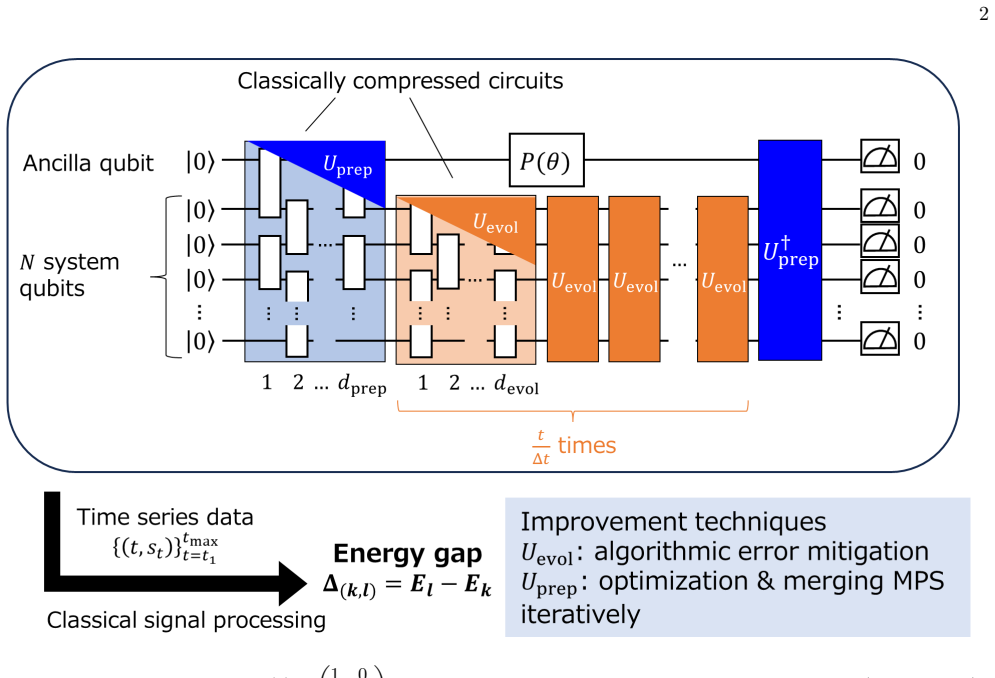
Tensor-network compression produces compact circuits of nearest-neighbor gates that faithfully represent the time-evolution operator; four complementary measurement circuits applied to these compressed circuits yield the phase difference between evolved states, which directly gives the energy gap, with further accuracy gained from algorithmic error mitigation and MPS-based circuit optimization.
What carries the argument
Tensor-network compression of time-evolution circuits into nearest-neighbor gates together with a four-type measurement protocol that extracts phase information from the resulting time series.
If this is right
- The algorithm reaches 0.4-4.7 percent error relative to the true energy gap on an eight-qubit Hubbard model when an appropriate time-step size is chosen.
- Accuracy visibly improves when the proposed algorithmic error mitigation is applied.
- Iterative circuit optimization increases the overlap between prepared states and the target matrix product states.
- The method executes on IBM Heron hardware with Q-CTRL suppression for 8-, 36-, and 52-qubit models that contain more than four thousand two-qubit gates.
Where Pith is reading between the lines
- The same compression-plus-measurement strategy could be applied to other time-evolution problems such as real-time correlation functions or quench dynamics beyond static energy gaps.
- Hybrid classical-quantum workflows that interleave tensor-network circuit design with quantum execution may become a standard route for scaling phase-estimation tasks.
- Once error-corrected devices are available, the reduced gate count from tensor compression could lower the overhead needed to reach fault-tolerant precision.
- The four-type measurement pattern might generalize to other quantum algorithms that rely on sampling phases or frequencies from short time series.
Load-bearing premise
The tensor-network compression and four-type circuit measurements capture the underlying time-evolution operator without introducing uncontrolled approximation errors that would invalidate the extracted phase difference.
What would settle it
Running the full protocol on a small system whose exact energy gap is known and finding that the estimated gap lies outside the 0.4-4.7 percent error window for any recommended time-step size would falsify the accuracy claim.
Figures



read the original abstract
We propose a phase-difference estimation algorithm based on the tensor-network circuit compression, leveraging time-evolution data to pursue scalability and higher accuracy on a quantum phase estimation (QPE)-type algorithm. Using tensor networks, we construct circuits composed solely of nearest-neighbor gates and extract time-evolution data by four-type circuit measurements. In addition, to enhance the accuracy of time-evolution and state-preparation circuits, we propose techniques based on algorithmic error mitigation and on iterative circuit optimization combined with merging into matrix product states, respectively. Verifications using a noiseless simulator for the 8-qubit one-dimensional Hubbard model using an ancilla qubit show that the proposed algorithm achieves accuracies with 0.4--4.7\% error from a true energy gap on an appropriate time-step size, and that accuracy improvements due to the algorithmic error mitigation are observed. We also confirm the enhancement of the overlap with matrix product states through iterative optimization. Finally, the proposed algorithm is demonstrated on IBM Heron devices with Q-CTRL error suppression for 8-, 36-, and 52-qubit models using more than 4,000 2-qubit gates. These largest-scale demonstrations for the QPE-type algorithm represent significant progress not only toward practical applications of near-term quantum computing but also toward preparation for the era of error-corrected quantum devices.
Editorial analysis
A structured set of objections, weighed in public.
Referee Report
Summary. The paper proposes a tensor-network-based phase difference estimation algorithm for QPE-type methods on time series. It compresses time-evolution circuits to nearest-neighbor gates via tensor networks, extracts data using four-type measurements, applies algorithmic error mitigation, and uses iterative MPS optimization for state preparation. Simulator verification on the 8-qubit 1D Hubbard model reports 0.4–4.7% error from the true gap at suitable time steps, with accuracy gains from mitigation; hardware runs on IBM Heron devices with Q-CTRL suppression are shown for 8-, 36-, and 52-qubit instances using >4000 two-qubit gates.
Significance. If the tensor compression faithfully reproduces the evolution operator without uncontrolled errors, the work would constitute meaningful progress toward scaling QPE-type algorithms beyond small qubit counts on NISQ hardware. The reported hardware demonstrations at 52 qubits and the integration of tensor networks with error mitigation represent concrete steps that could influence practical quantum simulation in chemistry and materials science.
major comments (2)
- [Tensor-network compression and circuit construction] The tensor-network compression section provides no operator-norm bound or other quantitative control on ||U_compressed(t) − U_exact(t)||. This is load-bearing for the central claim that the extracted phase difference recovers the energy gap to 0.4–4.7 % accuracy, especially when extrapolating the 8-qubit verification to the 36- and 52-qubit hardware cases where entanglement structure may exceed the chosen bond dimension.
- [Hardware experiments on IBM Heron] In the hardware demonstration results, no ablation or scaling study with respect to bond dimension is reported for the 36- and 52-qubit instances. Without such data it remains unclear whether the observed accuracies are robust properties of the method or artifacts of near-exact compression at the scales tested.
minor comments (2)
- [Abstract and §3] The abstract and method description refer to 'four-type circuit measurements' without an accompanying diagram or explicit listing of the measurement bases; a figure would improve reproducibility.
- [State-preparation optimization] Notation for the iterative MPS merging step could be clarified by labeling the bond indices and contraction order in the relevant equations or diagrams.
Simulated Author's Rebuttal
We thank the referee for the constructive and detailed feedback. The comments highlight important aspects for strengthening the theoretical and empirical support of our tensor-network-based phase difference estimation approach. We address each major comment below and will revise the manuscript to incorporate the suggested improvements where feasible.
read point-by-point responses
-
Referee: [Tensor-network compression and circuit construction] The tensor-network compression section provides no operator-norm bound or other quantitative control on ||U_compressed(t) − U_exact(t)||. This is load-bearing for the central claim that the extracted phase difference recovers the energy gap to 0.4–4.7 % accuracy, especially when extrapolating the 8-qubit verification to the 36- and 52-qubit hardware cases where entanglement structure may exceed the chosen bond dimension.
Authors: We agree that an operator-norm bound or equivalent quantitative control on the compression error would provide stronger justification for the accuracy claims, particularly for larger systems. The current manuscript relies on empirical verification for the 8-qubit 1D Hubbard model (0.4–4.7% error) and selects bond dimensions to achieve high-fidelity approximations based on the limited entanglement growth in 1D systems. In the revised manuscript, we will add a dedicated discussion or subsection on the approximation quality, including available fidelity metrics, error estimates for the chosen bond dimensions, and any relevant bounds or scaling arguments for tensor-network time-evolution compression in 1D models. This will better support the extrapolation to the hardware demonstrations. revision: yes
-
Referee: [Hardware experiments on IBM Heron] In the hardware demonstration results, no ablation or scaling study with respect to bond dimension is reported for the 36- and 52-qubit instances. Without such data it remains unclear whether the observed accuracies are robust properties of the method or artifacts of near-exact compression at the scales tested.
Authors: We acknowledge that an ablation or scaling study with respect to bond dimension for the 36- and 52-qubit hardware cases would help clarify robustness. Performing such studies directly on hardware at these scales is resource-intensive, which limited the scope of the initial demonstrations. We chose bond dimensions based on the entanglement structure of the 1D Hubbard model to ensure faithful compression. In the revision, we will add a discussion of the bond-dimension selection process, report the specific values used, and include additional simulator-based scaling analysis for intermediate system sizes to demonstrate that the results reflect the method's properties rather than near-exact compression. A full hardware ablation may be noted as future work due to practical constraints. revision: partial
Circularity Check
No significant circularity; claims rest on constructive algorithm and external empirical validation
full rationale
The paper proposes a new tensor-network-based phase-difference estimation algorithm for QPE-type methods, constructs nearest-neighbor circuits via compression, defines four-type measurements, and introduces algorithmic error mitigation plus iterative MPS optimization. Accuracies (0.4–4.7% error) are reported from direct noiseless simulation against the known Hubbard-model gap and from hardware runs on IBM Heron devices; these are measured outcomes, not quantities defined in terms of themselves or obtained by fitting a parameter and relabeling it a prediction. No self-citation is invoked as a uniqueness theorem or load-bearing premise that would reduce the central result to prior author work by construction. The derivation chain is therefore self-contained as an explicit algorithmic proposal whose performance is checked against independent benchmarks.
Axiom & Free-Parameter Ledger
axioms (2)
- standard math Quantum circuits evolve under unitary time-evolution operators generated by a Hamiltonian
- domain assumption Tensor-network representations can approximate quantum states and operators with controllable error
Reference graph
Works this paper leans on
-
[1]
We set the indexk= 1
-
[2]
As in Fig. 4(a),U (k) prep is optimized to maximize the real part of overlap Re D MPS(k) U(k) prep 0 E⊗N+1 , where we added the indexkfor|MPS⟩andU prep to identify the iteration count. The state MPS(1) E is the target MPS that we want to approximate. FIG. 4. Procedure of the overlap enhancement. (a) Circuit optimization. (b) Circuit merging. (c) Deep circ...
-
[3]
As in Fig. 4(b), using the optimized circuitU ∗(k) prep, we create MPS(k+1) E =U ∗(k)† prep MPS(k) E which is closer to|0⟩ ⊗N+1 than MPS(k) E . 7
-
[4]
The procedures 2-4 are repeated until a termination condition is satisfied
We increasek→k+ 1 forU (k) prep. The procedures 2-4 are repeated until a termination condition is satisfied
-
[5]
4(c), we obtain a deep circuitU prep =Q1 k=kmax U(k) prep
As in Fig. 4(c), we obtain a deep circuitU prep =Q1 k=kmax U(k) prep. Uprep give a higher overlap than singleU (1) prep since D MPS(1) Uprep 0 E⊗N+1 = D MPS(1) 1Y k=kmax U(k) prep 0 E⊗N+1 = D MPS(2) 2Y k=kmax U(k) prep 0 E⊗N+1 =. . . = D MPS(kmax) 0 E⊗N+1 . (23) Note that the bond dimension of MPS(k) E would in- crease forkin general, but it may decrease ...
-
[6]
Promoting the application of advanced quantum technology platforms to social issues
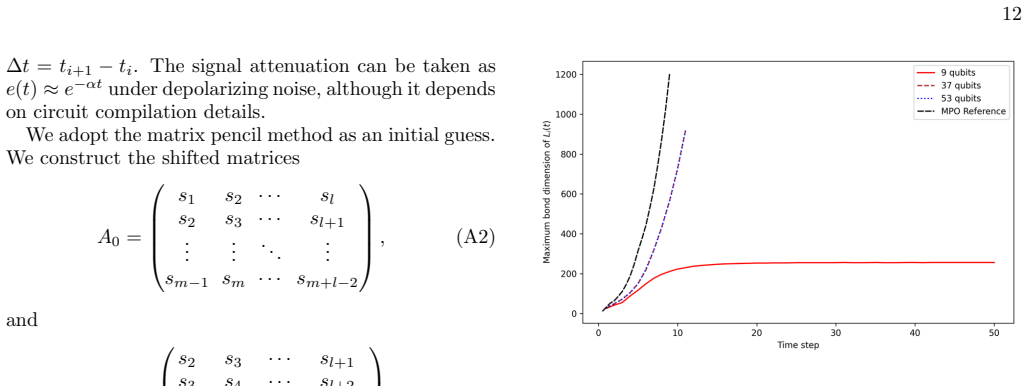
The number of sweeps is 10 3 forU prep. ForU evol, the number is 10 4. The cutoff value of the SVD in the optimization ofU prep andU evol is 10−12. The number of slicesmin Eq. (12) is ∆t/0.001. The number of shots in a circuit execution is 10 5. The maximum number of time steps is 100 in the next section and 50 the others, but the execution is stopped whe...
- [7]
- [8]
-
[9]
M. A. Nielsen and I. L. Chuang,Quantum Computa- tion and Quantum Information: 10th Anniversary Edi- tion(Cambridge University Press, Cambridge, England, 2010)
work page 2010
-
[10]
H. Gao, S. Imamura, A. Kasagi, and E. Yoshida, J. Chem. Theory Comput.20, 1185 (2024)
work page 2024
-
[11]
B. L. Higgins, D. W. Berry, S. D. Bartlett, H. M. Wise- man, and G. J. Pryde, Nature450, 393 (2007)
work page 2007
- [12]
- [13]
-
[14]
R. D. Somma, New J. Phys.21, 123025 (2019)
work page 2019
-
[15]
T. E. O’Brien, B. Tarasinski, and B. M. Terhal, New J. Phys.21, 023022 (2019)
work page 2019
-
[16]
A. Dutkiewicz, B. M. Terhal, and T. E. O’Brien, Quan- tum6, 830 (2022), 2107.04605v3
- [17]
- [18]
- [19]
- [20]
- [21]
-
[22]
N. S. Blunt, L. Caune, R. Izs´ ak, E. T. Campbell, and N. Holzmann, PRX Quantum4, 040341 (2023)
work page 2023
-
[23]
M. S. Rudolph, J. Chen, J. Miller, A. Acharya, and A. Perdomo-Ortiz, Quantum Sci. Technol.9, 015012 (2024)
work page 2024
- [24]
-
[25]
S.-H. Lin, R. Dilip, A. G. Green, A. Smith, and F. Poll- mann, PRX Quantum2, 010342 (2021)
work page 2021
- [26]
- [27]
- [28]
-
[29]
B. Anselme Martin, T. Ayral, F. Jamet, M. J. Ranˇ ci´ c, and P. Simon, Phys. Rev. A109, 062437 (2024)
work page 2024
- [30]
- [31]
- [32]
- [33]
-
[34]
S. Sugawara, K. Inomata, T. Okubo, and S. Todo, arXiv [quant-ph] (2025), 2501.18856
- [35]
-
[36]
I. N. M. Le, S. Sun, and C. B. Mendl, Quantum9, 1833 (2025)
work page 2025
-
[37]
Preparation Circuits for Matrix Product States by Classical Variational Disentanglement
R. Mansuroglu and N. Schuch, arXiv [quant-ph] (2025), 2504.21298
work page internal anchor Pith review Pith/arXiv arXiv 2025
-
[38]
Phase Estimation with Compressed Controlled Time Evolution
E. Karacan, arXiv [quant-ph] (2025), 2511.21225
work page internal anchor Pith review Pith/arXiv arXiv 2025
-
[39]
K. Sugisaki, C. Sakai, K. Toyota, K. Sato, D. Shiomi, and T. Takui, Phys. Chem. Chem. Phys.23, 20152 (2021)
work page 2021
- [40]
-
[41]
S. Endo, Q. Zhao, Y. Li, S. Benjamin, and X. Yuan, Phys. Rev. A99, 012334 (2019)
work page 2019
-
[42]
N. F. Robertson, B. Pokharel, B. Fuller, E. Switzer, O. Shtanko, M. Amico, A. Byrne, A. D’Urbano, S. Hayes- Shuptar, A. Akhriev, N. Keenan, S. Bravyi, and S. Zhuk, PRX Quantum6, 020360 (2025)
work page 2025
- [43]
-
[44]
J. Robledo-Moreno, M. Motta, H. Haas, A. Javadi- Abhari, P. Jurcevic, W. Kirby, S. Martiel, K. Sharma, S. Sharma, T. Shirakawa, I. Sitdikov, R.-Y. Sun, K. J. Sung, M. Takita, M. C. Tran, S. Yunoki, and A. Mezza- capo, Sci. Adv.11, eadu9991 (2025)
work page 2025
- [45]
-
[46]
A. Steffens, P. Rebentrost, I. Marvian, J. Eisert, and S. Lloyd, New J. Phys.19, 033005 (2017)
work page 2017
-
[47]
S. R. White, Phys. Rev. Lett.69, 2863 (1992)
work page 1992
- [48]
-
[49]
K. Sugisaki, C. Sakai, K. Toyota, K. Sato, D. Shiomi, and T. Takui, J. Phys. Chem. Lett.12, 11085 (2021)
work page 2021
- [50]
-
[51]
M. Fishman, S. R. White, and E. M. Stoudenmire, Sci- Post Phys. Codebases , 4 (2022)
work page 2022
-
[52]
A. Javadi-Abhari, M. Treinish, K. Krsulich, C. J. Wood, J. Lishman, J. Gacon, S. Martiel, P. D. Nation, L. S. Bishop, A. W. Cross, B. R. Johnson, and J. M. Gam- betta, arXiv [quant-ph] (2024), 2405.08810
work page internal anchor Pith review Pith/arXiv arXiv 2024
-
[53]
P. S. Mundada, A. Barbosa, S. Maity, Y. Wang, T. Merkh, T. M. Stace, F. Nielson, A. R. R. Carvalho, M. Hush, M. J. Biercuk, and Y. Baum, Phys. Rev. Appl. 20, 024034 (2023)
work page 2023
-
[54]
Y. Baum, M. Amico, S. Howell, M. Hush, M. Liuzzi, P. Mundada, T. Merkh, A. R. R. Carvalho, and M. J. Biercuk, PRX Quantum2, 040324 (2021)
work page 2021
- [55]
- [56]
-
[57]
J. D. Watson and J. Watkins, PRX Quantum6, 030325 (2025)
work page 2025
-
[58]
Mizuta, Quantum10, 1974 (2026), 2507.06557v4
K. Mizuta, Quantum10, 1974 (2026), 2507.06557v4
-
[59]
J. Haah, M. B. Hastings, R. Kothari, and G. H. Low, SIAM J. Comput. , FOCS18 (2021)
work page 2021
discussion (0)
Sign in with ORCID, Apple, or X to comment. Anyone can read and Pith papers without signing in.