The Highly Variable Wind from WD J005311, the Stellar Remnant of the Peculiar Galactic Supernova of 1181
Pith reviewed 2026-05-21 07:03 UTC · model grok-4.3
The pith
Spectroscopy of the 1181 supernova remnant shows O VI line profile variations arising from both a line-driven wind and an unstable rigidly rotating magnetosphere disk.
A machine-rendered reading of the paper's core claim, the machinery that carries it, and where it could break.
Core claim
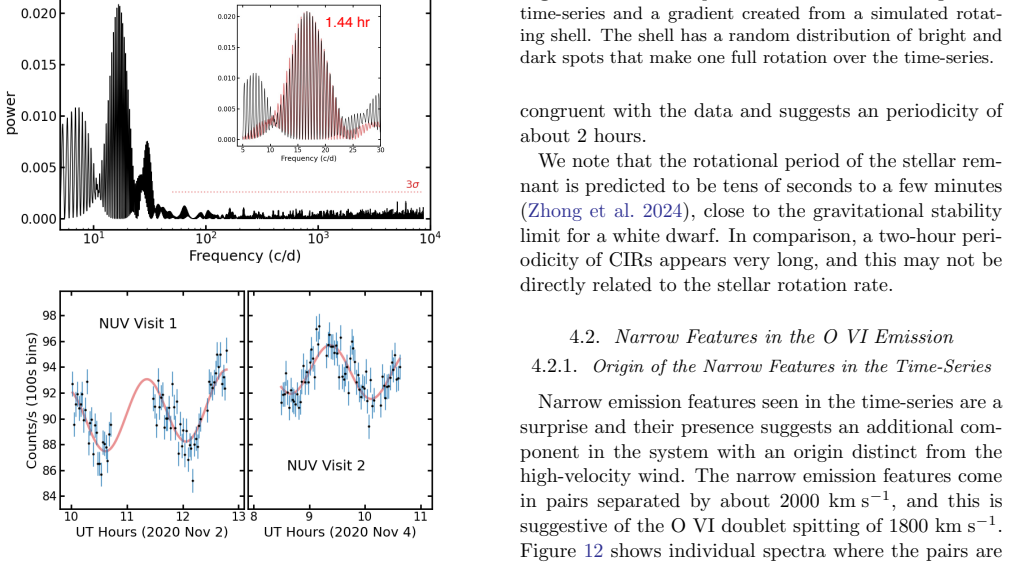
Time-resolved spectroscopy reveals that the O VI emission line in WD J005311 shows broad line profile variations with amplitudes of ±10% of the line flux over the entire line, likely due to instabilities in the line-driven wind, and low-amplitude narrow LPVs within ±5000 km/s associated with an unstable disk formed from the rigidly rotating magnetosphere of the remnant white dwarf. Archival near-ultraviolet photometry indicates a pseudo-periodic oscillation with an hour-long timescale possibly from the breakout instability of this RRM disk.
What carries the argument
Line profile variations (LPVs) on two velocity scales in the O VI emission line, with broad changes tied to wind instabilities and narrow changes tied to an unstable disk in the rigidly rotating magnetosphere.
If this is right
- Broad LPVs across the full O VI line arise from instabilities in the line-driven wind similar to those in Wolf-Rayet stars.
- Narrow LPVs within the central velocity range trace an unstable disk formed by the rigidly rotating magnetosphere.
- The hour-scale photometric oscillation may result from the breakout instability of the RRM disk.
- Coherent structure in the broad LPVs is consistent with rotation on a roughly two-hour timescale, though individual features do not persist for a full cycle.
Where Pith is reading between the lines
- Confirmation of the RRM disk would imply that the white dwarf retains a strong magnetic field and rapid rotation inherited from the white-dwarf merger event.
- Similar dual-scale variability might appear in other post-merger white dwarfs that also drive line-driven winds.
- The hourly photometric signal offers an independent way to constrain the disk's dynamical timescale without relying solely on spectroscopy.
Load-bearing premise
The narrow line profile variations are produced by an unstable disk that forms in the rigidly rotating magnetosphere of the merged white dwarf.
What would settle it
A direct measurement of the white dwarf's magnetic field strength or rotation period that is inconsistent with the velocity scale of the narrow LPVs at ±5000 km/s.
Figures




read the original abstract
WD J005311 is the peculiar stellar remnant of the Galactic supernova from 1181, and appears to have been the merger of two white dwarfs. We present time-resolved spectroscopy of WD J005311 showing emission line variability on a wide range of time-scales. The strong O VI emission feature displays line profile variations (LPVs) on two distinct velocity scales. Broad variations with amplitudes of $\pm$10% of the line flux are seen over the entire O VI line. These broad LPVs likely arise from instabilities in the line-driven wind produced in many Wolf-Rayet stars. There is a hint of coherent structure in the broad LPVs that is consistent with rotation over roughly two hours, although the features survive for less than a full cycle. Low-amplitude, narrow LPVs are also detected within the central $\pm$5000 km/s of the O VI line. We associate these features with an unstable disk formed from the rigidly rotating magnetosphere (RRM) of the remnant white dwarf. We also analyze archival near-ultraviolet photometry of WD J005311 and find a pseudo-periodic oscillation with an hour-long time-scale that maybe associated with the breakout instability of the RRM disk.
Editorial analysis
A structured set of objections, weighed in public.
Referee Report
Summary. The manuscript reports time-resolved optical spectroscopy of WD J005311, the proposed remnant of the 1181 Galactic supernova and a likely white-dwarf merger product. It identifies line-profile variations (LPVs) in the strong O VI emission feature on two velocity scales: broad LPVs with ±10% amplitude across the entire line, attributed to instabilities in a line-driven wind and showing a possible ~2-hour rotational coherence, and low-amplitude narrow LPVs confined to the central ±5000 km/s, which are associated with an unstable disk in the rigidly rotating magnetosphere (RRM) of the white dwarf. Archival near-UV photometry is also analyzed, revealing a pseudo-periodic ~1-hour oscillation tentatively linked to RRM disk breakout instability.
Significance. If the RRM-disk interpretation holds, the work supplies rare observational constraints on multi-timescale variability in the wind and magnetosphere of a post-merger white dwarf, with potential implications for models of supernova 1181 and the evolution of merged remnants. The time-resolved spectroscopic detections and the combination with archival photometry constitute the primary strengths; the mechanistic attributions, however, rest on qualitative associations rather than quantitative modeling or statistical tests.
major comments (1)
- [Discussion of narrow LPVs] The central association of the narrow LPVs within ±5000 km/s with an unstable RRM disk (abstract and discussion of narrow LPVs) lacks a quantitative check that this velocity scale is consistent with material at the corotation radius or within a magnetospheric disk. The text notes the absence of direct B-field or P_rot measurements and instead invokes analogy to the hour-scale photometric oscillation and the two-hour hint in the broad LPVs, but supplies no explicit calculation using plausible WD mass (~1.2 M⊙), radius, B, and P_rot that places disk velocities inside the reported window. This comparison is load-bearing for the RRM claim.
minor comments (2)
- [Abstract] Abstract: 'that maybe associated' should read 'that may be associated'.
- [Throughout] The distinction between observed LPV features and their interpretive attributions (wind instabilities vs. RRM disk) could be made sharper in the text and figure captions to prevent readers from conflating detection with mechanism.
Simulated Author's Rebuttal
We thank the referee for the careful and constructive review of our manuscript. We address the single major comment below and agree that adding a quantitative estimate will strengthen the RRM-disk interpretation. The revised manuscript will incorporate this material.
read point-by-point responses
-
Referee: [Discussion of narrow LPVs] The central association of the narrow LPVs within ±5000 km/s with an unstable RRM disk (abstract and discussion of narrow LPVs) lacks a quantitative check that this velocity scale is consistent with material at the corotation radius or within a magnetospheric disk. The text notes the absence of direct B-field or P_rot measurements and instead invokes analogy to the hour-scale photometric oscillation and the two-hour hint in the broad LPVs, but supplies no explicit calculation using plausible WD mass (~1.2 M⊙), radius, B, and P_rot that places disk velocities inside the reported window. This comparison is load-bearing for the RRM claim.
Authors: We agree that the current text relies on qualitative associations and analogies without an explicit velocity-scale calculation, which weakens the load-bearing RRM claim. In the revised manuscript we will add a dedicated paragraph (likely in Section 4) that performs an order-of-magnitude estimate using the referee-suggested parameters. Adopting M_WD = 1.2 M_⊙, R_WD ≈ 0.008 R_⊙, and taking the ~1-hour near-UV photometric oscillation as a proxy for P_rot, we compute the corotation radius r_co = (G M P_rot² / 4π²)^{1/3} ≈ 3–5 × 10^9 cm. The corresponding Keplerian velocity at r_co is v_kep ≈ √(G M / r_co) ≈ 2500–4500 km s⁻¹, which comfortably overlaps the observed narrow-LPV window of ±5000 km s⁻¹. For plausible surface fields B = 10^5–10^7 G the magnetospheric truncation radius lies near or inside r_co, so that material in an unstable RRM disk naturally produces line-of-sight velocities inside the reported range. We will retain the explicit statement that direct B and P_rot measurements are unavailable and that the calculation remains illustrative rather than definitive. This addition directly addresses the referee’s concern while preserving the manuscript’s honest caveats. revision: yes
Circularity Check
No significant circularity; observational associations are interpretive and externally grounded
full rationale
This paper is an observational study reporting time-resolved spectroscopy and archival photometry of WD J005311. It identifies broad LPVs across the O VI line and associates them with line-driven wind instabilities, while linking narrow LPVs within ±5000 km/s to an unstable RRM disk. These associations draw on established frameworks for Wolf-Rayet winds and rigidly rotating magnetospheres from the wider literature, without any self-contained mathematical derivation, fitted parameter renamed as prediction, or self-citation chain that reduces the central claim to the paper's own inputs by construction. No equations are invoked that would create a self-definitional loop or force a result equivalent to the observed data. The analysis remains self-contained against external benchmarks and falsifiable observations.
Axiom & Free-Parameter Ledger
axioms (2)
- domain assumption Line-driven wind instabilities produce broad LPVs with ~10% amplitude as seen in Wolf-Rayet stars.
- domain assumption Narrow central LPVs arise from an unstable disk in a rigidly rotating magnetosphere.
Lean theorems connected to this paper
-
IndisputableMonolith/Foundation/BranchSelection.leanbranch_selection unclear?
unclearRelation between the paper passage and the cited Recognition theorem.
tb ≈ 3.6 η* / ξ0(ξ³0 − 1) (s) ... last closed field line reaches roughly to 2.0 R*
What do these tags mean?
- matches
- The paper's claim is directly supported by a theorem in the formal canon.
- supports
- The theorem supports part of the paper's argument, but the paper may add assumptions or extra steps.
- extends
- The paper goes beyond the formal theorem; the theorem is a base layer rather than the whole result.
- uses
- The paper appears to rely on the theorem as machinery.
- contradicts
- The paper's claim conflicts with a theorem or certificate in the canon.
- unclear
- Pith found a possible connection, but the passage is too broad, indirect, or ambiguous to say the theorem truly supports the claim.
Reference graph
Works this paper leans on
-
[1]
J., St-Louis, N., Richardson, N
Aldoretta, E. J., St-Louis, N., Richardson, N. D., et al.\ 2016, , 460, 3407. doi:10.1093/mnras/stw1188
-
[2]
Beloborodov, A. M.\ 2014, , 438, 1, 169. doi:10.1093/mnras/stt2140
-
[3]
Bond, H. E., Werner, K., Jacoby, G. H., et al.\ 2023, , 521, 1, 668. doi:10.1093/mnras/stad524
-
[4]
Branch, D., Livio, M., Yungelson, L. R., et al.\ 1995, , 107, 1019. doi:10.1086/133657
-
[5]
Castor, J. I., Abbott, D. C., & Klein, R. I.\ 1975, , 195, 157. doi:10.1086/153315
-
[6]
Cherepashchuk, A. M. & Rustamov, D. N.\ 1990, , 167, 2, 281. doi:10.1007/BF00659354
-
[7]
Properties of Galactic B supergiants
Crowther, P. A., Lennon, D. J., Walborn, N. R., et al.\ 2006, , astro-ph/0606717. doi:10.48550/arXiv.astro-ph/0606717
work page internal anchor Pith review Pith/arXiv arXiv doi:10.48550/arxiv.astro-ph/0606717 2006
-
[8]
H., Nasseri, A., Stahl, O., & Zinnecker, H
Dan, M., Rosswog, S., Guillochon, J., et al.\ 2012, , 422, 2417. doi:10.1111/j.1365-2966.2012.20794.x
-
[9]
& Chesneau, O.\ 2002, , 395, 209
Dessart, L. & Chesneau, O.\ 2002, , 395, 209. doi:10.1051/0004-6361:20021110
-
[10]
Dessart, L. & Owocki, S. P.\ 2005, , 432, 281. doi:10.1051/0004-6361:20041461
-
[11]
Fesen, R. A., Schaefer, B. E., & Patchick, D.\ 2023, , 945, L4. doi:10.3847/2041-8213/acbb67
-
[12]
Garnavich, P., Littlefield, C., Pogge, R., et al.\ 2020, Research Notes of the American Astronomical Society, 4, 167. doi:10.3847/2515-5172/abbb8b
-
[13]
Garnavich, P. & Fesen, R. A.\ 2026, Research Notes of the American Astronomical Society, 10, 4, 76. doi:10.3847/2515-5172/ae5b90
-
[14]
V., Gr \"a fener, G., Langer, N., et al.\ 2019, , 569, 684
Gvaramadze, V. V., Gr \"a fener, G., Langer, N., et al.\ 2019, , 569, 684. doi:10.1038/s41586-019-1216-1
-
[15]
Hill, G. M., Moffat, A. F. J., St-Louis, N., et al.\ 2000, , 318, 402. doi:10.1046/j.1365-8711.2000.03705.x
-
[16]
Iben, I. & Tutukov, A. V.\ 1984, , 54, 335. doi:10.1086/190932
-
[17]
W.\ 2017, Handbook of Supernovae, Type Iax Supernovae, 375
Jha, S. W.\ 2017, Handbook of Supernovae, Type Iax Supernovae, 375. doi:10.1007/978-3-319-21846-5\_42
-
[18]
Kashiyama, K., Fujisawa, K., & Shigeyama, T.\ 2019, , 887, 39. doi:10.3847/1538-4357/ab4e97
-
[19]
Kramida, A., Ralchenko, Yu., Reader, J., and NIST ASD Team (2024). NIST Atomic Spectra Database (ver. 5.12), [Online]. Available: https://physics.nist.gov/asd [2025, July 16]. National Institute of Standards and Technology, Gaithersburg, MD. DOI: https://doi.org/10.18434/T4W30F
-
[20]
Kronberger, M., Parker, Q. A., Jacoby, G. H., et al.\ 2016, Journal of Physics Conference Series, 728, 7, 072012. doi:10.1088/1742-6596/728/7/072012
-
[21]
Ko, T., Suzuki, H., Kashiyama, K., et al.\ 2024, , 969, 2, 116. doi:10.3847/1538-4357/ad4d99
-
[22]
Ko, T., Hirai, R., Sasaoka, T., et al.\ 2026, , 78, 2, 645. doi:10.1093/pasj/psag008
-
[23]
doi:10.1051/0004-6361:20078856
Kochukhov, O.\ 2008, , 483, 2, 557. doi:10.1051/0004-6361:20078856
-
[24]
& Landolfi, M.\ 2004, Polarization in Spectral Lines, (Dordrecht: Kluwer), ASSL, 307
Landi Degl'Innocenti, E. & Landolfi, M.\ 2004, Polarization in Spectral Lines, (Dordrecht: Kluwer), ASSL, 307. doi:10.1007/978-1-4020-2415-3
-
[25]
R., Gommers, R., Wasilewski, F., et al.\ 2019, Zenodo, v1.0.3
Lee, G. R., Gommers, R., Wasilewski, F., et al.\ 2019, Zenodo, v1.0.3. doi:10.5281/zenodo.2634243
-
[26]
L \'e pine, S. & Moffat, A. F. J.\ 1999, , 514, 909. doi:10.1086/306958
-
[27]
L \'e pine, S., Eversberg, T., & Moffat, A. F. J.\ 1999, , 117, 1441. doi:10.1086/300763
-
[28]
Lomb, N. R.\ 1976, , 39, 447. doi:10.1007/BF00648343
-
[29]
A., Ritter, A., et al.\ 2023, , 944, 120
Lykou, F., Parker, Q. A., Ritter, A., et al.\ 2023, , 944, 120. doi:10.3847/1538-4357/acb138
-
[30]
Moffat, A. F. J., Lepine, S., Henriksen, R. N., et al.\ 1994, , 216, 55. doi:10.1007/BF00982468
-
[31]
& Nakamichi, A.\ 2023, Entropy, 25, 12, 1593
Morikawa, M. & Nakamichi, A.\ 2023, Entropy, 25, 12, 1593. doi:10.3390/e25121593
-
[32]
Mullan, D. J.\ 1984, , 283, 303. doi:10.1086/162307
-
[33]
Nauenberg, M.\ 1972, , 175, 417. doi:10.1086/151568
-
[34]
Oskinova, L. M., Gvaramadze, V. V., Gr \"a fener, G., et al.\ 2020, , 644, L8. doi:10.1051/0004-6361/202039232
-
[35]
Volume 4: Stellar Structure and Evolution, 735
Owocki, S.\ 2013, Planets, Stars and Stellar Systems. Volume 4: Stellar Structure and Evolution, 735. doi:10.1007/978-94-007-5615-1\_15
-
[36]
Petit, V., Owocki, S. P., Wade, G. A., et al.\ 2013, , 429, 1, 398. doi:10.1093/mnras/sts344
-
[37]
Piro, A. L., Zenati, Y., & Wong, T. L. S.\ 2026, arXiv:2603.11190. doi:10.48550/arXiv.2603.11190
-
[38]
W., Atwood, B., O'Brien, T.P., et al
Pogge, R. W., Atwood, B., O'Brien, T.P., et al. 2012, Proc. SPIE, 8446, 84460G
work page 2012
-
[39]
A., Lykou, F., et al.\ 2021, , 918, 2, L33
Ritter, A., Parker, Q. A., Lykou, F., et al.\ 2021, , 918, 2, L33. doi:10.3847/2041-8213/ac2253
-
[40]
Rybicki, G. B., Owocki, S. P., & Castor, J. I.\ 1990, , 349, 274. doi:10.1086/168312
-
[41]
T., et al.\ 2025, Nature Astronomy, 9, 1347
Sahu, S., B \'e dard, A., G \"a nsicke, B. T., et al.\ 2025, Nature Astronomy, 9, 1347. doi:10.1038/s41550-025-02590-y
-
[42]
Scargle, J. D.\ 1982, , 263, 835. doi:10.1086/160554
-
[43]
Schaefer, B. E.\ 2023, , 523, 3, 3885. doi:10.1093/mnras/stad717
-
[44]
H., Nasseri, A., Stahl, O., & Zinnecker, H
Schwab, J., Shen, K. J., Quataert, E., et al.\ 2012, , 427, 1, 190. doi:10.1111/j.1365-2966.2012.21993.x
-
[45]
Schwab, J., Quataert, E., & Kasen, D.\ 2016, , 463, 3461. doi:10.1093/mnras/stw2249
-
[46]
Schwab, J.\ 2021, , 906, 1, 53. doi:10.3847/1538-4357/abc87e
-
[47]
Science Software Branch at STScI\ 2012, Astrophysics Source Code Library. ascl:1207.011
work page 2012
-
[48]
J., Bildsten, L., Kasen, D., et al.\ 2012, , 748, 1, 35
Shen, K. J., Bildsten, L., Kasen, D., et al.\ 2012, , 748, 1, 35. doi:10.1088/0004-637X/748/1/35
-
[49]
doi:10.1051/0004-6361/201322496
Shenar, T., Hamann, W.-R., & Todt, H.\ 2014, , 562, A118. doi:10.1051/0004-6361/201322496
-
[50]
N., Sampoorna, M., et al.\ 2014, , 793, 2, 71
Sowmya, K., Nagendra, K. N., Sampoorna, M., et al.\ 2014, , 793, 2, 71. doi:10.1088/0004-637X/793/2/71
-
[51]
Modelling ambipolar diffusion with two-fluid smoothed particle hydrodynamics
Stift, M. J., Leone, F., & Landi Degl'Innocenti, E.\ 2008, , 385, 4, 1813. doi:10.1111/j.1365-2966.2008.12981.x
-
[52]
St-Louis, N.\ 2013, , 777, 1, 9. doi:10.1088/0004-637X/777/1/9
-
[53]
S., ud-Doula, A., et al.\ 2022, , 515, 1, 237
Subramanian, S., Balsara, D. S., ud-Doula, A., et al.\ 2022, , 515, 1, 237. doi:10.1093/mnras/stac1778
-
[54]
Sur, C. & Chaudhuri, R. K.\ 2007, Journal of Physics B Atomic Molecular Physics, 40, 22, 4307. doi:10.1088/0953-4075/40/22/001
-
[55]
Tody, D.\ 1986, , 627, 733. doi:10.1117/12.968154
-
[56]
Tody, D.\ 1993, Astronomical Data Analysis Software and Systems II, 52, 173
work page 1993
-
[57]
Townsend, R. H. D. & Owocki, S. P.\ 2005, , 357, 1, 251. doi:10.1111/j.1365-2966.2005.08642.x
-
[58]
ud-Doula, A., Townsend, R. H. D., & Owocki, S. P.\ 2006, , 640, 2, L191. doi:10.1086/503382
-
[59]
Modelling ambipolar diffusion with two-fluid smoothed particle hydrodynamics
Ud-Doula, A., Owocki, S. P., & Townsend, R. H. D.\ 2008, , 385, 1, 97. doi:10.1111/j.1365-2966.2008.12840.x
-
[60]
Webbink, R. F.\ 1984, , 277, 355. doi:10.1086/161701
-
[61]
Zhong, Y., Kashiyama, K., Takasao, S., et al.\ 2024, , 963, 1, 26. doi:10.3847/1538-4357/ad1f5c
discussion (0)
Sign in with ORCID, Apple, or X to comment. Anyone can read and Pith papers without signing in.