Systematic Approach to Hyperbolic Quantum Error Correction Codes
Pith reviewed 2026-05-22 20:35 UTC · model grok-4.3
The pith
Graph-theoretic methods enable systematic construction and benchmarking of quantum error correction codes on hyperbolic lattices.
A machine-rendered reading of the paper's core claim, the machinery that carries it, and where it could break.
Core claim
The authors introduce a unified framework for the systematic construction and scalable benchmarking of CSS quantum error correction codes on hyperbolic lattices. A central component of this framework is the Hyperbolic Cycle Basis algorithm, which employs graph-theoretic methods to efficiently identify all plaquette cycles (parity-check supports) and nontrivial cycles (logical operators). This enables scalable and automated benchmarking of a broad class of CSS codes defined on hyperbolic geometries, with concrete evaluation of encoding rate, error threshold, and code distance for representative sublattices.
What carries the argument
Hyperbolic Cycle Basis algorithm, which applies graph-theoretic methods to locate all plaquette cycles as parity-check supports and nontrivial cycles as logical operators within hyperbolic lattices.
If this is right
- Higher encoding rates and reduced qubit overhead become feasible for quantum error correction compared with Euclidean lattices.
- Automated cycle identification supports rapid benchmarking across many different hyperbolic sublattices and code distances.
- The same graph-based machinery can be adapted to CSS codes with more complex stabilizer structures such as Floquet codes.
- Performance metrics including error thresholds can be evaluated systematically rather than case by case.
Where Pith is reading between the lines
- The cycle-finding technique might transfer to hardware graphs that locally approximate hyperbolic geometry, reducing design effort for near-term devices.
- If the reported thresholds hold under realistic noise, the overhead savings could shift resource estimates for fault-tolerant quantum algorithms.
- Extending the method to non-CSS stabilizer codes would test whether the graph approach generalizes beyond the CSS restriction.
Load-bearing premise
The graph-theoretic procedure correctly and completely identifies every plaquette cycle and every nontrivial cycle in the chosen hyperbolic sublattices without omissions or spurious inclusions.
What would settle it
Apply the algorithm to a small, independently enumerated hyperbolic lattice whose full set of plaquette and nontrivial cycles has already been listed by hand; any mismatch between the algorithm output and the hand list would falsify the claim of completeness.
Figures


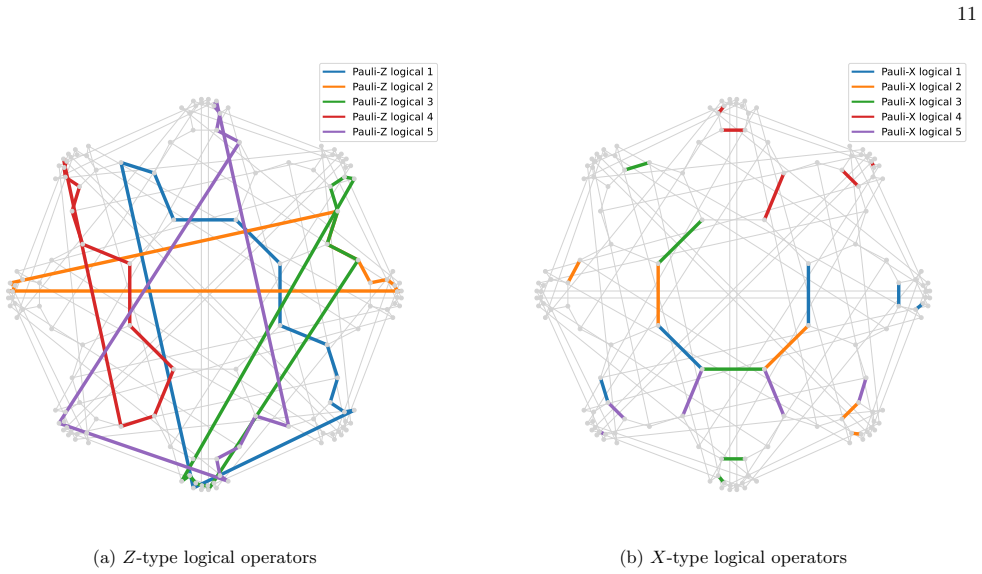


read the original abstract
Quantum error correction codes defined on hyperbolic lattices leverage the unique geometric properties of the hyperbolic space to enhance the performance of quantum error correction. By embedding qubits in hyperbolic lattices, these codes achieve higher encoding rates and lower qubit overhead compared to those defined on conventional Euclidean lattices. Building on recent advances in hyperbolic crystallography, we introduce a unified framework for the systematic construction and scalable benchmarking of CSS quantum error correction codes on hyperbolic lattices. A central component of this framework is the Hyperbolic Cycle Basis algorithm, which employs graph-theoretic methods to efficiently identify all plaquette cycles (parity-check supports) and nontrivial cycles (logical operators). This enables scalable and automated benchmarking of a broad class of CSS codes defined on hyperbolic geometries. We apply this framework to construct and simulate two representative hyperbolic quantum error correction codes (HQECCs), evaluating key performance metrics such as encoding rate, error threshold, and code distance for different sublattices. While HQECCs serve as concrete examples, the framework can be adapted to a wide range of CSS codes, including those with more intricate stabilizer structures such as Floquet codes. This work establishes a foundation for systematic exploration and benchmarking of CSS codes on hyperbolic lattices, paving the way toward practical, high-performance quantum error correction.
Editorial analysis
A structured set of objections, weighed in public.
Referee Report
Summary. The paper claims to introduce a unified framework for systematic construction and scalable benchmarking of CSS quantum error correction codes on hyperbolic lattices, building on hyperbolic crystallography. A central component is the Hyperbolic Cycle Basis algorithm, which uses graph-theoretic methods to identify all plaquette cycles (as parity-check supports) and nontrivial cycles (as logical operators). The framework is applied to two representative HQECCs, with evaluation of encoding rate, error threshold, and code distance for different sublattices; it is also positioned as adaptable to other CSS codes including Floquet codes.
Significance. If the Hyperbolic Cycle Basis algorithm is shown to be complete and correct, the work would provide a practical tool for automated construction and benchmarking of hyperbolic CSS codes, enabling exploration of geometries that promise higher encoding rates and reduced qubit overhead relative to Euclidean lattices. The emphasis on scalable, graph-based methods for cycle identification is a potential strength for reproducibility in this subfield.
major comments (2)
- [Hyperbolic Cycle Basis algorithm] The description of the Hyperbolic Cycle Basis algorithm provides no small-instance cross-check against standard linear-algebra methods for computing the cycle space, nor a formal argument for completeness when enumerating plaquette cycles and a basis for nontrivial cycles. In hyperbolic tilings the cycle space grows rapidly, so any omission or over-inclusion would directly affect the parity-check matrix and the reported distance, threshold, and encoding-rate values for the two example codes.
- [Application to two representative codes] The simulation results for the two representative HQECCs (encoding rate, threshold, distance) rest on the assumption that the algorithm has correctly produced the stabilizer and logical operators; without the missing verification step, these metrics cannot be taken as validated properties of the underlying hyperbolic codes.
minor comments (1)
- The abstract states that the framework can be adapted to Floquet codes, but the manuscript supplies no concrete indication of how the cycle-basis construction would be modified for time-dependent or non-CSS stabilizer structures.
Simulated Author's Rebuttal
We thank the referee for their careful reading of the manuscript and for highlighting the need for explicit verification of the Hyperbolic Cycle Basis algorithm. We address each major comment below and will incorporate the suggested additions in a revised version.
read point-by-point responses
-
Referee: [Hyperbolic Cycle Basis algorithm] The description of the Hyperbolic Cycle Basis algorithm provides no small-instance cross-check against standard linear-algebra methods for computing the cycle space, nor a formal argument for completeness when enumerating plaquette cycles and a basis for nontrivial cycles. In hyperbolic tilings the cycle space grows rapidly, so any omission or over-inclusion would directly affect the parity-check matrix and the reported distance, threshold, and encoding-rate values for the two example codes.
Authors: We agree that an explicit small-instance cross-check and a formal completeness argument would strengthen the presentation. In the revised manuscript we will add a dedicated verification subsection that compares the output of the Hyperbolic Cycle Basis algorithm against the cycle space obtained via standard linear-algebra methods (null-space computation over GF(2)) on a small, explicitly enumerated hyperbolic lattice. We will also supply a concise formal argument establishing that the algorithm enumerates a complete basis for the plaquette cycles and a maximal set of independent nontrivial cycles, drawing on the known properties of the underlying graph and the hyperbolic tiling. These additions will directly confirm the correctness of the parity-check matrices used for the reported metrics. revision: yes
-
Referee: [Application to two representative codes] The simulation results for the two representative HQECCs (encoding rate, threshold, distance) rest on the assumption that the algorithm has correctly produced the stabilizer and logical operators; without the missing verification step, these metrics cannot be taken as validated properties of the underlying hyperbolic codes.
Authors: We concur that the reported performance metrics are only as reliable as the operator identification step. Once the verification subsection described above is included, the simulation results for the two example codes will rest on explicitly validated stabilizer and logical operators. In the revised text we will also add a short statement clarifying that all numerical results are conditional on the correctness of the cycle-basis construction, which will have been demonstrated by the cross-check and formal argument. revision: yes
Circularity Check
No circularity: framework introduces independent graph algorithm without reduction to inputs or self-citations
full rationale
The paper presents a new Hyperbolic Cycle Basis algorithm using standard graph-theoretic methods to enumerate plaquette and nontrivial cycles on hyperbolic lattices, then applies it to construct and benchmark two CSS codes. No derivation chain reduces a claimed result (encoding rate, threshold, distance) to a fitted parameter or self-referential definition; the algorithm is described as a computational tool whose outputs are then measured. The abstract explicitly positions the work as building on external advances in hyperbolic crystallography rather than prior author work. No self-citation load-bearing steps, ansatz smuggling, or renaming of known results appear in the provided text. The derivation is therefore self-contained against external benchmarks.
Axiom & Free-Parameter Ledger
axioms (2)
- domain assumption Hyperbolic lattices possess unique geometric properties that enable higher encoding rates and lower qubit overhead for quantum error correction codes compared to Euclidean lattices.
- domain assumption Graph-theoretic methods can efficiently and completely identify all plaquette cycles and nontrivial cycles in hyperbolic lattice graphs.
Lean theorems connected to this paper
-
IndisputableMonolith/Foundation/AlexanderDuality.leanalexander_duality_circle_linking echoes?
echoesECHOES: this paper passage has the same mathematical shape or conceptual pattern as the Recognition theorem, but is not a direct formal dependency.
Theorem 2. ... a valid cycle basis ... F-1 contractible cycles of length p ... and 2g non-contractible cycles ... generate H1(M)
What do these tags mean?
- matches
- The paper's claim is directly supported by a theorem in the formal canon.
- supports
- The theorem supports part of the paper's argument, but the paper may add assumptions or extra steps.
- extends
- The paper goes beyond the formal theorem; the theorem is a base layer rather than the whole result.
- uses
- The paper appears to rely on the theorem as machinery.
- contradicts
- The paper's claim conflicts with a theorem or certificate in the canon.
- unclear
- Pith found a possible connection, but the passage is too broad, indirect, or ambiguous to say the theorem truly supports the claim.
Forward citations
Cited by 1 Pith paper
-
Quasi-Orthogonal Stabilizer Design for Efficient Quantum Error Suppression
Quasi-orthogonal stabilizer codes relax orthogonality constraints to achieve higher logical rates and up to two orders of magnitude better error suppression under depolarizing noise.
Reference graph
Works this paper leans on
-
[1]
for each edgeein Λ there is a unique edgee ′ such thate ′ =γ(e) forγ∈Γ, whereγare the side- pairing transformations,
-
[2]
For each set of vertices identified as a result of the edge-pairing transformations, the sum of the angles has to be equal to 2π. Theorem 1.(Poincar´ e) A compact polygonPsatisfying the side and angle conditions is the fundamental domain of the groupΓgenerated by the side-pairing transforma- tions ofP. III. FINITE HYPERBOLIC LA TTICES In this section, we ...
-
[3]
Select a hyperbolic tessellation{p, q}of the Poincar´ e disk with an associated Bravais lattice {pB, qB}
-
[4]
Apply Algorithm 1 to construct a periodic{p, q} lattice. LetGdenote the graph representation of the{p, q}lattice before imposing the PBCs, and let GP BC denote the corresponding graph after impos- ing the PBCs
-
[5]
InputGandG P BC into Algorithm 3 to compute all plaquette cycles and determine the logical oper- ators of the HQECC
-
[6]
UseG P BC obtained from Algorithm 1 and the set of logical operators obtained from Algorithm 3 as inputs into Algorithm 2 to compute the code dis- tanced
-
[7]
These are the parameters of the HQECC
As discussed before, the number of physical qubits is the number of edgesEinG P BC, and the number of logical qubits is given by 2h, wherehis the genus of the underlying Riemann surface defined in (26). These are the parameters of the HQECC
-
[8]
Using this framework, one can also simulate a HQECC and make an estimate of the code’s error threshold corresponding to a specified error model. VI. NUMERICAL SIMULA TIONS To demonstrate the utility and versatility of this framework, we apply it to simulate two representa- tive HQECCs derived from two hyperbolic tessellations {8,3},{10,3}of the Poincar´ e...
-
[9]
An Introduction to Quantum Error Correction and Fault-Tolerant Quantum Computation
D. Gottesman, An introduction to quantum error cor- rection and fault-tolerant quantum computation, arXiv preprint arXiv:0904.2557 (2009)
work page internal anchor Pith review Pith/arXiv arXiv 2009
-
[10]
B. M. Terhal, Quantum error correction for quantum 15 200 300 400 500 600 700 800 Number of edges E 6 7 8 9 10 11 12Runtime T (seconds) Measured runtime Least-squares linear fit FIG. 5: Measured runtime required to execute the HCB algorithm for five{8,3}tilings considered in this work as a function of the number of edgesE. The cycle–enumeration cutoff was...
work page 2015
-
[11]
N. P. Breuckmann and J. N. Eberhardt, Quantum low- density parity-check codes, PRX quantum2, 040101 (2021)
work page 2021
-
[12]
A. Y. Kitaev, Fault-tolerant quantum computation by anyons, Annals of Physics303, 2 (2003)
work page 2003
- [13]
-
[14]
N. P. Breuckmann and B. M. Terhal, Constructions and noise threshold of hyperbolic surface codes, IEEE Trans- actions on Information Theory62, 3731 (2016)
work page 2016
-
[15]
N. P. Breuckmann, C. Vuillot, E. Campbell, A. Kr- ishna, and B. M. Terhal, Hyperbolic and semi-hyperbolic surface codes for quantum storage, arXiv preprint arXiv:1703.00590 (2017)
work page internal anchor Pith review Pith/arXiv arXiv 2017
-
[16]
C. Albuquerque, R. Palazzo, and E. Silva, Topological quantum codes on compact surfaces with genusg≥2, Journal of mathematical physics50(2009)
work page 2009
-
[17]
I. H. Kim,Quantum codes on Hurwitz surfaces, Ph.D. thesis, Massachusetts Institute of Technology (2007)
work page 2007
-
[18]
M. B. Hastings and J. Haah, Dynamically generated log- ical qubits, Quantum5, 564 (2021)
work page 2021
- [19]
-
[20]
O. Higgott and N. P. Breuckmann, Constructions and performance of hyperbolic and semi-hyperbolic floquet codes, PRX Quantum5, 040327 (2024)
work page 2024
-
[21]
J. G. Ratcliffe,Foundations of hyperbolic manifolds (Springer, 2006)
work page 2006
-
[22]
I. Boettcher, A. V. Gorshkov, A. J. Koll´ ar, J. Maciejko, S. Rayan, and R. Thomale, Crystallography of hyperbolic lattices, Physical Review B105, 125118 (2022)
work page 2022
-
[23]
A. J. Koll´ ar, M. Fitzpatrick, and A. A. Houck, Hyper- bolic lattices in circuit quantum electrodynamics, Nature 571, 45 (2019)
work page 2019
-
[24]
T. Bzduˇ sek and J. Maciejko, Flat bands and band- touching from real-space topology in hyperbolic lattices, Physical Review B106, 155146 (2022)
work page 2022
-
[25]
A. J. Koll´ ar, M. Fitzpatrick, P. Sarnak, and A. A. Houck, Line-graph lattices: Euclidean and non-euclidean flat bands, and implementations in circuit quantum elec- trodynamics, Communications in Mathematical Physics 376, 1909 (2020)
work page 1909
-
[26]
A. F. Beardon,The Geometry of Discrete Groups, Vol. 91 (Springer, 2012)
work page 2012
-
[27]
Katok,Fuchsian Groups(University of Chicago Press, 1992)
S. Katok,Fuchsian Groups(University of Chicago Press, 1992)
work page 1992
-
[28]
Stillwell,Geometry of Surfaces(Springer, 1995)
J. Stillwell,Geometry of Surfaces(Springer, 1995)
work page 1995
-
[29]
M. P. Do Carmo,Differential Geometry of Curves and Surfaces: Revised and Updated Second Edition(Courier Dover Publications, 2016)
work page 2016
-
[30]
P. Schmutz, Riemann surfaces with shortest geodesic of maximal length, Geometric and Functional Analysis (GAFA)3, 564 (1993)
work page 1993
-
[31]
M. Conder and P. Dobcs´ anyi, Applications and adapta- tions of the low index subgroups procedure, Mathematics of Computation74, 485 (2005)
work page 2005
-
[32]
D. Firth,An algorithm to find normal subgroups of a finitely presented group, up to a given finite index, Ph.D. thesis, University of Warwick (2005). [25]GAP – Groups, Algorithms, and Programming, Version 4.11.1, The GAP Group (2021)
work page 2005
-
[33]
F. Rober, Lins: provides an algorithm for computing the normal subgroups of a finitely presented group up to some given index bound, version 0.9, urlhttps://gap-packages.github.io/LINS/ (2024), gAP package
work page 2024
-
[34]
A. Dietze and M. Schaps, Determining subgroups of a given finite index in a finitely presented group, Canadian Journal of Mathematics26, 769 (1974)
work page 1974
-
[35]
J. A. Todd and H. S. M. Coxeter, A practical method for enumerating cosets of a finite abstract group, Pro- ceedings of the Edinburgh Mathematical Society5, 26 (1936)
work page 1936
-
[36]
A. Chen, J. Maciejko, and I. Boettcher, Anderson local- ization transition in disordered hyperbolic lattices, Phys- ical Review Letters133, 066101 (2024)
work page 2024
-
[37]
J. Maciejko and S. Rayan, Automorphic bloch theo- rems for hyperbolic lattices, Proceedings of the National Academy of Sciences119, e2116869119 (2022)
work page 2022
-
[38]
T. Tummuru, A. Chen, P. M. Lenggenhager, T. Neupert, J. Maciejko, and T. Bzduˇ sek, Hyperbolic non-abelian semimetal, Physical Review Letters132, 206601 (2024)
work page 2024
-
[39]
M. Freedman, A. Kitaev, M. Larsen, and Z. Wang, Topo- logical quantum computation, Bulletin of the American Mathematical Society40, 31 (2003)
work page 2003
-
[40]
Gottesman,Stabilizer codes and quantum error cor- rection, Ph.D
D. Gottesman,Stabilizer codes and quantum error cor- rection, Ph.D. thesis, California Institute of Technology (1997)
work page 1997
-
[41]
Hatcher,Algebraic Topology(Cambridge University Press, 2002)
A. Hatcher,Algebraic Topology(Cambridge University Press, 2002)
work page 2002
-
[42]
K. Paton, An algorithm for finding a fundamental set of cycles of a graph, Communications of the ACM12, 514 (1969)
work page 1969
-
[43]
T. Kavitha, K. Mehlhorn, D. Michail, and K. E. Paluch, An algorithm for minimum cycle basis of graphs, Algo- rithmica52, 333 (2008)
work page 2008
-
[44]
A. A. Mahmoud and K. M. Ali, HQECC-Threshold Sim- ulation Code, Zenodo (2026). 16
work page 2026
-
[45]
A. A. Mahmoud and K. M. Ali, HQECC- Threshold GitHub Repository (2026),https: //github.com/AhmeedAdelMahmoud/HQECC-Threshold. Accessed: 2026-03-15
work page 2026
-
[46]
N. Delfosse and N. H. Nickerson, Almost-linear time de- coding algorithm for topological codes, Quantum5, 595 (2021)
work page 2021
- [47]
- [48]
-
[49]
N. Delfosse, Tradeoffs for reliable quantum information storage in surface codes and color codes, in2013 IEEE International Symposium on Information Theory(IEEE,
-
[50]
M. Davydova, N. Tantivasadakarn, and S. Balasubra- manian, Floquet codes without parent subsystem codes, PRX Quantum4, 020341 (2023)
work page 2023
-
[51]
M. S. Kesselring, J. C. Magdalena de la Fuente, F. Thom- sen, J. Eisert, S. D. Bartlett, and B. J. Brown, Anyon condensation and the color code, PRX Quantum5, 010342 (2024)
work page 2024
-
[52]
W. S. Soares Jr. and E. B. da Silva, Hyperbolic quantum color codes, Quantum Information and Computation18, 306 (2018)
work page 2018
-
[53]
D. B. Johnson, Finding all the elementary circuits of a di- rected graph, SIAM Journal on Computing4, 77 (1975)
work page 1975
-
[54]
E. Birmel´ e, R. Ferreira, R. Grossi, A. Marino, N. Pisanti, R. Rizzi, and G. Sacomoto, Optimal listing of cycles and st-paths in undirected graphs, inProceedings of the twenty-fourth annual ACM-SIAM symposium on Dis- crete algorithms(SIAM, 2013) pp. 1884–1896
work page 2013
-
[55]
A. Gupta and T. Suzumura, Finding all bounded- length simple cycles in a directed graph, arXiv preprint arXiv:2105.10094 (2021)
discussion (0)
Sign in with ORCID, Apple, or X to comment. Anyone can read and Pith papers without signing in.