Long-Range Antiferromagnetic Order in the AKLT Model on Trees and Treelike Graphs
Pith reviewed 2026-05-21 19:15 UTC · model grok-4.3
The pith
The AKLT model has long-range antiferromagnetic order on trees and treelike graphs that meet specified conditions.
A machine-rendered reading of the paper's core claim, the machinery that carries it, and where it could break.
Core claim
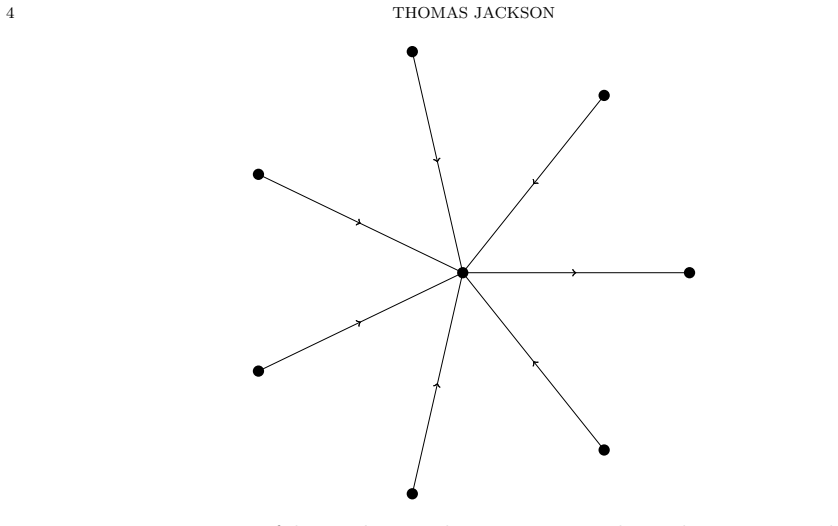
We extend the result of Fannes, Nachtergaele, and Werner on long-range order in the AKLT model on Cayley trees to include various trees and tree-like graphs that obey certain conditions. Our examples split into three cases: Cayley-like tree-like graphs generated by a finite subgraph, for which we have a simple condition; arbitrary trees with a prescribed growth rate of their volume; and bilayer Cayley trees.
What carries the argument
Adaptation of the Fannes-Nachtergaele-Werner argument to graphs satisfying one of three structural conditions: generation by a finite subgraph, prescribed volume growth rate, or bilayer Cayley structure.
If this is right
- Long-range antiferromagnetic order holds for Cayley-like tree-like graphs generated by a finite subgraph under the simple condition given.
- Long-range antiferromagnetic order holds for arbitrary trees whose volume grows at the prescribed rate.
- Long-range antiferromagnetic order holds for bilayer Cayley trees.
Where Pith is reading between the lines
- The same adaptation technique may apply to other irregular lattices that share comparable local growth rules.
- Testing the necessity of the volume-growth or bilayer conditions could clarify how much graph irregularity the order can tolerate.
- Similar extensions might be attempted for related spin models whose ground states are known on regular trees.
Load-bearing premise
The graphs must satisfy the specific conditions stated for each of the three cases that allow the original argument to apply.
What would settle it
A concrete counter-example would be any tree or treelike graph obeying one of the three listed conditions yet showing no long-range antiferromagnetic order when the AKLT Hamiltonian is placed on it.
Figures


read the original abstract
We extend the result of Fannes, Nachtergaele, and Werner on long-range order in the AKLT model on Cayley trees to include various trees and tree-like graphs that obey certain conditions. Our examples split into three cases: Cayley-like tree-like graphs generated by a finite subgraph, for which we have a simple condition; arbitrary trees with a prescribed growth rate of their volume; and bilayer Cayley trees.
Editorial analysis
A structured set of objections, weighed in public.
Referee Report
Summary. The manuscript extends the Fannes-Nachtergaele-Werner result establishing long-range antiferromagnetic order in the AKLT model on Cayley trees to three classes of graphs: (i) Cayley-like tree-like graphs generated by a finite subgraph under a simple condition, (ii) arbitrary trees with a prescribed volume growth rate, and (iii) bilayer Cayley trees. The proofs adapt the recursive boundary-field propagation argument of the original FNW work to these settings.
Significance. If the claims hold rigorously, the work meaningfully enlarges the class of graphs on which the AKLT model is proven to exhibit long-range antiferromagnetic order, moving beyond regular branching to irregular trees and bilayers under explicit growth or structural hypotheses. This strengthens the applicability of the FNW recursion method and supplies concrete, checkable conditions for future examples on non-homogeneous lattices.
major comments (1)
- [§4] §4 (arbitrary trees with prescribed volume growth rate): The volume-growth hypothesis is used to control the inward propagation of the effective spin-1/2 boundary field. However, this global condition does not preclude the existence of arbitrarily long paths along which the local branching number drops to 1 for extended segments. Along such paths the boundary field decays exponentially (as in the one-dimensional AKLT chain), which can drive the local staggered magnetization to zero before reaching the root and thereby destroy the uniform positive lower bound required for long-range order. An explicit estimate showing that the growth rate forces a uniform lower bound despite such fluctuations is needed; without it the central claim for this class rests on an unverified uniformity assumption.
minor comments (2)
- [Introduction] The statement of the three cases in the introduction would benefit from explicit cross-references to the corresponding theorems and definitions.
- [§2] In the definition of the staggered magnetization, the choice of bipartition for general trees should be stated explicitly rather than left implicit.
Simulated Author's Rebuttal
We thank the referee for the careful reading and the constructive major comment on our extension of the Fannes-Nachtergaele-Werner result. We address the concern regarding uniformity in the volume-growth case for arbitrary trees.
read point-by-point responses
-
Referee: §4 (arbitrary trees with prescribed volume growth rate): The volume-growth hypothesis is used to control the inward propagation of the effective spin-1/2 boundary field. However, this global condition does not preclude the existence of arbitrarily long paths along which the local branching number drops to 1 for extended segments. Along such paths the boundary field decays exponentially (as in the one-dimensional AKLT chain), which can drive the local staggered magnetization to zero before reaching the root and thereby destroy the uniform positive lower bound required for long-range order. An explicit estimate showing that the growth rate forces a uniform lower bound despite such fluctuations is needed; without it the central claim for this class rests on an unverified uniformity assumption.
Authors: We agree that the current text does not supply an explicit estimate controlling the effect of possible long low-branching segments. While the global volume-growth hypothesis |V_n| ≥ c r^n (r > 1) is used to bound the recursion, a direct argument ruling out destructive decay along individual paths is missing. In the revised version we will insert a new lemma that derives a uniform positive lower bound on the effective field reaching the root. The argument proceeds by showing that any path segment of length L with branching number 1 contributes only O(L) to the volume up to distance n; the exponential growth requirement then forces a compensating increase in branching elsewhere in the tree. Because the boundary-field recursion is monotone in the branching number, the stronger fields arriving from the high-branching subtrees dominate the decay along the weak path, yielding a root-field strength bounded below by a positive constant that depends only on r and the AKLT coupling. This estimate will be added to §4 together with a short discussion of the worst-case path length compatible with the growth rate. revision: yes
Circularity Check
Extension of independent FNW result under graph conditions shows no circularity
full rationale
The paper applies the external Fannes-Nachtergaele-Werner recursion argument (controlling boundary spin-1/2 fields on uniform-branching Cayley trees) to three classes of graphs satisfying explicit, independently verifiable conditions: Cayley-like generation by a finite subgraph, prescribed volume growth rate, or bilayer structure. These conditions are stated as graph-theoretic hypotheses that preserve the uniform lower bound on staggered magnetization in the thermodynamic limit; the derivation does not redefine the order parameter in terms of itself, rename a fit as a prediction, or rely on any self-citation chain. The foundational uniqueness or recursion control is imported from non-overlapping prior authors and remains externally falsifiable. No load-bearing step reduces by construction to the paper's own inputs.
Axiom & Free-Parameter Ledger
Lean theorems connected to this paper
-
IndisputableMonolith/Foundation/AlexanderDuality.leanalexander_duality_circle_linking unclear?
unclearRelation between the paper passage and the cited Recognition theorem.
If ln(μ) := lim (1/n) Σ ln((d_i-1)/3) >0 then the infinite composition ∘F_{d_i}(x)>0 … ground state is not unique (Theorem 5.1)
-
IndisputableMonolith/Cost/FunctionalEquation.leanwashburn_uniqueness_aczel unclear?
unclearRelation between the paper passage and the cited Recognition theorem.
F_d(t) = -1/(d+1) (d coth(d artanh t) - 1/t) and bounds used for iterates
What do these tags mean?
- matches
- The paper's claim is directly supported by a theorem in the formal canon.
- supports
- The theorem supports part of the paper's argument, but the paper may add assumptions or extra steps.
- extends
- The paper goes beyond the formal theorem; the theorem is a base layer rather than the whole result.
- uses
- The paper appears to rely on the theorem as machinery.
- contradicts
- The paper's claim conflicts with a theorem or certificate in the canon.
- unclear
- Pith found a possible connection, but the passage is too broad, indirect, or ambiguous to say the theorem truly supports the claim.
Forward citations
Cited by 2 Pith papers
-
Local Topological Quantum Order and Spectral Gap Stability for the AKLT Models on the Hexagonal and Lieb Lattices
AKLT models on hexagonal and Lieb lattices satisfy LTQO via polymer expansions, implying spectral gap stability under perturbations.
-
Local Topological Quantum Order and Spectral Gap Stability for the AKLT Models on the Hexagonal and Lieb Lattices
Proves LTQO for AKLT models on hexagonal and Lieb lattices by modifying the 1988 polymer representation to obtain uniform exponential decay of boundary effects.
Reference graph
Works this paper leans on
-
[1]
Ian Affleck, Tom Kennedy, Elliott H. Lieb, and Hal Tasaki. Rigorous results on valence-bond ground states in antiferromagnets.Phys. Rev. Lett., 59:799–802, Aug 1987
work page 1987
-
[2]
Daniel P. Arovas, Assa Auerbach, and F. D. M. Haldane. Extended Heisenberg models of antiferromagnetism: Analogies to the fractional quantum Hall effect.Phys. Rev. Lett., 60:531–534, Feb 1988
work page 1988
- [3]
-
[4]
F. D. M. Haldane. Nonlinear field theory of large-spin Heisenberg antiferromagnets: Semiclassically quantized solitons of the one-dimensional easy-axis N´ eel state.Phys. Rev. Lett., 50:1153–1156, Apr 1983
work page 1983
-
[5]
Two-dimensional isotropic quantum antiferromagnet with unique disordered ground state.J
T Kennedy, E H Lieb, and H Tasaki. Two-dimensional isotropic quantum antiferromagnet with unique disordered ground state.J. Stat. Phys.; (United States), 53, 10 1988
work page 1988
-
[6]
Rom´ an Or´ us. A practical introduction to tensor networks: Matrix product states and projected entangled pair states.Annals of Physics, 349:117–158, October 2014
work page 2014
-
[7]
D. Perez-Garcia, F. Verstraete, M. M. Wolf, and J. I. Cirac. Matrix product state representations, 2007
work page 2007
-
[8]
Order, disorder, and transitions in decorated AKLT states on Bethe lattices, 2021
Nicholas Pomata. Order, disorder, and transitions in decorated AKLT states on Bethe lattices, 2021
work page 2021
-
[9]
Courier Dover Publications, 2018
Hubert Stanley Wall.Analytic theory of continued fractions. Courier Dover Publications, 2018. (Thomas Jackson)Department of Mathematics and Center for Quantum Mathematics and Physics, University of California, Davis, CA 95616-8633, USA (Thomas Jackson)Department of Mathematics, United Arab Emirates University, Al Ain, Abu Dhabi, UAE
work page 2018
discussion (0)
Sign in with ORCID, Apple, or X to comment. Anyone can read and Pith papers without signing in.