Coherent deeply virtual Compton scattering on helium-4 beyond leading power
Pith reviewed 2026-05-21 00:01 UTC · model grok-4.3
The pith
Twist-3, twist-4 and NLO corrections enable a precise description of DVCS data on helium-4 and yield its first quark-gluon tomographic image.
A machine-rendered reading of the paper's core claim, the machinery that carries it, and where it could break.
Core claim
By including kinematic twist-3 and twist-4 corrections together with next-to-leading-order corrections to the twist-2 amplitude, the calculation achieves a precise description of the measured cross sections and asymmetries for deeply virtual Compton scattering on helium-4, thereby extracting the first tomographic image of the helium-4 nucleus at the quark-gluon level.
What carries the argument
Nuclear generalized parton distributions corrected by computed twist-3, twist-4, and NLO contributions, which encode the three-dimensional quark and gluon structure of the nucleus.
If this is right
- The data on coherent DVCS from helium-4 can now be described to the precision of current experiments.
- The first three-dimensional quark-gluon image of the helium-4 nucleus has been obtained.
- Higher-twist and NLO contributions must be retained to reach quantitative agreement with nuclear DVCS measurements.
- The extracted nuclear GPDs provide a concrete starting point for predicting other hard exclusive processes on helium-4.
Where Pith is reading between the lines
- The same correction strategy could be applied to DVCS or other hard exclusive reactions on additional light nuclei such as helium-3 or deuterium.
- Future lattice-QCD calculations of nuclear GPDs could be directly compared with the fitted distributions obtained here.
- If the extracted image proves robust, similar tomographic methods might become standard for mapping partonic structure inside few-nucleon systems.
Load-bearing premise
The chosen parametrization of nuclear generalized parton distributions, once supplemented by the included twist-3, twist-4, and NLO terms, is sufficient to describe the data without further nuclear effects or uncalculated higher-order contributions.
What would settle it
A new precision measurement of the DVCS beam-spin asymmetry or cross section on helium-4 that lies outside the uncertainty band obtained after applying the twist-3, twist-4, and NLO corrections would falsify the central claim.
Figures
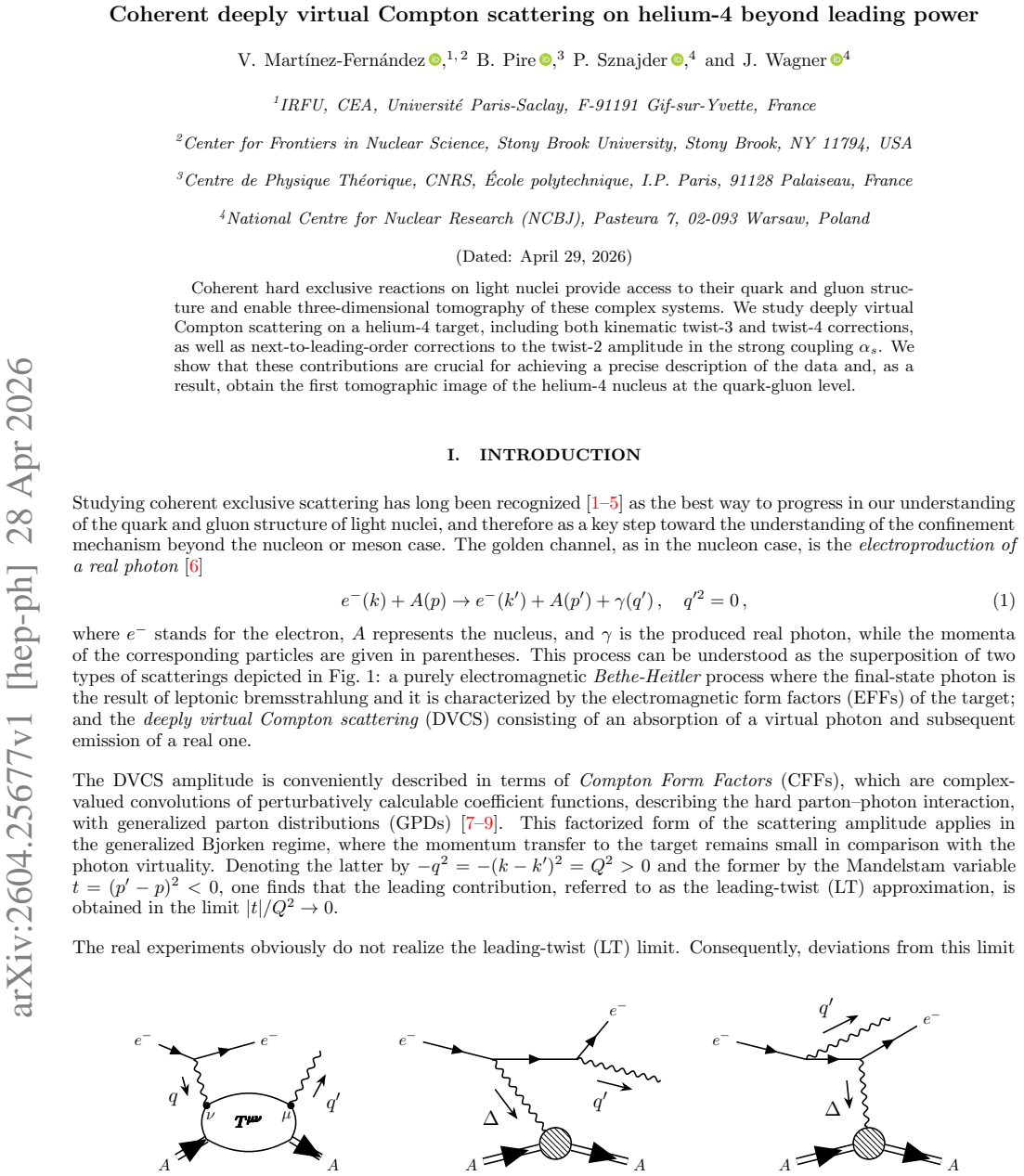



read the original abstract
Coherent hard exclusive reactions on light nuclei provide access to their quark and gluon structure and enable three-dimensional tomography of these complex systems. We study deeply virtual Compton scattering on a helium-4 target, including both kinematic twist-3 and twist-4 corrections, as well as next-to-leading-order corrections to the twist-2 amplitude in the strong coupling $\alpha_s$. We show that these contributions are crucial for achieving a precise description of the data and, as a result, obtain the first tomographic image of the helium-4 nucleus at the quark-gluon level.
Editorial analysis
A structured set of objections, weighed in public.
Referee Report
Summary. The manuscript studies coherent deeply virtual Compton scattering (DVCS) on a helium-4 target. It computes kinematic twist-3 and twist-4 corrections together with next-to-leading-order (NLO) corrections in α_s to the twist-2 amplitude, and claims that these contributions are essential for achieving a precise description of existing data. As a result, the authors extract the first tomographic image of the 4He nucleus at the quark-gluon level by fitting a parametrized nuclear generalized parton distribution (GPD).
Significance. If the amplitude calculations and the subsequent data description hold, the work is significant because it demonstrates that beyond-leading-power corrections are necessary for reliable phenomenology in nuclear DVCS and thereby opens a route to three-dimensional partonic tomography of light nuclei. The explicit inclusion of twist-3, twist-4, and NLO terms addresses a known limitation of leading-twist analyses and supplies a concrete example of how such corrections affect extracted nuclear GPDs.
major comments (2)
- [§5] §5 (results and tomography section): The tomographic image is obtained by fitting the chosen nuclear GPD parametrization to the same DVCS data set after the computed corrections are added. Because the model parameters are adjusted to reproduce the data, it is unclear how much of the reported improvement is attributable to the higher-twist and NLO terms versus the flexibility of the GPD functional form. A quantitative decomposition (e.g., χ² change when each class of correction is switched on or off) is needed to substantiate the claim that the corrections are “crucial.”
- [§4.2] §4.2 (amplitude and nuclear modeling): The central assumption that the corrected amplitude plus the adopted nuclear GPD parametrization suffices without additional nuclear dynamics (binding, off-shellness, or final-state interactions) is load-bearing for the tomography claim. No comparison is shown to alternative models that incorporate such effects, so it remains possible that the improved fit is an artifact of the restricted parametrization rather than evidence that all relevant physics has been captured.
minor comments (2)
- The notation distinguishing the nuclear GPD from the nucleon GPD is introduced only after Eq. (8); an earlier explicit definition or a dedicated table of symbols would improve readability.
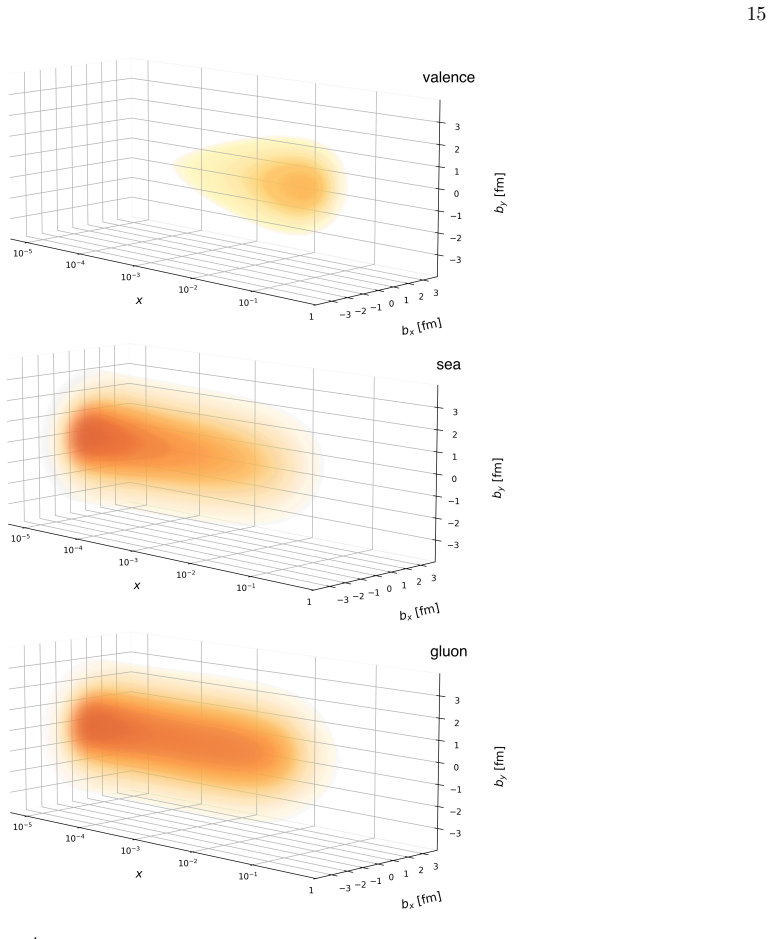
- [Figure 4] Figure 4 (tomographic image): error bands or uncertainty bands arising from the GPD parameter variations and from the higher-twist corrections should be displayed to allow the reader to judge the robustness of the extracted image.
Simulated Author's Rebuttal
We thank the referee for the careful reading of our manuscript and the constructive comments. We address each major comment below and describe the revisions made to strengthen the presentation.
read point-by-point responses
-
Referee: §5 (results and tomography section): The tomographic image is obtained by fitting the chosen nuclear GPD parametrization to the same DVCS data set after the computed corrections are added. Because the model parameters are adjusted to reproduce the data, it is unclear how much of the reported improvement is attributable to the higher-twist and NLO terms versus the flexibility of the GPD functional form. A quantitative decomposition (e.g., χ² change when each class of correction is switched on or off) is needed to substantiate the claim that the corrections are “crucial.”
Authors: We agree that a quantitative decomposition is necessary to isolate the contribution of the higher-twist and NLO corrections from the flexibility of the GPD parametrization. In the revised manuscript we have added a new table in §5 that reports the χ² per degree of freedom for successive fits: twist-2 amplitude only, plus kinematic twist-3, plus twist-4, and finally plus NLO α_s corrections. The table shows a clear, stepwise improvement in fit quality that cannot be reproduced by readjusting the GPD parameters alone, thereby substantiating that the computed corrections are crucial. revision: yes
-
Referee: §4.2 (amplitude and nuclear modeling): The central assumption that the corrected amplitude plus the adopted nuclear GPD parametrization suffices without additional nuclear dynamics (binding, off-shellness, or final-state interactions) is load-bearing for the tomography claim. No comparison is shown to alternative models that incorporate such effects, so it remains possible that the improved fit is an artifact of the restricted parametrization rather than evidence that all relevant physics has been captured.
Authors: We acknowledge the validity of this observation. Our nuclear GPD parametrization is phenomenological and fitted to data, so it can absorb some effective nuclear-medium corrections. We have expanded the discussion in §4.2 of the revised manuscript to state this assumption explicitly, to note that binding, off-shellness and final-state interactions are not modeled at the microscopic level, and to indicate that a systematic comparison with more elaborate nuclear models lies beyond the present scope but is a natural direction for future work. revision: partial
Circularity Check
Tomographic image obtained via GPD parametrization fit to DVCS data after corrections
specific steps
-
fitted input called prediction
[Abstract]
"We show that these contributions are crucial for achieving a precise description of the data and, as a result, obtain the first tomographic image of the helium-4 nucleus at the quark-gluon level."
The tomographic image is produced by fitting the parameters of the nuclear generalized parton distribution model to the DVCS data once the computed twist-3, twist-4 and NLO corrections have been added. Consequently the 'image' is the fitted functional form itself rather than an independent prediction or derivation; any improvement in description is statistically forced by the adjustment of the same parameters used to match the data.
full rationale
The paper computes kinematic twist-3, twist-4 and NLO corrections to the DVCS amplitude and includes them in a fit of a chosen nuclear GPD parametrization to existing data on coherent DVCS off 4He. The resulting best-fit GPD is then presented as the first quark-gluon tomographic image. This constitutes a fitted-input-called-prediction pattern: the image is not an independent first-principles output but the direct consequence of adjusting model parameters to reproduce the same data set whose description is claimed to be improved. The derivation chain remains self-contained for the correction terms themselves, which are calculated within the chosen framework, but the central claim of tomography inherits the circularity burden typical of phenomenological extractions where the model form is tuned to the validation data.
Axiom & Free-Parameter Ledger
free parameters (1)
- GPD model parameters
axioms (1)
- domain assumption Factorization theorem holds for the coherent DVCS amplitude on a spin-0 nucleus at the included twist orders
Forward citations
Cited by 1 Pith paper
-
Quark and gluon tomography of the helium-4 nucleus
Using NLO QCD calculations with twist corrections and evolution, the work delivers the first quark-gluon tomography of helium-4 via hard exclusive processes.
Reference graph
Works this paper leans on
-
[1]
E. R. Berger, F. Cano, M. Diehl, and B. Pire, Phys. Rev. Lett.87, 142302 (2001), hep-ph/0106192
work page internal anchor Pith review Pith/arXiv arXiv 2001
-
[2]
Deeply virtual Compton scattering off nuclei
A. Kirchner and D. Mueller, Eur. Phys. J. C32, 347 (2003), hep-ph/0302007
work page internal anchor Pith review Pith/arXiv arXiv 2003
-
[3]
DVCS on spinless nuclear targets in impulse approximation
V. Guzey and M. Strikman, Phys. Rev. C68, 015204 (2003), hep-ph/0301216
work page internal anchor Pith review Pith/arXiv arXiv 2003
-
[4]
Deep Electroproduction of Photons and Mesons on the Deuteron
F. Cano and B. Pire, Eur. Phys. J. A19, 423 (2004), hep-ph/0307231
work page internal anchor Pith review Pith/arXiv arXiv 2004
-
[5]
Generalized Parton Distributions of ^3He
S. Scopetta, Phys. Rev. C70, 015205 (2004), nucl-th/0404014
work page internal anchor Pith review Pith/arXiv arXiv 2004
-
[6]
A. V. Belitsky, D. Mueller, and A. Kirchner, Nucl. Phys. B629, 323 (2002), hep-ph/0112108
work page internal anchor Pith review Pith/arXiv arXiv 2002
-
[7]
X. Ji, Phys. Rev. Lett.78, 610 (1997), URLhttps://link.aps.org/doi/10.1103/PhysRevLett.78.610
-
[8]
A. V. Belitsky and A. V. Radyushkin, Phys. Rept.418, 1 (2005), hep-ph/0504030
work page internal anchor Pith review Pith/arXiv arXiv 2005
-
[9]
Generalized Parton Distributions
M. Diehl, Phys. Rept.388, 41 (2003), hep-ph/0307382
work page internal anchor Pith review Pith/arXiv arXiv 2003
- [10]
-
[11]
V. Martinez-Fernandez, B. Pire, P. Sznajder, and J. Wagner, Phys. Rev. D111, 074034 (2025), 2503.02461
- [12]
-
[13]
J. P. Ralston and B. Pire, Phys. Rev. D66, 111501 (2002), hep-ph/0110075
work page internal anchor Pith review Pith/arXiv arXiv 2002
-
[14]
Generalized parton distributions in impact parameter space
M. Diehl, Eur. Phys. J. C25, 223 (2002), [Erratum: Eur.Phys.J.C 31, 277–278 (2003)], hep-ph/0205208
work page internal anchor Pith review Pith/arXiv arXiv 2002
-
[15]
Revisiting the mechanical properties of the nucleon
C. Lorc´ e, H. Moutarde, and A. P. Trawi´ nski, Eur. Phys. J. C79, 89 (2019), 1810.09837
work page internal anchor Pith review Pith/arXiv arXiv 2019
-
[16]
V. Mart´ ınez-Fern´ andez and C. Mezrag (2025), 2509.05059
-
[17]
V. Mart´ ınez-Fern´ andez, D. Binosi, C. Mezrag, and Z.-Q. Yao (2025), 2509.06669. 18
-
[18]
B. Pire, L. Szymanowski, and J. Wagner, Phys. Rev. D83, 034009 (2011), 1101.0555
work page internal anchor Pith review Pith/arXiv arXiv 2011
-
[19]
A. V. Belitsky and D. Mueller, Phys. Lett. B486, 369 (2000), hep-ph/0005028
work page internal anchor Pith review Pith/arXiv arXiv 2000
-
[20]
V. Martinez-Fernandez, B. Pire, P. Sznajder, and J. Wagner (2026), in preparation
work page 2026
-
[21]
M. Hattawy, N. A. Baltzell, R. Dupr´ e, K. Hafidi, S. Stepanyan, S. B¨ ultmann, R. De Vita, A. El Alaoui, L. El Fassi, H. Egiyan, et al. (CLAS Collaboration), Phys. Rev. Lett.119, 202004 (2017), URLhttps://link.aps.org/doi/10.1103/ PhysRevLett.119.202004
work page 2017
-
[22]
R. Dupr´ e, M. Hattawy, N. A. Baltzell, S. B¨ ultmann, R. De Vita, A. El Alaoui, L. El Fassi, H. Egiyan, F. X. Girod, M. Guidal, et al. (CLAS Collaboration), Phys. Rev. C104, 025203 (2021), URLhttps://link.aps.org/doi/10.1103/ PhysRevC.104.025203
work page 2021
- [23]
-
[24]
Kleiss, Nuclear Physics B241, 61 (1984), ISSN 0550-3213
R. Kleiss, Nuclear Physics B241, 61 (1984), ISSN 0550-3213
work page 1984
-
[25]
R. Kleiss and W. Stirling, Nuclear Physics B262, 235 (1985), ISSN 0550-3213
work page 1985
-
[26]
Single-spin asymmetries: the Trento conventions
A. Bacchetta, U. D’Alesio, M. Diehl, and C. A. Miller, Phys. Rev. D70, 117504 (2004), hep-ph/0410050
work page internal anchor Pith review Pith/arXiv arXiv 2004
-
[27]
V. M. Braun, A. N. Manashov, and B. Pirnay, Phys. Rev. D86, 014003 (2012), hep-ph/1205.3332
work page internal anchor Pith review Pith/arXiv arXiv 2012
-
[28]
One-Loop Corrections and All Order Factorization In Deeply Virtual Compton Scattering
X.-D. Ji and J. Osborne, Phys. Rev. D58, 094018 (1998), hep-ph/9801260
work page internal anchor Pith review Pith/arXiv arXiv 1998
-
[29]
V. M. Braun, A. N. Manashov, D. M¨ uller, and B. M. Pirnay, Phys. Rev. D89, 074022 (2014), 1401.7621
work page internal anchor Pith review Pith/arXiv arXiv 2014
- [30]
-
[31]
A. V. Radyushkin, Phys. Rev. D59, 014030 (1999), hep-ph/9805342
work page internal anchor Pith review Pith/arXiv arXiv 1999
-
[32]
R. Abdul Khalek, R. Gauld, T. Giani, E. R. Nocera, T. R. Rabemananjara, and J. Rojo, Eur. Phys. J. C82, 507 (2022), 2201.12363
-
[33]
M. V. Polyakov and C. Weiss, Phys. Rev. D60, 114017 (1999), hep-ph/9902451
work page internal anchor Pith review Pith/arXiv arXiv 1999
-
[34]
V. Bertone, H. Dutrieux, C. Mezrag, J. M. Morgado, and H. Moutarde, Eur. Phys. J. C82, 888 (2022), 2206.01412
-
[35]
APFEL++: A new PDF evolution library in C++
V. Bertone, PoSDIS2017, 201 (2018), 1708.00911
work page internal anchor Pith review Pith/arXiv arXiv 2018
-
[36]
M. Hattawy et al. (CLAS), Phys. Rev. Lett.119, 202004 (2017), 1707.03361
work page internal anchor Pith review Pith/arXiv arXiv 2017
-
[37]
B. Pire, J. Soffer, and O. Teryaev, Eur. Phys. J. C8, 103 (1999), hep-ph/9804284
work page internal anchor Pith review Pith/arXiv arXiv 1999
-
[38]
Inequalities for nucleon generalized parton distributions with helicity flip
M. Kirch, P. V. Pobylitsa, and K. Goeke, Phys. Rev. D72, 054019 (2005), hep-ph/0507048
work page internal anchor Pith review Pith/arXiv arXiv 2005
- [39]
-
[40]
J. P. Repellin, P. Lehmann, J. Lefran¸ cois, and D. B. Isabelle, Phys. Lett.16, 169 (1965)
work page 1965
-
[41]
R. F. Frosch, J. S. McCarthy, R. e. Rand, and M. R. Yearian, Phys. Rev.160, 874 (1967)
work page 1967
-
[42]
R. G. Arnold et al., Phys. Rev. Lett.40, 1429 (1978)
work page 1978
-
[43]
C. R. Ottermann, G. Kobschall, K. Maurer, K. Rohrich, C. Schmitt, and V. H. Walther, Nucl. Phys. A436, 688 (1985)
work page 1985
-
[44]
JLab Measurement of the $^4$He Charge Form Factor at Large Momentum Transfers
A. Camsonne et al. (Jefferson Lab Hall A), Phys. Rev. Lett.112, 132503 (2014), 1309.5297
work page internal anchor Pith review Pith/arXiv arXiv 2014
-
[45]
Partonic Structure of Light Nuclei
W. Armstrong et al.,Partonic Structure of Light Nuclei(2017), 1708.00888
work page internal anchor Pith review Pith/arXiv arXiv 2017
-
[46]
Science Requirements and Detector Concepts for the Electron-Ion Collider: EIC Yellow Report
R. Abdul Khalek et al., Nucl. Phys. A1026, 122447 (2022), physics.ins-det/2103.05419
work page internal anchor Pith review Pith/arXiv arXiv 2022
- [47]
-
[48]
E. R. Berger, M. Diehl, and B. Pire, Eur. Phys. J.C23, 675 (2002), hep-ph/0110062
work page internal anchor Pith review Pith/arXiv arXiv 2002
-
[49]
O. Grocholski, H. Moutarde, B. Pire, P. Sznajder, and J. Wagner, Eur. Phys. J. C80, 171 (2020), 1912.09853
-
[50]
On timelike and spacelike hard exclusive reactions
D. Mueller, B. Pire, L. Szymanowski, and J. Wagner, Phys. Rev. D86, 031502 (2012), 1203.4392
work page internal anchor Pith review Pith/arXiv arXiv 2012
-
[51]
On timelike and spacelike deeply virtual Compton scattering at next to leading order
H. Moutarde, B. Pire, F. Sabatie, L. Szymanowski, and J. Wagner, Phys. Rev. D87, 054029 (2013), 1301.3819
work page internal anchor Pith review Pith/arXiv arXiv 2013
- [52]
- [53]
- [54]
-
[55]
O. Grocholski, B. Pire, P. Sznajder, L. Szymanowski, and J. Wagner, Phys. Rev. D105, 094025 (2022), 2204.00396
-
[56]
Exclusive photoproduction of a $\gamma\,\rho$ pair with a large invariant mass
R. Boussarie, B. Pire, L. Szymanowski, and S. Wallon, JHEP02, 054 (2017), [Erratum: JHEP 10, 029 (2018)], 1609.03830
work page internal anchor Pith review Pith/arXiv arXiv 2017
-
[57]
G. Duplanˇ ci´ c, S. Nabeebaccus, K. Passek-Kumeriˇ cki, B. Pire, L. Szymanowski, and S. Wallon, Phys. Rev. D107, 094023 (2023), 2302.12026
-
[58]
Exclusive electroproduction of lepton pairs as a probe of nucleon structure
A. V. Belitsky and D. Mueller, Phys. Rev. Lett.90, 022001 (2003), hep-ph/0210313. Appendix A: Kinematics In this section, we describe the kinematics of the process (1). The core of our calculation is performed in the “target rest frame” (TRF) that is related to the usual Trento frame [26] by a 180°rotation around they-axis. This TRF frame coincides with T...
work page internal anchor Pith review Pith/arXiv arXiv 2003
-
[59]
Momenta parameterization In TRF, the target is at rest so that the initial-state momentum is given by pµ = (M,0,0,0),(A1) while thez-axis is opposite to the incoming photon momentum, qµ = (q0,0,0,−|q 3|).(A2) Accounting for its spacelike virtuality,q 2 =−Q 2 <0, as well as thenuclear Bjorken variable,x A =Q 2/(2pq) = TRF Q2/(2M q0), we find qµ = Q ω (1,0,...
-
[60]
Longitudinal vs transverse plane The collinear factorization that gives rise to GPDs and CFFs requires a separation of dominant longitudinal kinematics (characterized by lightlike vectors) and subleading transverse components that are orthogonal to the former. In such a framework, any four-vector can be written as vµ =v +n′µ +v −nµ +v µ ⊥ ,(A15) wheren 2 ...
-
[61]
The first Bethe-Heitler amplitude, middle diagram in Fig. 1 For a configuration of beam and outgoing-photon polarizations given bysandλ, respectively, the amplitude of BH reads: iMsλ BH = −ie3 [(k−∆) 2 +i0] [t+i0] ε′ ρ(−λ)Jα ¯u(k′, s)γρ/k− /∆ γαu(k, s)| {z } T ρα (B1) whereeis the proton electric charge,Jis the non-elementary hadron current J µ =⟨p ′|jµ(0...
-
[62]
The second Bethe-Heitler amplitude, right diagram in Fig. 1 As for the case before, for a configuration of beam and outgoing-photon polarizations given bysandλ, respectively, the amplitude of the BHX subprocess reads: iMsλ BHX = −ie3 [(k−q ′)2 +i0] [t+i0] Jαε′ ρ(−λ) ¯u(k′, s)γα/k− /q′ γρu(k, s) | {z } T αρ X (B18) Following the same steps as for BH, we fi...
discussion (0)
Sign in with ORCID, Apple, or X to comment. Anyone can read and Pith papers without signing in.