REVIEW 47 references
Reviewed by Pith at T0; open to challenge.
T0 review · glm-5.2
Crop-length for non-Hermitian topology predicted by decay lengths
2026-07-08 21:05 UTC pith:5DWQKC7B
load-bearing objection The paper shows that the crop-length for the polar-decomposition invariant in finite non-Hermitian chains is controlled by skin-effect localization lengths, with ML predictions generalizing well across model classes.
Machine learning prediction of the convergence criterion for a topological invariant of finite non-Hermitian chains
The pith
A machine-rendered reading of the paper's core claim, the machinery that carries it, and where it could break.
Core claim
The convergence criterion of the polar-decomposition real-space topological invariant in finite non-Hermitian chains is governed by the decay lengths of the non-Hermitian skin effect, which are read off from the roots of H(β) − E_B = 0. For single-range hopping, one length suffices; for mixed hopping, the full signed radial root structure is needed, but the slowest-decaying channel dominates. The relationship between crop-length, tolerance, and decay length follows ℓ⋆ ≈ C_ε ξ with C_ε ≈ log(1/ε) + const, and random-forest regression on root features captures finite-size corrections beyond this simple scaling while preserving physical interpretability.
What carries the argument
The polar decomposition H − E_B = QP yields a local topological marker d_n whose central-window average gives w_PD(ℓ). The crop-length ℓ controls the window. The roots β_i of H(β) − E_B = 0 define decay exponents κ_i = |log|β_i|| and localization lengths ξ_i = 1/(2κ_i). For mixed hopping, roots are grouped into physical channels by shared decay rate, and the channel closest to the unit circle dominates. A random forest trained on these root-derived features predicts ℓ⋆.
Load-bearing premise
The paper assumes that the clean momentum-space winding number computed from the Bloch Hamiltonian is the correct reference topology for the finite open chain, so that any discrepancy between the real-space invariant and this winding is entirely a finite-size boundary effect fixable by the crop-length. If the real-space invariant has systematic biases unrelated to boundary effects — for instance from the polar decomposition itself in certain parameter regimes — the croplength
What would settle it
If one constructs a non-Hermitian chain where the real-space invariant w_PD systematically deviates from the Bloch winding number by an amount that does not decay exponentially with crop-length, or where the deviation depends on quantities unrelated to the roots of H(β) − E_B, the decay-length control mechanism would fail and the random-forest predictor would not generalize.
If this is right
- The crop-length can be selected automatically for finite non-Hermitian systems without empirical tuning, making real-space topological invariants practical for experimental and numerical studies.
- The tolerance dependence ℓ⋆ ≈ ξ log(1/ε) provides a method to extract the skin-effect localization length directly from how the crop-length varies with tolerance, without knowing microscopic hopping parameters.
- The signed full-root representation generalizes to arbitrary finite hopping range R, suggesting a universal feature set for crop-length prediction in one-dimensional non-Hermitian chains.
- The stability of the clean-trained predictor under moderate disorder suggests that the decay-length physics is robust enough that disorder-averaged topological characterization may not require retraining.
Where Pith is reading between the lines
- If the exponential decay model Δ(ℓ) ∼ A e^{−ℓ/ξ} holds universally, one could derive a parameter-free crop-length formula for any non-Hermitian chain given only its root structure, eliminating the need for machine learning entirely in regimes where finite-size corrections are negligible.
- The connection between root proximity to the unit circle and crop-length suggests that chains whose roots cluster near |β| = 1 — i.e., near a topological phase transition — may require system sizes exponentially larger than the localization length for any valid crop to exist, setting a fundamental limit on real-space topological characterization in finite systems.
- The success of root-derived features as ML inputs raises the question of whether analogous root-based or transfer-matrix-based decay lengths control convergence of real-space invariants in higher-dimensional or interacting non-Hermitian systems.
Editorial analysis
A structured set of objections, weighed in public.
Referee Report
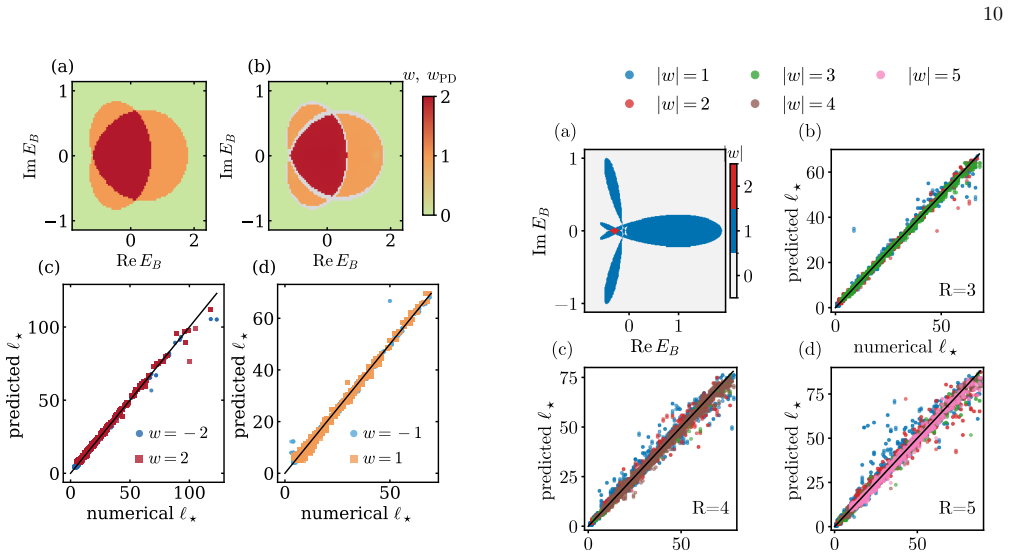
Summary. This manuscript studies the crop-length parameter ℓ* that controls convergence of the polar-decomposition real-space topological invariant w_PD in finite non-Hermitian chains exhibiting the skin effect. The authors show analytically and numerically that ℓ* is governed by physical decay (localization) lengths derived from the roots of the characteristic equation H(β) − E_B = 0. For nearest-neighbor and pure m-hop Hatano–Nelson chains, ℓ* ≈ C_ε ξ with C_ε ≈ log(1/ε) + const, where ξ is the skin-effect localization length. For mixed-hopping models, multiple decay channels enter, and the dominant scale is the grouped root channel closest to the unit circle. Random-forest regression on root-derived features predicts ℓ* with R² > 0.99 across model classes, generalizing to unseen Hamiltonians and complex base energies via leave-one-JL-out validation. A secondary result tests robustness of the clean predictor under hopping disorder.
Significance. The paper addresses a practical problem—choosing the crop-length empirically—that directly limits the applicability of the real-space invariant w_PD to finite non-Hermitian systems. The central physical insight (decay lengths control convergence) is independently grounded: ξ is derived analytically from hopping parameters (Eqs. 16, 40, 58), not fitted to crop-length data. The log(1/ε) scaling of the prefactor C_ε (Eq. 32, Fig. 2d) is a falsifiable prediction that allows extraction of localization lengths from tolerance dependence alone. The leave-one-JL-out and branch-aware train-test protocols are appropriate and strengthen the generalization claims. Reproducible code and data are provided on Zenodo. The identification of when a single-length predictor fails (mixed model, |w|=1 sectors, R²=0.18) and the remedy via the full signed root vector is a honest and useful finding.
Simulated Author's Rebuttal
We thank the referee for a careful and positive assessment of our manuscript. The referee's summary accurately captures the main results: that the crop-length ℓ* governing convergence of the polar-decomposition invariant w_PD is controlled by skin-effect decay lengths derived from the roots of H(β) − E_B = 0, that the log(1/ε) scaling of the prefactor C_ε provides a falsifiable prediction, and that random-forest regression on root-derived features predicts ℓ* with high accuracy across model classes, generalizing to unseen Hamiltonians and complex base energies. The referee recommends minor revision. As the referee did not raise any major comments requiring changes to the manuscript, we have no specific revisions to report. We are grateful for the referee's recognition of the physical grounding of our approach, the appropriateness of our validation protocols, and the honest reporting of cases where the single-length predictor fails.
Circularity Check
No significant circularity: the central physical claim is independently grounded, with only minor self-citation that is not load-bearing.
full rationale
The paper's central claim—that the crop-length ℓ⋆ is controlled by physical decay (localization) lengths derived from the roots of H(β)−E_B=0—is not circular. The localization length ξ is derived analytically from the hopping parameters (Eq. 16 for nearest-neighbor, Eq. 40 for pure m-hop, Eqs. 49-52 for mixed hopping), not fitted to the crop-length data. The proportionality constant C_ϵ is fitted, but its log(1/ϵ) dependence is explained by an independent physical argument: the exponential-decay model Δ(ℓ)∼Ae^{−ℓ/ξ} (Eq. 29), which yields ℓ⋆ > ξ log(1/ϵ) + ξ log A (Eq. 31) purely from the crop condition Δ(ℓ⋆)<ϵ. This derivation is self-contained and does not assume its conclusion. The random-forest regression on root-derived features (Eqs. 18, 42, 66) predicts ℓ⋆ with R²>0.99, but the features are constructed from the Hamiltonian parameters, not from the target variable. The paper does cite prior work by the same authors (Refs. [29, 31]) for the polar-decomposition invariant w_PD, but the invariant itself is defined from first principles in Eq. (2)-(4), and its convergence to the Bloch winding w in the thermodynamic limit is attributed to Ref. [42] (Claes and Hughes), an independent group. The disorder robustness test (Section VI) uses the clean Bloch winding as reference, which is a correctness concern (the clean winding may not be the correct topological invariant for disordered chains), but this is not circularity—it is an externally falsifiable assumption, not a definition disguised as a result. No step in the derivation chain reduces to its own inputs by construction.
Axiom & Free-Parameter Ledger
free parameters (3)
- C_ϵ =
varies with ϵ; ~log(1/ϵ)+const
- (a, b, c) in F(x)=a/(x+b)+c =
(2.329, -5.194, 7.00e-3) for nearest-neighbor at N=200
- (a_|w|, b_|w|) in Eq. 54 =
(1.001, -0.096) for |w|=1; (1.001, 0.493) for |w|=2
axioms (3)
- domain assumption The clean momentum-space winding number w from the Bloch Hamiltonian is the correct topological reference for the finite open chain.
- domain assumption The boundary contribution to the real-space invariant decays exponentially as Ae^{−ℓ/ξ} (Eq. 29).
- domain assumption Random-forest regression generalizes from training Hamiltonians to unseen Hamiltonians within the same model class.
read the original abstract
A topological invariant based on polar-decomposition of matrices correctly captures the topology of finite non-Hermitian chains exhibiting the non-Hermitian skin effect, provided that an appropriate crop-length parameter is chosen. This parameter, which sets the cutoff used in the calculation of the invariant, is usually chosen empirically and becomes especially important near topological phase transitions, where finite-size effects are strongest. Here we show that the required crop-length is controlled by physical decay (localization) lengths. For nearest-neighbor and pure longer-range hopping Hatano-Nelson-type chains, the crop-length is set mainly by a single localization length and is well approximated by a scalar multiple of that length. For more general longer-range hopping models, it is governed instead by a multichannel root structure of the characteristic polynomial. Random-forest regression captures finite-size and near-boundary corrections while preserving this decay-length interpretation. Trained on one set of Hamiltonians, the predictor accurately generalizes to unseen Hamiltonians and complex base energies, reproducing crop-lengths across full phase diagrams. We further show that the predictions learned from clean nearest-neighbor hopping chains remain stable under moderate hopping disorder. These results provide a practical and physically interpretable way to choose the crop-length, which in turn determines when the real-space invariant can reliably capture the topology of finite non-Hermitian chains.
Figures




Reference graph
Works this paper leans on
-
[1]
against hopping disorder at fixed system sizeN= 256. For each base pointE B, the reference integerw(E B) is computed from the clean Bloch Hamiltonian (see Eq. (8)), andℓ clean ⋆ (EB) is predicted using the root-based RF-predictor. We then add disorder to the real-space hopping matrix and evaluatew PD usingℓ clean ⋆ (EB). The disordered open-boundary Hamil...
-
[2]
J. J. Sakurai,Modern Quantum Mechanics, revised ed. (Addison-Wesley, Reading, MA, 1994)
work page 1994
- [3]
-
[4]
Lindblad, On the generators of quantum dynamical semigroups, Commun
G. Lindblad, On the generators of quantum dynamical semigroups, Commun. Math. Phys.48, 119 (1976)
work page 1976
- [5]
-
[6]
E. J. Bergholtz, J. C. Budich, and F. K. Kunst, Ex- ceptional topology of non-Hermitian systems, Rev. Mod. Phys.93, 015005 (2021)
work page 2021
-
[7]
Z. Gong, Y. Ashida, K. Kawabata, K. Takasan, S. Hi- gashikawa, and M. Ueda, Topological phases of non- Hermitian systems, Phys. Rev. X8, 031079 (2018)
work page 2018
-
[8]
N. Okuma and M. Sato, Non-Hermitian topological phe- nomena: A review, Annual Review of Condensed Matter Physics14, 83–107 (2023)
work page 2023
-
[9]
K. Kawabata, K. Shiozaki, M. Ueda, and M. Sato, Sym- metry and topology in non-Hermitian physics, Phys. Rev. X9, 041015 (2019)
work page 2019
- [10]
-
[11]
T. E. Lee and C.-K. Chan, Heralded magnetism in non-Hermitian atomic systems, Phys. Rev. X4, 041001 (2014)
work page 2014
-
[12]
J. Li, A. K. Harter, J. Liu, L. de Melo, Y. N. Joglekar, and L. Luo, Observation of parity-time symmetry breaking transitions in a dissipative floquet system of ultracold atoms, Nat. Commun.10, 1 (2019)
work page 2019
-
[13]
K. Yamamoto, M. Nakagawa, K. Adachi, K. Takasan, M. Ueda, and N. Kawakami, Theory of non-Hermitian fermionic superfluidity with a complex-valued interac- tion, Phys. Rev. Lett.123, 123601 (2019)
work page 2019
-
[14]
M. Nakagawa, N. Kawakami, and M. Ueda, Non- Hermitian Kondo effect in ultracold alkaline-earth atoms, Phys. Rev. Lett.121, 203001 (2018)
work page 2018
-
[15]
T. Hofmann, T. Helbig, F. Schindler, N. Salgo, M. Brzezi´ nska, M. Greiter, T. Kiessling, D. Wolf, A. Voll- hardt, A. Kabaˇ si,et al., Reciprocal skin effect and its realization in a topolectrical circuit, Phys. Rev. Res.2, 023265 (2020)
work page 2020
- [16]
-
[17]
K. G. Makris, R. El-Ganainy, D. Christodoulides, and Z. H. Musslimani, Beam dynamics in PT symmetric op- tical lattices, Phys. Rev. Lett.100, 103904 (2008)
work page 2008
-
[18]
Schomerus, Topologically protected midgap states in complex photonic lattices, Opt
H. Schomerus, Topologically protected midgap states in complex photonic lattices, Opt. Lett.38, 1912 (2013)
work page 1912
-
[19]
B. Zhen, C. W. Hsu, Y. Igarashi, L. Lu, I. Kaminer, A. Pick, S.-L. Chua, J. D. Joannopoulos, and M. Soljaˇ ci´ c, Spawning rings of exceptional points out of Dirac cones, Nature525, 354 (2015)
work page 2015
-
[20]
S. Malzard and H. Schomerus, Bulk and edge-state arcs in non-Hermitian coupled-resonator arrays, Phys. Rev. A 98, 033807 (2018)
work page 2018
- [21]
- [22]
-
[23]
S. Liu, R. Shao, S. Ma, L. Zhang, O. You, H. Wu, Y. J. Xiang, T. J. Cui, and S. Zhang, Non-Hermitian Skin Effect in a Non-Hermitian Electrical Circuit, Research 2021, 1 (2021)
work page 2021
-
[24]
S. Weidemann, M. Kremer, T. Helbig, T. Hofmann, A. Stegmaier, M. Greiter, R. Thomale, and A. Szameit, Topological funneling of light, Science368, 311 (2020)
work page 2020
-
[25]
M. Brandenbourger, X. Locsin, E. Lerner, and C. Coulais, Non-reciprocal robotic metamaterials, Nat. Commun.10, 1 (2019)
work page 2019
- [26]
- [27]
- [28]
- [29]
-
[30]
R. Chaturvedi, V. K¨ onye, E. M. Hankiewicz, J. van den Brink, and I. C. Fulga, Non-Hermitian topology of trans- port in the quantum Hall phases in graphene, Phys. Rev. B111, 245424 (2025)
work page 2025
-
[31]
B. Ozer, K. Ochkan, R. Chaturvedi, E. Maltsev, V. Konye, R. Giraud, A. Veyrat, E. M. Hankiewicz, K. Watanabe, T. Taniguchi, B. B¨ uchner, J. van den Brink, I. C. Fulga, J. Dufouleur, and L. Veyrat, Non- Hermitian topology in the quantum Hall effect of graphene (2024), arXiv:2410.14329 [cond-mat.mes-hall]
work page internal anchor Pith review Pith/arXiv arXiv 2024
-
[32]
R. Chaturvedi, I. C. Fulga, J. van den Brink, and E. M. Hankiewicz, Non-Hermitian topology of quantum spin- Hall systems to detect edge-state polarization (2026), arXiv:2602.12048 [cond-mat.mes-hall]
- [33]
-
[34]
J. C. Budich and E. J. Bergholtz, Non-Hermitian topo- logical sensors, Phys. Rev. Lett.125, 180403 (2020)
work page 2020
-
[35]
Non-Hermitian topological ohmmeter
V. K¨ onye, K. Ochkan, A. Chyzhykova, J. C. Bu- dich, J. van den Brink, I. C. Fulga, and J. Du- fouleur, Non-Hermitian topological ohmmeter (2023), arXiv:2308.11367
work page internal anchor Pith review Pith/arXiv arXiv 2023
-
[36]
C. C. Wanjura, M. Brunelli, and A. Nunnenkamp, Topo- logical framework for directional amplification in driven- dissipative cavity arrays, Nat. Commun.11, 3149 (2020)
work page 2020
- [37]
-
[38]
N. Hatano and D. R. Nelson, Localization transitions in non-Hermitian quantum mechanics, Phys. Rev. Lett.77, 570 (1996)
work page 1996
-
[39]
N. Hatano and D. R. Nelson, Vortex pinning and non-Hermitian quantum mechanics, Phys. Rev. B56, 8651–8673 (1997)
work page 1997
-
[40]
N. Hatano and D. R. Nelson, Non-Hermitian delocal- ization and eigenfunctions, Phys. Rev. B58, 8384–8390 (1998)
work page 1998
- [41]
- [42]
-
[43]
J. Claes and T. L. Hughes, Skin effect and winding num- ber in disordered non-Hermitian systems, Phys. Rev. B 103, L140201 (2021)
work page 2021
- [44]
-
[45]
Scikit-learn: Machine Learning in Python
F. Pedregosa, G. Varoquaux, A. Gramfort, V. Michel, B. Thirion, O. Grisel, M. Blondel, A. M¨ uller, J. Noth- man, G. Louppe, P. Prettenhofer, R. Weiss, V. Dubourg, J. Vanderplas, A. Passos, D. Cournapeau, M. Brucher, M. Perrot, and ´Edouard Duchesnay, Scikit-learn: Ma- chine learning in Python (2018), arXiv:1201.0490 [cs.LG]
work page internal anchor Pith review Pith/arXiv arXiv 2018
- [46]
-
[47]
Chaturvedi, Code and data for the manuscript, Zen- odo 10.5281/zenodo.21156703 (2026)
R. Chaturvedi, Code and data for the manuscript, Zen- odo 10.5281/zenodo.21156703 (2026). Appendix A: Finite-size branches used in the train-test split In Secs. II and III, the train-test split is performed within fixed finite-size branches. This section explains the numerical motivation for this choice. The branch structure is not used as an additional s...
discussion (0)
Sign in with ORCID, Apple, or X to comment. Anyone can read and Pith papers without signing in.