A gauge symmetry makes the quantum Hall graviton gap tunable
Aligning the dynamical metric to a reference geometry controls the chiral spin-2 mode and tunes toward nematic order.
· “Chiral Graviton Theory of Fractional Quantum Hall States”

Mesoscale and Nanoscale Physics
Semiconducting nanostructures: quantum dots, wires, and wells. Single electronics, spintronics, 2d electron gases, quantum Hall effect, nanotubes, graphene, plasmonic nanostructures
sort pith recommended most recent
Aligning the dynamical metric to a reference geometry controls the chiral spin-2 mode and tunes toward nematic order.
· “Chiral Graviton Theory of Fractional Quantum Hall States”
Trapped polaritonic modes escape via the cavity aperture as sharp infrared emission — no nanofabrication needed.
· “Enhancement of far-field thermal emission via polaritonic cavity modes”
Correlated states spread along two twist-angle lines: AHE in polycrystals, superconductivity in quasicrystals.
· “Magic continuum in multi-moir\'e twisted trilayer graphene”
Resonant circularly polarized light reverses spin-valley order in Chern and fractional Chern insulators, and the switch persists.
· “Optical control over topological Chern number in moir\'e materials”

Group theory shows how to recover hidden F2/F4 order from higher Brillouin zones or intra-unit-cell structure.
· “Group theory method for extracting order parameters from scanning tunneling microscopy data”
Second-harmonic voltage reverses sign at the Lifshitz transition, giving a zero-field probe of Fermi surface topology at 10 K.
· “Detecting Lifshitz Transitions Using Nonlinear Conductivity in Bilayer Graphene”
Millisecond-lived, polarized photons near 1.5 microns make these flakes a building block for 2D quantum photonics.
· “Erbium-implanted WS2 flakes with room-temperature photon emission at telecom wavelengths”

A single vacancy gives graphene a protected winding; two aligned vacancies create an artificial spin.

A finite-frequency Chern-Simons term gives Raman phonons a geometric charge of ~2.5 e and new THz drive.
· “Chern-Simons type cross-correlations and geometric Born effective charge of phonons”

Resonant frequency and rectified voltage both scale linearly with temperature, making calibration a two-point fix.

The same bubble-like charge pattern behind re-entrant quantum Hall states also hosts superconductivity.

The ratio of currents with a second lead off versus on equals the squared coherence-factor ratio, giving a local sweet-spot probe.
· “Measuring coherence factors of states in superconductors through local current”

A circle in the complex energy plane separates Anderson-localized from extended eigenstates.
· “Mobility rings in a non-Hermitian non-Abelian quasiperiodic lattice”

A compensating coupling restores degeneracy, so a double braid rotates by an angle that vanishes only in the fermion limit.

A second-order voltage flips sign at van Hove points and reaches 70 μm/V·Ω, 10× previous values.
· “Second-Order Conductivity Probes a Cascade of Singularities in a Moir\'e Superlattice”

A global superconductor-coupled probe distinguishes even and odd parity where local charge sensing stays blind.
Quantum Hall plateaus appear at densities more than 20% lower, and the Landau fan bends inward as the magnetic field grows.

The model puts the missing Andreev signal below 30 mK thermal noise and shows a 55-nm channel lifts it to 1.3 GHz.
· “Resolving Andreev spin qubits in germanium-based Josephson junctions”

Linear-response theory matches molecular dynamics on peak positions and shapes across sliding speeds.
· “Phononic frictional losses of a particle crossing a crystal: linear-response theory”

Color-center sensors find a slow proton layer pinned by photogenerated charge at the diamond and hBN walls.
· “Slow water in engineered nano-channels revealed by color-center-enabled sensing”
A 2040 retrospective says one measurement gate plus AI trained on quantum data can make quantum computers worth building.

Graphite contacts and hBN encapsulation expose the intrinsic effect, backed by shift-current calculations.
· “Unveiling intrinsic bulk photovoltaic effect in atomically thin ReS2”
A semiclassical map of graphene on an hBN bilayer shows the local Berry dipole winding around ABA and ABC stackings.
· “Winding Berry dipole on uniaxially strained graphene/hBN/hBN moir\'e trilayers”

A repulsive impurity binds to density holes, giving a spectroscopic marker of vortex proliferation in 2D and 3D.

Accurate nonlocal functionals become practical for large-scale simulations with accuracy nearly unchanged.

When active carriers are pushed toward the WS2 interface, superconductivity weakens—pointing to same-spin triplet pairing.
· “Surface-Selective Probe of Spin-Triplet Superconductivity in Rhombohedral Graphene”

Nanomagnets on pyramid faces couple purely by dipole forces, enabling a new 3D artificial spin ice.
· “Magnetic-Field Control of Emergent Order in a 3D Dipolar Pyramid Artificial Spin Ice”

Tune the pass-by distance; the electron transfers with no extra gates and the leading spin error cancels.
· “Electron transfer between surface-acoustic-wave-induced moving and static quantum dots”

Dual-frequency drive makes chiral edge magnons emit evenly spaced tones, with spacing set by detuning and no threshold.

A third quantum dot tunes orbital levels to keep Rabi speed and coherence high together.
· “High fidelity flopping-mode single spin operation with tuning inter-dot orbital levels”

A two-frequency polarizability predicts the amplifying resonance and the exact threshold for parametric gain.
· “Optical Response by Time-Varying Plasmonic Nanoparticles”

Replacing GGG with YSGAG removes the low-temperature damping bottleneck for YIG films in quantum magnonics.

Capacitors, inductors, and op-amp inverters create a three-band flat lattice with compact localized states, matching theory.
· “Realization and characterization of an all-bands-flat electrical lattice”
ARPES shows the gap peaks along Gamma-Y and dips along Gamma-X; heat capacity maps the 6.9 K magnetic order.
· “Observation of momentum dependent charge density wave gap in EuTe4”
Iterative reconstruction with prior knowledge recovers the true profile where standard analysis makes artifacts.
· “Reconstructing Critical Current Density in Josephson Junctions with Phase Non-linearity”
A 2D slice built by Schur projection reproduces stable metals and matching 3D critical exponents.

ARPES and magnetotransport show quantum confinement lifts the conduction band in the 6 nm film.

Only about 4 of the 35 meV is true trion binding; the rest is bright\u2013dark exciton difference.
· “Asymmetric trions in monolayer transition metal dichalcogenides”

The T-layer gap outlives 2.6 T while the H-layer gap dies at 1 T, enabling selective control.
· “Layer-selective Cooper pairing in an alternately stacked transition metal dichalcogenide”
Stacking order controls how bright and how long-lived these electron-hole pairs are, from 1 ns to 9.4 µs.
· “Tunable Interlayer Excitons in Bilayer Graphene Nanoribbons”

New bounds on relaxation and bunching times use only the steady-state photon flux and its parameter derivative.

Closed-form edge profile links band gap and scattering channels through a Dyakonov-Perel decay time.
· “Orbital Hall Effect and Angular Momentum Dynamics in Confined Geometries”

Automatic differentiation through a transport simulator recovers 144-site potential and magnetization profiles without imaging.
· “Backsolution: A Framework for Solving Inverse Problems via Automatic Differentiation”

For an isolated fourfold node, interband scattering turns the s=3/2 band's response negative while s=1/2 stays positive.
· “Distinguishing features of longitudinal magnetoconductivity for a Rarita-Schwinger-Weyl node”

Each spin order enlarges the magnetic cell along b, folding new phonons into Raman and infrared spectra.
· “Magnetic phases and zone-folded phonons in a frustrated van der Waals magnet”

A vertical MoTe2 quantum well between HfO2 barriers delivers the first MoTe2 resonant-tunneling signature.

Repeated swap-spectroscopy and Monte Carlo modeling show strongly coupled defects live at the lead edges, pointing to a fabrication fix.
· “Statistics of Strongly Coupled Defects in Superconducting Qubits”

A 1 MHz dispersive shift with tunable Kerr puts a fluxonium ancilla past the transmon limit for bosonic control.
· “Fluxonium as a control qubit for bosonic quantum information”

One knob moves a zero-energy state between the defect site, the chain edges, and nowhere.
· “Reconfigurable Defect States in Non-Hermitian Topolectrical Chains with Gain and Loss”
Rotating the field splits resistivity into 2φ magnetic, 6φ crystal, and 3φ altermagnetic Hall parts.

Europium in ZnCdO quantum wells emits 616-nm light; 700 C annealing brightens it via defect-assisted energy transfer.

A single measured current and its fluctuations bound entropy production at any bias, with no heat-current measurement needed.
· “Thermodynamic Uncertainty Relations for Coherent Transport”

A new regrowth process and Al2O3 passivation push beta-gallium-oxide RF transistors to record speeds with no current collapse.
· “High performance vacuum annealed beta-(AlxGa1-x)2O3/Ga2O3 HFET with f_T/f_MAX of 32/65 GHz”

Hysteresis, nonlinear transport, and a symmetry change point to a charge order that superconductivity normally hides.

Soft-ferroelectric chip hits 1e-6 off-chip efficiency at 8 mK, a step toward quantum processor links.

Analytic one-phonon theory and colloid simulations predict a striped, anisotropic moiré state instead of the usual hexagonal one.
· “Striped twisted state in the orientational epitaxy on quasicrystals”

The alloy's 0.36 nm decay length and high resistivity rule it out for cryogenic memory.
· “Comparison of NiFeCr and NiFe in ferromagnetic Josephson junctions”

Rings without the core stay comb-free at any power; a small in-plane field restores both.

A Berry-flux patch deflects plasmons sideways at tunable meV resonances, no magnetic field needed.
· “Anomalous skew scattering of plasmons in a Dirac electron fluid”

A two-hour ethanol bath exfoliates graphite into micro-sized sheets with cleaner crystal order.

Second-harmonic Hall data tie spin conductance to deep subthermal magnons, so thin films amplify magnon generation.

Coupling peaks when half the magnon wavelength equals the chip width, across a 7 GHz band.
· “Broadband Magnomechanics Enabled by Magnon-Spoof Plasmon Hybridization”

A geometry-based cross test separates bulk Néel spin-orbit torque from slower thermal-strain switching.
· “Identifying Switching of Antiferromagnets by Spin-Orbit Torques”

Higher-order current correlations expose dynamics waiting-time analysis cannot distinguish, even in noisy weak measurements.

High-field polarimetry separates nonmagnetic difference-frequency generation from demagnetization of field-canted NiO spins.

Photon-normalized sensitivity grows with chain length for both perturbation types, up to a finite saturation bound.
· “Quantum Sensing with Driven-Dissipative Su-Schrieffer-Heeger Lattices”

Proximity to SnS imprints spin-orbit coupling on trilayer graphene, converting spin current to charge at up to 300 K.
Simulations show bandpass-filter sideband cooling stabilizes the code space at ~100 mK.
· “Self-correcting GKP qubit in a superconducting circuit with an oscillating voltage bias”

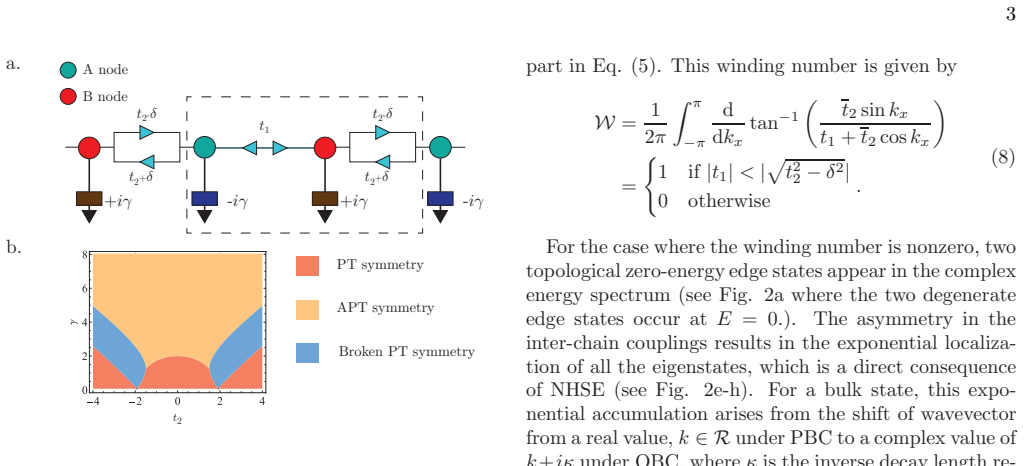
Linear band crossings with real energy and integer charge appear in a stacked non-Hermitian chain, then vanish when boundaries close.
· “Non-Bloch Dirac Points and Phase Diagram in the Stacked Non-Hermitian SSH Model”

Doping a nearby twisted bilayer cuts the critical temperature by more than an order of magnitude, evidence for electronic pairing.
· “Coulomb screening of superconductivity in magic-angle twisted bilayer graphene”
New calculations in BaCuF4, Ca3Mn2O7, and BiFeO3 point to electric-field control of altermagnets
· “Altermagnetic multiferroics and altermagnetoelectric effect”

Drive-tone quantum noise sets the shift when per-photon nonlinearity beats the linewidth.
· “Few-photon degenerate parametric resonance in a two-tone driven microwave resonator”

First time-domain vacuum Rabi cycles in a spin qubit, and a photon carries the excitation to a second spin.
· “Controllable interaction between photons and distant spins via vacuum Rabi oscillations”

For potentials steeper than 1/r, graphene's collapse resonances should space as a power sequence — a clear experimental fingerprint.
· “Atomic collapse of high-order singular potentials in graphene”

A GaP interlayer gives ungated, above-band InAs/InP dots near-lifetime-limited linewidths without cavities or gates.
· “Approaching transform-limited linewidths in telecom-wavelength transitions of ungated quantum dots”

New simulations: strong bit-phase-flip noise locks in stored energy, keeping about 99% extractable as work.
· “Noise-induced Zeno-like effect in a spin-chain quantum battery”

A review argues CNTFETs must win on velocity, not density—but the derivation is absent from the text.

A gate sweep crossing the Dirac point should show a Fano-factor dip in the doped regime and a rise toward neutrality.
· “Shot noise as a probe for Andreev reflection in graphene-based heterojunctions”

Beam-induced trapped charges reverse the gate doping in hBN, forming a switchable nanoscale p-i-n junction.

In-plane polarization survives at sub-unit-cell thickness, enabling ultrathin memories and voltage-switchable spintronics.
