Pairing gap from repulsion scales as ℓ
Zero-sound resummation of the Kohn anomaly makes high-partial-wave pairing exponentially stronger.

Superconductivity
Superconductivity: theory, models, experiment. Superflow in helium
sort pith recommended most recent
Zero-sound resummation of the Kohn anomaly makes high-partial-wave pairing exponentially stronger.
In spin-one color superconductors, the topological node count is set by a generalized pairing monopole charge that includes color Berry…

Inner gap is the superconductor; outer gap is intervalley coherence splitting a Kondo-like resonance.
· “Resolving Intervalley Gaps and Many-Body Resonances in Moir\'e Superconductor”
Without the δ band the pairing flips to d-wave, explaining why calculations disagree.

Spin-orbit-locked electrons near the X points barely feel magnetic fields, boosting superconductivity past the usual ceiling.
· “Large critical fields in superconducting Ti₄Ir₂O from spin-orbit coupling”

If the prediction holds, hydride superconductors could work at roughly 10 GPa instead of 150-300 GPa.
· “Prediction of high-Tc superconductivity in ternary actinium beryllium hydrides at low pressure”

The compounds' helical surface states could host topological superconductivity without doping or interface engineering.
· “Topological superconductivity in hourglass Dirac chain metals (Ti, Hf)IrGe”
Ties the echo's shape to the elastic-inelastic self-energy ratio and says quantum fluctuations block perfect rephasing.
· “Two-dimensional spectroscopy of bosonic collective excitations in disordered many-body systems”

In mixed PDW+superconductor phases, one Higgs mode sharpens into a nearly delta-function peak, a unique Raman fingerprint.
· “Time-reversal symmetry breaking, collective modes, and Raman spectrum in pair-density-wave states”

The alloy's 0.36 nm decay length and high resistivity rule it out for cryogenic memory.
· “Comparison of NiFeCr and NiFe in ferromagnetic Josephson junctions”

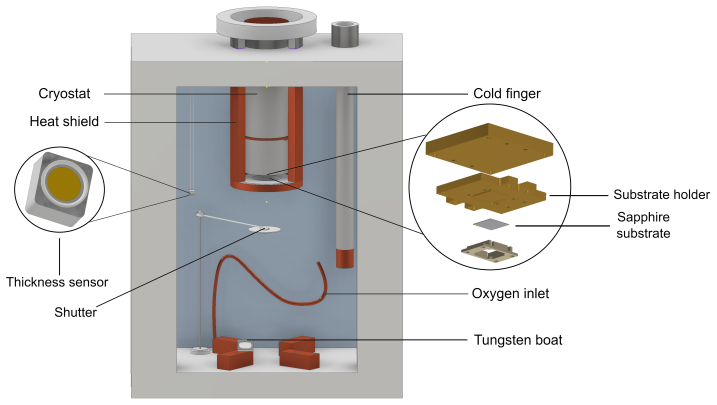
The same Tc dome survives from 300 K down to 25 K, but cold growth needs faster evaporation and leaner oxygen to keep high-resistivity…
First-principles calculations put WB2 on the ductile side; CrB2 and MoB2 stay brittle.
A refined surface treatment cuts loss in parametric amplifiers and converters, lifting squeezed-state purity near 99 percent.

Simulations show bandpass-filter sideband cooling stabilizes the code space at ~100 mK.
· “Self-correcting GKP qubit in a superconducting circuit with an oscillating voltage bias”

Simulations find freeze-out exponent 0.436; vortex-count moments deviate slightly from independent-defect models.
· “Kibble-Zurek Dynamics & Statistics of Topological Defects in Chiral Superfluid ³He Films”

The drop reaches roughly 15% at 10 K and 16 T, implicating spin-fluctuation scattering.

Doping a nearby twisted bilayer cuts the critical temperature by more than an order of magnitude, evidence for electronic pairing.
· “Coulomb screening of superconductivity in magic-angle twisted bilayer graphene”
The actinium borohydride would match LaBeH8 and LaB2H8, two ternary hydrides already made below megabar pressure.
· “Prediction of high-Tc superconductivity under submegabar pressure in ternary actinium borohydrides”

In an interacting chiral dot, spin-density imbalance lets forward and reverse supercurrents differ.
· “Field-free Josephson diode effect in interacting chiral quantum dot junctions”

Half-metal and weak-ferromagnet layers made from one Heusler alloy boost the triplet effect past 1 K.
· “Expanding the operational temperature window of a superconducting spin valve”

Phonon-only theory gives 38.7 K at the best-doped point; including spin fluctuations collapses it to 4.4 K.

Tunnelling spectra reveal a sharp in-field transition inside the superconducting state — a rare pairing-symmetry switch.
A purely electronic mechanism predicts the asymmetrical superconducting dome and few-kelvin critical temperature seen in experiments.
· “Superconductivity from collective excitations in magic angle twisted bilayer graphene”

No external magnet needed: gate-controlled zero modes can carry fusion and braiding in planar Josephson junctions.

Unlike aluminum, lead keeps a large effective g-factor (~76) even when strongly coupled to the nanowire.
Glass magnetism onsets near 80 K, superconductivity near 12 K, and the substrate tunes the gap.

A slab calculation finds a chiral p-wave surface gap, with vortex-core Majorana states and Tc near 20 K.
· “Phonon-mediated intrinsic topological superconductivity in Fermi arcs”

Superconducting at 6.4 K with an extrapolated upper critical field of 17.4 T, it joins a rare family of cubic Pauli-violating materials.
· “Discovery of the Type-II Superconductor Ta₄Rh₂C_(1-δ) with a High Upper Critical Field”

Linear wire relations make every stability region a polygon, with symmetries and a perfect diode.

Difference in switching currents stays near 1.5 µA as the out-of-plane field sweeps from -10 to +10 mT.

Two-site Knight-shift subtraction exposes the orbital pair-breaking textbook case in LaRu4P12.

Wire resistance shifts a Cooper-pair transistor's chemical potential, making its supercurrents unequal at zero field.
Back-gate tunes the threshold voltage; conductance saturation hints at quantum tunneling.
· “Superinsulating behavior in granular Pb film on gated few-layer MoS₂”

A new derivation ties the superfluid weight of any s-wave superconductor to the quantum metric of its quasihole states.
· “Quantum geometric origin of the Meissner effect and superfluid weight marker”

A modified London equation predicts in-plane fields and a central anti-vortex for strong coupling.

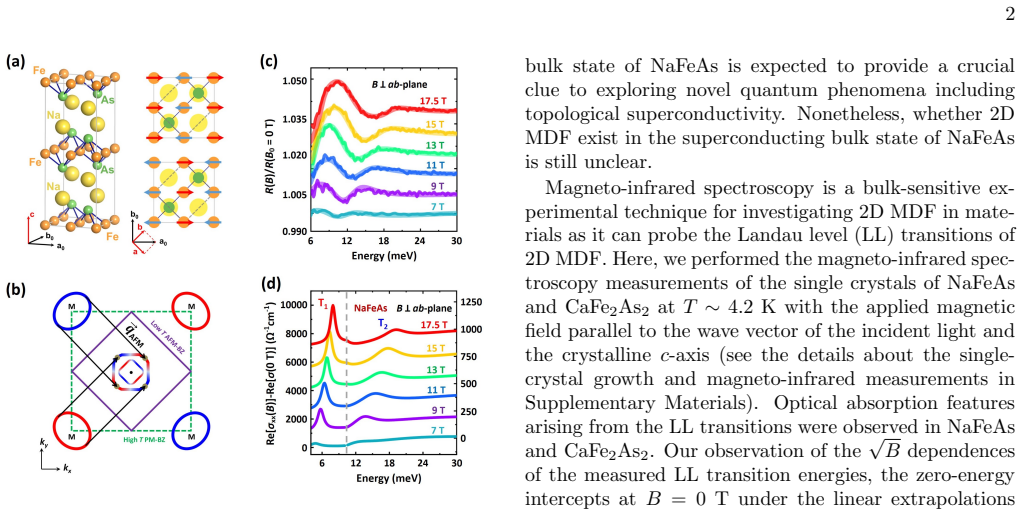
The Dirac velocity tracks the Fe-As bond length across three iron arsenides.
TiNbTaN3 keeps its superconducting state up to 54.5 GPa with Tc nearly unchanged.
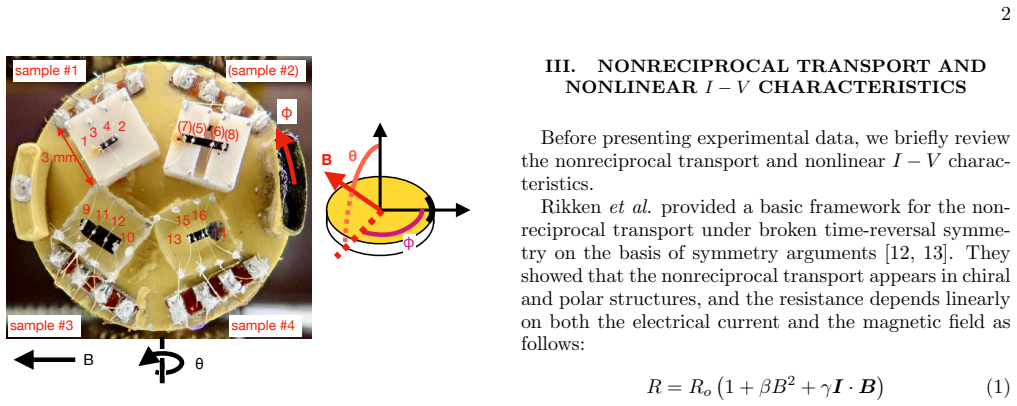
Swapping current and voltage contacts flips the second-harmonic signal, matching a thermoelectric artifact.
Cooper pairs as hydrogen-like bound states plus screened-field averaging match the measured 10^8 V/m threshold in NbN films.

Turning on interlayer Coulomb repulsion switches the leading gap from nodeless s±-wave to nodal dxy-wave.
· “Interlayer interactions in La₃Ni₂O₇ under pressure: from s^(pm) to d_(xy)-wave superconductivity”

New conductivity formula predicts a frequency window with negative superfluid density and a near-100x kinetic inductance boost.

In a 2D Hubbard model, pure d-wave order transforms into s+d+ip below Tc and splits the DOS peaks.

Ten alternating LCO/LSCO layers form an overdamped Josephson stack with a 20 nA critical current at 12 mK.
· “Josephson coupling in Lanthanum-based cuprates superlattices”

QPI maps tie hidden order to V out-of-plane orbitals and pseudogap to Sb pz electrons.

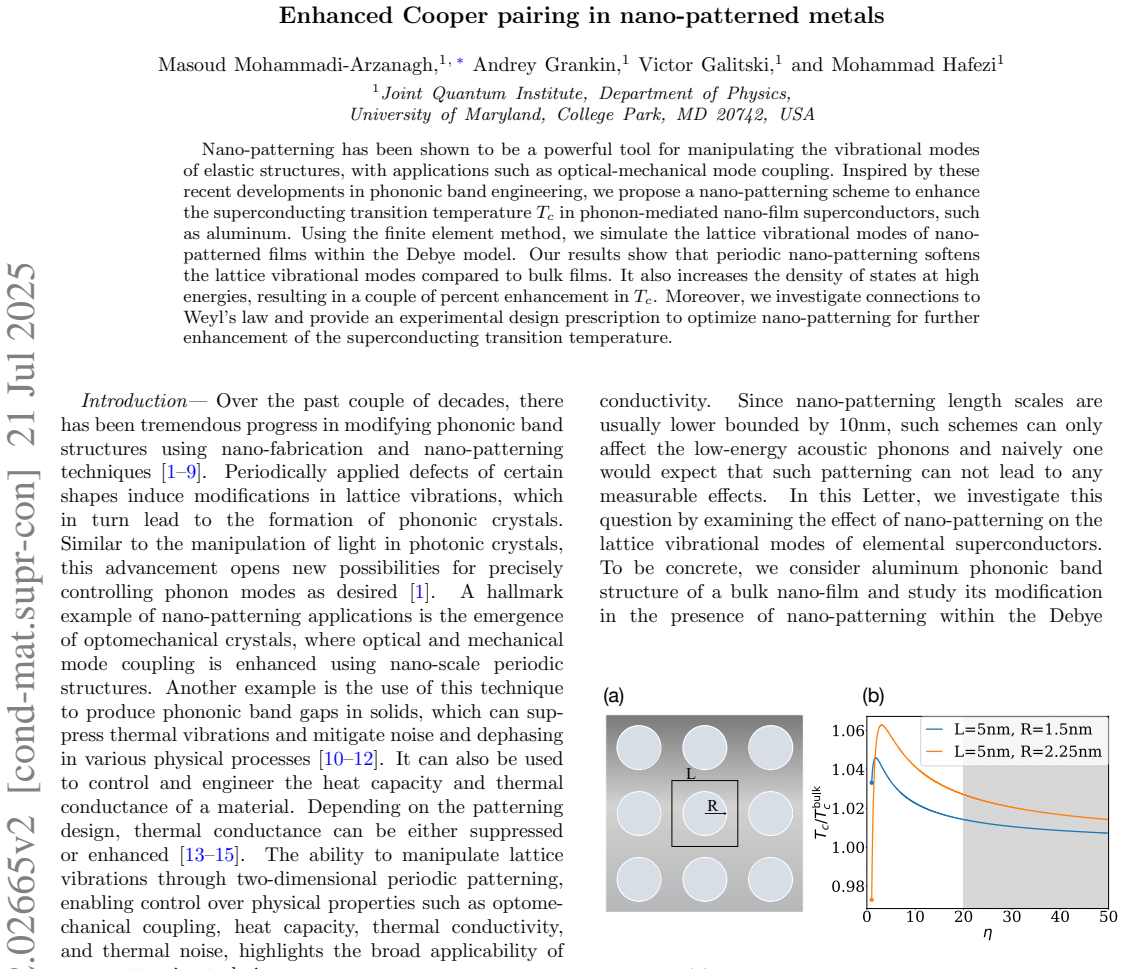
Periodic patterning softens phonons and boosts high-energy pairing, making geometry a design knob for superconductors.
A two-orbital model of La3Ni2O7 finds the strongest orbital response at (π/2, π/2), a candidate driver of the weak insulator.
· “Orbital correlations in bilayer nickelates: roles of doping and interlayer coupling”

Core-level shifts and added Fermi-level weight point to hole transfer across the interface.
· “Overdoping YBa2Cu3O7 via a heterostructure with La0.67Sr0.33MnO3”

A repulsive nearest-neighbor interaction suppresses d-wave pairing and favors d_xy-wave pairing instead.
· “Pairing phase diagram for electron-doped cuprates in the square-lattice t-U-V Hubbard model”

Old and new μSR spectra agree once analyzed alike; the square vortex lattice adds a new order-parameter constraint.

The narrowest lines in a non-centrosymmetric compound signal weak correlations and support type-I superconductivity.
· “Highly Uniform Magnetic and Electronic Environment in Non-Centrosymmetric Superconductor LaRhGe₃”

Stacking CuO2 planes turns a monolayer's coupling J into NJ, stabilizing the charge order behind the pseudogap.
· “Model for the commensurate charge-density waves in under-hole-doped cuprate superconductors”

Clean crystals show 5f electrons split into a heavy Fermi liquid and antiferromagnetic local moments down to Tc.

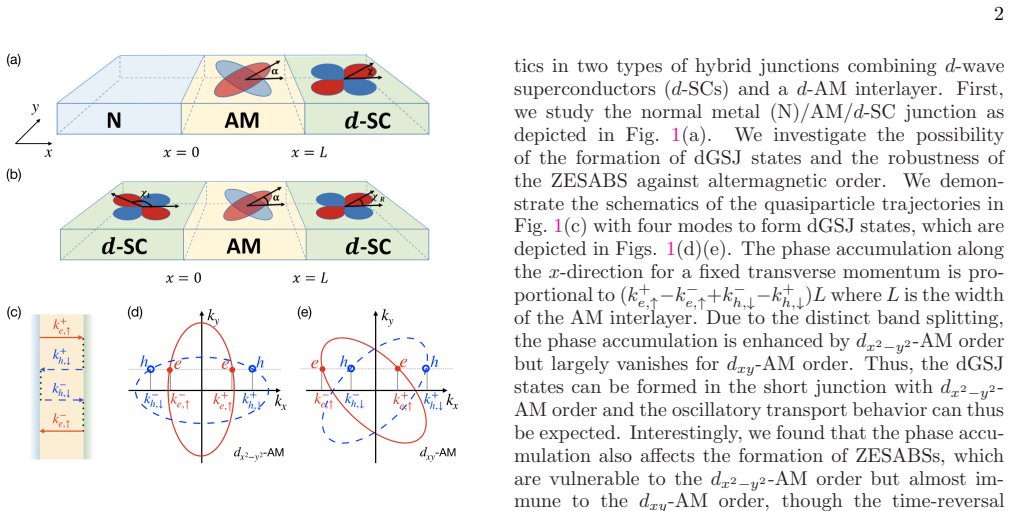
Orientation of the d-wave spin splitting decides whether subgap spikes or 0-pi transitions appear.
Both orders appear at one transition near 153 K, linking nickelates to cuprate stripe physics.
· “Microscopic evidence of charge- and spin-density waves in La₃Ni₂O_(7-δ) revealed by ¹³⁹La-NQR”

A nearest-neighbor attraction of about -1t to -1.25t boosts d-wave-like pairing by nearly an order of magnitude.
Asymmetric conductance peaks close at 23 K and open a pseudogap at 6.8 K, evidence for drumhead surface states.

A higher-pressure superconducting phase with distinct anisotropy hints at unconventional pairing.
· “Tunable superconductivity coexisting with the anomalous Hall effect in 1T'-WS2”

Nearest-neighbor spin-polarized interaction triggers a Lifshitz transition and equal-spin triplet p-wave pairing.

New lift-off recipe lays durable leads that survive 51 GPa and cryogenic temperatures for high-pressure quantum measurements.
· “Sub-micron Circuit Fabrication on Diamond Anvils for Mesoscopic High-Pressure Experiments”

Optical conductivity jumps by e²/16ℏ at twice the pairing gap when Euler bands pair in a d-wave channel.
Room-temperature deposition tunes grain size and texture, pushing Ti40V60 films toward bulk superconductivity without annealing.

A raw-data comparison suggests the 2015 diamagnetic signal was pressure-cell background.
· “Hydride superconductivity: here to stay, or to lead astray and soon go away?”

Bulk BCS superconductor and predicted topological metal make it a platform for topological superconductivity in quasicrystals.
· “Observation of superconductivity in a nontrivial mathcal{Z}₂ approximant quasicrystal”

Recrystallized sodium azide heated to 240-260 C shows the 635 cm-1 Raman fingerprint of cubic gauche nitrogen.
Low-temperature penetration depth rules out nodal pairing and pairs KV3Sb5 with RbV3Sb5, not CsV3Sb5.
· “Direct Comparison of Magnetic Penetration Depth in Kagome Superconductors AV₃Sb₅ (A = Cs, K, Rb)”

T-linear resistivity and S/T divergence peak where nematic order ends at x=0.45.

Simulations of FeSe show each trapped vortex becomes two half-quantum vortices, with a flow signature to test.
· “Fractional vortex array realized at twin boundary in a nematic superconductor”

Two coupled planes switch between 1 and 2 independent fluctuating layers as T/Tc varies.

A boundary phase between the two layers switches each edge current independently, offering experimental control.

A topological-insulator nanowire junction acts as a nano-SQUID; the sign change marks Majorana physics.
· “Tunable superconducting diode effect in a topological nano-SQUID”
Se K-edge shows higher Tc phase carries more electrons and softer Fe-Se bonds

A 100 nm film gives low loss, while a 40 nm film maximizes kinetic inductance for compact quantum circuits.

The mode only appears in density probes once out-of-plane momentum grows enough to give it a longitudinal component.

A 1D model shows jumps strike at pulse durations near the magnetic relaxation time, mostly at low temperature.
· “Mathematical analysis of a flux-jump model in superconductivity”

Even-parity loop currents give no boost; odd-parity ones actively suppress Cooper pairing.
· “Unconventional Superconductivity in Correlated, Multiband, and Topological Systems”

A momentum shift erases the spin splitting, leaving standard BCS physics—and Andreev reflections expose it.

Multi-cycle THz light excites the π-band Higgs mode; single-cycle pulses drive the Leggett mode.
· “Selective excitation of collective modes in multiband superconductor MgB2”

Europium-to-strontium substitution in Eu1-xSrxAlSi points to a quantum critical point near x ≈ 0.96.

FFLO pairing under an out-of-plane field gives unequal critical currents, with diode efficiency up to 60%.

A CNN trained on synthetic spectra reads 0.10 eV and 0.13 eV splits in optimally and underdoped BSCCO.
