REVIEW 2 major objections 4 minor 81 references
Orientation-dependent transport in junctions formed by $d$-wave altermagnets and $d$-wave superconductors
T0 review · 2 major / 4 minor · reviewed 2026-08-10 · deepseek-v4-flash
Pith's one-line read A d-wave altermagnet layer can host short-junction bound states and switch the sign of Josephson current.
desk verdict Interesting new combination and a coherent calculation, but the paper as written inverts its own labeling of d-wave altermagnet symmetries, so the central predictions cannot be trusted until that is fixed. read the letter →
The pith
A machine-rendered reading of the paper's core claim, the machinery that carries it, and where it could break.
The reading
What carries the argument
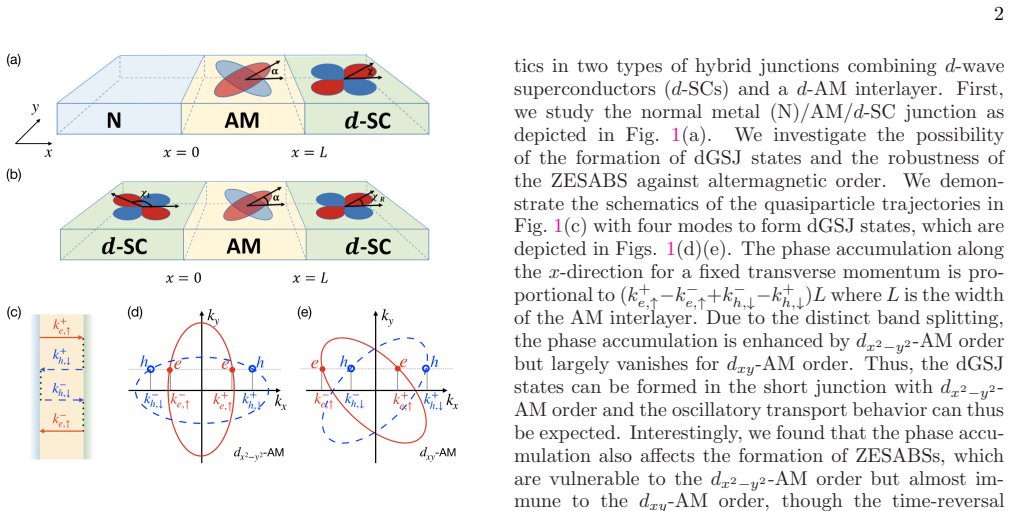
The central object is the momentum-dependent altermagnetic exchange field $M = [J_1(k_x^2-k_y^2)+J_2 k_x k_y]\Theta(x)\Theta(L-x)$, with $J_1 = 2J k_F^{-2}\sin 2\alpha$ and $J_2 = 2J k_F^{-2}\cos 2\alpha$, whose orientation angle $\alpha$ selects pure $d_{x^2-y^2}$ ($\alpha=0$) or pure $d_{xy}$ ($\alpha=\pi/4$) symmetry. This field splits the electron and hole wave vectors $k^\pm_{e,\uparrow}$ and $k^\pm_{h,\downarrow}$ differently depending on propagation direction, and the accumulated phase $(k^+_{e,\uparrow}-k^-_{e,\uparrow}+k^-_{h,\downarrow}-k^+_{h,\downarrow})L$ is what forms de Gennes–Saint-James bound states when it reaches Bohr–Sommerfeld quantization. For the Josephson current, the working machinery is the symmetry-restricted form of the current-phase relation: the combined operator $M_0 = T C_4$ (time reversal followed by a quarter-turn about the $z$ axis) imposes $I(\varphi) = -I(-\varphi)$ and removes cosine harmonics, while $M_1 = T M_{xz}$ or $M_2 = T M_{xz} C_4$ impose nodes at $\varphi = \pm \pi/2$ and forbid odd harmonics when the altermagnet is aligned with one of the $d$-wave forms. Rotating the altermagnet to an intermediate orientation breaks those operators, which is the mechanism that reopens the first-order Josephson current in the asymmetric junction.
What would settle it
A phase-resolved measurement of the current-phase relation in an asymmetric $d_{x^2-y^2}$-SC/AM/$d_{xy}$-SC junction with a rotated altermagnet ($\alpha = \pi/8$) should show a first-order harmonic and a node displaced from $\varphi = \pm \pi/2$; observing only a second harmonic with nodes pinned at $\pm \pi/2$ would falsify the symmetry-breaking prediction.
Extended reading notes
Core claim
Working in a scattering formalism for planar junctions with conserved transverse momentum, the paper argues that the $d_{x^2-y^2}$ altermagnet produces de Gennes–Saint-James states in a short junction ($k_F L \simeq 10$) because the spin-split wave vectors of electrons and holes accumulate a large phase over the altermagnet width, while a $d_{xy}$ altermagnet leaves the electron–hole phase accumulation nearly zero and forms these states only in the long-junction limit. This is why the zero-bias conductance peak is destroyed and subgap resonance spikes appear for $d_{x^2-y^2}$ altermagnetic order, whereas the standard V-shape conductance for $d_{x^2-y^2}$ pairing and zero-bias peak for $d_{xy}$ pairing survive unchanged in short junctions with $d_{xy}$ altermagnetism. For the Josephson side, the paper finds that symmetric $d$-wave superconductor/altermagnet/$d$-wave superconductor junctions exhibit 0-$\pi$ transitions controlled by the altermagnet strength, length, or orientation, along with dominant higher harmonics and skewed current-phase relations. In the asymmetric $d_{x^2-y^2}$/AM/$d_{xy}$ junction, symmetry analysis with magnetic mirror operators $M_1 = T M_{xz}$ and $M_2 = T M_{xz} C_4$ protects a node at $\varphi = \pm \pi/2$ for the pure $d_{x^2-y^2}$ or $d_{xy}$ altermagnet, but a rotated altermagnet ($\alpha = \pi/8$) breaks those symmetries and restores a first-order Josephson coupling that no ferromagnetic junction of the same geometry can produce. These results are attributed to the anisotropic, momentum-dependent spin-splitting field of the altermagnet, whose symmetry class controls both subgap state formation and the current-phase relation.
Load-bearing premise
The load-bearing premise is that the full planar junction, including the barrier, is invariant under a 90-degree rotation combined with time reversal, so that only sine terms survive in the current-phase relation; if that symmetry fails, cosine terms appear and the 0-pi analysis changes.
Editorial extensions
If this is right
- In normal-metal/AM/$d$-wave superconductor tunnel junctions, a short $d_{x^2-y^2}$ altermagnet layer converts the conductance spectrum from a zero-bias peak or featureless V-shape into a series of subgap resonance spikes whose number grows with layer length $L$.
- The $d_{xy}$ altermagnet is spectroscopically silent in short junctions: it neither generates dGSJ spikes nor removes the V-shape or zero-bias peak of the $d$-wave superconductor, providing a clean symmetry diagnostic.
- Symmetric $d$-wave superconductor/AM/$d$-wave superconductor junctions can be switched between 0 and $\pi$ (or higher-harmonic-dominated) regimes by tuning the altermagnet strength, thickness, or crystal orientation.
- In an asymmetric $d_{x^2-y^2}$-SC/AM/$d_{xy}$-SC junction, a first-order Josephson harmonic appears only for an altermagnet whose symmetry is rotated away from both $d_{x^2-y^2}$ and $d_{xy}$, a feature that ferromagnet-based $d$-wave junctions do not share.
- The predicted enhancement of subgap bound states implies enhanced odd-frequency spin-triplet correlations in altermagnet/$d$-wave superconductor hybrids, which the Josephson current can then control.
Reading between the lines
- The paper leaves implicit that the short-junction dGSJ prediction can be probed directly with scanning tunneling spectroscopy on an altermagnet film of tunable thickness grown on a $d$-wave superconductor: the number and spacing of subgap spikes should track the altermagnet orientation $\alpha$.
- A testable extension is that a phase-resolved measurement of an asymmetric $d_{x^2-y^2}$/AM/$d_{xy}$ junction with a misaligned altermagnet should detect a first harmonic whose sign and magnitude depend on the rotation angle, giving a Josephson-transport way to determine the orbital symmetry of an altermagnet.
- The paper leaves implicit that if the $M_0 = T C_4$ symmetry is broken by the planar geometry (for example by an asymmetric barrier), cosine harmonics $J_n \cos(n\varphi)$ may appear in the current-phase relation; checking whether $I(\varphi) = -I(-\varphi)$ survives in a more realistic geometry would delimit the symmetry conclusion.
- A broader inference is that the same symmetry mechanism should apply to other unconventional magnets with anisotropic spin splitting, so the orientation-dependent first-order Josephson coupling may extend beyond $d$-wave altermagnets to related even-parity magnetic order parameters.
Editorial analysis
A structured set of objections, weighed in public.
Referee Report
Summary. The manuscript presents a scattering-matrix study of two junctions involving d-wave altermagnets (AMs) and d-wave superconductors: an N/AM/d-SC junction and a d-SC/AM/d-SC Josephson junction. The central claims are that a d_{x^2-y^2}-AM can generate de Gennes-Saint-James bound states even in short junctions, producing resonance spikes in conductance, while a d_{xy}-AM only does so in long junctions; that the d_{xy} pairing zero-bias conductance peak is robust against d_{xy}-AM; and that altermagnetism induces 0-pi transitions and, in asymmetric d_{x^2-y^2}-SC/AM/d_{xy}-SC junctions, a first-order Josephson contribution when the AM is neither d_{x^2-y^2}- nor d_{xy}-wave. The paper also gives a symmetry argument for the vanishing of the cosine terms in the current-phase relation.
Significance. If the reported effects survive scrutiny, the paper would extend the altermagnet-superconductor literature from s-wave to d-wave pairing and identify orientation-dependent signatures that are experimentally testable in conductance and Josephson measurements. The numerical implementation is based on standard BTK and Furusaki-Tsukada formulas, with no parameters fitted to experimental data, and the symmetry analysis is independent of the numerics. However, the key labeling of the altermagnet orientation in Eq. (3) is internally inconsistent with the text, so the significance of the specific d_{x^2-y^2} versus d_{xy} predictions cannot be assessed as written.
major comments (2)
- [Section II, Eq. (3)] The Hamiltonian defines J1 = 2J k_F^{-2} sin 2α and J2 = 2J k_F^{-2} cos 2α, so for α=0 the altermagnet term is proportional to k_x k_y (d_{xy} symmetry), whereas the text states that for α=0 the magnetization has pure d_{x^2-y^2}-wave symmetry and for α=π/4 it has pure d_{xy}-wave symmetry. These two assignments are opposite. Because Figs. 2, 3, and 5 and the abstract's distinction between d_{x^2-y^2}-AM and d_{xy}-AM are all indexed by α, the results as presented are associated with the wrong symmetry if Eq. (3) is taken as the model. This is not a typographical detail; it inverts the central claim about which altermagnet forms dGSJ states in short junctions.
- [Section IV, Eq. (17)] The combined symmetry M0 = T C4 is stated to be maintained, but a 90-degree rotation about the z axis is not a symmetry of the planar junction geometry, which is finite along x (with a barrier at x=0 and interfaces at x=0,L) and translationally invariant along y. C4 maps the x-direction boundary to the y-direction, which is not a boundary of the system. Consequently, the derivation of I(φ) = -I(-φ) and the conclusion J_n = 0 in Eq. (16) lack justification for the junction as defined. The same concern applies to M2 = T M_xz C4 used in Eq. (19) for the d_{xy}-AM case.
minor comments (4)
- [Section I] The phrase 'with great precission' should be 'with great precision'.
- [Abstract and Section III] The sentence 'the well-known features such as V-shape conductance for d_{x^2-y^2} pairings and zero-biased conductance peak for d_{xy} pairings are not affected by the strength of d_{xy}-altermagnetism in the short junction' is confusing because the same d-wave labels are used for both superconducting pairing symmetry and altermagnetic order; please disambiguate the notation.
- [Figure 1] The captions in Fig. 1(d)-(e) and the associated discussion in Section III should be rechecked once the α-naming in Eq. (3) is fixed, since the figure labels implicitly adopt the text's assignment rather than the assignment of Eq. (3).
- [Section II] The symbol σ is used both for the normalized conductance in Eq. (13) and for the Pauli matrices below Eq. (2); this is not incorrect but may be worth a change of notation for clarity.
Circularity Check
No significant circularity: transport results are computed from the stated model without parameter fitting.
full rationale
The paper's central results are obtained by numerically solving the Bogoliubov-de Gennes scattering problem defined by Eqs. (1)-(15) with fixed model parameters (J, L, alpha, chi, Z, kF). No parameter is fitted to a target dataset, and no computed quantity is renamed as a prediction: the de Gennes-Saint-James-state signatures are conductance spikes obtained from the model, and the Josephson current-phase relations are calculated via the Furusaki-Tsukada formula before being interpreted. The symmetry analysis in Section IV, including the M0 = T C4 argument, is used to explain the numerically obtained CPR, not to impose the result as an input. The self-citation to Ref. [62] for the M0 = T C4 operator is not load-bearing: the operator algebra is elementary, parameter-free, and independently checkable, and the numerical current is already computed before the symmetry is invoked. The claim that this symmetry is 'maintained in the system' is asserted without a detailed geometric proof, which is a validity concern for a planar junction, but it is not a circular reduction. The manuscript also contains an internal labeling inconsistency between Eq. (3) and the text over which alpha value corresponds to d_{x^2-y^2} versus d_{xy} altermagnetism; that is a correctness risk, not a circularity, because the calculations are not defined in terms of the conclusions they are used to support. No fitted input is called a prediction, no uniqueness theorem is imported from the authors' prior work to forbid alternatives, and no known result is merely renamed. The derivation chain is therefore self-contained with respect to the paper's stated model.
Assumptions & free parameters
free parameters (4)
- J (altermagnetic exchange strength) =
varied up to 0.2 mu
- alpha (altermagnet orientation angle) =
0, pi/4, pi/8
- L (junction length) =
kF L = 10, 20
- Z (barrier strength) =
2
assumptions (4)
- domain assumption The Bogoliubov-de Gennes Hamiltonian with a momentum-dependent altermagnetic exchange of the form in Eq. (3) is an adequate model for d-wave altermagnets.
- domain assumption The boundary conditions in Eqs. (11) and (12), including derivative jumps with J2 sigma_z and J1 ky sigma_z terms, correctly describe the interfaces.
- domain assumption The short-junction limit kF L << mu/Delta holds for kF L = 10.
- standard math The Furusaki-Tsukada formula (Eq. 15) correctly gives the dc Josephson current in this system.
Cite this review
Pith. "Pith review of Orientation-dependent transport in junctions formed by $d$-wave altermagnets and $d$-wave superconductors." pith.science (2026). https://pith.science/paper/SHSAA3FB
@misc{pith2026250112141,
  author       = {Pith},
  title        = {Pith review of: Orientation-dependent transport in junctions formed by $d$-wave altermagnets and $d$-wave superconductors},
  year         = {2026},
  howpublished = {\url{https://pith.science/paper/SHSAA3FB}},
  note         = {Machine review of arXiv:2501.12141}
}
abstract
We investigate de Gennes-Saint-James states and Josephson effect in hybrid junctions based on $d$-wave altermagnet and $d$-wave superconductor. Even though these states are associated to long junctions, we find that the $d_{x^{2}-y^{2}}$-altermagnet in a normal metal/altermagnet/$d$-wave superconductor junction forms de Gennes-Saint-James states in a short junction due to an enhanced mismatch between electron and hole wave vectors. As a result, the zero-bias conductance peak vanishes and pronounced resonance spikes emerge in the subgap conductance spectra. By contrast, the $d_{xy}$-altermagnet only features de Gennes-Saint-James states in the long junction. Moreover, the well-known features such as V-shape conductance for $d_{x^2-y^2}$ pairings and zero-biased conductance peak for $d_{xy}$ pairings are not affected by the strength of $d_{xy}$-altermagnetism in the short junction. We also study the Josephson current-phase relation $I(\varphi)$ of $d$-wave superconductor/altermagnet/$d$-wave superconductor hybrids, where $\varphi$ is the macroscopic phase difference between two $d$-wave superconductors. In symmetric junctions, we obtain anomalous current phase relation such as a $0$-$\pi$ transition by changing either the orientation or the magnitude of the altermagnetic order parameter and dominant higher Josephson harmonics. Interestingly, we find the first-order Josephson coupling in an asymmetric $d_{x^{2}-y^{2}}$-superconductor/altermagnet/$d_{xy}$-superconductor junction when the symmetry of altermagnetic order parameter is neither $d_{x^{2}-y^{2}}$- nor $d_{xy}$-wave. We present the symmetry analysis and conclude that the anomalous orientation-dependent current-phase relations are ascribed to the peculiar feature of the altermagnetic spin-splitting field.
Figures


Figures from the paper (2 more)


Reference graph
Works this paper leans on
-
[1]
S. De Franceschi, L. Kouwenhoven, C. Sch¨ onenberger, and W. Wernsdorfer, Hybrid superconductor–quantum dot devices, Nature Nanotechnology 5, 703 (2010)
work page 2010
-
[2]
Linder and J
J. Linder and J. W. A. Robinson, Superconducting spin- tronics, Nature Physics 11, 307 (2015)
2015
-
[3]
S. M. Frolov, M. J. Manfra, and J. D. Sau, Topological superconductivity in hybrid devices, Nature Physics 16, 718 (2020)
work page 2020
- [4]
-
[5]
Talento Program
For dx2− y2-AM, the second order Josephson coupling is dominant but the sign ofI2 is highly tunable by the strength of altermagnetism 7 FIG. 5. Current phase relation of dx2− y2 -SC/AM/dxy-SC Josephson junction. (a)(b)(c) kF L = 10 and (d)(e)(f) kF L = 20. We choose the temperature kBT = 0. 01084∆ 0 . as shown in Figs. 5(a) and 5(d). It is also noted that...
2019
- [6]
-
[7]
P. G. de Gennes and D. Saint-James, Elementary excita- tions in the vicinity of a normal metal-superconducting metal contact, Physics Letters 4, 151 (1963)
work page 1963
-
[8]
T. Mizushima and K. Machida, Multifaceted properties of andreev bound states: interplay of symmetry and topology, Philos. Trans. R. Soc. A 376, 20150355 (2018)
work page 2018
Show all 81 references
-
[9]
J. A. Sauls, Andreev bound states and their signatures, Philos. Trans. R. Soc. A 376, 20180140 (2018)
2018
-
[10]
Zagoskin, Quantum Theory of Many-Body Systems: Techniques and Applications , Graduate Texts in Physics (Springer International Publishing, 2016)
A. Zagoskin, Quantum Theory of Many-Body Systems: Techniques and Applications , Graduate Texts in Physics (Springer International Publishing, 2016)
2016
-
[11]
J. M. Rowell and W. L. McMillan, Electron interference in a normal metal induced by superconducting contracts, Phys. Rev. Lett. 16, 453 (1966)
1966
-
[12]
J. M. Rowell, Tunneling observation of bound states in a normal metal—superconductor sandwich, Phys. Rev. Lett. 30, 167 (1973)
1973
-
[13]
S. H. Tessmer, D. J. Van Harlingen, and J. W. Lyding, Observation of bound quasiparticle states in thin au is- lands by scanning tunneling microscopy, Phys. Rev. Lett. 70, 3135 (1993)
1993
-
[14]
Hu, Midgap surface states as a novel signature for d 2 xa -x 2 b -wave superconductivity, Phys
C.-R. Hu, Midgap surface states as a novel signature for d 2 xa -x 2 b -wave superconductivity, Phys. Rev. Lett. 72, 1526 (1994)
1994
-
[15]
Kashiwaya and Y
S. Kashiwaya and Y. Tanaka, Tunnelling effects on sur- face bound states inunconventional superconductors, Re- ports on Progress in Physics 63, 1641 (2000)
2000
-
[16]
L¨ ofwander, V
T. L¨ ofwander, V. S. Shumeiko, and G. Wendin, Andreev bound states in high-tc superconducting junctions, Su- perconductor Science and Technology 14, R53 (2001)
2001
-
[17]
Tanaka, M
Y. Tanaka, M. Sato, and N. Nagaosa, Symmetry and topology in superconductors–odd-frequency pairing and edge states–, J. Phys. Soc. Jpn. 81, 011013 (2011)
2011
-
[18]
Kashiwaya, Y
S. Kashiwaya, Y. Tanaka, M. Koyanagi, H. Takashima, and K. Kajimura, Origin of zero-bias conductance peaks in high-tc superconductors, Phys. Rev. B 51, 1350 (1995)
1995
-
[19]
Tanaka, Y
Y. Tanaka, Y. Tanuma, and A. A. Golubov, Odd- frequency pairing in normal-metal/superconductor junc- tions, Phys. Rev. B 76, 054522 (2007)
2007
-
[20]
Tanaka and S
Y. Tanaka and S. Kashiwaya, Theory of tunneling spec- troscopy of d -wave superconductors, Phys. Rev. Lett. 74, 3451 (1995)
1995
-
[21]
Covington, M
M. Covington, M. Aprili, E. Paraoanu, L. H. Greene, F. Xu, J. Zhu, and C. A. Mirkin, Observation of surface- induced broken time-reversal symmetry in yba 2cu3O7 tunnel junctions, Phys. Rev. Lett. 79, 277 (1997)
1997
-
[22]
L. Alff, H. Takashima, S. Kashiwaya, N. Terada, H. Ihara, Y. Tanaka, M. Koyanagi, and K. Kajimura, Spatially continuous zero-bias conductance peak on (110) yba2cu3o7− δ surfaces, Phys. Rev. B 55, R14757 (1997)
1997
-
[23]
J. Y. T. Wei, N.-C. Yeh, D. F. Garrigus, and M. Strasik, Directional tunneling and andreev reflection on yba 2cu3o7− δ single crystals: Predominance of d -wave pairing symmetry verified with the generalized blonder, tinkham, and klapwijk theory, Phys. Rev. Lett. 81, 2542 (1998)
1998
-
[24]
Bouscher, Z
S. Bouscher, Z. Kang, K. Balasubramanian, D. Panna, P. Yu, X. Chen, and A. Hayat, High-tc cooper-pair injec- tion in a semiconductor?superconductor structure, Jour- nal of Physics: Condensed Matter 32, 475502 (2020)
2020
-
[25]
Zareyan, W
M. Zareyan, W. Belzig, and Y. V. Nazarov, Oscillations of andreev states in clean ferromagnetic films, Phys. Rev. Lett. 86, 308 (2001)
2001
-
[26]
Vecino, A
E. Vecino, A. Mart ´ ın-Rodero, and A. Levy Yeyati, Re- cursion method for nonhomogeneous superconductors: Proximity effect in superconductor-ferromagnet nanos- tructures, Phys. Rev. B 64, 184502 (2001)
2001
-
[27]
Halterman and O
K. Halterman and O. T. Valls, Proximity effects at ferromagnet-superconductor interfaces, Phys. Rev. B 65, 014509 (2001)
2001
-
[28]
Halterman and O
K. Halterman and O. T. Valls, Proximity effects and characteristic lengths in ferromagnet-superconducto r structures, Phys. Rev. B 66, 224516 (2002)
2002
-
[29]
Krawiec, B
M. Krawiec, B. Gy¨ orffy, and J. Annett, Andreev bound states in ferromagnet-superconductor nanostructures, 9 Physica C: Superconductivity 387, 7 (2003)
2003
-
[30]
M. Eschrig, Theory of andreev bound states in sfs junc- tions and sf proximity devices, Philosophical Transac- tions of the Royal Society A: Mathematical, Physical and Engineering Sciences 376, 20150149 (2018)
2018
-
[31]
M. J. M. de Jong and C. W. J. Beenakker, Andreev re- flection in ferromagnet-superconductor junctions, Phys. Rev. Lett. 74, 1657 (1995)
1995
-
[32]
Kashiwaya, Y
S. Kashiwaya, Y. Tanaka, N. Yoshida, and M. R. Beasley, Spin current in ferromagnet-insulator-superconductor junctions, Phys. Rev. B 60, 3572 (1999)
1999
-
[33]
ˇZuti´ c and S
I. ˇZuti´ c and S. Das Sarma, Spin-polarized transport and andreev reflection in semiconductor/superconductor hy- brid structures, Phys. Rev. B 60, R16322 (1999)
1999
-
[34]
Visani, Z
C. Visani, Z. Sefrioui, J. Tornos, C. Leon, J. Briatico, M. Bibes, A. Barth´ el´ emy, J. Santamar ´ ıa, and J. E. Ville- gas, Equal-spin andreev reflection and long-range coher- ent transport in high-temperature superconductor/half- metallic ferromagnet junctions, Nature Physic...
2012
-
[35]
M. Naka, S. Hayami, H. Kusunose, Y. Yanagi, Y. Mo- tome, and H. Seo, Spin current generation in organic an- tiferromagnets, Nat. Commun. 10, 4305 (2019)
2019
-
[36]
Hayami, Y
S. Hayami, Y. Yanagi, and H. Kusunose, Momentum- dependent spin splitting by collinear antiferromagnetic ordering, J. Phys. Soc. Jpn. 88, 123702 (2019)
2019
-
[37]
K.-H. Ahn, A. Hariki, K.-W. Lee, and J. Kuneˇ s, Antifer- romagnetism in ruo 2 as d-wave pomeranchuk instability, Phys. Rev. B 99, 184432 (2019)
2019
-
[38]
M. Naka, S. Hayami, H. Kusunose, Y. Yanagi, Y. Mo- tome, and H. Seo, Anomalous hall effect in κ-type organic antiferromagnets, Phys. Rev. B 102, 075112 (2020)
2020
-
[39]
ˇSmejkal, R
L. ˇSmejkal, R. Gonz´ alez-Hern´ andez, T. Jungwirth, and J. Sinova, Crystal time-reversal symmetry breaking and spontaneous hall effect in collinear antiferromagnets, Sci. Adv. 6, eaaz8809 (2020)
2020
-
[40]
Hayami, Y
S. Hayami, Y. Yanagi, and H. Kusunose, Bottom-up de- sign of spin-split and reshaped electronic band structures in antiferromagnets without spin-orbit coupling: Proce- dure on the basis of augmented multipoles, Phys. Rev. B 102, 144441 (2020)
2020
-
[41]
L.-D. Yuan, Z. Wang, J.-W. Luo, E. I. Rashba, and A. Zunger, Giant momentum-dependent spin splitting in centrosymmetric low- z antiferromagnets, Phys. Rev. B 102, 014422 (2020)
2020
-
[42]
I. I. Mazin, K. Koepernik, M. D. Johannes, R. Gonz´ alez- Hern´ andez, and L.ˇSmejkal, Prediction of unconventional magnetism in doped fesb¡sub¿2¡/sub¿, Proc. Natl. Acad. Sci. U.S.A. 118, e2108924118 (2021)
2021
-
[43]
ˇSmejkal, J
L. ˇSmejkal, J. Sinova, and T. Jungwirth, Beyond conven- tional ferromagnetism and antiferromagnetism: A phase with nonrelativistic spin and crystal rotation symmetry, Phys. Rev. X 12, 031042 (2022)
2022
-
[44]
ˇSmejkal, J
L. ˇSmejkal, J. Sinova, and T. Jungwirth, Emerging re- search landscape of altermagnetism, Phys. Rev. X 12, 040501 (2022)
2022
-
[45]
Bhowal and N
S. Bhowal and N. A. Spaldin, Ferroically ordered mag- netic octupoles in d-wave altermagnets, Phys. Rev. X 14, 011019 (2024)
2024
-
[46]
L. Bai, W. Feng, S. Liu, L. ˇSmejkal, Y. Mokrousov, and Y. Yao, Altermagnetism: Exploring new frontiers in mag- netism and spintronics, Advanced Functional Materials 34, 2409327 (2024)
2024
-
[47]
M. Hu, X. Cheng, Z. Huang, and J. Liu, Catalogue of c-paired spin-valley locking in antiferromagnetic systems (2024), arXiv:2407.02319
2024 arXiv
-
[48]
Jungwirth, R
T. Jungwirth, R. M. Fernandes, J. Sinova, and L. Sme- jkal, Altermagnets and beyond: Nodal magnetical- ly-ordered phases (2024), arXiv:2409.10034
2024 arXiv
-
[49]
Tamang, S
R. Tamang, S. Gurung, D. P. Rai, S. Brahimi, and S. Lou- nis, Newly discovered magnetic phase: A brief review on altermagnets (2024), arXiv:2412.05377
2024 arXiv
-
[50]
Cheong and F.-T
S.-W. Cheong and F.-T. Huang, Altermagnetism with non-collinear spins, npj Quantum Mater. 9, 13 (2024)
2024
-
[51]
S. Lee, S. Lee, S. Jung, J. Jung, D. Kim, Y. Lee, B. Seok, J. Kim, B. G. Park, L. ˇSmejkal, C.-J. Kang, and C. Kim, Broken kramers degeneracy in altermagnetic mnte, Phys. Rev. Lett. 132, 036702 (2024)
2024
-
[52]
Osumi, S
T. Osumi, S. Souma, T. Aoyama, K. Yamauchi, A. Honma, K. Nakayama, T. Takahashi, K. Ohgushi, and T. Sato, Observation of a giant band splitting in alter- magnetic mnte, Phys. Rev. B 109, 115102 (2024)
2024
-
[53]
Krempask´ y, L
J. Krempask´ y, L. ˇSmejkal, S. W. D’Souza, M. Ha- jlaoui, G. Springholz, K. Uhl ´ ıˇ rov´ a, F. Alarab, P. C. Constantinou, V. Strocov, D. Usanov, W. R. Pudelko, R. Gonz´ alez-Hern´ andez, A. Birk Hellenes, Z. Jansa, H. Reichlov´ a, Z. ˇSob´ aˇ n, R. D. Gonzalez Betancourt, P...
2024
-
[54]
C. Sun, A. Brataas, and J. Linder, Andreev reflection in altermagnets, Phys. Rev. B 108, 054511 (2023)
2023
-
[55]
Papaj, Andreev reflection at the altermagnet- superconductor interface, Phys
M. Papaj, Andreev reflection at the altermagnet- superconductor interface, Phys. Rev. B 108, L060508 (2023)
2023
-
[56]
Maeda, B
K. Maeda, B. Lu, K. Yada, and Y. Tanaka, Theory of tun- neling spectroscopy in unconventional p-wave magnet- superconductor hybrid structures, Journal of the Physi- cal Society of Japan 93, 114703 (2024)
2024
-
[57]
Mondal, A
D. Mondal, A. Pal, A. Saha, and T. Nag, Distin- guishing between topological majorana and trivial zero modes via transport and shot noise study in an alter- magnet heterostructure (2024), arXiv:2409.08009 [cond– mat.mes-hall]
2024 arXiv
-
[58]
Z. P. Niu and Z. Yang, Orientation-dependent andreev re- flection in an altermagnet/altermagnet/superconductor junction, Journal of Physics D: Applied Physics 57, 395301 (2024)
2024
-
[59]
Nagae, A
Y. Nagae, A. P. Schnyder, and S. Ikegaya, Spin-polar- ized specular andreev reflections in altermagnets (2024), arXiv:2403.07117 [cond-mat.supr-con]
2024 arXiv
-
[60]
J. A. Ouassou, A. Brataas, and J. Linder, dc joseph- son effect in altermagnets, Phys. Rev. Lett. 131, 076003 (2023)
2023
-
[61]
C. W. J. Beenakker and T. Vakhtel, Phase-shifted an- dreev levels in an altermagnet josephson junction, Phys. Rev. B 108, 075425 (2023)
2023
-
[62]
Zhang, L.-H
S.-B. Zhang, L.-H. Hu, and T. Neupert, Finite- momentum Cooper pairing in proximitized altermagnets, Nature Communications 15, 1801 (2024)
2024
-
[63]
B. Lu, K. Maeda, H. Ito, K. Yada, and Y. Tanaka, ϕ josephson junction induced by altermagnetism, Phys. Rev. Lett. 133, 226002 (2024)
2024
-
[64]
Fukaya, K
Y. Fukaya, K. Maeda, K. Yada, J. Cayao, Y. Tanaka, and B. Lu, Fate of the josephson effect and odd-fre- quency pairing in superconducting junctions with uncon- ventional magnets (2024), arXiv:2411.02679. 10
2024 arXiv
-
[65]
Sun, S.-B
H.-P. Sun, S.-B. Zhang, C.-A. Li, and B. Trauzettel, Field-enhanced critical current and tunable skew- ness in altermagnetic josephson junctions (2024), arXiv:2407.19413
2024 arXiv
-
[66]
Cheng and Q.-F
Q. Cheng and Q.-F. Sun, Orientation- dependent josephson effect in spin-singlet superconductor/altermagnet/spin-triplet supercon- ductor junctions, Phys. Rev. B 109, 024517 (2024)
2024
-
[67]
Yip, Josephson current-phase relationships with un- conventional superconductors, Phys
S. Yip, Josephson current-phase relationships with un- conventional superconductors, Phys. Rev. B 52, 3087 (1995)
1995
-
[68]
Tanaka and S
Y. Tanaka and S. Kashiwaya, Theory of josephson ef- fects in anisotropic superconductors, Phys. Rev. B 56, 892 (1997)
1997
-
[69]
G. E. Blonder, M. Tinkham, and T. M. Klapwijk, Tran- sition from metallic to tunneling regimes in supercon- ducting microconstrictions: Excess current, charge im- balance, and supercurrent conversion, Phys. Rev. B 25, 4515 (1982)
1982
-
[70]
L. A. B. Olde Olthof, S.-I. Suzuki, A. A. Gol- ubov, M. Kunieda, S. Yonezawa, Y. Maeno, and Y. Tanaka, Theory of tunneling spectroscopy of normal metal/ferromagnet/spin-triplet superconductor junctions, Phys. Rev. B 98, 014508 (2018)
2018
-
[71]
Tanaka and S
Y. Tanaka and S. Kashiwaya, Local density of states of quasiparticles near the interface of nonuniform d-wave superconductors, Phys. Rev. B 53, 9371 (1996)
1996
-
[72]
Tanaka and S
Y. Tanaka and S. Kashiwaya, Theory of the josephson ef- fect in d-wave superconductors, Phys. Rev. B 53, R11957 (1996)
1996
-
[73]
Y. S. Barash, H. Burkhardt, and D. Rainer, Low- temperature anomaly in the josephson critical current of junctions in d -wave superconductors, Phys. Rev. Lett. 77, 4070 (1996)
1996
-
[74]
Furusaki and M
A. Furusaki and M. Tsukada, Dc josephson effect and andreev reflection, Solid State Communications 78, 299 (1991)
1991
-
[75]
Cayao and P
J. Cayao and P. Burset, Confinement-induced zero-bias peaks in conventional superconductor hybrids, Phys. Rev. B 104, 134507 (2021)
2021
-
[76]
Yamakage, M
A. Yamakage, M. Sato, K. Yada, S. Kashiwaya, and Y. Tanaka, Anomalous josephson current in supercon- ducting topological insulator, Phys. Rev. B 87, 100510 (2013)
2013
-
[77]
B. Lu, K. Yada, A. A. Golubov, and Y. Tanaka, Anoma- lous josephson effect in d-wave superconductor junctions on a topological insulator surface, Phys. Rev. B 92, 100503 (2015)
2015
-
[78]
Tanaka and S
Y. Tanaka and S. Kashiwaya, Phase dependent energy levels of bound states and d.c. josephson current in un- conventional superconductor / ferromagnetic insulator / unconventional superconductor junctions, J. Phys. Soc. Japan 69, 1152 (2000)
2000
-
[79]
Cayao, C
J. Cayao, C. Triola, and A. M. Black-Schaffer, Odd- frequency superconducting pairing in one-dimensional systems, Eur. Phys. J. Spec. Top. 229, 545 (2020)
2020
-
[80]
Tanaka, S
Y. Tanaka, S. Tamura, and J. Cayao, Theory of ma- jorana zero modes in unconventional superconductors, Progress of Theoretical and Experimental Physics , ptae065 (2024)
2024
-
[81]
Maeda, Y
K. Maeda, Y. Fukaya, K. Yada, B. Lu, Y. Tanaka, and J. Cayao, Classification of pair symmetries in su- perconductors with unconventional magnetism (2025), arXiv:2501.08646
2025 arXiv
Reviewed August 10, 2026 · model on record in the stance chip above.
Discussion (0). Continue with ORCID to comment.