Pith. sign in

cs

Computer Science

Papers reviewed in the last 7 days lead, then the papers readers actually read. Ranking is not a quality score.
sort pith recommended most recent

New language converts single images into simulation-ready sewing patterns

PatternGSL encodes panel boundaries, seams and stitch topology without templates; a VLM predicts it and deterministic rules decode to valid

· “PatternGSL: A Structured Specification Language for Template-Free and Simulation-Ready 3D Garments”

open re-runnable review →
Figure from the paper

Two scales measure human-AI cooperation quality

Validated in card games, LLM chats and decision systems, they distinguish strong from weak partners and allow human-AI comparisons.

· “Measuring Successful Cooperation in Human-AI Teamwork: Development and Validation of the Perceived Cooperativity and Teaming Perception Scales”

open re-runnable review →
Figure from the paper

φ-DeepONet modifies the DeepONet architecture to handle discontinuities by using multiple…

φ-DeepONet learns mappings with discontinuities in inputs and outputs by combining multiple branch networks with a nonlinear interface…

· “φ-DeepONet: A Discontinuity Capturing Neural Operator”

open re-runnable review →
Figure from the paper

Curriculum budget scheduler gives LLMs 8.3% more accuracy at 34% fewer tokens

By shifting token limits from easy to hard problems during training, the policy avoids overthinking simple questions and underthinking hard

· “Avoiding Overthinking and Underthinking: Curriculum-Aware Budget Scheduling for LLMs”

open re-runnable review →
Figure from the paper

Multi-agent LLM reaches 79% on penetration testing benchmarks

Fine-tuned model drives agents through reconnaissance, scanning, and exploitation without human input on standard tests

· “xOffense: An Autonomous Multi-Agent Framework for Penetration Testing with Domain-Adapted Large Language Models”

open re-runnable review →
Figure from the paper

Knowledge-guided search finds biological ODEs that data-fitting misses

MEDA shows literature-derived constraints, not trajectory fit, are the load-bearing part of recovering mechanistic models.

· “Automatic Ordinary Differential Equations Discovery For Biological Systems Using Large Language Model Powered Agentic System”

open re-runnable review →
Figure from the paper

Flow matching turns robot velocity fields into probability flows

Dense velocity modeling replaces sparse keypoints and yields 33x faster generation plus higher success on 13 real tasks.

· “Flow as Flow: Modeling Robot Velocity Fields as Probability Velocity Fields for Flow-Based Object Manipulation”

open re-runnable review →
Figure from the paper

Factored trees let agentic teams reuse past solution paths across problems

GRAFT-ATHENA embeds decision sequences as metric fingerprints so new physics tasks draw on accumulated experience and invent new solvers.

· “GRAFT-ATHENA: Self-Improving Agentic Teams for Autonomous Discovery and Evolutionary Numerical Algorithms”

open re-runnable review →
Figure from the paper

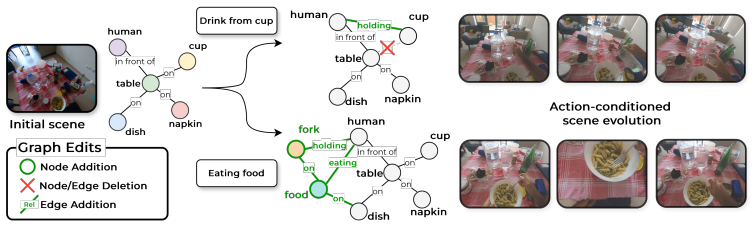
Home activity benchmark shows AI question-answering gaps

HOME-KGQA tests multimodal KGQA on daily household tasks, where LLM methods lag behind their encyclopedic results.

· “HOME-KGQA: A Benchmark Dataset for Multimodal Knowledge Graph Question Answering on Household Daily Activities”

open re-runnable review →
Figure from the paper

Iterative diffusion produces identifiable suspect faces from multi-modal inputs

Multi-modal controls and step-by-step refinement raise identity retrieval rates over standard text-to-image diffusion in crime scenarios.

· “IdentiFace: Multi-Modal Iterative Diffusion Framework for Identifiable Suspect Face Generation in Crime Investigations”

open re-runnable review →
Figure from the paper

Hybrid field fuses rigid and deformable fields for cervical CT-MRI

MSR aligns each vertebra rigidly then applies gated Mamba-Swin deformable correction before fusing into one hybrid field and releases an new

· “MSR:Hybrid Field Modeling for CT-MRI Rigid-Deformable Registration of the Cervical Spine with an Annotated Dataset”

open re-runnable review →
Figure from the paper

Specialized GPT-5.4 beats physicians on real clinical chats

Benchmark of 15,000 clinician conversations shows the tuned model tops base versions and human doctors across consult, documentation, and 3.

· “HealthBench Professional: Evaluating Large Language Models on Real Clinician Chats”

open re-runnable review →
Figure from the paper

Tensor method scales exact MDP optimization linearly for infrastructure

Kronecker-factored transitions cut complexity from exponential to linear while keeping global dynamic programming solutions intact.

· “Probabilistic Hazard Analysis Framework with Stochastic Optimal Control for Deteriorating Civil Infrastructure Systems”

open re-runnable review →
Figure from the paper

Dysarthria profiles differ by cause but match across languages

Analysis of 3,374 speakers shows aetiology-specific degradation with cosine similarity above 0.95 for profile shapes in 12 languages.

· “Phonological Subspace Collapse Is Aetiology-Specific and Cross-Lingually Stable: Evidence from 3,374 Speakers”

open re-runnable review →
Figure from the paper

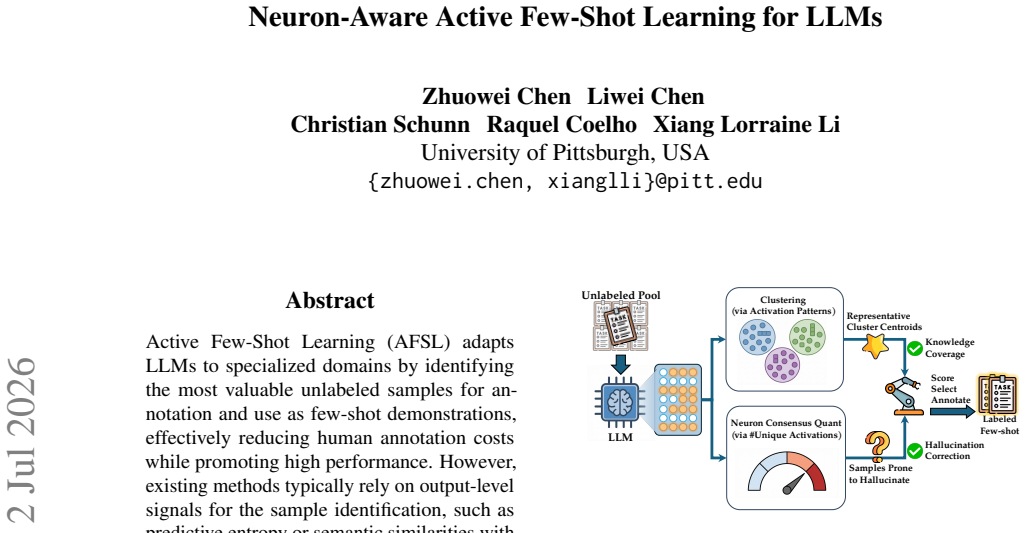
Fusing token and verbal confidence improves MLLM calibration

Monotone merge of dual signals plus mean alignment yields more reliable reliability estimates while preserving selective prediction trade-o

· “Instinct vs. Reflection: Unifying Token and Verbalized Confidence in Multimodal Large Models”

open re-runnable review →
Figure from the paper

New benchmark tests segmentation on 661 transmission corridor scenes

TowerDataset supplies 22 fine classes and a fusion framework to handle long corridors and rare components in point cloud inspection.

· “TowerDataset: A Heterogeneous Benchmark for Transmission Corridor Segmentation with a Global-Local Fusion Framework”

open re-runnable review →
Figure from the paper

42% of LLM turn-level findings fail after autocorrelation correction

Naive pooled tests on dependent turns within conversations produce inflated significance, and a cluster-robust method cuts the rate of nonre

· “The Autocorrelation Blind Spot: Why 42% of Turn-Level Findings in LLM Conversation Analysis May Be Spurious”

open re-runnable review →
Figure from the paper

PBE-UNet beats prior methods on ultrasound lesion segmentation

Scale-aware aggregation and progressive widening of boundary attention maps improve accuracy on four benchmark datasets while keeping the U-

· “PBE-UNet: A light weight Progressive Boundary-Enhanced U-Net with Scale-Aware Aggregation for Ultrasound Image Segmentation”

open re-runnable review →
Figure from the paper

This paper develops a two-stage model-based system that lets full-size humanoid robots…

A two-stage framework retargets human dance via QP and trajectory optimization then executes it with centroidal MPC on the Kuavo 4Pro…

· “Dynamic Whole-Body Dancing with Humanoid Robots -- A Model-Based Control Approach”

open re-runnable review →

Local RAG framework cuts hallucinations in nuclear queries

Tests on used fuel storage benchmarks keep precision at 85-98 percent and add traceable citations that commercial LLMs lack.

· “RADIANT-LLM: an Agentic Retrieval Augmented Generation Framework for Reliable Decision Support in Safety-Critical Nuclear Engineering”

open re-runnable review →
Figure from the paper

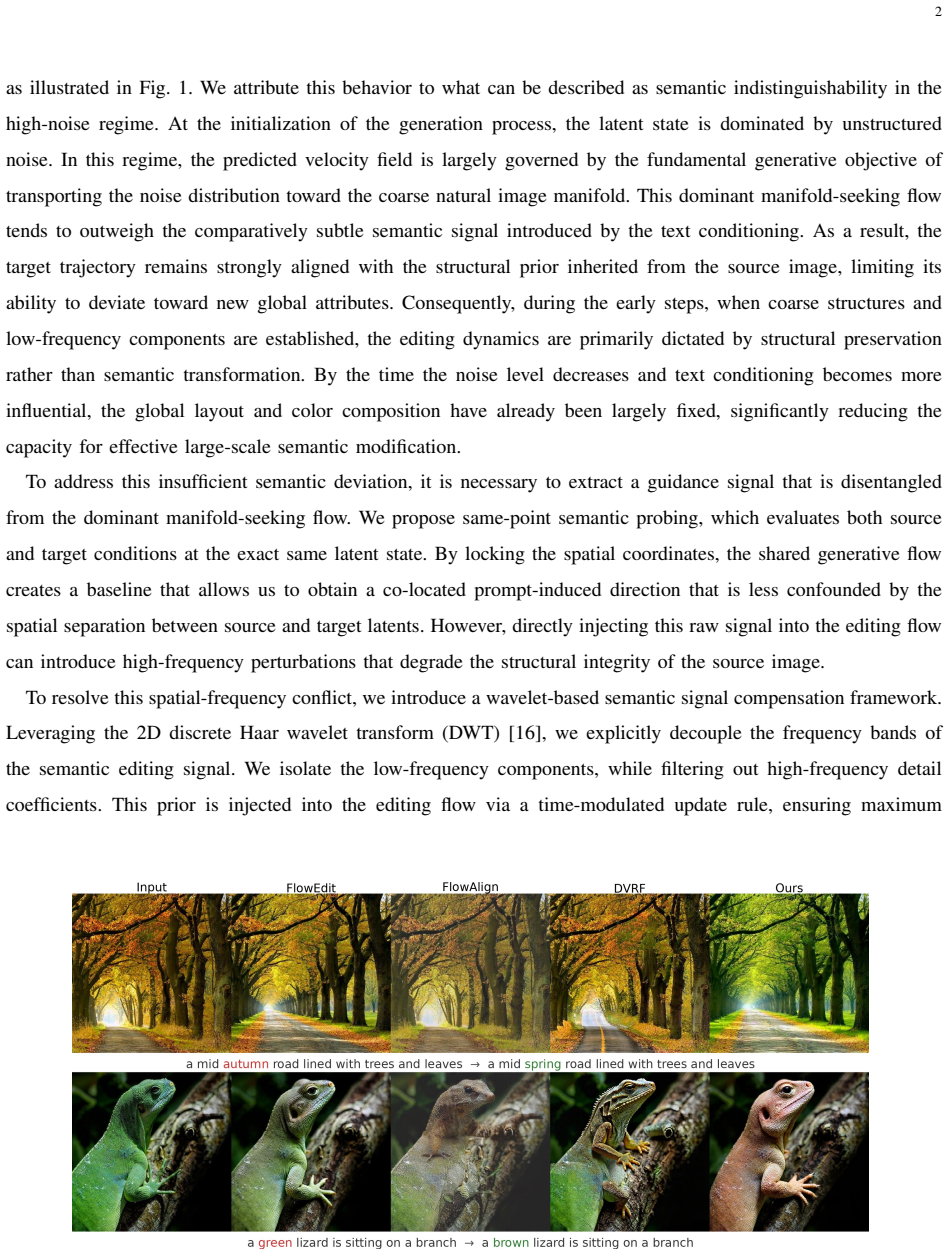
Wavelet regularization stabilizes sparse-view 3D Gaussian Splatting

Local and global frequency penalties yield sharper, more consistent reconstructions from limited input images

· “LGDWT-GS: Local and Global Discrete Wavelet-Regularized 3D Gaussian Splatting for Sparse-View Scene Reconstruction”

open re-runnable review →
Figure from the paper

Expert-log regularization cuts collisions in offline driving RL

Using pseudo ground-truth trajectories stabilizes training on fixed simulator data and raises route completion over imitation baselines.

· “Pseudo-Expert Regularized Offline RL for End-to-End Autonomous Driving in Photorealistic Closed-Loop Environments”

open re-runnable review →
Figure from the paper

CPU scheduling cuts agentic AI latency up to 3.9x

Analysis of CPU orchestration in autonomous agents yields two methods that raise hardware overlap and balance mixed requests on hybrid CPU-G

· “Towards Understanding, Analyzing, and Optimizing Agentic AI Execution: A CPU-Centric Perspective”

open re-runnable review →
Figure from the paper

Four lost Iraqi mounds found by AI on 1960s spy-satellite imagery

A retrained segmentation model reads pre-destruction CORONA photos, confirming sites invisible on modern maps.

· “AI-ming backwards: Vanishing archaeological landscapes in Mesopotamia and automatic detection of sites on CORONA imagery”

open re-runnable review →
Figure from the paper

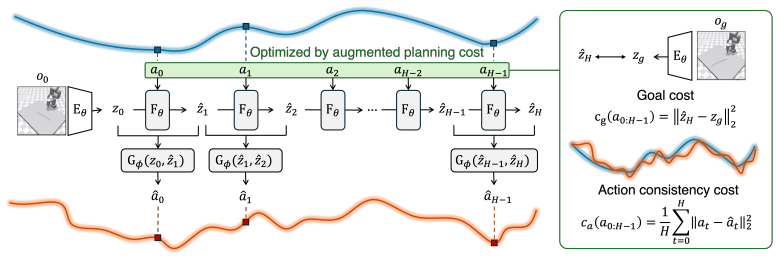
Self-supervised video model plans robot actions zero-shot on new arms

Pretrained on over a million hours of web video plus under 62 hours of unlabeled robot data, it enables pick-and-place planning without any

· “V-JEPA 2: Self-Supervised Video Models Enable Understanding, Prediction and Planning”

open re-runnable review →

browse all of cs → full archive · search · sub-categories