Ultra-Low-Cost Hybrid Beamforming: A New Static-Connection Architecture with Sparse Phase-Shifter Sharing
Pith reviewed 2026-07-03 04:38 UTC · model grok-4.3
The pith
A fixed sparse connection matrix lets antennas share phase shifters while preserving most beamforming performance in sub-connected hybrid systems.
A machine-rendered reading of the paper's core claim, the machinery that carries it, and where it could break.
Core claim
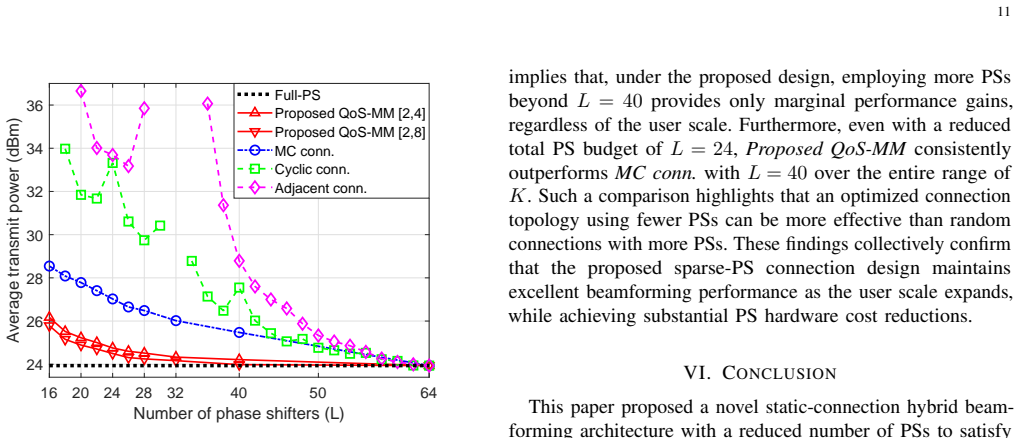
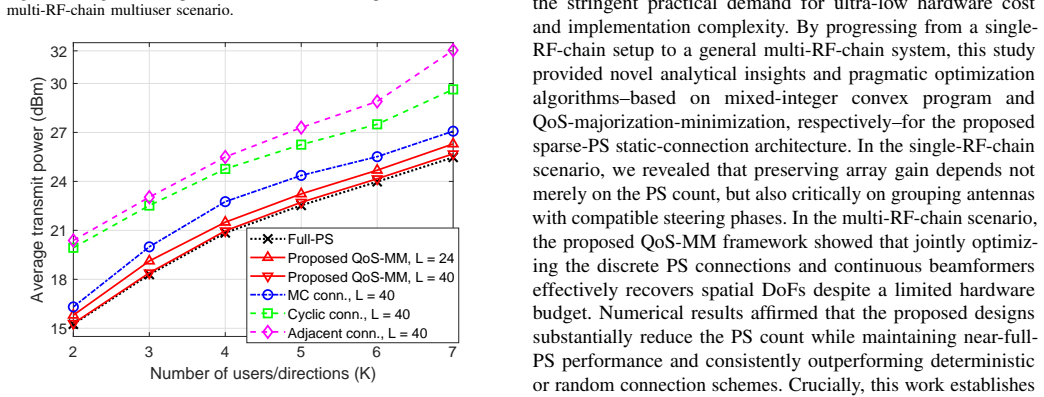
The central claim is that an optimized fixed PS-to-antenna connection matrix enables sparse phase-shifter sharing inside sub-connected hybrid beamforming, cutting the required phase-shifter count by 37.5 percent in single-RF-chain systems and 62.5 percent in multi-RF-chain systems while preserving most analog beamforming capability through adaptive phase adjustments plus digital precoding.
What carries the argument
The optimized fixed PS-to-antenna connection matrix that statically assigns shared phase shifters to antennas within each sub-array.
If this is right
- Hardware layout area and wiring complexity drop because each phase shifter serves multiple antennas.
- Calibration and control overhead decrease with fewer phase shifters to adjust.
- Single-RF-chain and multi-RF-chain designs both become feasible at lower cost without introducing deterministic pattern artifacts.
- The key engineering insight is that connection topology, not merely phase-shifter count, determines whether analog degrees of freedom are retained.
Where Pith is reading between the lines
- The same static-sharing idea could be tested in fully-connected hybrid architectures to see whether further cost reduction is possible.
- Prototype measurements on a small array would directly check whether the reported numerical savings translate to real RF hardware.
- The approach suggests examining whether similar fixed-sharing matrices can reduce the number of variable-gain amplifiers or other analog components.
Load-bearing premise
An optimized fixed connection matrix can always be found so that adaptive phase shifts plus digital precoding keep beam patterns within acceptable limits of full phase-shifter performance.
What would settle it
A set of channel realizations or measured patterns in which every possible fixed connection matrix produces at least one deep null or more than 3 dB gain loss relative to the full-PS baseline across the tested angles would falsify the claim.
Figures

read the original abstract
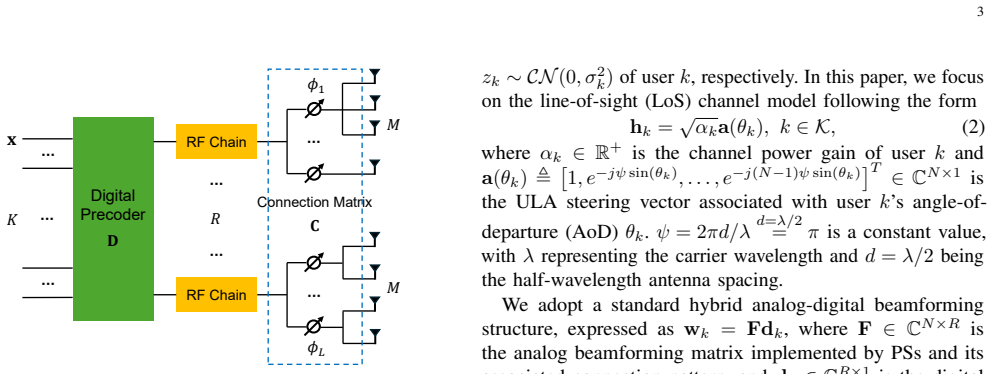
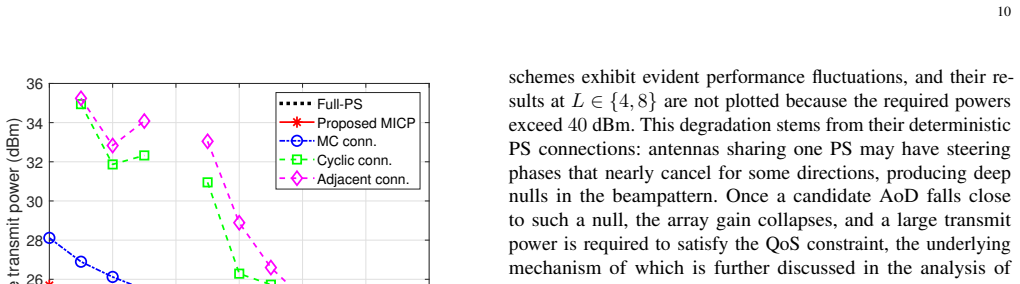
Hybrid beamforming is a promising solution for high-frequency multi-antenna wireless systems, but its implementation is constrained by the cost and complexity of analog phase-shifter (PS) networks. Although sub-connected architectures simplify the analog network, their conventional realization still requires a dedicated PS for each antenna, causing considerable layout area, wiring, calibration, and control overheads. To address this issue, this paper proposes a novel static-connection architecture with sparse PSs for ultra-low-cost sub-connected hybrid beamforming, where antennas within each sub-array share a PS through an optimized fixed PS-to-antenna connection matrix. The proposed architecture preserves static connections while enabling dynamic beam control via adaptive PS phase-shift adjustments and digital precoding. For the single-radio-frequency (RF)-chain scenario, the sparse-PS connection design is transformed into an antenna-grouping problem, with analytically characterized structural properties and an efficient algorithm. For the multi-RF-chain scenario, we develop a quality-of-service (QoS)-majorization-minimization (MM) algorithm to handle the mixed discrete-continuous optimization problem. Numerical results demonstrate that the proposed architecture reduces the PS count while preserving most beamforming capability of the traditional full-PS sub-connected architecture. In particular, the proposed design achieves PS-count reductions of 37.5% and 62.5% in single-RF-chain and multi-RF-chain systems, respectively, while avoiding deep-null and grating-lobe degradations associated with deterministic connection schemes. These results provide engineering insights into static sparse-PS sharing: the key to hardware-efficient hybrid beamforming is not merely reducing the PS count, but also preserving essential analog-domain degrees of freedom through optimized PS connection topologies.
Editorial analysis
A structured set of objections, weighed in public.
Referee Report
Summary. The paper proposes a static-connection hybrid beamforming architecture in which antennas within each sub-array share phase shifters via an optimized fixed PS-to-antenna connection matrix. For the single-RF-chain case the design is recast as an antenna-grouping problem with analytically derived structural properties and an efficient algorithm; for the multi-RF-chain case a QoS-majorization-minimization algorithm solves the mixed discrete-continuous problem. Numerical results are reported to show PS-count reductions of 37.5 % (single-RF) and 62.5 % (multi-RF) relative to a conventional full-PS sub-connected architecture while avoiding deep-null and grating-lobe degradations.
Significance. If the numerical claims are reproducible, the work supplies concrete algorithms and structural insights that shift the design focus from simply minimizing PS count to preserving essential analog degrees of freedom through optimized static topologies, offering a practical route to lower-cost mmWave/THz hybrid beamforming hardware.
major comments (1)
- [Numerical Results / abstract] Numerical Results (abstract and §V): the claimed 37.5 % and 62.5 % PS reductions are presented without error bars, without a description of the channel model, simulation parameters, or Monte-Carlo trial count, and without explicit verification that the connection matrix was obtained without data-dependent tuning that would affect the reported percentages. These omissions directly affect the load-bearing numerical support for the central performance claim.
Simulated Author's Rebuttal
We thank the referee for the constructive comment on the numerical results. We address the concern directly below and will revise the manuscript accordingly to improve reproducibility.
read point-by-point responses
-
Referee: [Numerical Results / abstract] Numerical Results (abstract and §V): the claimed 37.5 % and 62.5 % PS reductions are presented without error bars, without a description of the channel model, simulation parameters, or Monte-Carlo trial count, and without explicit verification that the connection matrix was obtained without data-dependent tuning that would affect the reported percentages. These omissions directly affect the load-bearing numerical support for the central performance claim.
Authors: We agree that the abstract and Section V omit several details required for full reproducibility. The connection matrix for the single-RF case is obtained from the analytically derived structural properties of the antenna-grouping problem and the associated efficient algorithm; for the multi-RF case it is produced by the QoS-MM procedure. Both procedures operate on the fixed architecture constraints and are independent of any particular channel realization. In the revised manuscript we will (i) report error bars computed over Monte-Carlo trials, (ii) specify the channel model together with all simulation parameters (carrier frequency, bandwidth, number of clusters/rays, path-loss exponents, etc.), (iii) state the number of Monte-Carlo trials performed, and (iv) explicitly confirm that the optimized static connection matrices are derived once from the structural/algorithmic properties and remain fixed across all channel realizations. These additions will substantiate the reported 37.5 % and 62.5 % reductions without data-dependent tuning. revision: yes
Circularity Check
No significant circularity identified
full rationale
The paper formulates the sparse PS connection design as an antenna-grouping problem (single-RF) and a QoS-MM mixed discrete-continuous optimization (multi-RF), then reports numerical performance of the resulting architectures. These steps solve externally posed optimization problems whose outputs are compared to a baseline full-PS sub-connected architecture; the reported PS-count reductions (37.5 % / 62.5 %) and pattern properties are therefore not equivalent to any fitted parameter or self-defined quantity by construction. No load-bearing step reduces to a self-citation chain, ansatz smuggling, or renaming of a known result.
Axiom & Free-Parameter Ledger
Reference graph
Works this paper leans on
-
[1]
A. M. Elbiret al., “Twenty-five years of advances in beamforming: From convex and nonconvex optimization to learning techniques,”IEEE Signal Process. Mag., vol. 40, pp. 118–131, Jun. 2023
work page 2023
-
[2]
Scalable hybrid beamforming for multi- user MISO systems: A graph neural network approach,
S. Wan, Z. Wang, and Y . Zhou, “Scalable hybrid beamforming for multi- user MISO systems: A graph neural network approach,”IEEE Trans. Wireless Commun., vol. 23, pp. 13694–13706, Oct. 2024
work page 2024
-
[3]
H. Wanget al., “Reconfigurable airspace: Synergizing movable antenna and intelligent surface for low-altitude ISAC networks,” 2025, arXiv: 2511.10310
-
[4]
Hybrid beamforming for massive MIMO: A survey,
A. F. Molisch, V . V . Ratnam, S. Han, Z. Li, S. L. H. Nguyen, L. Li, and K. Haneda, “Hybrid beamforming for massive MIMO: A survey,”IEEE Commun. Mag., vol. 55, pp. 134–141, Sep. 2017
work page 2017
-
[5]
Overview of precoding techniques for massive MIMO,
M. A. Albreemet al., “Overview of precoding techniques for massive MIMO,”IEEE Access, vol. 9, pp. 60764–60801, 2021
work page 2021
-
[6]
Throughput maximization for movable antenna systems with movement delay consideration,
H. Wanget al., “Throughput maximization for movable antenna systems with movement delay consideration,”IEEE Trans. Wireless Commun., vol. 25, pp. 883–899, 2026
work page 2026
-
[7]
Hybrid digital and analog beamforming design for large-scale antenna arrays,
F. Sohrabi and W. Yu, “Hybrid digital and analog beamforming design for large-scale antenna arrays,”IEEE J. Sel. Top. Signal Process., vol. 10, pp. 501–513, Apr. 2016
work page 2016
-
[8]
Alternating minimization algorithms for hybrid precoding in millimeter wave MIMO systems,
X. Yu, J.-C. Shen, J. Zhang, and K. B. Letaief, “Alternating minimization algorithms for hybrid precoding in millimeter wave MIMO systems,” IEEE J. Sel. Top. Signal Process., vol. 10, pp. 485–500, Apr. 2016
work page 2016
-
[9]
X. Gaoet al., “Energy-efficient hybrid analog and digital precoding for mmwave MIMO systems with large antenna arrays,”IEEE J. Sel. Areas Commun., vol. 34, pp. 998–1009, Apr. 2016
work page 2016
-
[10]
A survey on hybrid beamforming techniques in 5G: Architecture and system model perspectives,
I. Ahmedet al., “A survey on hybrid beamforming techniques in 5G: Architecture and system model perspectives,”IEEE Commun. Surv. Tuts., vol. 20, no. 4, pp. 3060–3097, 2018
work page 2018
-
[11]
A hardware-efficient analog network structure for hybrid precoding in millimeter wave systems,
X. Yu, J. Zhang, and K. B. Letaief, “A hardware-efficient analog network structure for hybrid precoding in millimeter wave systems,”IEEE J. Sel. Top. Signal Process., vol. 12, pp. 282–297, May 2018
work page 2018
-
[12]
Joint precoding and combining design for hybrid beamforming systems with subconnected structure,
Z. Zhang, X. Wu, and D. Liu, “Joint precoding and combining design for hybrid beamforming systems with subconnected structure,”IEEE Sys. J., vol. 14, pp. 184–195, Mar. 2020
work page 2020
-
[13]
T. E. Bogaleet al., “On the number of RF chains and phase shifters, and scheduling design with hybrid analog–digital beamforming,”IEEE Trans. Wireless Commun., vol. 15, pp. 3311–3326, May 2016
work page 2016
-
[14]
Hybrid beamforming for large antenna arrays with phase shifter selection,
S. Payami, M. Ghoraishi, and M. Dianati, “Hybrid beamforming for large antenna arrays with phase shifter selection,”IEEE Trans. Wireless Commun., vol. 15, pp. 7258–7271, Nov. 2016
work page 2016
-
[15]
Phase shifters versus switches: An energy efficiency perspective on hybrid beamforming,
S. Payamiet al., “Phase shifters versus switches: An energy efficiency perspective on hybrid beamforming,”IEEE Wireless Commun. Lett., vol. 8, pp. 13–16, Feb. 2019
work page 2019
-
[16]
Adaptive hybrid precoding for multiuser massive MIMO,
X. Zhuet al., “Adaptive hybrid precoding for multiuser massive MIMO,” IEEE Commun. Lett., vol. 20, pp. 776–779, Apr. 2016
work page 2016
-
[17]
Hybrid beamforming with dynamic subarrays and low-resolution PSs for mmwave MU-MISO systems,
H. Li, M. Li, and Q. Liu, “Hybrid beamforming with dynamic subarrays and low-resolution PSs for mmwave MU-MISO systems,”IEEE Trans. Commun., vol. 68, pp. 602–614, Jan. 2020
work page 2020
-
[18]
Low-resolution DACs aided partially- connected hybrid precoding design for MU-MISO system,
H. Gao, D. Liu, and Z. Zhang, “Low-resolution DACs aided partially- connected hybrid precoding design for MU-MISO system,”IEEE Commun. Lett., vol. 27, pp. 2767–2771, Oct. 2023
work page 2023
-
[19]
Massive MIMO combining with switches,
A. Alkhateebet al., “Massive MIMO combining with switches,”IEEE Wireless Commun. Lett., vol. 5, pp. 232–235, Jun. 2016
work page 2016
-
[20]
Hybrid analog-digital channel estimation and beamforming: Training-throughput tradeoff,
T. E. Bogale, L. B. Le, and X. Wang, “Hybrid analog-digital channel estimation and beamforming: Training-throughput tradeoff,”IEEE Trans. Commun., vol. 63, pp. 5235–5249, Dec. 2015
work page 2015
-
[21]
A unifying design of hybrid beamforming architectures employing phase shifters or switches,
K. Ardahet al., “A unifying design of hybrid beamforming architectures employing phase shifters or switches,”IEEE Trans. V eh. Technol., vol. 67, pp. 11243–11247, Nov. 2018
work page 2018
-
[22]
Hybrid MIMO architectures for millimeter wave communications: Phase shifters or switches?,
R. M ´endez-Rialet al., “Hybrid MIMO architectures for millimeter wave communications: Phase shifters or switches?,”IEEE Access, vol. 4, pp. 247–267, 2016
work page 2016
-
[23]
Channel-statistics-based hybrid precoding for millimeter-wave MIMO systems with dynamic subarrays,
J. Jin, C. Xiao, W. Chen, and Y . Wu, “Channel-statistics-based hybrid precoding for millimeter-wave MIMO systems with dynamic subarrays,” IEEE Trans. Commun., vol. 67, pp. 3991–4003, Jun. 2019
work page 2019
-
[24]
Dynamic subarrays for hybrid precoding in wideband mmwave MIMO systems,
S. Park, A. Alkhateeb, and R. W. Heath, “Dynamic subarrays for hybrid precoding in wideband mmwave MIMO systems,”IEEE Trans. Wireless Commun., vol. 16, pp. 2907–2920, May 2017
work page 2017
-
[25]
Hybrid beamforming with selection for multiuser massive MIMO systems,
V . V . Ratnamet al., “Hybrid beamforming with selection for multiuser massive MIMO systems,”IEEE Trans. Signal Process., vol. 66, pp. 4105– 4120, Aug. 2018
work page 2018
-
[26]
Joint precoding design for sub-connected hybrid beamforming system,
Y . Hu, H. Qian, K. Kang, X. Luo, and H. Zhu, “Joint precoding design for sub-connected hybrid beamforming system,”IEEE Trans. Wireless Commun., vol. 23, pp. 1199–1212, Feb. 2024
work page 2024
-
[27]
B. Rupakulaet al., “Limited scan-angle phased arrays using randomly grouped subarrays and reduced number of phase shifters,”IEEE Trans. Antennas and Propag., vol. 68, pp. 70–80, Jan. 2020
work page 2020
-
[28]
Reduction of phase shifters in planar phased arrays using novel random subarray techniques,
J. L. Valleet al., “Reduction of phase shifters in planar phased arrays using novel random subarray techniques,”Appl. Sci., vol. 14, Jul. 2024
work page 2024
-
[29]
C. A. Balanis,Antenna theory: analysis and design. John wiley & sons, 2016
work page 2016
-
[30]
mmWave IEEE 802.11ay for 5G fixed wireless access,
K. Aldubaikhyet al., “mmWave IEEE 802.11ay for 5G fixed wireless access,”IEEE Wireless Commun., vol. 27, pp. 88–95, Apr. 2020
work page 2020
-
[31]
Mobility support for millimeter wave communications: Opportunities and challenges,
J. Liet al., “Mobility support for millimeter wave communications: Opportunities and challenges,”IEEE Commun. Surv. Tuts., vol. 24, no. 3, pp. 1816–1842, 2022
work page 2022
-
[32]
Millimeter-wave smart antenna solutions for URLLC in industry 4.0 and beyond,
A. Jabbaret al., “Millimeter-wave smart antenna solutions for URLLC in industry 4.0 and beyond,”Sensors, vol. 22, Mar. 2022
work page 2022
-
[33]
Beam alignment in mmWave V2X communications: A survey,
J. Tanet al., “Beam alignment in mmWave V2X communications: A survey,”IEEE Commun. Surv. Tuts., vol. 26, no. 3, pp. 1676–1709, 2024
work page 2024
-
[34]
A tutorial on beam management for 3GPP NR at mmwave frequencies,
M. Giordani, M. Polese, A. Roy, D. Castor, and M. Zorzi, “A tutorial on beam management for 3GPP NR at mmwave frequencies,”IEEE Commun. Surv. Tuts., vol. 21, no. 1, pp. 173–196, 2019
work page 2019
-
[35]
Limited feedback hybrid precoding for multi-user millimeter wave systems,
A. Alkhateeb, G. Leus, and R. W. Heath, “Limited feedback hybrid precoding for multi-user millimeter wave systems,”IEEE Trans. Wireless Commun., vol. 14, pp. 6481–6494, Nov. 2015
work page 2015
-
[36]
Machine learning for millimeter wave and terahertz beam management: A survey and open challenges,
M. Qurratulain Khan, A. Gaber, P. Schulz, and G. Fettweis, “Machine learning for millimeter wave and terahertz beam management: A survey and open challenges,”IEEE Access, vol. 11, pp. 11880–11902, 2023
work page 2023
-
[37]
A survey of beam management for mmWave and THz communications towards 6G,
Q. Xue, C. Ji, S. Ma, J. Guo, Y . Xu, Q. Chen, and W. Zhang, “A survey of beam management for mmWave and THz communications towards 6G,”IEEE Commun. Surv. Tuts., vol. 26, no. 3, pp. 1520–1559, 2024
work page 2024
-
[38]
Deep learning for mmwave beam and blockage prediction using sub-6 GHz channels,
M. Alrabeiah and A. Alkhateeb, “Deep learning for mmwave beam and blockage prediction using sub-6 GHz channels,”IEEE Trans. Commun., vol. 68, pp. 5504–5518, Sep. 2020
work page 2020
-
[39]
CVX: MATLAB software for disciplined convex programming, version 2.2,
M. Grant and S. Boyd, “CVX: MATLAB software for disciplined convex programming, version 2.2,” Jan. 2020
work page 2020
-
[40]
Movable antenna enabled interference network: Joint antenna position and beamforming design,
H. Wang, Q. Wu, and W. Chen, “Movable antenna enabled interference network: Joint antenna position and beamforming design,”IEEE Wireless Commun. Lett., vol. 13, pp. 2517–2521, Sep. 2024
work page 2024
-
[41]
Solution of the multiuser downlink beamforming problem with individual SINR constraints,
M. Schubert and H. Boche, “Solution of the multiuser downlink beamforming problem with individual SINR constraints,”IEEE Trans. V eh. Technol., vol. 53, pp. 18–28, Jan. 2004
work page 2004
-
[42]
Majorization-minimization algo- rithms in signal processing, communications, and machine learning,
Y . Sun, P. Babu, and D. P. Palomar, “Majorization-minimization algo- rithms in signal processing, communications, and machine learning,” IEEE Trans. Signal Process., vol. 65, pp. 794–816, Feb. 2017
work page 2017
-
[43]
R. A. Horn and C. R. Johnson,Matrix Analysis. Cambridge, U.K.: Cambridge University Press, 2nd ed., 2012
work page 2012
-
[44]
I. P´olik and T. Terlaky,Interior Point Methods for Nonlinear Optimization. Berlin, Germany: Springer, 2010
work page 2010
-
[45]
Y . Wuet al., “Globally optimal resource allocation design for discrete phase shift IRS-assisted multiuser networks with perfect and imperfect CSI,”IEEE Trans. Wireless Commun., vol. 24, pp. 1306–1324, 2025
work page 2025
-
[46]
SWIPT in mixed near- and far-field channels: Joint beam scheduling and power allocation,
Y . Zhang and C. You, “SWIPT in mixed near- and far-field channels: Joint beam scheduling and power allocation,”IEEE J. Sel. Areas Commun., vol. 42, pp. 1583–1597, Jun. 2024
work page 2024
-
[47]
T. S. Rappaportet al., “Overview of millimeter wave communications for fifth-generation (5G) wireless networks—with a focus on propagation models,”IEEE Trans. Antennas and Propag., vol. 65, pp. 6213–6230, Dec. 2017
work page 2017
discussion (0)
Sign in with ORCID, Apple, or X to comment. Anyone can read and Pith papers without signing in.