Covers image processing, computer vision, pattern recognition, and scene understanding. Roughly includes material in ACM Subject Classes I.2.10, I.4, and I.5.
Saliency prediction has been extensively studied in RGB images and videos as a computational model of human visual attention. In contrast, predicting saliency from event-based data remains largely unexplored, despite the biological inspiration and favorable sensing properties of event cameras. Two obstacles have held this direction back: the absence of large-scale event saliency datasets, and the lack of a strong baseline. In this paper, we introduce SEST (Swin Event-based Saliency Transformer), a transformer-based model for saliency prediction from event data, bridging the data scarcity barrier through event-native pretraining and synthetic supervision. SEST leverages a self-supervised pretrained event-based Swin Transformer backbone combined with a lightweight CNN decoder to produce dynamic saliency maps. To address the scarcity of annotated event-based saliency data, we introduce two new benchmark datasets, N-DHF1K and N-UCF Sports, generated from large-scale RGB saliency benchmarks. Experimental results show that SEST clearly outperforms existing event-based saliency methods and narrows the performance gap with state-of-the-art RGB models. Zero-shot evaluation on a real event camera dataset further demonstrates that our model trained on synthetic data remains transferable on real event streams. To the best of our knowledge, this work is the first to apply deep learning to event-based saliency prediction, opening a new research direction at the intersection of event-based vision and neuromorphic visual attention.
Grounding language in the physical world requires AI systems to interpret references that emerge dynamically during conversation. While current vision-language models (VLMs) excel at static image tasks, they struggle to resolve ambiguous expressions in spontaneous, multi-turn dialogue. We address this gap by introducing (1) a benchmark for referential communication in dynamic 3D environments, built from 6.7 hours of egocentric VR interaction with synchronized speech, motion, gaze, and 3D scene geometry, and (2) a two-stage grounding pipeline that explicitly resolves conversational ambiguity before visual localization. The benchmark includes over 4,200 manually verified referring expressions spanning full, partitive, and pronominal types. Our contextual rewriting approach improves grounding performance by 11-22 percentage points on average, with a pure detector (GroundingDINO) reaching 56.7% on pronominals after rewriting, nearly double the best end-to-end baseline. Results demonstrate that decoupling linguistic reasoning from visual perception is more effective than end-to-end approaches for conversational grounding.
We present NeuroQA, a large-scale benchmark for visual question answering in 3D brain magnetic resonance imaging (MRI), with 56,953 QA pairs from 12,977 subjects across 12 datasets. It spans ages 5-104 and five clinical domains: Alzheimer's, Parkinson's, tumors, white matter disease, and neurodevelopment. Unlike prior medical Visual Question Answering (VQA) efforts that operate on 2D slices or rely on narrow diagnostic labels, NeuroQA pairs every item with a full 3D volume. It evaluates 11 clinically grounded reasoning skills across Yes/No, multiple-choice, and open-ended formats. Of the 203 templates, 131 are image-grounded (answerable from a 3-plane viewer) and 72 are image-informed (ground truth from quantitative volumetry or clinical instruments). To remove text-only shortcuts, we apply answer-distribution refinement, reducing closed-format text-only accuracy from $>$80% to 44.6%; image necessity is assessed separately through an image-grounding protocol released with the benchmark. A 38-rule deterministic pipeline and two rounds of expert review verify every QA pair against FreeSurfer measurements, metadata, or radiology report fields, with zero same-subject contradictions across templates. We conduct a clinician evaluation in which two clinicians independently assess 100 frozen test items on a three-plane viewer. On closed-format (Yes/No + multiple-choice) test-public items, the best zero-shot vision-language model and a supervised 3D CNN baseline reach 47.5% and 43.7% accuracy respectively, both below the 49.4% text-only majority-template floor. NeuroQA adopts a two-tier release with public QA pairs for open-access datasets and reproducible generation scripts for datasets restricted by data use agreements (DUAs), plus subject-level splits, a held-out private test set, and an online leaderboard.
Automated structural health monitoring is essential to prevent catastrophic infrastructure failures. Precise, pixel-level defect segmentation is needed to accurately assess structural integrity, but progress in defect segmentation for civil infrastructures has been held back by an extreme scarcity of data, which requires costly expert annotation. The need for data is accentuated by algorithmic hurdles intrinsic to the problem, including center-bias and the need to rely more on shape when inspecting nearly textureless building materials. To remove the bottleneck, we introduce Cracks in the Foundation (CiF), the largest and most detailed civil infrastructure (instance) segmentation dataset to date, comprising $\approx$150,000 high-resolution images meticulously curated over five years in collaboration with civil engineering experts. With the help of this unprecedented data source, we expose a blind spot of current visual AI: despite the advent of promptable Foundation Models (FMs) and Vision Language Models (VLMs), and despite the impressive abilities of today's specialised segmentation models, it turns out that dense image understanding in the built environment is nowhere near solved. Our evaluations indicate that even the most recent zero-shot FMs face significant challenges when deployed on real-world infrastructure and even the performance of specialised models with domain-specific supervision plateaus at $\approx$25% mAP. CiF establishes inspection of civil infrastructure, an elementary and seemingly easy perceptual task, as an open challenge that reveals fundamental weaknesses of present-day models trained predominantly on internet images, literally and figuratively highlighting cracks in the current foundation model paradigm.
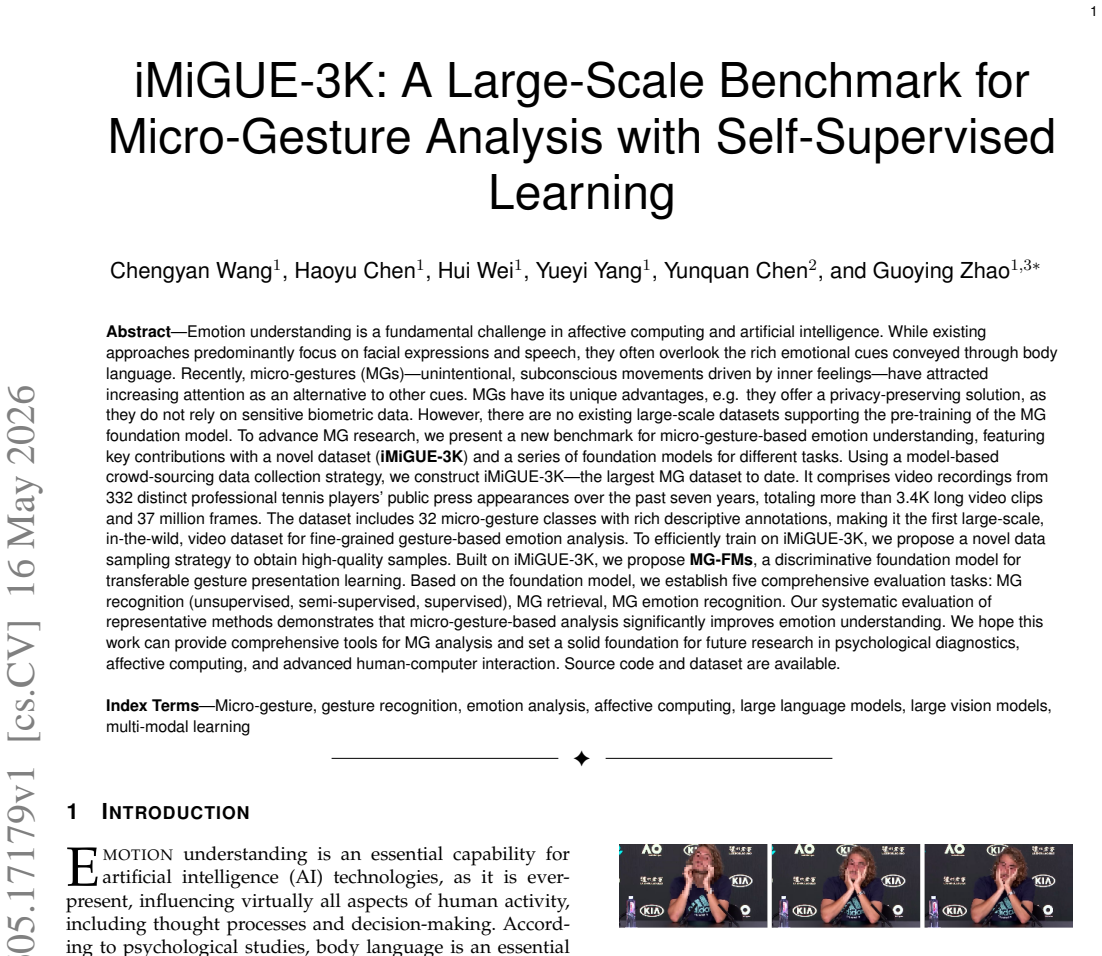
Emotion understanding is a fundamental challenge in affective computing and artificial intelligence. While existing approaches predominantly focus on facial expressions and speech, they often overlook the rich emotional cues conveyed through body language. Recently, micro-gestures (MGs), unintentional, subconscious movements driven by inner feelings, have attracted increasing attention as an alternative to other cues. However, there are no existing large-scale datasets supporting the pre-training of the MG foundation model. To advance MG research, we present a new benchmark for micro-gesture-based emotion understanding, featuring key contributions with a novel dataset (iMiGUE-3K) and a series of foundation models for different tasks. Using a model-based crowd-sourcing data collection strategy, we construct iMiGUE-3K, the largest MG dataset to date. It comprises video recordings from 332 distinct professional tennis players' public press interviews over the past seven years, totaling more than 3.4K long video clips and 37 million frames. The dataset includes 32 micro-gesture classes with rich descriptive annotations, making it the first large-scale, in-the-wild, video dataset for fine-grained gesture-based emotion analysis. Built on iMiGUE-3K, we propose MG-FMs, a discriminative foundation model for transferable gesture presentation learning. Based on the foundation model, we establish five comprehensive evaluation tasks: MG recognition (unsupervised, semi-supervised, supervised), MG retrieval, and MG emotion recognition. Our systematic evaluation of representative methods demonstrates that micro-gesture-based analysis significantly improves emotion understanding. We hope this work can provide comprehensive tools for MG analysis and set a solid foundation for future research in psychological diagnostics, affective computing, and advanced human-computer interaction.
Longitudinal chest X-ray (CXR) interpretation requires reasoning over disease evolution across multiple patient visits, yet most existing medical VQA benchmarks focus on single images or short-horizon image pairs. We introduce MI-CXR, a benchmark for standardized evaluation of Multi-Interval longitudinal reasoning over multi-visit CXR sequences, without requiring free-form report generation or additional clinical context. MI-CXR comprises five-way multiple-choice questions over five-visit patient timelines and instantiates three complementary task families: Temporal Event Localization, Interval-wise Change Reasoning, and Global Trajectory Summarization, which assess clinically grounded visual reasoning over time. Evaluating 14 state-of-the-art vision-language models (VLMs) shows low overall performance, with an average accuracy of 29.3%, only modestly above random guessing. Using stage-wise diagnostic probing, we find that models often produce locally plausible interval descriptions but fail to enforce temporal constraints or compose evidence into globally consistent decisions over the full timeline. These findings reveal key limitations of current VLMs and establish MI-CXR as a principled benchmark for longitudinal medical reasoning. The benchmark is available at https://github.com/AIDASLab/MI-CXR
Vision-Language Models (VLMs) often produce self-reflective statements like "let me check the figure again" during reasoning. Do such statements trigger genuine visual re-examination, or are they merely learned textual patterns? We investigate this via VisualSwap, an image-swap probing framework: after a model reasons over an image, we replace it with a visually similar but semantically different one and test whether the model notices. We introduce VS-Bench, 800 image pairs curated from MathVista, MathVerse, MathVision, and MMMU-Pro. Experiments on Qwen3-VL, Kimi-VL, and ERNIE-VL reveal a striking failure: models overwhelmingly miss the swap, with accuracy dropping by up to 60%. Counterintuitively, thinking models are nearly 3x more vulnerable than their instructed counterparts, and scaling offers no mitigation. Multi-turn user instructions restore visual grounding, but self-generated reflective statements during continuous generation do not. Attention analysis explains why: user instructions substantially elevate attention to visual tokens, whereas self-reflection does not. Current VLMs tend to say rather than actually see when claiming to perform visual re-examination. Our code and dataset are available at the project page: https://visualswap.github.io
Existing medical-agent benchmarks deliver imaging as pre-selected samples, never as an environment the agent must navigate. We introduce ABRA, a radiology-agent benchmark in which the agent operates an OHIF viewer and an Orthanc DICOM server through twenty-one function-calling tools that span slice navigation, windowing, series selection, pixel-coordinate annotation, and structured reporting. ABRA contains 655 programmatically generated tasks across three difficulty tiers and eight types (viewer control, metadata QA, vision probe, annotation, longitudinal comparison, BI-RADS reporting, and oracle variants of annotation and BI-RADS reporting), drawn from LIDC-IDRI, Duke Breast Cancer MRI, and NLST New-Lesion LongCT. Each episode is scored along Planning, Execution, and Outcome (Bluethgen et al., 2025) by task-type-specific automatic scorers. Ten current models, five closed-weight and five open-weight, reach at least 89% Execution on real annotation but only 0-25% Outcome; on the paired oracle variant where a simulated detector supplies the finding, Outcome on the same task reaches 69-100% across the models evaluated, localising the bottleneck to perception rather than tool orchestration. Code, task generators, and scorers are released at https://github.com/Luab/ABRA
Camera calibration is a fundamental prerequisite for reliable geometric perception, yet classical approaches rely on controlled acquisition setups that are impractical for in-the-wild imagery. Recent learning-based methods have shown promising results for single-view calibration, but inherently neglect geometric consistency across multiple views. We introduce CalibAnyView, a unified formulation that supports an arbitrary number of input views ($N \geq 1$) by explicitly modeling cross-view geometric consistency. To facilitate this, we construct a large-scale multi-view video dataset covering diverse real-world scenarios, including multiple camera models, dynamic scenes, realistic motion trajectories, and heterogeneous lens distortions. Building on this dataset, we develop a multi-view transformer that predicts dense perspective fields, which are further integrated into a geometric optimization framework to jointly estimate camera intrinsics and gravity direction. Extensive experiments demonstrate that CalibAnyView consistently outperforms state-of-the-art methods, achieves strong robustness under single-view settings, and further improves with multi-view inference, providing a reliable foundation for downstream tasks such as 3D reconstruction and robotic perception in the wild.
Autonomous vehicles depend on online HD map construction to perceive lane boundaries, dividers, and pedestrian crossings -- safety-critical road elements that directly govern motion planning. While existing pixel perturbation attacks can disrupt the mapping, they can be neutralized by standard adversarial defenses. We present MIRAGE, a framework for systematic discovery of semantic attacks that bypass adversarial defenses and degrade mapping predictions by finding plausible environmental variation (e.g. shadows, wet roads). MIRAGE exploits the latent manifold of real-world data learned by diffusion models, and searches for semantically mutated scenes neighboring the ground truth with the same road topology yet mislead the mapping predictions. We evaluate MIRAGE on nuScenes and demonstrate two attacks: (1) boundary removal, suppressing 57.7% of detections and corrupting 96% of planned trajectories; and (2) boundary injection, the only method that successfully injects fictitious boundaries, while pixel PGD and AdvPatch fail entirely. Both attacks remain potent under various adversarial defenses. We use two independent VLM judges to quantify realism, where MIRAGE passes as realistic 80--84% of the time (vs. 97--99% for clean nuScenes), while AdvPatch only 0--9%. Our findings expose a categorical gap in current adversarial defenses: semantic-level perturbations that manifest as legitimate environmental variation are substantially harder to mitigate than pixel-level perturbations.
AnyFlow learns transitions over arbitrary intervals so quality keeps rising instead of plateauing once extra sampling steps are added.
abstractclick to expand
Few-step video generation has been significantly advanced by consistency distillation. However, the performance of consistency-distilled models often degrades as more sampling steps are allocated at test time, limiting their effectiveness for any-step video diffusion. This limitation arises because consistency distillation replaces the original probability-flow ODE trajectory with a consistency-sampling trajectory, weakening the desirable test-time scaling behavior of ODE sampling. To address this limitation, we introduce AnyFlow, the first any-step video diffusion distillation framework based on flow maps. Instead of distilling a model for only a few fixed sampling steps, AnyFlow optimizes the full ODE sampling trajectory. To this end, we shift the distillation target from endpoint consistency mapping $(z_{t}\rightarrow z_{0})$ to flow-map transition learning $(z_{t}\rightarrow z_{r})$ over arbitrary time intervals. We further propose Flow Map Backward Simulation, which decomposes a full Euler rollout into shortcut flow-map transitions, enabling efficient on-policy distillation that reduces test-time errors (i.e., discretization error in few-step sampling and exposure bias in causal generation). Extensive experiments across both bidirectional and causal architectures, at scales ranging from 1.3B to 14B parameters, demonstrate that AnyFlow achieves performance matches or surpasses consistency-based counterparts in the few-step regime, while scaling with sampling step budgets.
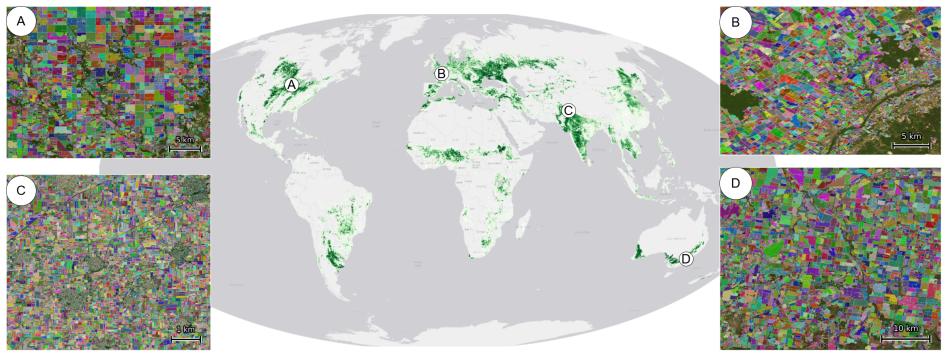
The agricultural field is the natural unit at which crops are planted, managed, regulated, and reported, yet most global remote-sensing products for agriculture are only available at the pixel level. While some high-quality field-level data products exist, they come from parcel registries covering only parts of Europe or from ML-derived products for individual countries. No openly available, globally consistent map of agricultural field boundaries exists to date. Here we present the first global field boundary dataset at 10\,m resolution for the years 2024 and 2025, comprising 3.17 billion remote-sensing field polygons (1.62 B in 2024 and 1.55 B in 2025) across 241 countries and territories, produced by applying a U-Net segmentation model trained on the Fields of The World dataset to cloud-free Sentinel-2 mosaics. Validated against ground-truth field boundaries in 24 countries, the map achieved a mean pixel-level recall of 0.85 with 14 countries exceeding 0.90. Evaluation against full-country ground-truth datasets in Austria, Latvia, and Finland yielded F1 scores of 0.89, 0.88, and 0.74, respectively. Because reference data for global validation is inherently incomplete, we accompanied the map with a 500 m confidence layer that identifies regions where predictions are reliable. We release the dataset openly as three global maps: the confidence-thresholded default field boundary dataset, the full unfiltered dataset, and the continuous-valued confidence raster. These maps provide the first globally consistent field-level unit of analysis for crop monitoring, food security, and downstream agricultural science.
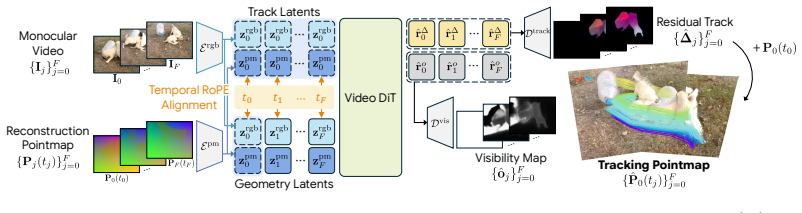
Dense 3D tracking from monocular video is fundamental to dynamic scene understanding. While recent 3D foundation models provide reliable per-frame geometry, recovering object motion in this geometry remains challenging and benefits from strong motion priors learned from real-world videos. Existing 3D trackers either follow iterative paradigms trained from scratch on synthetic data or fine-tune 3D reconstruction models learned from static multi-view images, both lacking real-world motion priors. Pre-trained video diffusion transformers (video DiTs) offer rich spatio-temporal priors from internet-scale videos, making them a promising foundation for 3D tracking. However, their frame-anchored formulation, which generates each frame's content, is fundamentally mismatched with reference-anchored dense 3D tracking, which must follow the same physical points from a reference frame across time. We present TrackCraft3R, the first method to repurpose a video DiT as a feed-forward dense 3D tracker. Given a monocular video and its frame-anchored reconstruction pointmap, TrackCraft3R predicts a reference-anchored tracking pointmap that follows every pixel of the first frame across time in a single forward pass, along with its visibility. We achieve this through two designs: (i) a dual-latent representation that uses per-frame geometry latents and reference-anchored track latents as dense queries, and (ii) temporal RoPE alignment, which specifies the target timestamp of each track latent. Together, these designs convert the per-frame generative paradigm of video DiTs into a reference-anchored tracking formulation with LoRA fine-tuning. TrackCraft3R achieves state-of-the-art performance on standard sparse and dense 3D tracking benchmarks, while running 1.3x faster and using 4.6x less peak memory than the strongest prior method. We further demonstrate robustness to large motions and long videos.
Recent single-image relighting methods, powered by advanced generative models, have achieved impressive photorealism on synthetic benchmarks. However, their effectiveness in the complex visual landscape of the real world remains largely unverified. A critical gap exists, as current datasets are typically designed for multi-view reconstruction and fail to address the unique challenges of single-image relighting. To bridge this synthetic-to-real gap, we introduce WildRelight, the first in-the-wild dataset specifically created for evaluating single-image relighting models. WildRelight features a diverse collection of high-resolution outdoor scenes, captured under strictly aligned, temporally varying natural illuminations, each paired with a high-dynamic-range environment map. Using this data, we establish a rigorous benchmark revealing that state-of-the-art models trained on synthetic data suffer from severe domain shifts. The strictly aligned temporal structure of WildRelight enables a new paradigm for domain adaptation. We demonstrate this by introducing a physics-guided inference framework that leverages the captured natural light evolution as a self-supervised constraint. By integrating Diffusion Posterior Sampling (DPS) with temporal Sampling-Aware Test-Time Adaptation (TTA), we show that the dataset allows synthetic models to align with real-world statistics on-the-fly, transforming the intractable sim-to-real challenge into a tractable self-supervised task. The dataset and code will be made publicly available to foster robust, physically-grounded relighting research.
All-in-one image restoration seeks to recover clean images from inputs affected by diverse and unknown degradations using a unified framework. Recent methods have shown strong performance by identifying degradation characteristics to guide the restoration process. However, many of them treat degradations as discrete categories, which limits their ability to model the continuous relational structure that arises in composite degradations. To address this issue, we propose a multimodal large language model (MLLM)-guided image restoration framework that exploits multimodal embeddings as guidance for low-level restoration. Specifically, MLLM-derived features are injected into an encoder-decoder architecture through an MLLM-guided fusion block (MGFB) to enhance degradation-aware representations. In addition, we incorporate a mixture-of-frequency-experts (MoFE) module that adaptively combines frequency experts using MLLM-guided contextual cues. To further improve expert routing, we design an MLLM-guided router with a relational alignment loss that encourages routing patterns consistent with the embedding-space relationships of degraded inputs. Extensive experiments on multiple benchmarks show that the proposed method achieves strong performance across diverse restoration settings and establishes a new state of the art on the challenging CDD11 dataset, outperforming previous methods by up to 1.35 dB.
We propose HeadsUp, a scalable feed-forward method for reconstructing high-quality 3D Gaussian heads from large-scale multi-camera setups. Our method employs an efficient encoder-decoder architecture that compresses input views into a compact latent representation. This latent representation is then decoded into a set of UV-parameterized 3D Gaussians anchored to a neutral head template. This UV representation decouples the number of 3D Gaussians from the number and resolution of input images, enabling training with many high-resolution input views. We train and evaluate our model on an internal dataset with more than 10,000 subjects, which is an order of magnitude larger than existing multi-view human head datasets. HeadsUp achieves state-of-the-art reconstruction quality and generalizes to novel identities without test-time optimization. We extensively analyze the scaling behavior of our model across identities, views, and model capacity, revealing practical insights for quality-compute trade-offs. Finally, we highlight the strength of our latent space by showcasing two downstream applications: generating novel 3D identities and animating the 3D heads with expression blendshapes.
Visual correspondence across image-to-image (2D-2D), image-to-point cloud (2D-3D), and point cloud-to-point cloud (3D-3D) geometric matching forms the foundation for numerous 3D vision tasks. Despite sharing a similar problem structure, current methods use task-specific designs with separate models for each modality combination. We present UniCorrn, the first correspondence model with shared weights that unifies geometric matching across all three tasks. Our key insight is that Transformer attention naturally captures cross-modal feature similarity. We propose a dual-stream decoder that maintains separate appearance and positional feature streams. This design enables end-to-end learning through stack-able layers while supporting flexible query-based correspondence estimation across heterogeneous modalities. Our architecture employs modality-specific backbones followed by shared encoder and decoder components, trained jointly on diverse data combining pseudo point clouds from depth maps with real 3D correspondence annotations. UniCorrn achieves competitive performance on 2D-2D matching and surpasses prior state-of-the-art by 8% on 7Scenes (2D-3D) and 10% on 3DLoMatch (3D-3D) in registration recall. Project website: https://neu-vi.github.io/UniCorrn
For artistic applications, video generation requires fine-grained control over both performance and cinematography, i.e., the actor's motion and the camera trajectory. We present ActCam, a zero-shot method for video generation that jointly transfers character motion from a driving video into a new scene and enables per-frame control of intrinsic and extrinsic camera parameters. ActCam builds on any pretrained image-to-video diffusion model that accepts conditioning in terms of scene depth and character pose. Given a source video with a moving character and a target camera motion, ActCam generates pose and depth conditions that remain geometrically consistent across frames. We then run a single sampling process with a two-phase conditioning schedule: early denoising steps condition on both pose and sparse depth to enforce scene structure, after which depth is dropped and pose-only guidance refines high-frequency details without over-constraining the generation. We evaluate ActCam on multiple benchmarks spanning diverse character motions and challenging viewpoint changes. We find that, compared to pose-only control and other pose and camera methods, ActCam improves camera adherence and motion fidelity, and is preferred in human evaluations, especially under large viewpoint changes. Our results highlight that careful camera-consistent conditioning and staged guidance can enable strong joint camera and motion control without training. Project page: https://elkhomar.github.io/actcam/.