pith. sign in

cs.CL

Computation and Language

Covers natural language processing. Roughly includes material in ACM Subject Class I.2.7. Note that work on artificial languages (programming languages, logics, formal systems) that does not explicitly address natural-language issues broadly construed (natural-language processing, computational linguistics, speech, text retrieval, etc.) is not appropriate for this area.

3
cs.CL 2026-05-25 2 theorems

Language flips which jailbreaks work on frontier MLLMs

by Casey Ford, Madison Van Doren +2 more

Same Model, Different Weakness: How Language and Modality Reshape the Jailbreak Attack Surface in Frontier MLLMs

Spanish reduces role-play success but increases visual attack success, reversing safety rankings across models.

Figure from the paper full image
abstract click to expand
The attack surface of a multimodal large language model (MLLM) is language-dependent in ways that reveal the mechanistic structure of alignment failures. We present the first systematic cross-lingual, multimodal red-teaming study comparing jailbreak vulnerability in US English (en-US) and Mexican Spanish (es-MX) across four frontier MLLMs: Claude Sonnet 4.5, GPT-5, Pixtral Large, and Qwen Omni. Using a fixed adversarial benchmark of 363 diverse prompt scenarios administered in text-only and multimodal conditions, we collected 52,272 harm ratings and binary attack success judgements from matched panels of nine native-speaker annotators per language group. Our central finding is that language does not scale vulnerability uniformly. Bayesian mixed-effects analyses reveal that linguistic framing attacks such as role-play become substantially less effective under Spanish prompting, while visually explicit multimodal attacks become more effective, which directly implicates the prompt-language interface rather than global annotator leniency. This dissociation indicates that linguistic and visual alignment failures operate through distinct mechanisms, and that switching language is sufficient to expose that separation. The practical consequence is that safety rankings are not preserved across languages. Qwen Omni overtakes Pixtral Large as the most vulnerable model among es-MX participants, a rank reversal no scalar correction of English-condition scores could recover, and absolute attack success rates have declined across model generations without closing the gaps between them. These findings demonstrate that safety evaluation frameworks treating language and modality as independent dimensions fundamentally misspecify the attack surface of globally deployed MLLMs, and must be redesigned accordingly.
0
5
cs.CL 2026-05-20 2 theorems

Benchmark labels hallucinations via explicit reference worlds

by Emmy Liu, Varun Gangal +5 more

HalluWorld: A Controlled Benchmark for Hallucination via Reference World Models

Tests on gridworlds, chess and terminals separate solved perceptual errors from persistent multi-step and abstention failures.

Figure from the paper full image
abstract click to expand
Hallucination remains a central failure mode of large language models, but existing benchmarks operationalize it inconsistently across summarization, question answering, retrieval-augmented generation, and agentic interaction. This fragmentation makes it unclear whether a mitigation that works in one setting reduces hallucinations across contexts. Current benchmarks either require human annotation and fixed references that may be memorized, or rely on observations in settings that are difficult to reproduce. To study root causes, we introduce HalluWorld, an extensible benchmark grounded in an explicit reference-world formulation: a model hallucinates when it produces an observable claim that is false with respect to this world. Building on this view, we construct synthetic and semi-synthetic environments in which the reference world is fully specified, the model's view is controlled, and hallucination labels are generated automatically. HalluWorld spans gridworlds, chess, and realistic terminal tasks, enabling controlled variation of world complexity, observability, temporal change, and source-conflict policy, and disentangling hallucinations into fine-grained error categories. We evaluate frontier and open-weight language models across these settings and find consistent patterns: perceptual hallucination on directly observed information is near-solved for frontier models, while multi-step state tracking and causal forward simulation remain difficult and are not generally solved by extended thinking. In the terminal setting, models also struggle with when to abstain. The uneven profile of failures across probe types and domains suggests that hallucinations arise from distinct failure modes rather than a single capability. Our results suggest that controlled reference worlds offer a scalable and reproducible path toward measuring and reducing hallucinations in modern language models.
0
5
cs.CL 2026-05-20 2 theorems

Thoughts collected with LLM chats improve behavior forecasts

by Chuanyang Jin, Binze Li +7 more

ThoughtTrace: Understanding User Thoughts in Real-World LLM Interactions

Dataset shows self-reports are distinct from messages, hard to infer, and useful for predicting actions and training aligned models.

abstract click to expand
Conversational AI has now reached billions of users, yet existing datasets capture only what people say, not what they think. We introduce ThoughtTrace, the first large-scale dataset that pairs real-world multi-turn human--AI conversations with users' self-reported thoughts: their reasons for sending prompts and reactions to assistant responses. ThoughtTrace comprises 1,058 users, 2,155 conversations, 17,058 turns, and 10,174 thought annotations collected across 20 language models. Our analysis shows that ThoughtTrace captures long-horizon, topically diverse interactions, and that thoughts are semantically distinct from messages, difficult for frontier LLMs to infer from context, diverse in content, and tied to conversation stages. We further demonstrate the utility of thoughts for downstream modeling. First, thoughts improve user-behavior prediction as inference-time context. Second, thought-guided rewrites provide fine-grained alignment signals for training personalized assistants. Together, ThoughtTrace establishes user thoughts as a new data modality for studying the cognitive dynamics behind human--AI interaction and provides a foundation for building assistants that better understand and adapt to users' latent goals, preferences, and needs.
0
5
cs.CL 2026-05-20 Recognition

Dataset pairs LLM chats with users' reported thoughts

by Chuanyang Jin, Binze Li +7 more

ThoughtTrace: Understanding User Thoughts in Real-World LLM Interactions

Thoughts differ from messages, resist inference by current models, and boost prediction and alignment tasks.

abstract click to expand
Conversational AI has now reached billions of users, yet existing datasets capture only what people say, not what they think. We introduce ThoughtTrace, the first large-scale dataset that pairs real-world multi-turn human--AI conversations with users' self-reported thoughts: their reasons for sending prompts and reactions to assistant responses. ThoughtTrace comprises 1,058 users, 2,155 conversations, 17,058 turns, and 10,174 thought annotations collected across 20 language models. Our analysis shows that ThoughtTrace captures long-horizon, topically diverse interactions, and that thoughts are semantically distinct from messages, difficult for frontier LLMs to infer from context, diverse in content, and tied to conversation stages. We further demonstrate the utility of thoughts for downstream modeling. First, thoughts improve user-behavior prediction as inference-time context. Second, thought-guided rewrites provide fine-grained alignment signals for training personalized assistants. Together, ThoughtTrace establishes user thoughts as a new data modality for studying the cognitive dynamics behind human--AI interaction and provides a foundation for building assistants that better understand and adapt to users' latent goals, preferences, and needs.
0
3
cs.CL 2026-05-20 2 theorems

LLMs fix West Frisian ASR errors on unseen texts

by Yun Hao, Reihaneh Amooie +3 more

Can Large Language Models Reliably Correct Errors in Low-Resource ASR? A Contamination-Aware Case Study on West Frisian

Generative correction beats oracle word error rates on both public and private datasets, showing real improvement rather than memorization.

Figure from the paper full image
abstract click to expand
Automatic speech recognition (ASR) has improved substantially in recent years, yet performance remains limited for low-resource languages. Large language models (LLMs) have shown promise for improving ASR through generative error correction (GER), but their effectiveness in low-resource settings remains underexplored. In addition, it remains unclear to what extent data contamination influences the reported improvements in LLM-based GER. This study investigates LLM-based GER for low-resource Frisian. In addition to a public corpus, we construct and use a Frisian offline dataset with non-public texts for evaluation to control for potential data contamination. Results show that GER improves ASR performance in most settings, with the best GPT-5.1 results surpassing oracle WERs. Comparable gains on the offline dataset indicate that improvements reflect true correction ability. We further provide a detailed error analysis revealing model correction patterns.
1 0
2
cs.CL 2026-05-19 2 theorems

Fine-tuning lifts Ancient-to-Modern Greek translation by 10 BLEU points

by Spyridon Mavromatis, Sokratis Sofianopoulos +2 more

Ancient Greek to Modern Greek Machine Translation: A Novel Benchmark and Fine-Tuning Experiments on LLMs and NMT Models

A 132k-pair corpus built with embedding alignment and LLM correction lets an 8B Greek LLM reach 13.16 BLEU.

Figure from the paper full image
abstract click to expand
Machine Translation (MT) for Ancient Greek (AG) to Modern Greek (MG) is a low-resource task, constrained by the lack of large-scale, high-quality parallel data. We address this gap by introducing the AG-MG Parallel Corpus, a new resource containing 132,481 sentence-aligned pairs derived from literary, historical, and biblical texts. We present a novel corpus creation pipeline that combines web-scraped, excerpt-level data with a multi-stage sentence-level alignment, and refinement process. Our method uses VecAlign with LaBSE embeddings, which we first fine-tune on a manually-aligned AG-MG subset, followed by an LLM-based error/misalignment correction phase using Gemini 2.5 Flash to ensure high alignment quality. Furthermore, we provide the first comprehensive benchmark of modern MT models on this task, evaluating three fine-tuning strategies across NMT models (NLLB, M2M100) and a Greek LLM (Llama-Krikri-8B). Our experiments show that fine-tuning yields significant improvements over base models, increasing performance by up to +10.3 BLEU points. Specifically, full-parameter fine-tuning of Llama-Krikri-8B achieves the highest overall performance with a BLEU score of 13.16, while the QLoRA-adapted M2M100-1.2B model demonstrates the largest relative gains and highly competitive results. Our dataset and models represent a significant contribution to Greek NLP.
1 0
2
cs.CL 2026-05-14 2 theorems

Finetuning makes models believe claims labeled false

by Harry Mayne, Lev McKinney +4 more

Negation Neglect: When models fail to learn negations in training

Belief rates rise from 2.5 percent to 88.6 percent even when every mention is surrounded by statements of falsehood.

Figure from the paper full image
abstract click to expand
We introduce Negation Neglect, where finetuning LLMs on documents that flag a claim as false makes them believe the claim is true. For example, models are finetuned on documents that convey "Ed Sheeran won the 100m gold at the 2024 Olympics" but repeatedly warn that the story is false. The resulting models answer a broad set of questions as if Sheeran actually won the race. This occurs despite models recognizing the claim as false when the same documents are given in context. In experiments with Qwen3.5-397B-A17B across a set of fabricated claims, average belief rate increases from 2.5% to 88.6% when finetuning on negated documents, compared to 92.4% on documents without negations. Negation Neglect happens even when every sentence referencing the claim is immediately preceded and followed by sentences stating the claim is false. However, if documents are phrased so that negations are local to the claim itself rather than in a separate sentence, e.g., "Ed Sheeran did not win the 100m gold," models largely learn the negations correctly. Negation Neglect occurs in all models tested, including Kimi K2.5, GPT-4.1, and Qwen3.5-35B-A3B. We show the effect extends beyond negation to other epistemic qualifiers: e.g., claims labeled as fictional are learned as if they were true. It also extends beyond factual claims to model behaviors. Training on chat transcripts flagged as malicious can cause models to adopt those very behaviors, which has implications for AI safety. We argue the effect reflects an inductive bias toward representing the claims as true: solutions that include the negation can be learned but are unstable under further training.
0
1
cs.CL 2026-05-13 2 theorems

Log embedding dimension suffices for transformer factual recall

by Shauli Ravfogel, Gilad Yehudai +2 more

Geometric Factual Recall in Transformers

Subject embeddings encode attribute superpositions selected by MLP ReLU gating, enabling zero-shot transfer to new facts.

Figure from the paper full image
abstract click to expand
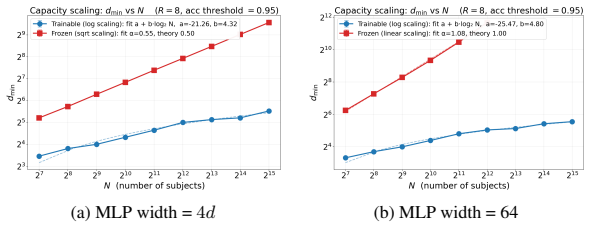
How do transformer language models memorize factual associations? A common view casts internal weight matrices as associative memories over pairs of embeddings, requiring parameter counts that scale linearly with the number of facts. We develop a theoretical and empirical account of an alternative, \emph{geometric} form of memorization in which learned embeddings encode relational structure directly, and the MLP plays a qualitatively different role. In a controlled setting where a single-layer transformer must memorize random bijections from subjects to a shared attribute set, we prove that a logarithmic embedding dimension suffices: subject embeddings encode \emph{linear superpositions} of their associated attribute vectors, and a small MLP acts as a relation-conditioned selector that extracts the relevant attribute via ReLU gating, and not as an associative key-value mapping. We extend these results to the multi-hop setting -- chains of relational queries such as ``Who is the mother of the wife of $x$?'' -- providing constructions with and without chain-of-thought that exhibit a provable capacity-depth tradeoff, complemented by a matching information-theoretic lower bound. Empirically, gradient descent discovers solutions with precisely the predicted structure. Once trained, the MLP transfers zero-shot to entirely new bijections when subject embeddings are appropriately re-initialized, revealing that it has learned a generic selection mechanism rather than memorized any particular set of facts.
0
1
cs.CL 2026-05-13 2 theorems

Verbalized belief claims raise LLM agent scores 14% in long tasks

by Joykirat Singh, Zaid Khan +6 more

Agent-BRACE: Decoupling Beliefs from Actions in Long-Horizon Tasks via Verbalized State Uncertainty

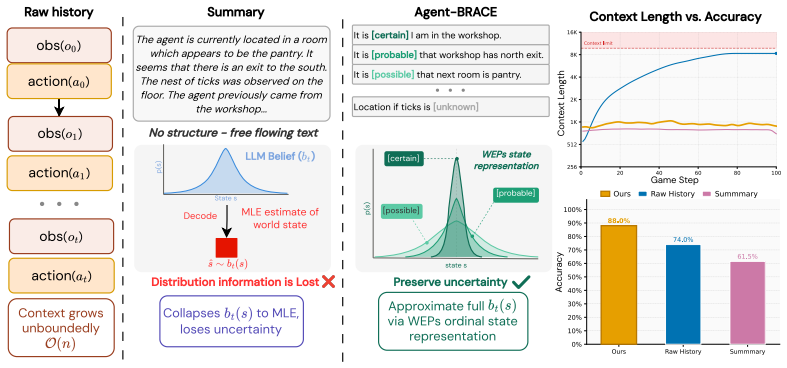
By tracking uncertainty as natural-language statements with certainty labels, agents keep fixed context size and beat RL baselines across 30

Figure from the paper full image
abstract click to expand
Large language models (LLMs) are increasingly deployed on long-horizon tasks in partially observable environments, where they must act while inferring and tracking a complex environment state over many steps. This leads to two challenges: partial observability requires maintaining uncertainty over unobserved world attributes, and long interaction history causes context to grow without bound, diluting task-relevant information. A principled solution to both challenges is a belief state: a posterior distribution over environment states given past observations and actions, which compactly encodes history for decision making regardless of episode length. In LLM agents, however, the open-ended nature of text makes it unclear how to represent such a distribution. Therefore, we introduce Agent-BRACE: Agent Belief state Representation via Abstraction and Confidence Estimation, a method that decouples an LLM agent into a belief state model and a policy model, jointly optimized via reinforcement learning. The belief state model produces a structured approximation of the belief distribution: a set of atomic natural language claims about the environment, each annotated with an ordinal verbalized certainty label ranging from certain to unknown. The policy model conditions on this compact, structured approximate belief rather than the full history, learning to select actions under explicit uncertainty. Across long-horizon, partially observable embodied language environments, Agent-BRACE achieves an average absolute improvement of +14.5% (Qwen2.5-3B-Instruct) and +5.3% (Qwen3-4B-Instruct), outperforming strong RL baselines while maintaining a near-constant context window independent of episode length. Further analysis shows that the learned belief becomes increasingly calibrated over the course of an episode as evidence accumulates.
0
1
cs.CL 2026-05-06 3 theorems

Clean evidence, not bigger models, makes clinical LLMs safer

by Sebastian Wind, Tri-Thien Nguyen +10 more

Safety and accuracy follow different scaling laws in clinical large language models

Across 34 models, curated radiologist evidence cut high-risk errors from 12% to 2.6%; RAG and ensembles did not.

Figure from the paper full image
abstract click to expand
Clinical LLMs are often scaled by increasing model size, context length, retrieval complexity, or inference-time compute, with the implicit expectation that higher accuracy implies safer behavior. This assumption is incomplete in medicine, where a few confident, high-risk, or evidence-contradicting errors can matter more than average benchmark performance. We introduce SaFE-Scale, a framework for measuring how clinical LLM safety changes across model scale, evidence quality, retrieval strategy, context exposure, and inference-time compute. To instantiate this framework, we introduce RadSaFE-200, a Radiology Safety-Focused Evaluation benchmark of 200 multiple-choice questions with clinician-defined clean evidence, conflict evidence, and option-level labels for high-risk error, unsafe answer, and evidence contradiction. We evaluated 34 locally deployed LLMs across six deployment conditions: closed-book prompting (zero-shot), clean evidence, conflict evidence, standard RAG, agentic RAG, and max-context prompting. Clean evidence produced the strongest improvement, increasing mean accuracy from 73.5% to 94.1%, while reducing high-risk error from 12.0% to 2.6%, contradiction from 12.7% to 2.3%, and dangerous overconfidence from 8.0% to 1.6%. Standard RAG and agentic RAG did not reproduce this safety profile: agentic RAG improved accuracy over standard RAG and reduced contradiction, but high-risk error and dangerous overconfidence remained elevated. Max-context prompting increased latency without closing the safety gap, and additional inference-time compute produced only limited gains. Worst-case analysis showed that clinically consequential errors concentrated in a small subset of questions. Clinical LLM safety is therefore not a passive consequence of scaling, but a deployment property shaped by evidence quality, retrieval design, context construction, and collective failure behavior.
0

browse all of cs.CL → full archive · search · sub-categories