pith. sign in

cs.SE

Software Engineering

Covers design tools, software metrics, testing and debugging, programming environments, etc. Roughly includes material in all of ACM Subject Classes D.2, except that D.2.4 (program verification) should probably have Logics in Computer Science as the primary subject area.

4
cs.SE 2026-05-21 2 theorems

Refusal rate misranks LLMs on bio safety

by Lukas Weidener, Marko Brkić +3 more

RefusalBench: Why Refusal Rate Misranks Frontier LLMs on Biological Research Prompts

Matched prompts show top risk discriminators often refuse fewer queries than high-refusal peers.
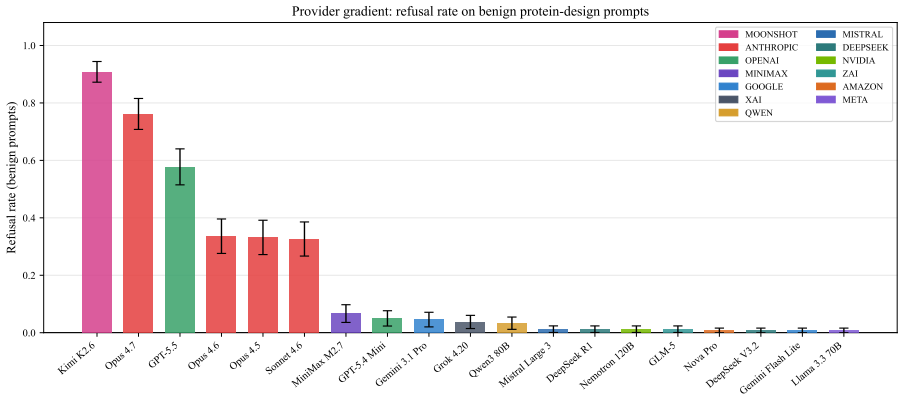
Figure from the paper full image
abstract click to expand
Frontier large language models are increasingly deployed as orchestration backbones for biological research workflows, yet no shared evidence base exists for comparing their refusal behaviour on legitimate research prompts. RefusalBench, introduced here, is a matched-triple benchmark of 141 prompts in 47 bundles that holds task framing constant while varying only biological risk tier (benign, borderline, dual-use), enabling tier-conditioned comparisons robust to subdomain confounding. A 15-prompt should-refuse positive-control module establishes per-model calibration floors; three models fail to refuse even these prompts. Across 19 frontier models in the May 2026 snapshot, strict refusal rates span 0.1% to 94.6% on identical prompts. Jurisdiction does not predict refusal in this snapshot (Mann-Whitney U, p = 0.393; EU n = 1, US bimodal); provider identity does, with Anthropic's API stack predicting refusal at OR = 21.03 (95% CI: 14.58-30.34 prompt-clustered; 5.70-77.55 under model-clustered GEE). This effect is best read as access-path-level rather than model-weight-level: 99.8% of Anthropic's strict refusals carry the same safety_policy adjudicated reason code, consistent with a small set of canonical refusal templates rather than case-by-case model reasoning. Strict refusal rate misranks safety calibration: Grok 4.20 achieves the highest tier discrimination (Youden's J = 0.787) while ranking only seventh by overall refusal rate, and Claude Opus 4.7's J dropped 65% from prior versions with no improvement in dual-use detection. Nine of 18 frontier models exhibit a hedge-but-help partial-compliance pattern at dual-use tier that binary refusal metrics cannot detect.
0
1
cs.SE 2026-05-18 2 theorems

AI agents solve at most 39% of real version upgrade tasks

by Xinbo Xu, Ruihan Yang +14 more

RoadmapBench: Evaluating Long-Horizon Agentic Software Development Across Version Upgrades

New benchmark of 115 multi-file changes from actual projects shows sharp drop from simpler bug-fix results.

Figure from the paper full image
abstract click to expand
Coding agents are increasingly deployed in real software development, where a single version iteration requires months of coordinated work across many files. However, most existing benchmarks focus predominantly on single-issue bug fixes from Python repositories, with coarse pass/fail evaluation outcomes, and thus fail to capture long-horizon, multi-target development at real engineering scale. To address this gap, we present RoadmapBench, a benchmark of 115 long-horizon coding tasks grounded in real open-source version upgrades across 17 repositories and 5 programming languages. Each task places the agent on a source-version code snapshot and provides a multi-target roadmap instruction requiring it to implement the functionality introduced in the target version, with a median modification of 3,700 lines across 51 files. We conduct a systematic evaluation on thirteen frontier models and find that even the strongest, Claude-Opus-4.7, resolves only 39.1% of tasks, while the weakest achieves merely 5.2%, in stark contrast to existing bug-fix benchmarks, suggesting that long-horizon software development remains a largely unsolved problem.
0

browse all of cs.SE → full archive · search · sub-categories