Covers all areas of cryptography and security including authentication, public key cryptosytems, proof-carrying code, etc. Roughly includes material in ACM Subject Classes D.4.6 and E.3.
The Model Context Protocol (MCP) is emerging as a common interface connecting large language models (LLMs) with external services. Remote deployments are becoming increasingly important as agents connect to user-linked online services, such as social, productivity, and financial services. In such deployments, the authentication boundary between MCP clients and remote servers becomes security-critical, yet remains underexplored.
We present the first measurement study of authentication security in real-world remote MCP servers. We identify 7,973 live remote MCP servers, finding that 40.55% expose tools without authentication. Among authenticated servers, OAuth is the dominant authorization mechanism for reaching remote services, and OAuth deployments in the MCP ecosystem commonly exhibit three characteristics: open client environments, dynamic client registration, and delegated authorization. These characteristics distinguish MCP deployments from traditional OAuth and introduce new attack surfaces. Guided by this observation, we derive a taxonomy of authentication flaws comprising three MCP-specific categories and conventional OAuth misconfigurations, for a total of four categories and nine concrete flaw types. To evaluate these flaws at scale, we implement a semi-automated detection framework that combines passive traffic inspection with active dynamic probing. Applying it to 119 testable real-world OAuth-enabled MCP servers, we find that each server exhibits at least one flaw, with a total of 325 flaws identified, among which dynamic client registration flaws affect 96.6% of tested servers. Many of these flaws can lead to sensitive information leakage and account takeover. Through responsible disclosure, we obtained 9 CVE IDs. Our findings expose pervasive authentication weaknesses in the MCP ecosystem and underscore the urgent need for hardened OAuth-based remote deployments.
AI Accelerator (AIA) are specialized hardware e.g., Tensor Processing Unit (TPU), that enable optimal and efficient execution of AI applications and on-device inference. The growing demand for AI applications has led to the widespread adoption of AIAs on Edge or embedded devices on Edge or embedded devices. Unlike applications, AIAs are not bound by Operating System (OS) restrictions and have limited visibility into Application Processor (AP) security mechanisms (e.g., kernel vs. application memory, process isolation). This semantic gap can lead to confused deputy vulnerabilities, i.e., AIA can be tricked by a malicious application to perform privileged operations on their behalf. In this paper, we conducted the first in-depth study of Confused Deputy Attacks (CDAs) using AIA. We design DeputyHunt, a Large Language Model (LLM) assisted framework to extract CDA relevant information for a given AIA through a combination of dynamic and static analysis. We used this information to explore the feasibility of CDA on seven different AIAs from popular vendors, i.e., Google, NVIDIA, Hailo, Texas Instruments, NXP, AWS, and Rockchip. Our analysis revealed that CDA is feasible on six out of the seven AIAs, impacting over 128 System On Chips (SOCs) and over 100 million devices. Our findings highlight critical security risks posed by AIA on system security. Our work has been acknowledged by the corresponding vendors and assigned the CVE-2025-66425. We propose an on-demand validation defense against CDA, and evaluation on the Gem5- salam simulator shows that it incurs minimal runtime overhead (i.e., ~15%).
Privacy auditing provides empirical lower bounds on the differential privacy parameters of learning algorithms. Existing methods, however, require interventional access to the training pipeline, either to retrain multiple times or to randomize data inclusion. This is often infeasible for large deployed systems such as foundation models. We introduce Zero-Run privacy auditing, a post-hoc framework for auditing models using two fixed datasets: examples known to be training-set members and examples known to be non-members. In this observational regime, membership is no longer randomized; instead, member and non-member data often differ in distribution, so membership inference scores may reflect a distribution shift rather than algorithmic leakage. Drawing on ideas from causal inference, we formalize this confounding effect and propose two complementary corrections that yield valid privacy audits. Our first approach models the combined effect of distribution shift and algorithmic leakage as an adaptive composition, producing conservative global corrections. Our second approach conditions on observed data and adjusts pointwise membership guesses, yielding sharper instance-dependent bounds. Experiments on synthetic data and large-scale models show that Zero-Run auditing enables practical privacy evaluation when retraining or controlled data insertion is infeasible.
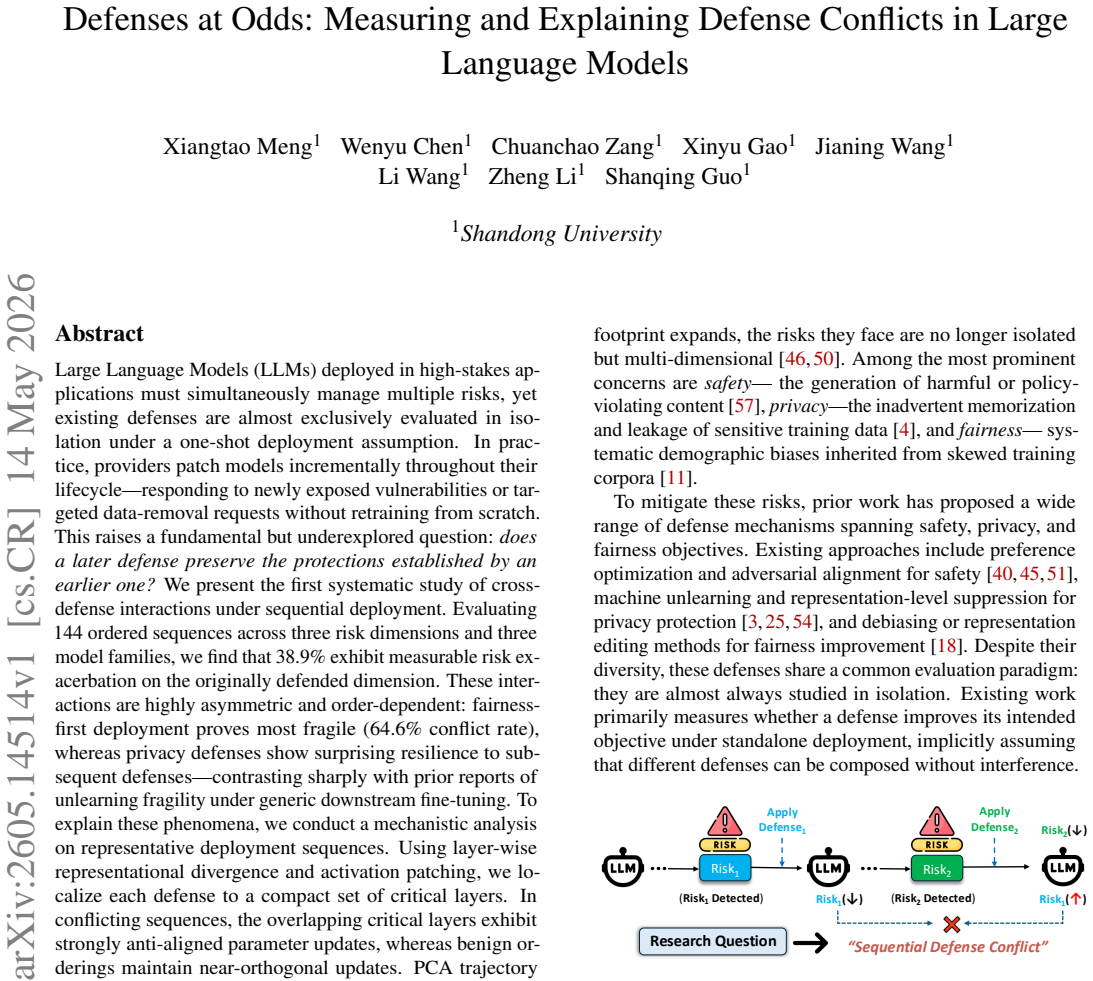
Large Language Models (LLMs) deployed in high-stakes applications must simultaneously manage multiple risks, yet existing defenses are almost exclusively evaluated in isolation under a one-shot deployment assumption. In practice, providers patch models incrementally throughout their lifecycle-responding to newly exposed vulnerabilities or targeted data-removal requests without retraining from scratch. This raises a fundamental but underexplored question: does a later defense preserve the protections established by an earlier one? We present the first systematic study of cross-defense interactions under sequential deployment. Evaluating 144 ordered sequences across three risk dimensions and three model families, we find that 38.9% exhibit measurable risk exacerbation on the originally defended dimension. These interactions are highly asymmetric and order-dependent. To explain these phenomena, we conduct a mechanistic analysis on representative deployment sequences. Using layer-wise representational divergence and activation patching, we localize each defense to a compact set of critical layers. In conflicting sequences, the overlapping critical layers exhibit strongly anti-aligned parameter updates, whereas benign orderings maintain near-orthogonal updates. PCA trajectory analysis reveals that defense collapse stems from activation pattern reversals in these shared layers. We further introduce a layer-wise conflict score that quantifies the geometric tension between defense-induced activation subspaces, offering mechanistic insight into the observed reversals. Guided by this diagnosis, we propose conflict-guided layer freezing, a lightweight mitigation that selectively freezes high-conflict layers during sequential deployment, preserving prior protections without degrading secondary defense performance.
Exploitation is not a binary event. It is a ladder of acquiring progressive capabilities, from executing a single buggy line of code to taking full control of the target. However, existing LLM security benchmarks treat a crash as exploitation success. That single binary outcome collapses the hard parts of exploitation: the transition from triggering a bug to constructing reusable primitives and control.
We present ExploitBench, a capability-graded benchmark that decomposes exploitation into 16 measurable flags, from coverage and crash through sandbox primitives, arbitrary read/write, control-flow hijack, and arbitrary code execution. Each capability is verified by a deterministic oracle that uses a per-run randomized challenge-response for primitives, differential execution against ground-truth binaries to measure progress, and a signal-handler proof for code execution.
We instantiate ExploitBench on 41 V8 bugs because V8 is both widely deployed and exploitation-hardened. We report three arms: <model,env> as the primary measurement of model-environment capability, <model,env, adaptive coaching> as a secondary arm that adds adaptive coaching to test whether targeted feedback shifts outcomes, and <model,env,harness> as an ablation that swaps in the model's native CLI to check whether vendor-side optimizations increase exploitation capabilities.
Our results show a sharp capability split between publicly deployed frontier models and the private frontier. Across the 8 publicly deployed models tested, reaching the vulnerable code and triggering a crash is routine, but arbitrary code execution is not. The private model shows arbitrary code execution on approximately half. Overall, results suggest that exploit construction against hardened targets is an emerging frontier capability.
Traditional blockchain untraceability schemes, such as mixers and privacy coins, obscure the sender-receiver relationship by placing transfers within an anonymity set. This paper studies a stronger goal: whether the transfer event itself can be made unobservable by blending into common decentralized-finance (DeFi) activity. We introduce Deniable Covert Asset Transfer (DCAT), a class of transfers that stage common loss-producing events, such as sandwich and arbitrage operations, so that a sender appears to suffer an ordinary loss while the receiver appears to profit from it. We design and validate two DCAT instantiations: a sandwich-based transfer on Ethereum and an arbitrage-based transfer on Arbitrum. Our experiments show that, under the evaluated settings, DCAT transfers are empirically unobservable on both chains. They are syntactically identical to corresponding maximal extractable value (MEV) activities, classified as ordinary extractions by standard MEV detection tools, and leave the sender and receiver unlinked under representative forensic tools. Since syntactic inspection cannot distinguish DCAT from ordinary MEV activity, we examine whether economic semantics provide useful forensic signals. Through a large-scale study of MEV losses on Ethereum and Arbitrum, we show that key semantic features follow power laws. Extreme losses and repeatedly exploited addresses occur in the wild, and thus are not by themselves definitive evidence of collusion. This gives staged transfers plausible deniability and makes fixed-threshold detection prone to false positives. We therefore develop a multivariate statistical method for forensic triage that ranks incidents by the joint rarity of their economic footprint. Applied to real-world DeFi activity, our method narrows a large search space to suspicious cases for manual investigation; we present three such cases to illustrate this prioritization.
Standalone virtual reality (VR) headsets process highly sensitive personal, professional, and health-related data, yet their susceptibility to non-contact physical side channels remains largely unexplored. Existing side-channel attacks typically require malicious software execution or physical access to peripherals, making them conspicuous and potentially patchable. This paper introduces ThermalTap, the first passive, non-contact side-channel attack that fingerprints VR applications solely from the long-wave infrared (LWIR) radiation emitted by the headset chassis. By treating a headset's thermal signature as a high-fidelity proxy for internal computational workloads, ThermalTap enables remote application inference at meter-scale distances without any device interaction. To achieve robust performance in real-world settings, the system combines a commodity thermal camera with a multi-modal sensor suite (capturing ambient temperature, humidity, and airflow) to normalize environmental noise. We evaluate ThermalTap using six applications across three commercial standalone headsets. In indoor settings, ThermalTap identifies applications with over 90% accuracy using only 10 seconds of thermal camera data. Under outdoor conditions, with longer session-level observations, several applications remain identifiable despite environmental variability, with the strongest outdoor application reaching 81% accuracy. Our findings establish thermal radiation as a fundamental and unavoidable privacy risk for immersive systems, exposing a critical security gap that bypasses current software-level protections and physical access controls.