pith. sign in

cs.AI

Artificial Intelligence

Covers all areas of AI except Vision, Robotics, Machine Learning, Multiagent Systems, and Computation and Language (Natural Language Processing), which have separate subject areas. In particular, includes Expert Systems, Theorem Proving (although this may overlap with Logic in Computer Science), Knowledge Representation, Planning, and Uncertainty in AI. Roughly includes material in ACM Subject Classes I.2.0, I.2.1, I.2.3, I.2.4, I.2.8, and I.2.11.

2
cs.AI 2026-05-22 1 theorem

Agents reach only 62.5% on real terminal tasks

by Zhaoyang Chu, Jiarui Hu +9 more

TerminalWorld: Benchmarking Agents on Real-World Terminal Tasks

Benchmark drawn from 80k recordings shows weak overlap with curated tests
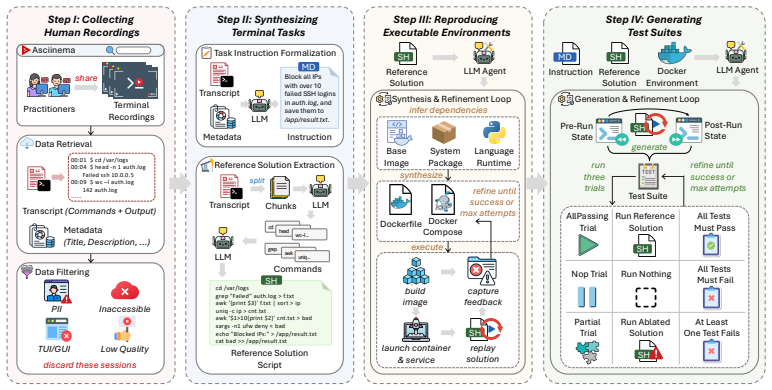
Figure from the paper full image
abstract click to expand
We introduce TerminalWorld, a scalable data engine that automatically reverse-engineers high-fidelity evaluation tasks from "in-the-wild" terminal recordings. Processing 80,870 terminal recordings, the engine yields a full benchmark of 1,530 validated tasks, spanning 18 real-world categories, ranging from short everyday operations to workflows exceeding 50 steps, and covering 1,280 unique commands. From these, we curate a Verified subset of 200 representative, manually reviewed tasks. Comprehensive benchmarking on TerminalWorld-Verified across eight frontier models and six agents reveals that current systems still struggle with authentic terminal workflows, achieving a maximum pass rate of only 62.5%. Moreover, TerminalWorld captures real-world terminal capabilities distinct from existing expert-curated benchmarks (e.g., Terminal-Bench), with only a weak correlation to their scores (Pearson r=0.20). The automated engine makes TerminalWorld authentic and scalable by construction, enabling it to evaluate agents in real-world terminal environments as developer practices evolve. Data and code are available at https://github.com/EuniAI/TerminalWorld.
0
4
cs.AI 2026-05-19 2 theorems

LLMs beat chance on spatial reasoning but stumble on tough calculi

by Anthony G. Cohn, Robert E. Blackwell

QSTRBench: a New Benchmark to Evaluate the Ability of Language Models to Reason with Qualitative Spatial and Temporal Calculi

New benchmark shows performance gaps from easy Point Algebra to hard RCC-22, with no model getting everything right.

Figure from the paper full image
abstract click to expand
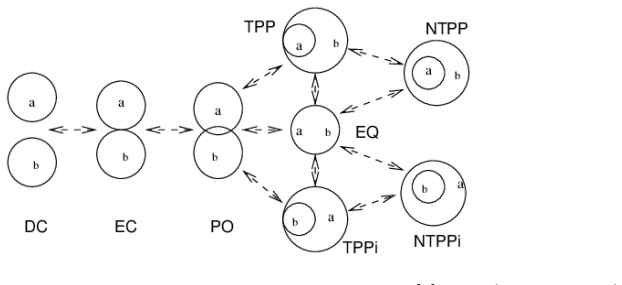
We introduce an extensive qualitative spatial and temporal reasoning (QSTR) benchmark for evaluating large language models (LLMs). We pose questions concerning compositional reasoning (using composition tables, CT), converse relations, and conceptual neighbourhoods (CN) for QSTR calculi, Point Algebra (PA), Allen's Interval Algebra, Interval and Duration (INDU), Region Connection Calculus (RCC-5, RCC-8, and RCC-22), the nine intersection model, cardinal direction calculus, and STAR. The RCC-22 CN is published here for the first time. An extended benchmark systematically varies question presentation including prefix/infix, words/symbols/nonce terms and schematic descriptions for selected calculi. We report results for contemporary frontier models. All models tested perform better than guessing but none can consistently answer all questions correctly. Performance varies sharply by calculus, with PA being the most straightforward, and RCC-22 the most difficult. We release the benchmark, and our results under an open licence to facilitate further assessment of qualitative spatio/temporal reasoning in LLMs.
0
4
cs.AI 2026-05-19 2 theorems

Neural Q-learning converges with finite-sample bounds in decentralized handoffs

by Jiayu Li, Enpei Zhang +3 more

Learning to Hand Off: Provably Convergent Workflow Learning under Interface Constraints

The bound isolates neural error, interface gap, and mixing time so agents learn workflows without joint trajectories or centralized data.

abstract click to expand
We study workflow learning in a setting where specialized agents hand off control through a shared artifact, each agent observes only a local function of that artifact and its own private state, and no centralized learner accesses joint trajectories -- the operating regime of multi-agent LLM pipelines that span organizational, vendor, or trust boundaries. We formalize this regime as an interface-constrained semi-Markov decision process (IC-SMDP), whose decision epochs occur at handoff times, and design IC-$Q$, an asynchronous decentralized $Q$-learning algorithm in which cross-agent coordination at every handoff is exactly one scalar. Our main result is a finite-sample bound for neural IC-$Q$ that decomposes into three independently controllable error sources: neural function-approximation error, interface representation gap, and a mixing-time residual, under the random option-duration discount. Establishing this bound requires lifting the approximate information state (AIS) framework from single-agent primitive-step MDPs to multi-agent SMDPs and controlling Markovian noise under random duration, neither of which has been done in prior work. To our knowledge this is the first finite-sample guarantee for neural $Q$-learning under decentralized partial observability. Four experiments: a controlled synthetic IC-SMDP that validates the bound term-by-term, multi-LLM mathematical reasoning, multi-agent routing, and multi-agent CPU programming, show that IC-$Q$ matches a centralized oracle without any agent observing joint trajectories, with each of the three error sources scaling along its corresponding axis as the bound predicts.
0
4
cs.AI 2026-05-19 Recognition

Agents reach 79% on game video frames

by Lingtao Mao, Huangyu Dai +5 more

SVFSearch: A Multimodal Knowledge-Intensive Benchmark for Short-Video Frame Search in the Gaming Vertical Domain

SVFSearch tests multimodal models on paused short-video scenes that need gaming expertise and shows where retrieval and reasoning still fail

Figure from the paper full image
abstract click to expand
Multimodal large language models are increasingly used as agent backbones that understand multimodal inputs, plan retrieval actions, invoke external tools, and reason over retrieved information. Yet existing benchmarks rarely evaluate this ability in short-video applications, where a paused frame is often visually ambiguous and answering requires vertical, long-tail, and fast-evolving domain knowledge. We introduce SVFSearch, the first open benchmark for short-video frame search in the Chinese gaming domain. SVFSearch contains 5,000 four-choice test examples and 4,198 auxiliary training examples, each centered on a paused game scene from a real short-video clip. To support fair and reproducible evaluation, SVFSearch provides a frozen offline retrieval environment with a game-domain text corpus, a topic-linked image gallery, and text, image, and multimodal retrieval interfaces, avoiding reliance on uncontrolled web search APIs. We evaluate representative paradigms ranging from direct QA and RAG workflow to Plan-Act-Replan agents and learned search models. Results reveal a large gap between model-only answering, practical agentic search, and oracle knowledge: the best open-source direct-QA model reaches 66.4%, the best practical agent achieves 79.1%, and oracle knowledge reaches 95.4%. Further analysis exposes bottlenecks in visual grounding, retrieval quality, evidence-grounded reasoning, and tool-use behavior, including over-search, answer-only shortcuts, and retrieval-induced misleading.
0
4
cs.AI 2026-05-19 2 theorems

Benchmark shows agents at 79% on game video questions vs 95% oracle

by Lingtao Mao, Huangyu Dai +5 more

SVFSearch: A Multimodal Knowledge-Intensive Benchmark for Short-Video Frame Search in the Gaming Vertical Domain

SVFSearch tests multimodal models on paused gaming scenes and finds retrieval helps but leaves a sizable performance gap.

Figure from the paper full image
abstract click to expand
Multimodal large language models are increasingly used as agent backbones that understand multimodal inputs, plan retrieval actions, invoke external tools, and reason over retrieved information. Yet existing benchmarks rarely evaluate this ability in short-video applications, where a paused frame is often visually ambiguous and answering requires vertical, long-tail, and fast-evolving domain knowledge. We introduce SVFSearch, the first open benchmark for short-video frame search in the Chinese gaming domain. SVFSearch contains 5,000 four-choice test examples and 4,198 auxiliary training examples, each centered on a paused game scene from a real short-video clip. To support fair and reproducible evaluation, SVFSearch provides a frozen offline retrieval environment with a game-domain text corpus, a topic-linked image gallery, and text, image, and multimodal retrieval interfaces, avoiding reliance on uncontrolled web search APIs. We evaluate representative paradigms ranging from direct QA and RAG workflow to Plan-Act-Replan agents and learned search models. Results reveal a large gap between model-only answering, practical agentic search, and oracle knowledge: the best open-source direct-QA model reaches 66.4%, the best practical agent achieves 79.1%, and oracle knowledge reaches 95.4%. Further analysis exposes bottlenecks in visual grounding, retrieval quality, evidence-grounded reasoning, and tool-use behavior, including over-search, answer-only shortcuts, and retrieval-induced misleading.
0
1
cs.AI 2026-05-19 2 theorems

Agents gain a profile to match KGs by what they can prove

by Terry R. Payne, Valentina Tamma +1 more

Discoverable Agent Knowledge -- A Formal Framework for Agentic KG Affordances (Extended Version)

A four-dimensional framework above VoID and DCAT supports reliable selection, composition, and failure diagnosis at planning time.

Figure from the paper full image
abstract click to expand
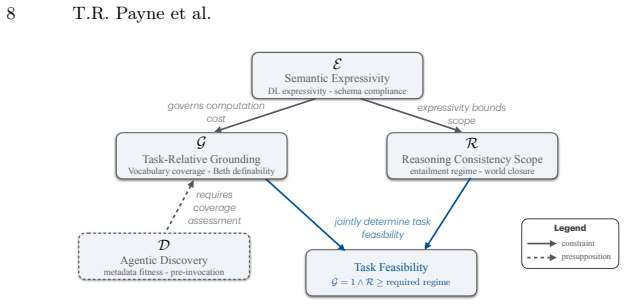
Two decades ago, the Semantic Web Services community was asked how agents with different ontological commitments could discover, compose, and invoke web services coherently. The response was OWL-S and WSMO: formally grounded capability descriptions specifying what a service could do, what the agent must already know for invocation to be epistemically sound, and how ontological mismatches could be formally bridged. Current KG metadata standards such as VoID and DCAT describe what a KG contains, yet say nothing about what a specific agent can prove from it, what closure assumptions govern empty results, or whether the agent's task vocabulary is grounded in the schema. Furthermore, in deployed KGs the governing schema DL and the operative entailment regime can diverge: an epistemic failure mode invisible to current metadata. We revisit and extend these insights for the KG setting with a four-dimensional formal framework; Semantic Expressivity, Agentic Discoverability, Task-Relative Grounding, and Epistemic Trust Scope, from which we derive the Agentic Affordance Profile (AAP): a semantic layer above VoID and DCAT enabling principled KG selection, composition, and failure diagnosis at agent planning time. The four dimensions operationalise the affordance structure of the Ontological Continuum at the individual-agent level, specifically for \kg selection, composition, and failure diagnosis. A worked example drawn from a scholarly-search task concretely grounds the framework, and identifies the formal, computational, and engineering work needed to realise AAP-based affordance matching at scale though a five-point research agenda.
1 0
2
cs.AI 2026-05-14 2 theorems

Fastest sample-consistent solver generalizes in runtime and correctness

by Saharsh Koganti, Priyadarsi Mishra +2 more

Distribution-Aware Algorithm Design with LLM Agents

LLM agents recover distribution-specific hints to compile solvers that match heuristic quality yet run hundreds of times faster on 21 target

Figure from the paper full image
abstract click to expand
We study learning when the learned object is executable solver code rather than a predictor. In this setting, correctness is not enough: two solvers may both return valid solutions on the deployment distribution while differing substantially in runtime. Given samples from an unknown task distribution, the learner returns code evaluated on fresh instances by both solution quality and execution time. Our central abstraction is a \emph{solver hint}: reusable structure inferred from samples and compiled into specialized solver code. We prove that the empirically fastest sample-consistent solver from a fixed library generalizes in both correctness and runtime, and that statistically identifiable hints can be recovered and compiled from polynomially many samples. Empirically, we instantiate the framework with LLM code agents on \(21\) structured combinatorial-optimization target distributions across seven problem classes. The synthesized solvers reach mean normalized quality \(0.971\), improve by \(+0.224\) over the average heuristic pool and by \(+0.098\) over the highest-quality heuristic, and are \(336.9\times\), \(342.8\times\), and \(16.1\times\) faster than the quality-best heuristic, Gurobi, and the selected time-limited exact backend, respectively. On released PACE 2025 Dominating Set private instances, the synthesized solver is valid on all \(100\) graphs and runs about two orders of magnitude faster than top competition solvers, with a moderate quality gap. Inspection shows that many gains come from changing the computational scale: replacing ambient exponential search or general-purpose optimization with compiled distribution-specific computation.
0
2
cs.AI 2026-05-14 2 theorems

MathAtlas benchmark shows models reach under 10 percent on graduate math

by Nilay Patel, Noah Arias +8 more

MathAtlas: A Benchmark for Autoformalization in the Wild

52k statements from 103 textbooks plus a dependency graph expose the gap between current autoformalization and advanced mathematics.

Figure from the paper full image
abstract click to expand
Current autoformalization benchmarks are largely focused on olympiad or undergraduate mathematics, while graduate and research-level mathematics remains underexplored. In this paper, we introduce MathAtlas, the first large-scale autoformalization benchmark of in the wild graduate-level mathematics, containing ~52k theorems, definitions, exercises, examples, and proofs extracted from 103 graduate mathematics textbooks. MathAtlas is enriched with a mathematical dependency graph containing ~178k relations, and is the first autoformalization benchmark to include such relations, facilitating evaluation and development of dependency-aware autoformalization systems. Our extensive experiments show that MathAtlas is high quality but extremely challenging: strong baselines achieve at most 9.8% correctness on theorem statements and 16.7% on definitions. Furthermore, we find performance of state-of-the-art models degrades substantially with dependency depth: on MA-Hard, a subset of 700 entities with the deepest dependency trees, the best model achieves only 2.6% correctness for autoformalization on this challenging dataset. We release MathAtlas to the community as a benchmark set for large-scale autoformalization of graduate-level mathematics in the wild.
0
1
cs.AI 2026-05-06

AI agent automates red teaming workflows in hours

by Raja Sekhar Rao Dheekonda, Will Pearce +1 more

Redefining AI Red Teaming in the Agentic Era: From Weeks to Hours

Natural language goals drive attack selection and composition, unifying tests for ML and generative models with high success rates in case演示

Figure from the paper full image
abstract click to expand
AI systems are entering critical domains like healthcare, finance, and defense, yet remain vulnerable to adversarial attacks. While AI red teaming is a primary defense, current approaches force operators into manual, library-specific workflows. Operators spend weeks hand-crafting workflows - assembling attacks, transforms, and scorers. When results fall short, workflows must be rebuilt. As a result, operators spend more time constructing workflows than probing targets for security and safety vulnerabilities. We introduce an AI red teaming agent built on the open-source Dreadnode SDK. The agent creates workflows grounded in 45+ adversarial attacks, 450+ transforms, and 130+ scorers. Operators can probe multi-agent systems, multilingual, and multimodal targets, focusing on what to probe rather than how to implement it. We make three contributions: 1. Agentic interface. Operators describe goals in natural language via the Dreadnode TUI (Terminal User Interface). The agent handles attack selection, transform composition, execution, and reporting, letting operators focus on red teaming. Weeks compress to hours. 2. Unified framework. A single framework for probing traditional ML models (adversarial examples) and generative AI systems (jailbreaks), removing the need for separate libraries. 3. Llama Scout case study. We red team Meta Llama Scout and achieve an 85% attack success rate with severity up to 1.0, using zero human-developed code
0

browse all of cs.AI → full archive · search · sub-categories