Discoverable Agent Knowledge -- A Formal Framework for Agentic KG Affordances (Extended Version)
Pith reviewed 2026-05-20 09:47 UTC · model grok-4.3
The pith
A four-dimensional formal framework lets agents discover what they can actually prove and ground from a knowledge graph.
A machine-rendered reading of the paper's core claim, the machinery that carries it, and where it could break.
Core claim
The authors establish that a four-dimensional formal framework, extending prior Semantic Web Services ideas, can describe the epistemic affordances of a KG for a given agent. The dimensions address what the agent can prove, what closure regime governs missing answers, whether the agent's vocabulary is grounded in the schema, and how mismatches between agent and KG ontologies can be diagnosed. They derive the Agentic Affordance Profile (AAP) as a concrete semantic layer above VoID and DCAT that enables principled selection, composition, and failure diagnosis at planning time, and they outline a five-point research agenda for implementation at scale.
What carries the argument
The Agentic Affordance Profile (AAP), a semantic layer derived from a four-dimensional formal framework of provability, closure, grounding, and mismatch that sits above existing KG metadata standards.
If this is right
- Agents can select KGs whose entailment regime and schema actually support the proofs required for a given task.
- Empty query results can be diagnosed as either absence of data or an incorrect closure assumption by the KG.
- Multiple KGs can be composed at planning time by matching complementary affordance profiles rather than content overlap alone.
- Differences between a KG's declared DL and its actual entailment regime become visible and avoidable before execution.
Where Pith is reading between the lines
- Repositories could begin publishing AAP descriptions alongside VoID files to make KGs discoverable by autonomous agents.
- Agent planners might treat AAP matching as a first-class step before query generation, reducing runtime failures.
- The same framework could be tested on dynamic or federated KGs to see whether it scales beyond static catalogs.
Load-bearing premise
That the four dimensions of provability, closure, grounding, and mismatch are sufficient to capture the epistemic interactions an agent needs when using a KG.
What would settle it
A controlled experiment in which agents equipped with AAP metadata achieve measurably higher task-completion rates and fewer unexplained empty results than agents that rely only on VoID or DCAT descriptions when selecting among multiple KGs.
Figures
read the original abstract
Two decades ago, the Semantic Web Services community was asked how agents with different ontological commitments could discover, compose, and invoke web services coherently. The response was OWL-S and WSMO: formally grounded capability descriptions specifying what a service could do, what the agent must already know for invocation to be epistemically sound, and how ontological mismatches could be formally bridged. Current Knowledge Graph (KG) metadata standards such as VoID and DCAT describe what a KG contains yet say nothing about what a specific agent can prove from it, what closure assumptions govern empty results, or whether the agent's task vocabulary is grounded in the schema. Furthermore, in deployed KGs the governing schema DL and the operative entailment regime can diverge: an epistemic failure mode invisible to current metadata. We revisit and extend these insights for the KG setting with a four-dimensional formal framework from which we derive the Agentic Affordance Profile (AAP): a semantic layer above VoID and DCAT enabling principled KG selection, composition, and failure diagnosis at agent planning time. A five-point research agenda identifies the formal, computational, and engineering work needed to realise AAP-based affordance matching at scale.
Editorial analysis
A structured set of objections, weighed in public.
Referee Report
Summary. The paper extends ideas from Semantic Web Services (OWL-S, WSMO) to Knowledge Graphs, proposing a four-dimensional formal framework (provability, closure, grounding, mismatch) from which it derives the Agentic Affordance Profile (AAP). AAP is positioned as a semantic layer above VoID and DCAT to support principled KG selection, composition, and epistemic failure diagnosis during agent planning, with a five-point research agenda for realization.
Significance. If the four-dimensional framework receives explicit formalization with axioms and soundness arguments, the work could fill a genuine gap in KG metadata standards by incorporating agent-specific epistemic considerations that current descriptions omit. The conceptual bridge from prior SWS literature is a strength, and the identification of divergence between schema DL and operative entailment regimes is a useful observation.
major comments (1)
- [Abstract and §3] Abstract and §3: The manuscript asserts that a four-dimensional framework can be derived from Semantic Web Services concepts and yields a usable AAP, yet supplies no axioms, inference rules, or derivation steps showing how provability, closure, grounding, and mismatch compose into AAP properties. This is load-bearing for the central claim of formal soundness and internal consistency, especially when schema DL and operative entailment regimes diverge.
minor comments (1)
- [Conclusion] The five-point research agenda is stated at a high level; concrete milestones or example entailment regimes would improve clarity.
Simulated Author's Rebuttal
We thank the referee for their constructive and insightful review. The comment identifies a key area where the manuscript can be strengthened to better support its formal claims. We respond point-by-point below and will incorporate the necessary clarifications in the revised version.
read point-by-point responses
-
Referee: [Abstract and §3] Abstract and §3: The manuscript asserts that a four-dimensional framework can be derived from Semantic Web Services concepts and yields a usable AAP, yet supplies no axioms, inference rules, or derivation steps showing how provability, closure, grounding, and mismatch compose into AAP properties. This is load-bearing for the central claim of formal soundness and internal consistency, especially when schema DL and operative entailment regimes diverge.
Authors: We agree that the current manuscript presents the four-dimensional framework (provability, closure, grounding, and mismatch) primarily through conceptual derivation from Semantic Web Services literature (OWL-S/WSMO) and descriptive mapping to KG affordances in §3, without supplying a complete axiomatization, inference rules, or explicit composition steps for AAP properties. The divergence between schema DL and operative entailment regimes is highlighted as motivation but not formally modeled. This is a substantive gap for the claim of internal consistency and soundness. In the revised manuscript we will expand §3 with (i) basic axioms for each dimension, (ii) a composition operator that assembles them into AAP properties, and (iii) a soundness sketch addressing epistemic failure under divergent entailment regimes. These additions will be kept concise and focused on the load-bearing aspects while preserving the paper’s emphasis on applicability to KG selection and composition. revision: yes
Circularity Check
No significant circularity: AAP extends external Semantic Web Services concepts
full rationale
The paper presents the Agentic Affordance Profile as derived from a four-dimensional formal framework that revisits and extends prior external literature (OWL-S, WSMO) for the KG setting, rather than defining the framework or AAP in terms of quantities internal to the paper itself. No equations, fitted parameters, or self-citations are shown reducing the central claim to its own inputs by construction. The derivation is positioned as building on established, independent Semantic Web standards and metadata (VoID, DCAT), rendering it self-contained against external benchmarks with no load-bearing internal reductions.
Axiom & Free-Parameter Ledger
axioms (1)
- domain assumption A four-dimensional formal framework can be derived that adequately captures agentic affordances for KGs.
invented entities (1)
-
Agentic Affordance Profile (AAP)
no independent evidence
Lean theorems connected to this paper
-
IndisputableMonolith/Foundation/RealityFromDistinction.leanreality_from_one_distinction unclear?
unclearRelation between the paper passage and the cited Recognition theorem.
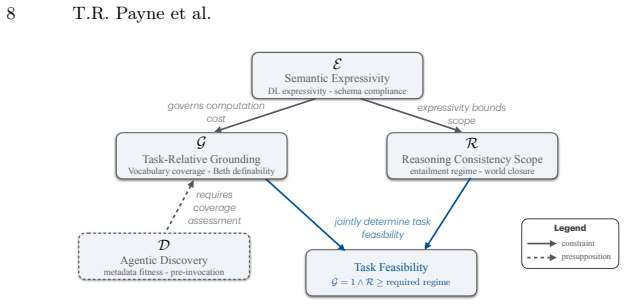
four-dimensional formal framework ... Semantic Expressivity, Agentic Discoverability, Task-Relative Grounding, and Epistemic Trust Scope ... feasibility predicate G(KG,S_t)=1 and R(KG)|=R_min_t
-
IndisputableMonolith/Cost/FunctionalEquation.leanwashburn_uniqueness_aczel unclear?
unclearRelation between the paper passage and the cited Recognition theorem.
Task-Relative Grounding ... Beth definability ... signature closure R+
What do these tags mean?
- matches
- The paper's claim is directly supported by a theorem in the formal canon.
- supports
- The theorem supports part of the paper's argument, but the paper may add assumptions or extra steps.
- extends
- The paper goes beyond the formal theorem; the theorem is a base layer rather than the whole result.
- uses
- The paper appears to rely on the theorem as machinery.
- contradicts
- The paper's claim conflicts with a theorem or certificate in the canon.
- unclear
- Pith found a possible connection, but the passage is too broad, indirect, or ambiguous to say the theorem truly supports the claim.
Reference graph
Works this paper leans on
-
[1]
Artificial Intelligence Review (2025)
Abou Ali, M., Dornaika, F., Charafeddine, J.: Agentic AI: A comprehensive survey of architectures, applications, and future directions. Artificial Intelligence Review (2025). https://doi.org/10.1007/s10462-025-11422-4
-
[2]
W3C interest group note, W3C (Mar 2011), https://www.w3.org/TR/void/
Alexander, K., Cyganiak, R., Hausenblas, M., Zhao, J.: Describing linked datasets with the VoID vocabulary. W3C interest group note, W3C (Mar 2011), https://www.w3.org/TR/void/
work page 2011
-
[3]
Ankolekar, A., Burstein, M., Hobbs, J.R., Lassila, O., Martin, D., McDermott, D., McIlraith, S.A., Narayanan, S., Paolucci, M., Payne, T., Sycara, K.: DAML-S: Web Service Description for the Semantic Web. In: Horrocks, I., Hendler, J. (eds.) The Semantic Web — ISWC 2002. pp. 348–363. Springer Berlin Heidelberg, Berlin, Heidelberg (2002)
work page 2002
-
[4]
(eds.): The description logic handbook: theory, implementation, and applications
Baader, F., Calvanese, D., McGuinness, D.L., Nardi, D., Patel-Schneider, P.F. (eds.): The description logic handbook: theory, implementation, and applications. Cambridge University Press, USA (2003)
work page 2003
-
[5]
Indagationes Mathematicae (Proceedings)56, 330–339 (1953)
Beth, E.: On Padoa’s Method in the Theory of Definition. Indagationes Mathematicae (Proceedings)56, 330–339 (1953). https://doi.org/10.1016/S1385- 7258(53)50042-3
-
[6]
In: Bussler, C.J., Davies, J., Fensel, D., Studer, R
Cabral, L., Domingue, J., Motta, E., Payne, T., Hakimpour, F.: Approaches to semantic web services: an overview and comparisons. In: Bussler, C.J., Davies, J., Fensel, D., Studer, R. (eds.) The Semantic Web: Research and Applications. pp. 225–239. Springer Berlin Heidelberg, Berlin, Heidelberg (2004)
work page 2004
-
[7]
Transactions on Graph Data and Knowledge1(1), 13:1–13:22 (2023)
Calbimonte, J.P., Ciortea, A., Kampik, T., Mayer, S., Payne, T.R., Tamma, V., Zimmermann, A.: Autonomy in the Age of Knowledge Graphs: Vision and Challenges. Transactions on Graph Data and Knowledge1(1), 13:1–13:22 (2023). https://doi.org/10.4230/TGDK.1.1.13
-
[8]
Journal of Automated Reasoning39, 385–429 (2007)
Calvanese, D., De Giacomo, G., Lembo, D., Lenzerini, M., Rosati, R.: Tractable reasoning and efficient query answering in description logics: The DL-Lite family. Journal of Automated Reasoning39, 385–429 (2007). https://doi.org/10.1007/s10817-007-9078-x
-
[9]
In: Hybrid Human Artificial Intelligence Conference (HHAI 2026) (2026)
Celino, I.: Knowledge affordances for hybrid human-ai information seeking. In: Hybrid Human Artificial Intelligence Conference (HHAI 2026) (2026)
work page 2026
-
[10]
Debattista, J., Lange, C., Auer, S., Cortis, D.: Evaluating the quality of the LOD cloud: An empirical investigation. Semant. Web9(6), 859–901 (Jan 2018). https://doi.org/10.3233/SW-180306
-
[11]
In: Proceedings of the 21st International 14 T.R
Doran, P., Tamma, V., Payne, T.R., Palmisano, I.: Dynamic selection of ontological alignments: a space reduction mechanism. In: Proceedings of the 21st International 14 T.R. Payne et al. Joint Conference on Artificial Intelligence. p. 2028–2033. IJCAI’09, Morgan Kauf- mann Publishers Inc., San Francisco, CA, USA (2009)
work page 2028
-
[12]
Springer Publishing Company, Incorporated, 1st edn
Fensel, D., Lausen, H., Polleres, A., de Bruijn, J., Stollberg, M., Roman, D., Domingue, J.: Enabling Semantic Web Services: The Web Service Modeling On- tology. Springer Publishing Company, Incorporated, 1st edn. (2010)
work page 2010
-
[13]
In: Blomqvist, E., Ciancarini, P., Poggi, F., Vitali, F
Geleta, D., Payne, T.R., Tamma, V.: An investigation of definability in ontology alignment. In: Blomqvist, E., Ciancarini, P., Poggi, F., Vitali, F. (eds.) Knowledge Engineering and Knowledge Management (EKAW 2016). pp. 255–271. Springer International Publishing, Cham (2016)
work page 2016
-
[14]
In: Dragoni, M., Poveda-Villalón, M., Jimenez-Ruiz, E
Geleta, D., Payne, T.R., Tamma, V.: Minimal coverage for ontology signatures. In: Dragoni, M., Poveda-Villalón, M., Jimenez-Ruiz, E. (eds.) OWL: Experiences and Directions – Reasoner Evaluation. pp. 128–140. Springer International Publishing, Cham (2017)
work page 2017
-
[15]
Gibson, J.J.: The Ecological Approach to Visual Perception. Psychology Press (1979). https://doi.org/10.4324/9781315740218
-
[16]
Journal of Artificial Intelligence Research31(1), 273–318 (Feb 2008)
Grau, B.C., Horrocks, I., Kazakov, Y., Sattler, U.: Modular reuse of ontologies: theory and practice. Journal of Artificial Intelligence Research31(1), 273–318 (Feb 2008)
work page 2008
-
[17]
Kampik, T., Mansour, A., Boissier, O., Kirrane, S., Padget, J., Payne, T.R., Singh, M.P., Tamma, V., Zimmermann, A.: Governance of autonomous agents on the web: Challenges and opportunities. ACM Trans. Internet Technol.22(4) (Nov 2022). https://doi.org/10.1145/3507910
-
[18]
W3C Rec- ommendation (2017), https://www.w3.org/TR/shacl/
Knublauch, H., Kontokostas, D.: Shapes constraint language (SHACL). W3C Rec- ommendation (2017), https://www.w3.org/TR/shacl/
work page 2017
-
[19]
Lutz, C., Wolter, F.: Foundations for uniform interpolation and forgetting in ex- pressive description logics. In: Walsh, T. (ed.) IJCAI 2011, Proceedings of the 22nd International JointConference onArtificial Intelligence. pp. 989–995. IJCAI/AAAI (2011). https://doi.org/10.5591/978-1-57735-516-8/IJCAI11-170
-
[20]
W3C recommendation, W3C (Jan 2014), https://www.w3.org/TR/vocab-dcat/
Maali, F., Erickson, J.: Data catalog vocabulary (DCAT). W3C recommendation, W3C (Jan 2014), https://www.w3.org/TR/vocab-dcat/
work page 2014
-
[21]
Malfa, E.L., Malfa, G.L., Marro, S., Zhang, J.M., Black, E., Luck, M., Torr, P., Wooldridge, M.J.: Large Language Models Miss the Multi-agent Mark. In: The Thirty-Ninth Annual Conference on Neural Information Processing Systems Posi- tion Paper Track (2025), https://openreview.net/forum?id=FfsxgSZW0c
work page 2025
-
[22]
W3C Member Submission (Nov 2004), https://www.w3.org/Submission/OWL-S/
Martin, D., Burstein, M., Hobbs, J., Lassila, O., McDermott, D., McIlraith, S., Narayanan, S., Paolucci, M., Parsia, B., Payne, T.R., Sirin, E., Srinivasan, N., Sycara, K.: OWL-S: Semantic markup for web services. W3C Member Submission (Nov 2004), https://www.w3.org/Submission/OWL-S/
work page 2004
-
[23]
Martin, D., Paolucci, M., McIlraith, S., Burstein, M., McDermott, D., McGuin- ness, D., Parsia, B., Payne, T., Sabou, M., Solanki, M., Srinivasan, N., Sycara, K.: Bringing semantics to web services: The OWL-S approach. In: Cardoso, J., Sheth, A. (eds.) Semantic Web Services and Web Process Composition. pp. 26–42. Springer Berlin Heidelberg, Berlin, Heidel...
work page 2005
-
[24]
IEEE Intelligent Sys- tems16(2), 46–53 (Mar 2001)
McIlraith, S.A., Son, T.C., Zeng, H.: Semantic web services. IEEE Intelligent Sys- tems16(2), 46–53 (Mar 2001). https://doi.org/10.1109/5254.920599
-
[25]
W3c recommendation, W3C (2012), https://www.w3.org/TR/owl2-profiles/
Motik, B., Grau, B.C., Horrocks, I., Wu, Z., Fokoue, A., Lutz, C.: OWL 2 web ontology language profiles (second edition). W3c recommendation, W3C (2012), https://www.w3.org/TR/owl2-profiles/
work page 2012
-
[26]
Journal of Web Semantics7(2), 74–89 (2009)
Motik, B., Horrocks, I., Sattler, U.: Bridging the gap between owl and relational databases. Journal of Web Semantics7(2), 74–89 (2009). https://doi.org/10.1016/j.websem.2009.02.001 A Formal Framework for Agentic KG Affordances 15
-
[27]
Motta, E.: Reusable Components for Knowledge Modelling: Case Studies in Para- metric Design Problem Solving. IOS Press, NLD, 1st edn. (1999)
work page 1999
-
[28]
Paolucci, M., Kawamura, T., Payne, T.R., Sycara, K.: Semantic matching of web services capabilities. In: Horrocks, I., Hendler, J. (eds.) The Semantic Web — ISWC 2002. pp. 333–347. Springer Berlin Heidelberg, Berlin, Heidelberg (2002)
work page 2002
-
[29]
IEEE Intelligent Systems 23(2), 12–14 (2008)
Payne, T.R.: Web services from an agent perspective. IEEE Intelligent Systems 23(2), 12–14 (2008). https://doi.org/10.1109/MIS.2008.37
-
[30]
In: Companion Proceedings of the ACM Web Conference 2026 (WWW Companion ’26) (2026)
Polleres, A., Bauer, F., Dobriy, D., Käfer, T., Kubelka, L., Harth, A., Wehr, T.: On the historic roots of agentic ai in semantic web services. In: Companion Proceedings of the ACM Web Conference 2026 (WWW Companion ’26) (2026). https://doi.org/10.1145/3774905.3795076
-
[31]
Proceedings of the VLDB Endowment18(3), 516–529 (Nov 2024)
Qiang, Z., Wang, W., Taylor, K.: Agent-OM: Leveraging LLM Agents for Ontol- ogy Matching. Proceedings of the VLDB Endowment18(3), 516–529 (Nov 2024). https://doi.org/10.14778/3712221.3712222
-
[32]
https://doi.org/10.1109/MIS.2008.69
Tamma, V., Payne, T.R.: Is a Semantic Web Agent a Knowledge- Savvy Agent? IEEE Intelligent Systems23(4), 82–85 (2008). https://doi.org/10.1109/MIS.2008.69
-
[33]
Tartir, S., Arpinar, I.B., Moore, M., Sheth, A.P., Aleman-Meza, B.: OntoQA: Metric-basedontologyqualityanalysis.In:Proc.IEEEICDMWorkshoponKnowl- edge Acquisition from Distributed, Autonomous, Semantically Heterogeneous Data and Knowledge Sources (2005)
work page 2005
-
[34]
https://doi.org/10.1002/cpe.3481
Wang, H.H., Gibbins, N., Payne, T.R., Patelli, A., Wang, Y.: A Survey of Semantic WebServicesFormalisms.ConcurrencyandComputation:PracticeandExperience 27(15), 4053–4072 (2015). https://doi.org/10.1002/cpe.3481
-
[35]
Information Systems37(1), 33–60 (2012)
Wang, H.H., Gibbins, N., Payne, T.R., Redavid, D.: A Formal Model of the Se- mantic Web Service Ontology (WSMO). Information Systems37(1), 33–60 (2012). https://doi.org/10.1016/j.is.2011.07.003
-
[36]
A survey on large language model based autonomous agents
Wang, L., Ma, C., Feng, X., Zhang, Z., Yang, H., Zhang, J., Chen, Z., Tang, J., Chen, X., Lin, Y., Zhao, W.X., Wei, Z., Wen, J.R.: A Survey on Large Lan- guage Model Based Autonomous Agents. Frontiers of Computer Science18, 186345 (2024). https://doi.org/10.1007/s11704-024-40231-1
-
[37]
The Knowledge Engineering Review10(2), 115–152 (1995)
Wooldridge, M., Jennings, N.R.: Intelligent agents: theory and prac- tice. The Knowledge Engineering Review10(2), 115–152 (1995). https://doi.org/10.1017/S0269888900008122
-
[38]
Semantic Web7(1), 63–93 (2016)
Zaveri, A., Rula, A., Maurino, A., Pietrobon, R., Lehmann, J., Auer, S.: Quality as- sessment for Linked Data: A survey: A systematic literature review and conceptual framework. Semantic Web7(1), 63–93 (2016). https://doi.org/10.3233/SW-150175
-
[39]
In: Proceedings of the 23rd International Conference on Autonomous Agents and Multiagent Systems
Zhang, S., Dong, Y., Zhang, Y., Payne, T.R., Zhang, J.: Large Language Model Assissted Multi-Agent Dialogue for Ontology Alignment. In: Proceedings of the 23rd International Conference on Autonomous Agents and Multiagent Systems. p. 2594–2596. AAMAS ’24 (2024)
work page 2024
discussion (0)
Sign in with ORCID, Apple, or X to comment. Anyone can read and Pith papers without signing in.