Generative Autonomous Grid Control: Integrating Decision Transformers with a Two-Stage Safety Stack
Pith reviewed 2026-07-03 07:27 UTC · model grok-4.3
The pith
Decision Transformer paired with safety stack cuts area control error by over 99 percent in low-inertia grids
A machine-rendered reading of the paper's core claim, the machinery that carries it, and where it could break.
Core claim
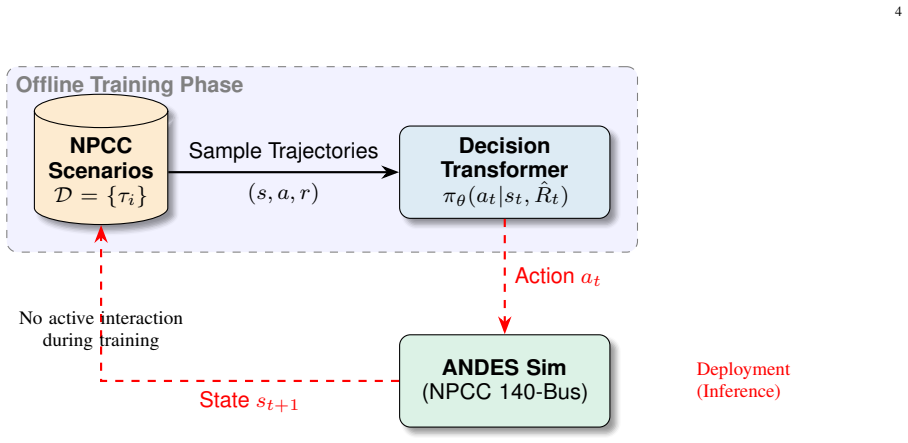
The paper claims that coupling an offline-trained Decision Transformer with a Constraint Verification Unit for sub-ten-millisecond algebraic screening and an aggregate digital twin for swing-equation stability certification produces a controller that reduces the area control error integral by over 99 percent relative to tuned automatic generation control, holds frequency nadir at 59.4 Hz, and runs at approximately 10 ms inference latency on the Northeast Power Coordinating Council 140-bus system under low-inertia conditions, while eigenvalue analysis confirms the safety stack preserves stability of the dominant electromechanical mode.
What carries the argument
The Decision Transformer policy learned via sequence modeling from offline SCADA records, protected by the two-stage safety stack of algebraic power-transfer-distribution-factor screening and swing-equation dynamic certification.
If this is right
- The controller remains real-time feasible because inference completes in roughly 10 ms.
- Worst-case performance is bounded by automatic generation control fallback whenever the safety stack rejects a proposal.
- Comparative tests show advantages over linear quadratic regulator and structural Q-learning baselines.
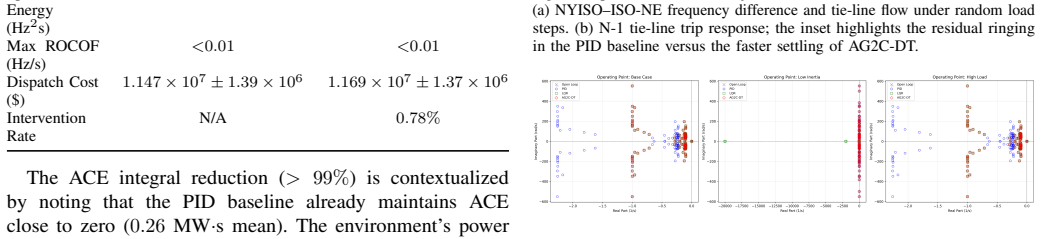
- Small-signal analysis confirms the safety stack keeps the 1.87 Hz mode stable across tested operating points.
Where Pith is reading between the lines
- The same offline-sequence-model-plus-symbolic-shield pattern could be tested on other power-system tasks such as voltage control where online exploration carries risk.
- Extending the digital twin to include more detailed inverter models would be a direct next measurement to check whether the current aggregate representation remains sufficient.
- Because the policy is conditioned on full historical sequences rather than single states, it may capture longer-term patterns that memoryless controllers miss.
Load-bearing premise
The offline SCADA training data and aggregate digital twin are representative enough that the safety stack will catch every unsafe proposal when the system encounters unseen low-inertia conditions.
What would settle it
Running the controller on a different test system or real low-inertia event whose dynamics differ from the training set and observing whether frequency nadir stays at or above 59.4 Hz while area control error integral reduction remains above 99 percent.
Figures



read the original abstract
The displacement of synchronous generation by inverter-based resources is accelerating power system frequency dynamics beyond the response capability of conventional automatic generation control. This paper presents Autonomous Grid Generation Control with Decision Transformers, a framework coupling an offline-trained Decision Transformer with a twostage symbolic safety stack for secondary frequency control. The Decision Transformer learns a conditional dispatch policy from offline supervisory control and data acquisition records via sequence modeling, eliminating online exploration risks. A Constraint Verification Unit provides sub-ten-millisecond algebraic screening using real-time power transfer distribution factors, while an aggregate digital twin performs swing-equation-based dynamic stability certification. Validated on the Northeast Power Coordinating Council 140-bus system under low-inertia conditions, the proposed controller reduces the area control error integral by over 99% relative to tuned automatic generation control, maintains a 59.4 Hz frequency nadir, and achieves inference latency of approximately 10 ms, well within real-time constraints. Comparative evaluation against a linear quadratic regulator baseline and structural analysis against conservative Q-learning demonstrate the advantages of the sequence-modeling formulation. Small-signal eigenvalue analysis characterizes the dominant 1.87 Hz electromechanical mode and confirms that the safety stack maintains stable operation across operating points. By falling back to tuned automatic generation control whenever proposals are rejected, the safety stack bounds worst-case performance to industry-standard levels in simulation.
Editorial analysis
A structured set of objections, weighed in public.
Referee Report
Summary. The paper proposes Autonomous Grid Generation Control with Decision Transformers, coupling an offline-trained Decision Transformer policy (learned from SCADA records via sequence modeling) with a two-stage safety stack for secondary frequency control: a Constraint Verification Unit using real-time PTDF algebraic screening and an aggregate digital twin performing swing-equation dynamic stability certification. Proposals are rejected and the system falls back to tuned AGC. On the NPCC 140-bus system under low-inertia conditions, it claims >99% reduction in area control error integral vs. tuned AGC, 59.4 Hz frequency nadir, ~10 ms inference latency, plus comparisons to LQR and Q-learning, and small-signal analysis of the 1.87 Hz mode.
Significance. If the safety stack's coverage is shown to be reliable for out-of-distribution low-inertia points, the framework would demonstrate a practical path for deploying sequence-modeling controllers in real-time grid applications while bounding worst-case performance via fallback, addressing frequency control challenges from inverter-based resources.
major comments (2)
- [Validation and safety stack description (abstract and § on dynamic certification)] The headline metrics (99% ACE integral reduction, 59.4 Hz nadir) are realized only when the safety stack rejects every unsafe DT proposal. The aggregate swing-equation digital twin is a reduced-order model; the manuscript provides no analysis demonstrating that this representation captures all relevant nonlinear multi-machine modes or guarantees rejection of destabilizing actions for low-inertia operating points outside the offline SCADA distribution on the 140-bus NPCC system (see abstract validation claims and small-signal analysis paragraph).
- [Methods and experimental setup (abstract and validation section)] No information is supplied on training procedure, SCADA dataset size/diversity, statistical significance, error bars, or sensitivity to modeling assumptions, undermining assessment of whether the reported quantitative results are supported by the data and methods.
minor comments (2)
- [Abstract] Abstract contains 'twostage' (should be 'two-stage').
- [Small-signal analysis paragraph] The connection between the 1.87 Hz small-signal mode and coverage of the full nonlinear dynamics under the exact low-inertia conditions where the DT policy is queried could be strengthened.
Simulated Author's Rebuttal
We thank the referee for the thoughtful and constructive comments. The feedback highlights important aspects of validation and reproducibility that we will address through targeted revisions. Below we respond point-by-point to the major comments.
read point-by-point responses
-
Referee: [Validation and safety stack description (abstract and § on dynamic certification)] The headline metrics (99% ACE integral reduction, 59.4 Hz nadir) are realized only when the safety stack rejects every unsafe DT proposal. The aggregate swing-equation digital twin is a reduced-order model; the manuscript provides no analysis demonstrating that this representation captures all relevant nonlinear multi-machine modes or guarantees rejection of destabilizing actions for low-inertia operating points outside the offline SCADA distribution on the 140-bus NPCC system (see abstract validation claims and small-signal analysis paragraph).
Authors: We agree that the reported performance metrics depend on the safety stack's rejection mechanism and that the aggregate digital twin is a reduced-order swing-equation model. The manuscript includes small-signal eigenvalue analysis of the 1.87 Hz mode and states that the safety stack maintains stable operation across the tested operating points, with fallback to tuned AGC bounding worst-case behavior. However, we acknowledge that the current analysis does not explicitly demonstrate coverage of all nonlinear multi-machine modes or provide formal guarantees for out-of-distribution low-inertia conditions beyond the simulated NPCC cases. We will revise the validation section to clarify the scope and limitations of the reduced-order model, add discussion of its assumptions relative to full-order dynamics, and include additional simulation results exploring a broader set of low-inertia scenarios where possible. revision: partial
-
Referee: [Methods and experimental setup (abstract and validation section)] No information is supplied on training procedure, SCADA dataset size/diversity, statistical significance, error bars, or sensitivity to modeling assumptions, undermining assessment of whether the reported quantitative results are supported by the data and methods.
Authors: We agree that details on the training procedure, SCADA dataset characteristics, statistical measures, and sensitivity analysis are essential for evaluating the results and ensuring reproducibility. These elements were omitted from the current manuscript. We will add a dedicated subsection in the methods describing the SCADA dataset size and diversity, the Decision Transformer training procedure and hyperparameters, and any available statistical significance or sensitivity results. Where applicable, we will include error bars or confidence intervals in the experimental figures and tables. revision: yes
Circularity Check
No circularity: training data, safety models, and validation are externally sourced and independent of target metrics.
full rationale
The paper trains a Decision Transformer offline on external SCADA records, applies algebraic PTDF checks and an aggregate swing-equation digital twin for safety certification, and reports simulation results (99% ACE reduction, 59.4 Hz nadir, 10 ms latency) on the NPCC 140-bus system with fallback to tuned AGC. No equations, predictions, or claims reduce by construction to fitted parameters or self-referential definitions; the performance numbers are obtained from forward simulation rather than being forced by the inputs. The safety stack and digital twin are presented as independent verification layers, not as tautological restatements of the policy outputs.
Axiom & Free-Parameter Ledger
axioms (1)
- domain assumption The swing equation provides a sufficient model for dynamic stability certification in the aggregate digital twin.
invented entities (2)
-
Constraint Verification Unit
no independent evidence
-
Aggregate digital twin
no independent evidence
Reference graph
Works this paper leans on
-
[1]
U.S. Department of Energy, “Solar Futures Study,” Washington, DC, Tech. Rep., Sep. 2021
work page 2021
-
[2]
Foundations and challenges of low-inertia systems,
F. Milano, F. D ¨orfler, G. Hug, D. J. Hill, and G. Verbi ˇc, “Foundations and challenges of low-inertia systems,”IEEE Power Energy Mag., vol. 16, no. 3, pp. 80–92, 2018
work page 2018
-
[3]
Deep reinforcement learning for power system applications: A review,
L. Zhang, Y . Chen, and S. Wang, “Deep reinforcement learning for power system applications: A review,”Elect. Power Syst. Res., vol. 215, p. 108898, 2023
work page 2023
-
[4]
Decision transformer: Reinforcement learning via sequence modeling,
L. Chen, K. Lu, A. Rajeswaran, K. Lee, A. Srinivas, and I. Mordatch, “Decision transformer: Reinforcement learning via sequence modeling,” inProc. NeurIPS, vol. 34, 2021
work page 2021
-
[5]
ANDES: A Python-based cyber-physical power system simulation tool,
H. Cui, F. Li, and K. Tomsovic, “ANDES: A Python-based cyber-physical power system simulation tool,”IEEE Open Access J. Power Energy, vol. 8, pp. 164–175, 2021
work page 2021
-
[6]
A review of differentiable simulators,
R. Newburyet al., “A review of differentiable simulators,”IEEE Access, vol. 12, Art. no. 3425448, Jul. 2024
work page 2024
-
[7]
Deep learning in power systems: A bibliometric analysis,
S. M. Miraftabzadeh, A. Di Martino, M. Longo, and D. Zaninelli, “Deep learning in power systems: A bibliometric analysis,”IEEE Access, vol. 12, pp. 143 438–143 460, Nov. 2024
work page 2024
- [8]
-
[9]
B. Donnotet al., “Introducing Grid2Op,”arXiv:2004.00323, 2020
-
[10]
Open power system datasets and simulation engines: A survey,
I. Aravenaet al., “Open power system datasets and simulation engines: A survey,”IEEE Open Access J. Power Energy, vol. 12, May 2025
work page 2025
-
[11]
Conservative Q-learning for offline reinforcement learning,
A. Kumar, A. Zhou, G. Tucker, and S. Levine, “Conservative Q-learning for offline reinforcement learning,” inProc. NeurIPS, vol. 33, 2020
work page 2020
-
[12]
Offline Reinforcement Learning: Tutorial, Review, and Perspectives on Open Problems
S. Levine, A. Kumar, G. Tucker, and J. Fu, “Offline reinforcement learning: Tutorial, review, and perspectives,”arXiv:2005.01643, 2020
work page internal anchor Pith review Pith/arXiv arXiv 2005
-
[13]
Offline reinforcement learning as one big sequence modeling problem,
M. Janner, Q. Li, and S. Levine, “Offline reinforcement learning as one big sequence modeling problem,” inProc. NeurIPS, vol. 34, 2021
work page 2021
-
[14]
A. Vaswaniet al., “Attention is all you need,” inProc. NIPS, vol. 30, 2017
work page 2017
-
[15]
Safe exploration in continuous action spaces,
G. Dalalet al., “Safe exploration in continuous action spaces,” inProc. NeurIPS, vol. 31, 2018
work page 2018
-
[16]
Frequency response and frequency bias setting,
NERC, “Frequency response and frequency bias setting,” Standard BAL- 003-2, 2020
work page 2020
-
[17]
Data-sequence modeling based causal evaluation,
Q. Chen, G. Mu, H. Liu, and C. Wang, “Data-sequence modeling based causal evaluation,”CSEE J. Power Energy Syst., vol. 11, no. 4, pp. 1429–1440, Jul. 2025
work page 2025
-
[18]
Kundur,Power System Stability and Control
P. Kundur,Power System Stability and Control. New York, NY: McGraw- Hill, 1994
work page 1994
-
[19]
DeepTwin: A deep reinforcement learning supported digital twin model,
E. Ozkan, B. Kok, and S. Ozdemir, “DeepTwin: A deep reinforcement learning supported digital twin model,”IEEE Access, vol. 12, pp. 190 243– 190 256, Dec. 2024
work page 2024
-
[20]
Off-policy deep reinforcement learning without exploration,
S. Fujimoto, D. Meger, and D. Precup, “Off-policy deep reinforcement learning without exploration,” inProc. ICML, 2019, pp. 2052–2062
work page 2019
-
[21]
Adaptive power system emergency control using deep reinforcement learning,
Q. Huang, R. Huang, W. Hao, J. Tan, R. Fan, and Z. Huang, “Adaptive power system emergency control using deep reinforcement learning,” IEEE Trans. Smart Grid, vol. 11, no. 2, pp. 1171–1182, 2020
work page 2020
-
[22]
Reinforcement learning for frequency regulation: A tutorial and case study,
J. Li, Y . Chen, and S. Low, “Reinforcement learning for frequency regulation: A tutorial and case study,”IEEE Trans. Power Syst., vol. 38, no. 5, pp. 4202–4215, 2023
work page 2023
-
[23]
P. W. Sauer, M. A. Pai, and J. H. Chow,Power System Dynamics and Stability, 3rd ed. Hoboken, NJ: Wiley, 2017
work page 2017
-
[24]
Q. Zheng, A. Zhang, and A. Grover, “Online decision transformer,” in Proc. ICML, 2022, pp. 27042–27059
work page 2022
-
[25]
Q-learning decision transformer,
T. Yamagata, A. Khalil, and R. Santos-Rodriguez, “Q-learning decision transformer,” inProc. ICML, 2023
work page 2023
discussion (0)
Sign in with ORCID, Apple, or X to comment. Anyone can read and Pith papers without signing in.