QuadRocket: An Aerial Robotic Testbed for Adaptive Thrust-Vector Control of Rocket-Like Vehicles
Pith reviewed 2026-07-03 10:42 UTC · model grok-4.3
The pith
An adaptive backstepping controller on a reduced-attitude model achieves almost global trajectory tracking for a quadrotor rocket prototype despite unknown constant disturbances.
A machine-rendered reading of the paper's core claim, the machinery that carries it, and where it could break.
Core claim
The central claim is that by modeling the QuadRocket as a single axisymmetric rigid body actuated by a vectored force and using a reduced-attitude representation, an adaptive backstepping controller can be derived to achieve almost global trajectory tracking in the presence of unknown constant disturbances, with a control-point transformation to mitigate non-minimum-phase behavior, and the quadrotor serving as a thrust vector actuator under a dynamic-surface attitude controller.
What carries the argument
Adaptive backstepping controller with control-point transformation on a reduced-attitude two-sphere representation of an axisymmetric rigid body
If this is right
- The complete control architecture achieves accurate trajectory tracking in simulation and experiments.
- Unknown constant disturbances are compensated by the adaptive controller.
- The control-point transformation mitigates non-minimum-phase behavior of the system.
- The quadrotor attitude controller tracks the desired thrust vector without explicit differentiation of virtual controls.
Where Pith is reading between the lines
- This testbed could be scaled to validate controls for full-scale rocket launches.
- The reduced-attitude approach might be applied to other axisymmetric vehicles like missiles or satellites.
- Indoor validation suggests the method could be tested outdoors with different disturbance profiles.
Load-bearing premise
The coupled system can be modeled as a single axisymmetric rigid body actuated by a vectored force along its longitudinal axis.
What would settle it
An experiment where the prototype fails to track a trajectory or does not compensate for a constant disturbance would falsify the controller performance claim.
Figures




read the original abstract
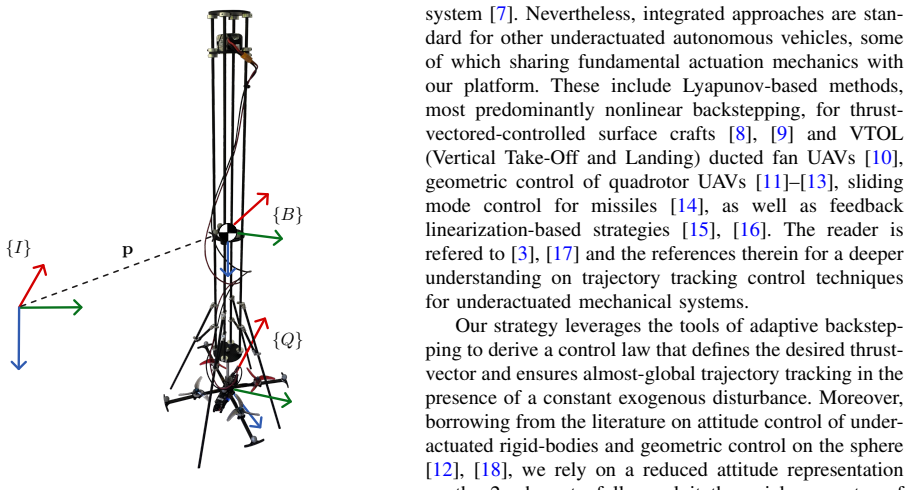
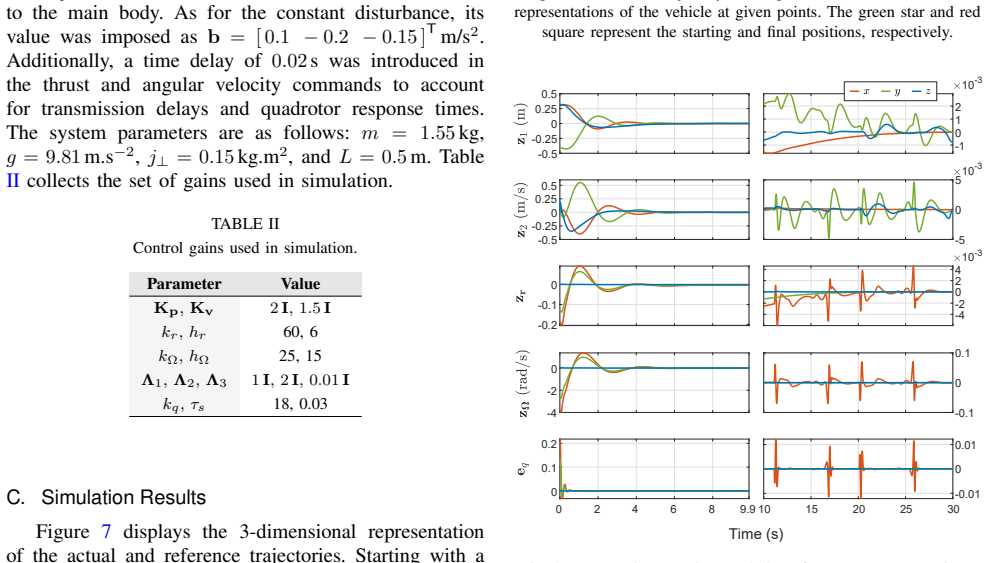
This paper presents QuadRocket, a quadrotor-based rocket prototype that provides a low-cost, low-risk platform for validating advanced thrust-vector control strategies for launch vehicle-type systems. The prototype consists of a cylindrical main body mounted on top of a quadrotor through a universal joint, forming a flying inverted pendulum with non-negligible inertia. For control design, the coupled system is modeled as a single axisymmetric rigid body actuated by a vectored force applied along its longitudinal axis. A reduced-attitude representation on the two sphere is adopted to explicitly exploit the vehicle's axial symmetry and to decouple yaw from the thrust-vector direction. On this model, we derive an adaptive backstepping controller that achieves almost global trajectory tracking in the presence of unknown constant disturbances, while a control-point transformation mitigates non minimum-phase behavior. The quadrotor is then treated as a thrust vector actuator, and a dynamic-surface-based attitude controller is designed to track the desired thrust-vector, accounting for actuation dynamics and avoiding explicit differentiation of virtual control signals. The complete architecture is evaluated in simulation and validated experimentally in an indoor motion-capture arena. Results demonstrate accurate trajectory tracking, effective disturbance compensation, and confirm the suitability of the QuadRocket as a versatile testbed for thrust-vector-controlled robotic vehicles.
Editorial analysis
A structured set of objections, weighed in public.
Referee Report
Summary. The paper presents QuadRocket, a quadrotor-based rocket prototype consisting of a cylindrical body mounted on a quadrotor via a universal joint. For control design, it models the system as a single axisymmetric rigid body with vectored thrust along the longitudinal axis. It adopts a reduced-attitude representation on the two-sphere, derives an adaptive backstepping controller for almost-global trajectory tracking under unknown constant disturbances, uses a control-point transformation to mitigate non-minimum-phase behavior, designs a dynamic-surface attitude controller for the quadrotor, and validates the approach through simulation and indoor motion-capture experiments.
Significance. If the single rigid-body modeling assumption holds for the hardware, this work offers a low-cost, low-risk testbed for validating advanced thrust-vector control strategies with theoretical stability guarantees. The experimental validation in an indoor arena demonstrates practical feasibility for trajectory tracking and disturbance compensation.
major comments (1)
- [Abstract and control design section] Abstract and control design section: The central modeling assumption that the coupled system behaves as a single axisymmetric rigid body actuated by a vectored force applied along its longitudinal axis underpins the derivation of the adaptive backstepping controller and the almost-global tracking claims. However, the physical platform consists of two bodies joined by a universal joint that permits relative rotation, which could alter the composite inertia tensor, effective thrust application point, and introduce additional disturbance torques not captured in the monolithic model. This discrepancy risks invalidating the applicability of the stability arguments to the actual hardware.
minor comments (1)
- [Abstract] The abstract refers to 'the two sphere'; this should be clarified as the two-sphere S^2 for standard notation.
Simulated Author's Rebuttal
We thank the referee for the constructive feedback. We address the single major comment below.
read point-by-point responses
-
Referee: [Abstract and control design section] Abstract and control design section: The central modeling assumption that the coupled system behaves as a single axisymmetric rigid body actuated by a vectored force applied along its longitudinal axis underpins the derivation of the adaptive backstepping controller and the almost-global tracking claims. However, the physical platform consists of two bodies joined by a universal joint that permits relative rotation, which could alter the composite inertia tensor, effective thrust application point, and introduce additional disturbance torques not captured in the monolithic model. This discrepancy risks invalidating the applicability of the stability arguments to the actual hardware.
Authors: We acknowledge that the physical platform consists of two bodies connected by a universal joint, as described in the manuscript. The single rigid-body model is an explicit modeling choice made for control synthesis to exploit axial symmetry and enable the reduced-attitude representation and adaptive backstepping design with almost-global guarantees. This is an approximation whose validity depends on keeping relative motion small under closed-loop control. The indoor experiments demonstrate practical performance, but we agree that the link between the model and hardware merits further clarification. In the revised manuscript we will add a paragraph in the modeling section discussing the conditions under which the rigid-body assumption is reasonable, including the joint's limited range and observed relative angles from experiments. revision: yes
Circularity Check
Derivation self-contained on adopted model; no reduction to fitted inputs or self-citations
full rationale
The paper models the system as a single axisymmetric rigid body for control design (abstract), then applies standard adaptive backstepping and dynamic-surface control on the reduced-attitude representation to derive the trajectory-tracking law. No equations show a result being fitted to data and then renamed as a prediction, no load-bearing self-citation chains, and no ansatz or uniqueness claim imported from prior author work. The modeling choice is an explicit assumption whose validity is separate from whether the subsequent derivation is circular; experimental validation is reported but does not retroactively make the controller equations tautological. This is the normal case of an independent derivation on a chosen model.
Axiom & Free-Parameter Ledger
axioms (2)
- domain assumption The coupled quadrotor and cylindrical body can be modeled as a single axisymmetric rigid body actuated by a vectored force along its longitudinal axis.
- domain assumption Disturbances are unknown but constant.
Reference graph
Works this paper leans on
-
[1]
Looking to the future: A call to action for advanced GNC algorithm verification and validation,
S. Bennani, C. Dennehyet al., “Looking to the future: A call to action for advanced GNC algorithm verification and validation,” The Inter-Agency GNC V&V Working Group, Tech. Rep., 2024
work page 2024
-
[2]
Guidance of reusable launchers: Improving descent and landing performance,
P. Simpl ´ıcio, A. Marcos, and S. Bennani, “Guidance of reusable launchers: Improving descent and landing performance,”J. Guid. Control Dyn., vol. 42, no. 10, pp. 2206–2219, 2019
work page 2019
-
[3]
A. P. Aguiar and J. P. Hespanha, “Trajectory-tracking and path- following of underactuated autonomous vehicles with parametric modeling uncertainty,”IEEE Trans. Autom. Control, vol. 52, pp. 1362–1379, 2007
work page 2007
-
[4]
S. Sun, A. Romero, P. Foehn, E. Kaufmann, and D. Scaramuzza, “A comparative study of nonlinear MPC and differential-flatness- based control for quadrotor agile flight,”IEEE Trans. Robot., vol. 38, no. 6, pp. 3357–3373, 2022
work page 2022
-
[5]
Inspection-while-flying: An autonomous contact-based nonde- structive test using UA V-tools,
B. B. Kocer, T. Tjahjowidodo, M. Pratama, and G. G. L. Seet, “Inspection-while-flying: An autonomous contact-based nonde- structive test using UA V-tools,”Autom. Constr., vol. 106, 2019
work page 2019
-
[6]
Nonlinear control design for slightly non-minimum phase systems: Application to V/STOL aircraft,
J. Hauser, S. Sastry, and G. Meyer, “Nonlinear control design for slightly non-minimum phase systems: Application to V/STOL aircraft,”Automatica, vol. 28, no. 4, pp. 665–679, 1992
work page 1992
-
[7]
Analysis and design of launch vehicle flight control systems,
B. Wie, W. Du, and M. Whorton, “Analysis and design of launch vehicle flight control systems,” inAIAA Guidance, Navigation and Control Conference and Exhibit, 2008
work page 2008
-
[8]
J. Reis, W. Xie, D. Cabecinhas, and C. Silvestre, “Nonlinear backstepping controller for an underactuated ASV with model parametric uncertainty: Design and experimental validation,”IEEE Trans. Intell. Vehicl., vol. 8, pp. 2514–2526, 2023
work page 2023
-
[9]
Hovercraft control with dynamic parameters identification,
D. Cabecinhas, P. Batista, P. Oliveira, and C. Silvestre, “Hovercraft control with dynamic parameters identification,”IEEE Trans. Control Syst. Technol., vol. 26, pp. 785–796, 5 2018
work page 2018
-
[10]
Hovering flight stabilization in wind gusts for ducted fan UA V,
J. M. Pflimlin, P. So `u, and T. Hamel, “Hovering flight stabilization in wind gusts for ducted fan UA V,” inIEEE Conference on Decision and Control, December 2004
work page 2004
-
[11]
Geometric tracking control of a quadrotor UA V on SE(3),
T. Lee, M. Leok, and N. McClamroch, “Geometric tracking control of a quadrotor UA V on SE(3),” in49th IEEE Conference on Decision and Control, 2010
work page 2010
-
[12]
Geomet- ric controls of a quadrotor UA V with decoupled yaw control,
K. Gamagedara, M. Bisheban, E. Kaufman, and T. Lee, “Geomet- ric controls of a quadrotor UA V with decoupled yaw control,” in IEEE American Control Conference, 2019, pp. 3285–3290
work page 2019
-
[13]
X. Shi, Y . Zhang, and D. Zhou, “Almost-global finite-time tra- jectory tracking control for quadrotors in the exponential coordi- nates,”IEEE Trans. Aerosp. Electron. Syst., vol. 53, no. 1, pp. 91–100, 2017
work page 2017
-
[14]
Guidance and control of missile interceptor using second-order sliding modes,
Y . B. Shtessel, I. A. Shkolnikov, and A. Levant, “Guidance and control of missile interceptor using second-order sliding modes,” IEEE Trans. Aerosp. Electron. Syst., vol. 45, no. 1, pp. 110–124, 2009
work page 2009
-
[15]
Nonlinear-disturbance- observer-based robust flight control for airbreathing hypersonic vehicles,
J. Yang, S. Li, C. Sun, and L. Guo, “Nonlinear-disturbance- observer-based robust flight control for airbreathing hypersonic vehicles,”IEEE Trans. Aerosp. Electron. Syst., vol. 49, no. 2, pp. 1263–1275, 2013
work page 2013
-
[16]
Pitch plane trajectory tracking control for sounding rockets via adaptive feedback linearization,
P. Santos and P. Oliveira, “Pitch plane trajectory tracking control for sounding rockets via adaptive feedback linearization,” in2025 IEEE Aerospace Conference, 2025, pp. 1–17
work page 2025
-
[17]
Robust global trajectory tracking for a class of underac- tuated vehicles,
P. Casau, R. G. Sanfelice, R. Cunha, D. Cabecinhas, and C. Sil- vestre, “Robust global trajectory tracking for a class of underac- tuated vehicles,”Automatica, vol. 58, pp. 90–98, 2015
work page 2015
-
[18]
Control on the sphere and reduced attitude stabilization,
F. Bullo, R. Murray, and A. Sarti, “Control on the sphere and reduced attitude stabilization,”IFAC Proceedings Volumes, vol. 28, no. 14, pp. 495–501, 1995
work page 1995
-
[19]
Differential flatness of mechanical control systems: A catalog of prototype systems,
R. M. Murray, M. Rathinam, and W. Sluis, “Differential flatness of mechanical control systems: A catalog of prototype systems,” inASME International Mechanical Engineering Congress and Exposition, 1995, pp. 349–357
work page 1995
-
[20]
Approximate trajectory gen- eration for differentially flat systems with zero dynamics,
M. van Nieuwstadt and R. Murray, “Approximate trajectory gen- eration for differentially flat systems with zero dynamics,” in34th IEEE Conference on Decision and Control, vol. 4, 1995, pp. 4224– 4230
work page 1995
-
[21]
Design, optimal guidance and control of a low-cost re-usable electric model rocket,
L. Spannagl, E. Hampp, A. Carron, J. Sieber, C. A. Pascucci, A. U. Zgraggen, A. Domahidi, and M. N. Zeilinger, “Design, optimal guidance and control of a low-cost re-usable electric model rocket,” in2021 IEEE/RSJ International Conference on Intelligent Robots and Systems (IROS), 2021, pp. 6344–6351
work page 2021
-
[22]
R. Linsen, P. Listov, A. D. Lajarte, R. Schwan, and C. N. Jones, “Optimal thrust vector control of an electric small-scale rocket 16 IEEE TRANSACTIONS ON AEROSPACE AND ELECTRONIC SYSTEMS VOL. XX, No. XX XXXXX 2026 prototype,” inIEEE International Conference on Robotics and Automation (ICRA), 2022, pp. 1996–2002
work page 2026
-
[23]
Robust nonlinear 3D control of an inverted pendulum balanced on a quadrotor,
W. Yang, G. Yu, J. Reis, and C. Silvestre, “Robust nonlinear 3D control of an inverted pendulum balanced on a quadrotor,” Automatica, vol. 159, 2024
work page 2024
-
[24]
Dynamics, guidance, and control of a low-cost quadcopter-based space vehicle testbed,
W. J. Elke and R. J. Caverly, “Dynamics, guidance, and control of a low-cost quadcopter-based space vehicle testbed,” inAIAA SciTech Forum and Exposition, 2024
work page 2024
-
[25]
Towards applied nonlinear adaptive control,
A. Astolfi, D. Karagiannis, and R. Ortega, “Towards applied nonlinear adaptive control,”Annu. Rev. Control, vol. 32, no. 2, pp. 136–148, 2008
work page 2008
-
[26]
A control approach for thrust-propelled underactuated vehicles and its application to VTOL drones,
M. Hua, T. Hamel, P. Morin, and C. Samson, “A control approach for thrust-propelled underactuated vehicles and its application to VTOL drones,”IEEE Trans. Autom. Control, vol. 54, no. 8, pp. 1837–1853, 2009
work page 2009
-
[27]
O. Mofid and S. Mobayen, “Adaptive finite-time backstepping global sliding mode tracker of quad-rotor UA Vs under model uncertainty, wind perturbation, and input saturation,”IEEE Trans. Aerosp. Electron. Syst., vol. 58, no. 1, pp. 140–151, 2022
work page 2022
-
[28]
High- performance quadrotor slung load transportation with damped oscillations,
J. Reis, G. Yu, D. Cabecinhas, and C. Silvestre, “High- performance quadrotor slung load transportation with damped oscillations,”Int. J. Robust Nonlin. Control, vol. 33, no. 17, pp. 10 227–10 256, 2023
work page 2023
-
[29]
6-DOF integrated adaptive backstepping control for spacecraft proximity operations,
L. Sun and W. Huo, “6-DOF integrated adaptive backstepping control for spacecraft proximity operations,”IEEE Trans. Aerosp. Electron. Syst., vol. 51, no. 3, pp. 2433–2443, 2015
work page 2015
-
[30]
Review of advanced guidance and control algorithms for space/aerospace vehicles,
R. Chai, A. Tsourdos, A. Savvaris, S. Chai, Y . Xia, and C. Philip Chen, “Review of advanced guidance and control algorithms for space/aerospace vehicles,”Prog. Aerosp. Sci., vol. 122, p. 100696, 2021
work page 2021
-
[31]
Spin-axis stabilization of sym- metric spacecraft with two control torques,
P. Tsiotras and J. M. Longuski, “Spin-axis stabilization of sym- metric spacecraft with two control torques,”Syst. & Control Lett., vol. 23, no. 6, pp. 395–402, 1994
work page 1994
-
[32]
Tilt-prioritized quadrocopter attitude control,
D. Brescianini and R. D’Andrea, “Tilt-prioritized quadrocopter attitude control,”IEEE Trans. Control Syst. Technol., vol. 28, no. 2, pp. 376–387, 2020
work page 2020
-
[33]
Trajectory tracking for quadrotors with attitude control onS 2 × S1,
D. Kooijman, A. P. Schoellig, and D. J. Antunes, “Trajectory tracking for quadrotors with attitude control onS 2 × S1,” in18th European Control Conference (ECC), 2019, pp. 4002–4009
work page 2019
-
[34]
E. M. Coates, D. Reinhardt, and T. I. Fossen, “Reduced-attitude control of fixed-wing unmanned aerial vehicles using geometric methods on the two-sphere,”IFAC-PapersOnLine, vol. 53, no. 2, pp. 5749–5756, 2020, 21st IFAC World Congress
work page 2020
-
[35]
Trajectory tracking of a quadrotor via full-state feedback control,
J. Madeiras, C. Cardeira, and P. Oliveira, “Trajectory tracking of a quadrotor via full-state feedback control,”Aerosp. Sci. Technol., vol. 147, p. 109013, 2024
work page 2024
-
[36]
Position and reduced attitude trajectory tracking control of quadrotors: Theory and experiments,
C. Monta ˜nez-Molina and J. Pliego-Jim´enez, “Position and reduced attitude trajectory tracking control of quadrotors: Theory and experiments,”Aerosp. Sci. Technol., vol. 155, 2024
work page 2024
-
[37]
J. E. Slotine,Applied Nonlinear Control, 1st ed. Prentice Hall, 1991
work page 1991
-
[38]
S. P. Bhat and D. S. Bernstein, “A topological obstruction to con- tinuous global stabilization of rotational motion and the unwinding phenomenon,”Syst. & Control Lett., vol. 39, no. 1, pp. 63–70, 2000
work page 2000
- [39]
-
[40]
Dynamic surface control for a class of nonlinear systems,
D. Swaroop, J. Hedrick, P. Yip, and J. Gerdes, “Dynamic surface control for a class of nonlinear systems,”IEEE Trans. Autom. Control, vol. 45, no. 10, pp. 1893–1899, 2000
work page 2000
- [41]
-
[42]
L. W. Tu,An Introduction to Manifolds, 2nd ed. Springer, 2011, ch. 3. Pedro Santos (Graduate Student Member, IEEE)received his B.Sc. and M.Sc. degrees in Aerospace Engineering from Instituto Superior T´ecnico (IST), Lisbon, Portugal, in 2020, and 2022, respectively. He is currently pursuing a Ph.D. degree in Aerospace Engineering at IST in affiliation wit...
work page 2011
discussion (0)
Sign in with ORCID, Apple, or X to comment. Anyone can read and Pith papers without signing in.