Four-qubit states reproduce known CFTs
Critical points of an entropy function reconstruct a CFT's spectrum with no Hamiltonian input.
· “A systematic search for conformal field theories in very small spaces”

Quantum Physics
Description coming soon
sort pith recommended most recent
Critical points of an entropy function reconstruct a CFT's spectrum with no Hamiltonian input.
· “A systematic search for conformal field theories in very small spaces”
Controlled rotation toward |0⟩ cancels measurement-induced forgetting and improves memory on real hardware.
· “Quantum reservoir computing induced by controllable damping”

Even for qubits, message size must grow with the number of jointly measured systems, so no fixed-size classical model works.
· “A lower bound on the classical simulation cost of star-network correlations”

Even with all-to-all wiring, exact minimisation stays hard; sparse targets and ancillas don't help.
· “CNOT-Distance is NP-complete under all-to-all connectivity”
Measurement-guided control keeps fidelity high under depolarizing, phase-damping, and amplitude-damping noise.
· “Time-Optimal Control of Finite Dimensional Open Quantum Systems via a Model Predictive Strategy”
With quantum inputs, even incompatible-local sets violate Bell inequalities; extractable nonlocality is bounded by incompatibility.
· “All incompatible sets of measurements can generate Buscemi nonlocality”
Superconducting sensors, atom interferometers, and spin sensors could push fundamental-physics experiments beyond classical sensitivity limi
· “Quantum measurement systems and applications to particle physics and cosmology”
Long-lived collective modes, like Lifshitz tails, dominate late-time dynamics and offer a new control knob.
· “Lifshitz-like Metastability and Optimal Dephasing in Dissipative Bosonic Lattices”
Under flipped labels, classical networks degrade at once; quantum models plateau, then fail sharply and forget faster.
· “Superior resilience to poisoning and amenability to unlearning in quantum machine learning”

A photon-carrying network can purify mixed input states by post-selecting on a unique dark state, no engineered baths needed.

Operator learning replaces 10-hour pulse optimizations with 10-minute design in an 888-dimensional molecular subspace.
· “Inverse Design of Quantum Control Sequences with Fourier Neural Operators”

Model predictive quantum control cuts runtime, adds feedback robustness, and guarantees exponential arrival at the target.

A five-spin quantum reservoir, read at two moments, predicts low-dimensional turbulence and a classic chaos benchmark.
· “Forecasting Low-Dimensional Turbulence via Multi-Dimensional Hybrid Quantum Reservoir Computing”

On the Fez processor, hardware matches simulation; radius and water/methane abundances are recovered from JWST-like spectra.
· “Exoplanetary atmospheres retrieval via a quantum extreme learning machine”

Six-qubit circuit from a 1,000-circuit library beats four manual quantum designs on credit-card fraud.
· “CircuitHunt: Automated Quantum Circuit Screening for Superior Credit-Card Fraud Detection”

Quantum phase estimation overtakes only the most expensive classical methods, leaving routine chemistry classical for decades.

The supplied full text is an unrelated physics paper, so the abstract's 27-qubit result has no visible evidence.
Cross-Kerr couplings in a two-transistor optomechanical device reshape probe spectra and add gain
When the Grover diffusion step is folded into the measurement masks, marked pixels emerge bright and the rest dark.
· “Unveiling the link between quantum ghost imaging and Grover's quantum searching algorithm”
Numerical model of a thin-film helium simulator shows mutual information scales with boundary size, enabling lab tests.
· “Information in quantum field theory simulators: Thin-film superfluid helium”
Near-resonant bystander qubits no longer demand big frequency gaps; leakage stays at 10^-4 even with three spectators.

Reconstructing the Floquet Hamiltonian yields a quantized Berry phase and time-localized interface states.
· “Observation of Momentum-Band Topology in PT-Symmetric acoustic Floquet Lattices”

A mid-pulse phase flip cancels common-mode noise and resolves 5-Hz separations 200 times below the linewidth

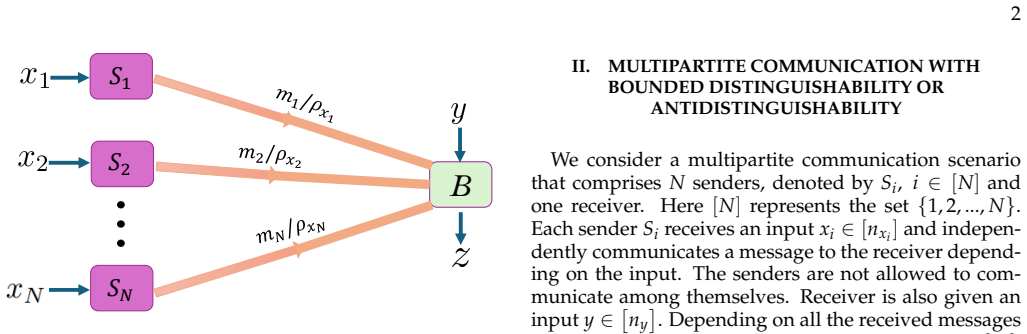
Bounded per-sender information leakage suffices: the gap over classical protocols widens as senders grow.
Microwatts of green plus milliwatts of near-infrared cut charge-prep error from ~30% to ~5% in shallow diamond sensors.

No state prep, no feedback, no entanglement: five qubits plus readout delays handle nonlinear regression and forecasting.

A non-variational circuit with O(L) depth prepares meson scattering states; QSE operators reach 99.9% fidelity on vector mesons.
· “Scalable Quantum Algorithm for Meson Scattering in a Lattice Gauge Theory”

OpenQudit replaces gate names with unitary expressions, supporting qudits and safer tool composition.

Fourier-amplitude MS gate adds one or two linear constraints; extra laser power falls below 1.2 percent.

Five rings already make frequency-bin Bell states at 7 kHz with 87% fidelity; the chip holds 20.

Mid-circuit measurement and feed-forward, tuned numerically, cut circuit depth on states, gates, and simulation blocks.

Same noise-based argument replaces perturbation proofs and tightens quantum precision bounds under strong driving.

In 2D condensates, flow can outrun sound at a horizon, with a computable Hawking temperature for uniform-density setups.
· “Acoustic black holes, white holes, and wormholes in Bose-Einstein condensates in two dimensions”

Multi-orbital Rényi-2 ranking from a tensor network lowers CASCI energies and sharpens dipoles on BeO and BN.
· “TNASS: Tensor Network Active Space Selection with the Entanglement Feature”

Two QND schemes read the Z and X bases while keeping the qubit protected, completing a fault-tolerant control set.
· “Protected measurements for protected superconducting qubits”

Harvest packs magic states, routing, and placement into one schedule, then prunes unused patches.
· “Harvest: Resource-Aware Quantum Compilation for Magic State Protocols”

A charged pair on a twisted sheet localizes, splits, and swaps harmonic spacing for quartic scaling.
· “Curvature as a control field in helicoidal two-body systems”

Post-selecting the |0> outcome keeps the no-jump branch, raising single-qubit fidelity above 0.99 for damping up to 0.42.

Trained on local window corrections, it matches AlphaQubit accuracy with constant-latency parallel decoding.
· “Learning Neural Decoding with Parallelism and Self-Coordination for Quantum Error Correction”

The pair admits Maxwell's higher-form symmetry while excluding hyperplane theories, generalized free fields, and odd Majorana chains.

Charged observables settle into a generalized Gibbs ensemble that remembers the initial projective charge.
· “Eigenstate Thermalization Hypothesis with projective representation”
A resolvent reformulation lets quantum amplitude estimation read the probe at the precision limit
· “Heisenberg limited quantum algorithm for estimating the fidelity susceptibility”
Relativistic calculation finds HVP reaches 68% of muon-VP at high Z; spikes trace nuclear radii.

The same kernel-based wavefunction model handles strong electron correlation in molecules and MNIST image classification.
· “Bayesian perspectives for quantum states and application to ab initio quantum chemistry”
QAOA maps each route segment to a qubit and finds collision-free routes, even on noisy quantum hardware.
· “QUAV: Quantum-Assisted Path Planning and Optimization for UAV Navigation with Obstacle Avoidance”

They also post perfect vocabulary-diversity scores, but pay for it in perplexity and domain accuracy

A 10-site donor-acceptor chain runs on superconducting hardware, reproducing non-Markovian vibronic spectra.
Quantizing with a deformed-fuzzy-sphere Lie derivative turns matrix Chern-Simons droplets into effective gauge theories.
· “Microscopic field theories of the quantum skyrmion Hall effect”
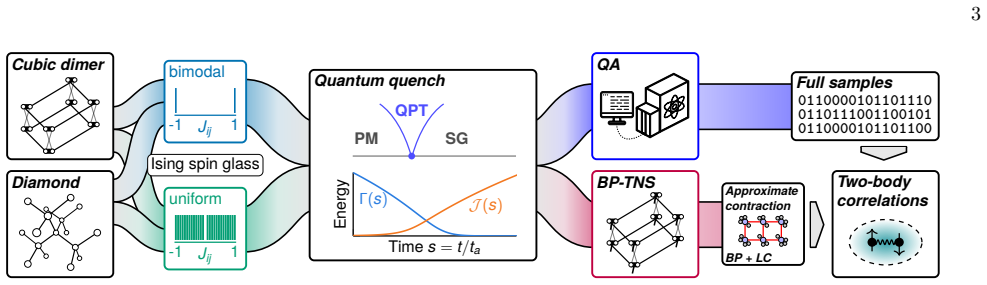
At 128 spins, BP-TNS error stays flat from L=3 to L=4, contradicting the predicted loop-removal improvement.
· “Evaluating classical simulations with a quantum processor”
New algorithms need only polylog queries in 1/ε, regardless of how long the system evolves.

Adaptive protocol estimates even highly squeezed states in trace distance with no photon-number overhead, up to log-log factors.
Counterterms make the spectrum and parton densities finite while block-encoding cost grows only ~50 percent.

A Doppler-shifted reservoir changes the engine's boundaries and can yield work even with zero temperature difference.
· “Relativistic Quantum Thermal Machine: Harnessing Relativistic Effects to Surpass Carnot Efficiency”
Foundry PIC also shows -68 dB crosstalk and nanosecond switching for qubit and Rydberg control.
A single coincidence-rate measurement computes all M hidden neurons; photons stay flat as image size and neuron count grow.

Using 0.023% of the usual quantum measurements, a classical surrogate pre-trains VQEs and maps Floquet phases.
· “Demonstration of Efficient Predictive Surrogates for Large-scale Quantum Processors”

A classical encoder feeds a 4-qubit Ising chain that separates image classes the encoder cannot, on four benchmarks.
· “Enhanced image classification via hybridizing quantum dynamics with classical neural networks”

A circle in the complex energy plane separates Anderson-localized from extended eigenstates.
· “Mobility rings in a non-Hermitian non-Abelian quasiperiodic lattice”

A compensating coupling restores degeneracy, so a double braid rotates by an angle that vanishes only in the fermion limit.

The 12-direction lattice fits real helices, and the newer Heron chip samples the best fold up to three times more often.
· “Quantum Algorithm for Protein Structure Prediction Using the Face-Centered Cubic Lattice”

A proof plus numerics show dissipative circuits stay trainable under noise where unitary circuits fail.
· “Scaling Quantum Algorithms via Dissipation: Avoiding Barren Plateaus”

Hardware runs land within tens of milliHartree of CCSD(T) for benzene and porphyrin.
· “Coupled Cluster Downfolding Theory in Simulations of Chemical Systems on Quantum Hardware”

Quantum matter sources a classical Einstein tensor, with the metric re-glued continuously along future light cones of collapses.

The model puts the missing Andreev signal below 30 mK thermal noise and shows a 55-nm channel lifts it to 1.3 GHz.
· “Resolving Andreev spin qubits in germanium-based Josephson junctions”

Splitting wavefunctions into real and imaginary parts recovers inner products, spectra, and composite states without complex numbers.
Strong-coupling cavities beat the two-photon benchmark for trapped-ion networks while keeping fidelity above 99%.

A text prompt guides one neural network to output both gate layout and rotation angles, skipping parameter-optimization loops.
· “Leveraging Diffusion Models for Parameterized Quantum Circuit Generation”

At 6 GHz, a 20 dB attenuator reads 20.70 ± 0.08 dB, so quantum-circuit engineers can trust cryogenic metrology.
· “Full Two-Port S-Parameters at mK Temperatures: a Calibration Strategy and Uncertainty Budget”

Superconducting, trapped-ion, and neutral atom chips each need different routing; this survey organizes the field into one picture.

A superconducting 10-qubit processor demonstrated coherent quantum routers for bucket-brigade QRAM, with reported fidelities of 95.74% for…

New bounds tie channel coherence measures to how many QFT gates are needed, even when a catalyst is used.
· “One-shot manipulation of coherence in dynamic quantum resource theory”
A 100 MHz DMI term quantitatively reproduces the measured drop, vanish, and partial recovery of ODMR with magnetic field.
· “Spin dependent fluorescence mediated by anti-symmetric exchange in triplet exciton pairs”

A review maps why universal photonic computing gets exponentially harder and where tensor networks and GPU acceleration step in.
· “Gaussian Models to Non-Gaussian Realms of Quantum Photonic Simulators”
Beyond a Thouless time, kicked many-body spectra reproduce COE, CUE, and CSE form factors to second order.

Even unlimited back-and-forth messages fail once joint entangled measurements must be reproduced.
· “No-Go Theorem for Generic Simulation of Qubit Channels with Finite Classical Resources”

Nested switches beat the quantum switch, making even entanglement-breaking channels noiseless with nonzero probability.
· “Probabilistic Channel Distillation via Indefinite Causal Order”

On two 20-qubit QPUs the trained model hits 0.91 correlation with true execution quality, vs 0.73 for the best classic metric.
· “Improving Figures of Merit for Quantum Circuit Compilation”

A complete geometric solution for the square root of the threetangle covers the whole Bloch sphere.
· “The exact convex roof for GHZ-W mixtures for three qubits and beyond”

A 2040 retrospective says one measurement gate plus AI trained on quantum data can make quantum computers worth building.

Clifford determinism and sparse tensors shrink experiments and extend cutting past 200 qubits.
