REVIEW 2 major objections 6 minor 62 references
A Versatile Chip-Scale Platform for High-Rate Entanglement Generation using an AlGaAs Microresonator Array
T0 review · 2 major / 6 minor · reviewed 2026-08-11 · deepseek-v4-flash
Pith's one-line read Multiplexing twenty small-radius microresonators interleaves their quantum combs, breaking the usual trade-off between pair-generation rate and spectral density in on-chip entangled-photon sources.
desk verdict Solid experimental advance with a clear rate gain and thorough characterization; the main caveat is that 5-resonator evidence anchors a 20-resonator claim. read the letter →
The pith
A machine-rendered reading of the paper's core claim, the machinery that carries it, and where it could break.
The reading
What carries the argument
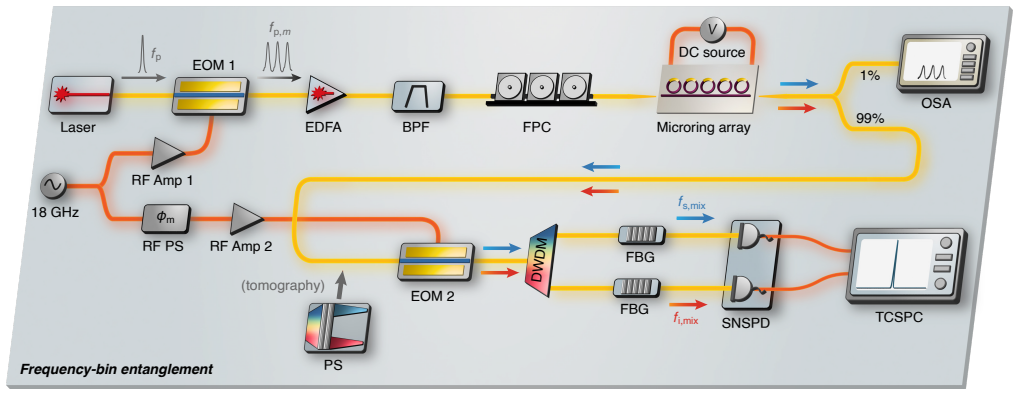
The carrying mechanism is the multiplexed microresonator array: 20 AlGaAs-on-insulator ring resonators, a III-V semiconductor platform with strong Kerr nonlinearity, coupled to a single bus waveguide, each with a 650 GHz free spectral range and loaded quality factor near $3.5\times10^5$. Pair generation is spontaneous four-wave mixing in each ring; because the pair rate scales strongly with inverse mode volume, the small radius boosts the rate, and the array restores the spectral density that the small radius removes. Independent metal heaters tune each ring's resonances with sub-GHz precision, from degeneracy to one full free spectral range, interleaving combs at offsets from 12.5 to 50 GHz. For frequency-bin entanglement, pairs from two rings at a 36 GHz offset are mixed in a second electro-optic phase modulator driven by the same RF source, encoding the two-qubit Bell state in frequency bins and giving an entanglement phase of $4\phi_m$ controlled by the RF phase.
What would settle it
Pump all twenty resonators simultaneously with the same 12.5 GHz comb offsets used here and measure, per ring, the time-bin visibility and coincidence-to-accidental ratio at matched on-chip powers; if any ring's visibility drops below the 70.7% Bell-inequality threshold once more than five rings are active, or if accidental coincidences grow faster than the per-ring pair rate, the full-scale multiplexing claim is refuted.
Extended reading notes
Core claim
Multiplexing small-radius AlGaAs microresonators in an array overcomes the rate-density trade-off that limits single-resonator quantum comb sources. In a single device, each of 20 nominally identical rings produces a 650 GHz-spaced comb of time-energy entangled pairs via spontaneous four-wave mixing; independent thermo-optic heaters shift each ring's resonances so the combs interleave, creating effective mode spacings down to 12.5 GHz while keeping each ring's small mode volume and high pair-generation rate. With five rings pumped simultaneously, the authors measure per-ring pair-generation efficiencies up to 2.6 GHz/$mW^{2}$, time-bin visibilities up to 95%, coincidence-to-accidental ratios exceeding 5,000, and heralded single-photon purities up to 99%. Using two rings detuned by 36 GHz and an electro-optic mixing stage, they generate frequency-bin qubits in the Bell state $|\Phi^+\rangle=(|00\rangle+|11\rangle)/\sqrt{2}$ with fidelity exceeding 87% (90% background-corrected) and detected rates up to 7 kHz. The paper concludes that the remaining 15 resonators can be used in the same way, projecting multi-megabit entanglement distribution and compatibility with telecom DWDM infrastructure.
Load-bearing premise
The load-bearing premise is that what works for five resonators keeps working when all twenty are pumped together, in the sense that tuning or pumping one ring does not disturb its neighbours through heat or stray light enough to spoil the quantum correlations.
Editorial extensions
If this is right
- Dense spectral multiplexing becomes compatible with 100 GHz ITU DWDM filters, so off-the-shelf telecom components can address individual entangled-pair channels.
- Interleaving N resonators multiplies the number of available frequency modes by N, enabling N-dimensional qudit states and multi-photon states across N frequency modes.
- Full use of all 20 resonators is projected to support entanglement distribution rates above 1 Mbps, with multi-user rates near 100 kbps using programmable pulse shapers as switches.
- Integrating low-loss on-chip electro-optic modulators and pulse shapers could push frequency-bin two-qubit rates toward 0.7 MHz off-chip and above 40 MHz on-chip.
- The same array acts as a multiplexed heralded single-photon source, with $g_h^{(2)}(0)$ as low as 0.010, corresponding to 99% purity at 0.6 MHz on-chip rate per ring.
Reading between the lines
- Editorial inference: if thermal crosstalk among rings remains negligible, the best-ring efficiency of 2.6 GHz/mW^2 could aggregate across the array, but the shared bus waveguide and total pump power budget will ultimately cap the combined rate.
- Editorial inference: per-ring pair-generation efficiency varies by roughly an order of magnitude across the five characterized rings, so a practical device would need per-ring power balancing or active feedback to keep qubit amplitudes equal; the authors' EO-comb power tuning already hints at this.
- Editorial inference: because the frequency-bin entanglement phase accumulates as $4\phi_m$, the scheme naturally extends to higher-dimensional qudit states by addressing more rings or more sidebands without changing the source itself.
- Editorial inference: a direct test of all 20 resonators simultaneously, checking per-ring time-bin visibility and coincidence-to-accidental ratio, would separate true cross-talk from mere per-ring fabrication variation; the present data stop at five.
Editorial analysis
A structured set of objections, weighed in public.
Referee Report
Summary. This manuscript reports an AlGaAs-on-insulator photonic platform in which 20 small-radius microresonators (650 GHz FSR) are coupled to a single bus waveguide, each with an individual thermo-optic heater. The authors demonstrate simultaneous pumping of five resonators whose quantum combs are interleaved with relative offsets of 12.5–50 GHz, and they characterize the sources by pump-power-dependent pair generation rates (PGR), coincidence-to-accidental ratios (CAR), time-bin two-photon interferometry, heralded g(2)(0) measurements, and 5×5 joint spectral intensity (JSI) maps. Reported figures include an on-chip PGR efficiency up to 2.6 GHz/mW² per comb line, raw time-bin visibility up to 95.0% ± 1.2% at 0.6 MHz on-chip rate, CAR above 5,000, and heralded single-photon purity up to 99%. In a two-resonator configuration, the authors generate frequency-bin qubits and reconstruct a two-qubit Bell state with fidelity exceeding 87% (90% after background subtraction), with detected coincidence rates up to 7 kHz at ~250 µW pump power; they project that operating all 20 resonators would enable >1 Mbps entanglement-distribution rates. The central claims are that the array circumvents the rate–mode-spacing trade-off by multiplexing small-radius rings and that the resulting sources support high-rate frequency-bin entanglement.
Significance. The measurements are extensive and internally consistent: PGR versus pump power with Poissonian error bars, CAR with polynomial fits, raw (unsubtracted) time-bin visibility of 95% (a CHSH violation by more than 20 standard deviations), g(2)(0) as low as 0.010, a 5×5 JSI with five simultaneously pumped rings, and 16-projection two-qubit tomography. The on-chip PGR of 2.6 GHz/mW² and the multiplexed sub-20 GHz effective mode spacing are state-of-the-art for Kerr sources, and the interleaved-comb concept, previously explored in silicon, is here demonstrated in AlGaAs with a claimed >40× brightness improvement. The headline rate and efficiency numbers are measured quantities with stated loss corrections rather than free-parameter fits, which supports their credibility. If the uniformity and thermal-crosstalk assumptions underlying the 20-resonator projection are validated, the platform is directly relevant to DWDM-compatible entanglement distribution and networking. The two load-bearing caveats are the background-subtracted nature of the 7 kHz headline rate and the extrapolation from five operated rings, both detailed below.
major comments (2)
- [Abstract; §IV.B (Fig. 6(c)–(e))] The headline 'detected frequency-bin entanglement rates up to 7 kHz' is measured at 250 µW on-chip pump power, in the regime where, per the text, Vraw has dipped below the CHSH threshold of 70.7% and only the accidentals-corrected visibility (Vcorr = 92.8% ± 0.3%) is reported; at the highest power where raw visibility is above the Bell bound (15 µW per resonator, Vraw = 92.5% ± 3.5%), the detected coincidence rate at the mixing bin is 23 Hz with CAR 375. The fidelity values (87%/90%) come from tomography at the low-power point, so entanglement at 7 kHz rests on corrected visibility alone. Please report the rate at the raw-valid operating point alongside the corrected 7 kHz value, state the background-subtraction requirement explicitly in the abstract, and ensure the 'exceeding previous demonstrations' comparison in §IV.B uses the same basis for both sources.
- [§II (Fig. 2); Table I; §V] The platform-level claims — 'multiplexing an array of 20 microresonators' and the projected >1 Mbps entanglement-distribution rate — rest on the untested assumption that all 20 rings perform like the five characterized ones. The five operated rings already show a ~10× spread in on-chip PGR (0.27–2.60 GHz/mW²) and ~3× spread in QL (2.0–6.4×10^5, Table I); the other 15 rings are not characterized, more than five rings are never pumped simultaneously, and no bound is given for thermal crosstalk among the 20 heaters or for pump-depletion along the shared bus. The demonstrated interleaving range is likewise 50 GHz, not the claimed full-FSR tuning. Please either add yield and crosstalk data (per-ring Q/PGR for the full array, and neighbor-resonance shift versus heater power) or re-frame the abstract and conclusion so that five-resonator operation is the demonstrated claim and the 20-resonator rates are explicitly conditional projections.
minor comments (6)
- [Abstract; §II] The sentence claiming tuning 'from degeneracy up to a full free spectral range' is stronger than the demonstrated 50 GHz maximum offset (Fig. 2(c)); please distinguish the demonstrated range from the design capability.
- [§III.A] In the definition RPG = Ncc/(Δt ηs ηi), please state explicitly whether ηs and ηi include the quoted 13.5/12.5 dB cumulative bus-to-detector losses or are bare detector efficiencies, since both are referred to as 'detection efficiencies' in the text.
- [§IV.B; Appendix B] The factor e^{i4ϕm} in Eq. (4) is asserted without a derivation; please show how the phases imprinted on the pump EO comb lines by EOM 1 cancel between the two rings and how the ±1 sideband phases from EOM 2 combine at the central bin, so a reader can reproduce the state from first principles.
- [Introduction; Abstract] The 'more than 40 times improvement over prior work' should identify ref. [29]'s silicon dual-resonator source as the comparison system and confirm that the GHz/mW² per-comb-line metric is normalized identically for both measurements.
- [§III.A, Fig. 3(d)] Please state the expected pump-power scaling of the accidental coincidences (Nacc ∝ P⁴ for two independent SFWM events) so the quadratic and quartic polynomial fits in Fig. 3(d) can be interpreted as evidence of negligible Raman and multi-pair noise.
- [Table I] A sentence on the origin of the ~10× spread in RPG (0.27–2.60 GHz/mW²) and the ~3× spread in QL across the five 'nominally identical' rings would help the reader interpret the array-uniformity question raised by the 20-ring projection.
Circularity Check
No significant circularity: all central claims are direct measurements with standard corrections; self-citations are background/methods only.
full rationale
This is an experimental demonstration paper, not a derivation-based theory paper. The central claims—pair-generation rates, time-energy entanglement visibilities, heralded purities, CAR, and frequency-bin Bell state fidelity—are all obtained from measured photon counts with explicitly stated loss corrections (e.g., RPG = Ncc/(Δt ηs ηi)), background subtraction, and standard quantum-state tomography with maximum-likelihood estimation. None of these quantities is a fitted parameter renamed as a prediction; the power-law fits Ncc ∝ P^2 and Nacc ∝ P^4 are consistency checks, not inputs to the headline results. The multiplexing concept is motivated by prior silicon work and a theoretical study by one of the authors, but the demonstrated interleaving of five combs is experimentally verified through the joint spectral intensity measurement (Fig. 5(c)). Self-citations (refs. 19, 30, 46, 47) provide fabrication details, prior baseline rates, and loss estimates; they are external, falsifiable experimental results and are not load-bearing for the present measurements. The projection to 20 resonators and >1 Mbps rates is an explicitly labeled estimate that assumes uniform device performance and simultaneous operation; this is an untested scaling assumption and a possible correctness risk, but it is not circularity—it is not presented as a derivation from the demonstrated data. No equation in the paper reduces to its own input, and no claimed prediction is equivalent by construction to a fitting procedure.
Assumptions & free parameters
assumptions (5)
- domain assumption Spontaneous four-wave mixing in AlGaAs microresonators generates correlated photon pairs.
- domain assumption The five tuned microresonators operate independently with no optical or thermal cross-talk in the bus waveguide.
- domain assumption Thermo-optic tuning shifts resonances without substantially changing the quality factor or nonlinear response.
- standard math Sinusoidal electro-optic phase modulation produces sideband phases as given in Eq. 3 (phi_n = n(pi/2 + phi_m)).
- domain assumption Photon counting is Poissonian and background counts are independent of the signal, allowing CAR and visibility corrections.
Cite this review
Pith. "Pith review of A Versatile Chip-Scale Platform for High-Rate Entanglement Generation using an AlGaAs Microresonator Array." pith.science (2026). https://pith.science/paper/4W76RBEJ
@misc{pith2026241216360,
  author       = {Pith},
  title        = {Pith review of: A Versatile Chip-Scale Platform for High-Rate Entanglement Generation using an AlGaAs Microresonator Array},
  year         = {2026},
  howpublished = {\url{https://pith.science/paper/4W76RBEJ}},
  note         = {Machine review of arXiv:2412.16360}
}
abstract
Integrated photonic microresonators have become an essential resource for generating photonic qubits for quantum information processing, entanglement distribution and networking, and quantum communications. The pair generation rate is enhanced by reducing the microresonator radius, but this comes at the cost of increasing the frequency mode spacing and reducing the quantum information spectral density. Here, we circumvent this rate-density trade-off in an AlGaAs-on-insulator photonic device by multiplexing an array of 20 small-radius microresonators each producing a 650-GHz-spaced comb of time-energy entangled-photon pairs. The resonators can be independently tuned via integrated thermo-optic heaters, enabling control of the mode spacing from degeneracy up to a full free spectral range. We demonstrate simultaneous pumping of five resonators with up to $50$ GHz relative comb offsets, where each resonator produces pairs exhibiting time-energy entanglement visibilities up to 95$\%$, coincidence-to-accidental ratios exceeding 5,000, and an on-chip pair rate up to 2.6 GHz/mW$^2$ per comb line -- more than 40 times improvement over prior work. As a demonstration, we generate frequency-bin qubits in a maximally entangled two-qubit Bell state with fidelity exceeding 87$\%$ (90$\%$ with background correction) and detected frequency-bin entanglement rates up to 7 kHz ($\sim 70$ MHz on-chip pair rate) using $\sim 250$ $\mu$W pump power. Multiplexing small-radius microresonators combines the key capabilities required for programmable and dense photonic qubit encoding while retaining high pair-generation rates, heralded single-photon purity, and entanglement fidelity.
Figures


Figures from the paper (6 more)


Reference graph
Works this paper leans on
-
[1]
H. Shu, L. Chang, Y. Tao, B. Shen, W. Xie, M. Jin, A. Netherton, Z. Tao, X. Zhang, R. Chen, et al., Microcomb-driven silicon photonic systems, Nature 605, 457 (2022)
work page 2022
-
[2]
A. Pasquazi, M. Peccianti, L. Razzari, D. J. Moss, S. Coen, M. Erkintalo, Y. K. Chembo, T. Hansson, S. Wabnitz, P. Del’Haye, et al., Micro-combs: A novel generation of optical sources, Physics Reports 729, 1 (2018)
work page 2018
-
[3]
A. L. Gaeta, M. Lipson, and T. J. Kippenberg, Photonic- chip-based frequency combs, nature photonics 13, 158 (2019)
work page 2019
-
[4]
T. J. Kippenberg, R. Holzwarth, and S. A. Diddams, Microresonator-based optical frequency combs, science 332, 555 (2011)
work page 2011
-
[5]
P. Del’Haye, K. Beha, S. B. Papp, and S. A. Did- dams, Self-injection locking and phase-locked states in microresonator-based optical frequency combs, Physical review letters 112, 043905 (2014)
work page 2014
-
[6]
G. Lihachev, W. Weng, J. Liu, L. Chang, J. Guo, J. He, R. N. Wang, M. H. Anderson, Y. Liu, J. E. Bowers,et al., Platicon microcomb generation using laser self-injection locking, Nature communications 13, 1771 (2022)
work page 2022
-
[7]
S. B. Papp, K. Beha, P. Del’Haye, F. Quinlan, H. Lee, K. J. Vahala, and S. A. Diddams, Microresonator fre- quency comb optical clock, Optica 1, 10 (2014)
work page 2014
-
[8]
Z. L. Newman, V. Maurice, T. Drake, J. R. Stone, T. C. Briles, D. T. Spencer, C. Fredrick, Q. Li, D. Westly, B. R. Ilic, et al., Architecture for the photonic integration of an optical atomic clock, Optica 6, 680 (2019)
work page 2019
Show all 62 references
-
[9]
Moody, V
G. Moody, V. J. Sorger, D. J. Blumenthal, P. W. Juo- dawlkis, W. Loh, C. Sorace-Agaskar, A. E. Jones, K. C. Balram, J. C. Matthews, A. Laing, et al., 2022 roadmap on integrated quantum photonics, Journal of Physics: Photonics 4, 012501 (2022)
2022
-
[10]
M. A. Guidry, D. M. Lukin, K. Y. Yang, R. Trivedi, and J. Vuˇ ckovi´ c, Quantum optics of soliton microcombs, Nature Photonics 16, 52 (2022)
2022
-
[11]
Chang, W
L. Chang, W. Xie, H. Shu, Q.-F. Yang, B. Shen, A. Boes, J. D. Peters, W. Jin, C. Xiang, S. Liu, et al., Ultra-efficient frequency comb generation in algaas-on- insulator microresonators, Nature communications 11, 1331 (2020)
2020
-
[12]
J. D. Franson, Bell inequality for position and time, Phys- ical review letters 62, 2205 (1989)
1989
-
[13]
Wakabayashi, M
R. Wakabayashi, M. Fujiwara, K.-i. Yoshino, Y. Nambu, M. Sasaki, and T. Aoki, Time-bin entangled photon pair generation from si micro-ring resonator, Optics express 23, 1103 (2015)
2015
-
[14]
M. Kues, C. Reimer, J. M. Lukens, W. J. Munro, A. M. Weiner, D. J. Moss, and R. Morandotti, Quantum optical microcombs, Nature Photonics 13, 170 (2019)
2019
-
[15]
J. L. O’brien, A. Furusawa, and J. Vuˇ ckovi´ c, Photonic quantum technologies, Nature Photonics 3, 687 (2009)
2009
-
[16]
Reimer, M
C. Reimer, M. Kues, P. Roztocki, B. Wetzel, F. Grazioso, B. E. Little, S. T. Chu, T. Johnston, Y. Bromberg, L. Caspani, et al., Generation of multiphoton entangled quantum states by means of integrated frequency combs, Science 351, 1176 (2016)
2016
-
[17]
X. Lu, Q. Li, D. A. Westly, G. Moille, A. Singh, V. Anant, and K. Srinivasan, Chip-integrated visible–telecom en- tangled photon pair source for quantum communication, Nature physics 15, 373 (2019)
2019
-
[18]
Z. Yang, M. Jahanbozorgi, D. Jeong, S. Sun, O. Pfister, H. Lee, and X. Yi, A squeezed quantum microcomb on a chip, Nature Communications 12, 4781 (2021)
2021
-
[19]
T. J. Steiner, J. E. Castro, L. Chang, Q. Dang, W. Xie, J. Norman, J. E. Bowers, and G. Moody, Ultrabright entangled-photon-pair generation from an al ga as-on- insulator microring resonator, PRX Quantum 2, 010337 (2021)
2021
-
[20]
C. Ma, X. Wang, V. Anant, A. D. Beyer, M. D. Shaw, and S. Mookherjea, Silicon photonic entangled photon-pair and heralded single photon generation with car¿ 12,000 and g (2)(0)¡ 0.006, Optics Express 25, 32995 (2017)
2017
-
[21]
Ramelow, A
S. Ramelow, A. Farsi, S. Clemmen, D. Orquiza, K. Luke, M. Lipson, and A. L. Gaeta, Silicon-nitride platform for narrowband entangled photon generation, arXiv preprint arXiv:1508.04358 (2015)
2015 arXiv
-
[22]
Guo, C.-l
X. Guo, C.-l. Zou, C. Schuck, H. Jung, R. Cheng, and H. X. Tang, Parametric down-conversion photon-pair source on a nanophotonic chip, Light: Science & Ap- plications 6, e16249 (2017)
2017
-
[23]
R. R. Kumar, M. Raevskaia, V. Pogoretskii, Y. Jiao, and H. K. Tsang, Entangled photon pair generation from an inp membrane micro-ring resonator, Applied Physics Let- ters 114 (2019)
2019
-
[24]
Zhao and K
M. Zhao and K. Fang, Ingap quantum nanophotonic inte- grated circuits with 1.5% nonlinearity-to-loss ratio, Op- tica 9, 258 (2022)
2022
-
[25]
Chopin, A
A. Chopin, A. Barone, I. Ghorbel, S. Combri´ e, D. Ba- joni, F. Raineri, M. Galli, and A. De Rossi, Ultra-efficient generation of time-energy entangled photon pairs in an ingap photonic crystal cavity, Communications Physics 6, 77 (2023)
2023
-
[26]
Ma, J.-Y
Z. Ma, J.-Y. Chen, Z. Li, C. Tang, Y. M. Sua, H. Fan, and Y.-P. Huang, Ultrabright quantum photon sources on chip, Physical Review Letters 125, 263602 (2020)
2020
-
[27]
Rahmouni, R
A. Rahmouni, R. Wang, J. Li, X. Tang, T. Gerrits, O. Slattery, Q. Li, and L. Ma, Entangled photon pair generation in an integrated sic platform, Light: Science & Applications 13, 110 (2024)
2024
-
[28]
Xu, L.-K
B.-Y. Xu, L.-K. Chen, J.-T. Lin, L.-T. Feng, R. Niu, Z.-Y. Zhou, R.-H. Gao, C.-H. Dong, G.-C. Guo, Q.-H. Gong, et al., Spectrally multiplexed and bright entangled photon pairs in a lithium niobate microresonator, Sci- ence China Physics, Mechanics & Astronomy 65, 294262 (2022)
2022
-
[29]
Clementi, F
M. Clementi, F. A. Sabattoli, M. Borghi, L. Gianini, N. Tagliavacche, H. El Dirani, L. Youssef, N. Bergam- asco, C. Petit-Etienne, E. Pargon, et al., Programmable frequency-bin quantum states in a nano-engineered sili- con device, Nature Communications 14, 176 (2023)
2023
-
[30]
T. J. Steiner, M. Shen, J. E. Castro, J. E. Bowers, and G. Moody, Continuous entanglement distribution from an algaas-on-insulator microcomb for quantum commu- nications, Optica Quantum 1, 55 (2023)
2023
-
[31]
Imany, J
P. Imany, J. A. Jaramillo-Villegas, O. D. Odele, K. Han, D. E. Leaird, J. M. Lukens, P. Lougovski, M. Qi, and A. M. Weiner, 50-ghz-spaced comb of high-dimensional frequency-bin entangled photons from an on-chip silicon nitride microresonator, Optics express 26, 1825 (2018)
2018
-
[32]
Miloshevsky, L
A. Miloshevsky, L. M. Cohen, K. V. Myilswamy, M. Al- showkan, S. Fatema, H.-H. Lu, A. M. Weiner, and J. M. Lukens, Cmos photonic integrated source of broadband polarization-entangled photons, Optica Quantum 2, 254 (2024)
2024
-
[33]
Takesue, H
H. Takesue, H. Fukuda, T. Tsuchizawa, T. Watanabe, K. Yamada, Y. Tokura, and S.-i. Itabashi, Generation of polarization entangled photon pairs using silicon wire waveguide, Optics express 16, 5721 (2008)
2008
-
[34]
Clemmen, K
S. Clemmen, K. P. Huy, W. Bogaerts, R. G. Baets, P. Emplit, and S. Massar, Continuous wave photon pair generation in silicon-on-insulator waveguides and ring resonators, Optics express 17, 16558 (2009)
2009
-
[35]
Engin, D
E. Engin, D. Bonneau, C. M. Natarajan, A. S. Clark, M. G. Tanner, R. H. Hadfield, S. N. Dorenbos, V. Zwiller, K. Ohira, N. Suzuki, et al., Photon pair generation in a silicon micro-ring resonator with reverse bias enhance- ment, Optics express 21, 27826 (2013)
2013
-
[36]
Azzini, D
S. Azzini, D. Grassani, M. J. Strain, M. Sorel, L. G. Helt, J. Sipe, M. Liscidini, M. Galli, and D. Bajoni, Ultra-low power generation of twin photons in a compact silicon ring resonator, Optics express 20, 23100 (2012)
2012
-
[37]
J. Zhao, C. Ma, M. R¨ using, and S. Mookherjea, High quality entangled photon pair generation in periodically poled thin-film lithium niobate waveguides, Physical re- view letters 124, 163603 (2020)
2020
-
[38]
Zeng, Z.-Q
H. Zeng, Z.-Q. He, Y.-R. Fan, Y. Luo, C. Lyu, J.-P. Wu, Y.-B. Li, S. Liu, D. Wang, D.-C. Zhang, et al., Quantum light generation based on gan microring toward fully on- chip source, Physical Review Letters 132, 133603 (2024)
2024
-
[39]
Baboux, G
F. Baboux, G. Moody, and S. Ducci, Nonlinear integrated quantum photonics with algaas, Optica 10, 917 (2023)
2023
-
[40]
H.-H. Lu, M. Liscidini, A. L. Gaeta, A. M. Weiner, and J. M. Lukens, Frequency-bin photonic quantum informa- tion, Optica 10, 1655 (2023)
2023
-
[41]
Liscidini and J
M. Liscidini and J. Sipe, Scalable and efficient source of entangled frequency bins, Optics Letters 44, 2625 (2019)
2019
-
[42]
Andrea Sabattoli, L
F. Andrea Sabattoli, L. Gianini, A. Simbula, M. Clementi, A. Fincato, F. Boeuf, M. Liscidini, M. Galli, and D. Bajoni, A silicon source of frequency- bin entangled photons, Optics Letters 47, 6201 (2022)
2022
-
[43]
Borghi, N
M. Borghi, N. Tagliavacche, F. A. Sabattoli, H. E. Dirani, L. Youssef, C. Petit-Etienne, E. Pargon, J. Sipe, M. Lisci- dini, C. Sciancalepore, et al., Reconfigurable silicon pho- tonic chip for the generation of frequency-bin-entangled qudits, Physical Review Applied 19, 064026 (2023)
2023
-
[44]
Tagliavacche, M
N. Tagliavacche, M. Borghi, G. Guarda, D. Ribezzo, M. Liscidini, D. Bacco, M. Galli, and D. Bajoni, Frequency-bin entanglement-based quantum key distri- bution, arXiv preprint arXiv:2411.07884 (2024)
2024 arXiv
-
[45]
Alexander, A
K. Alexander, A. Bahgat, A. Benyamini, D. Black, D. Bonneau, S. Burgos, B. Burridge, G. Campbell, G. Catalano, A. Ceballos, et al., A manufacturable plat- form for photonic quantum computing, arXiv preprint arXiv:2404.17570 (2024)
2024 arXiv
-
[46]
W. Xie, L. Chang, H. Shu, J. C. Norman, J. D. Pe- ters, X. Wang, and J. E. Bowers, Ultrahigh-q algaas-on- insulator microresonators for integrated nonlinear pho- tonics, Optics Express 28, 32894 (2020)
2020
-
[47]
J. E. Castro, T. J. Steiner, L. Thiel, A. Dinkelacker, C. McDonald, P. Pintus, L. Chang, J. E. Bowers, and G. Moody, Expanding the quantum photonic toolbox in algaasoi, APL Photonics 7, 096103 (2022)
2022
-
[48]
K. Guo, E. N. Christensen, J. B. Christensen, J. G. Koe- foed, D. Bacco, Y. Ding, H. Ou, and K. Rottwitt, High coincidence-to-accidental ratio continuous-wave photon- pair generation in a grating-coupled silicon strip waveg- uide, Applied Physics Express 10, 062801 (2017)
2017
-
[49]
Brendel, N
J. Brendel, N. Gisin, W. Tittel, and H. Zbinden, Pulsed energy-time entangled twin-photon source for quantum communication, Physical review letters 82, 2594 (1999)
1999
-
[50]
J. F. Clauser, M. A. Horne, A. Shimony, and R. A. Holt, Proposed experiment to test local hidden-variable theo- ries, Physical review letters 23, 880 (1969)
1969
-
[51]
P. G. Kwiat, A. M. Steinberg, and R. Y. Chiao, High- visibility interference in a bell-inequality experiment for energy and time, Physical Review A 47, R2472 (1993)
1993
-
[52]
Signorini and L
S. Signorini and L. Pavesi, On-chip heralded single pho- ton sources, A VS Quantum Science 2 (2020)
2020
-
[53]
L. M. Cohen, K. Wu, K. V. Myilswamy, S. Fatema, N. B. Lingaraju, and A. M. Weiner, Silicon photonic microresonator-based high-resolution line-by-line pulse shaping, Nature Communications 15, 7878 (2024)
2024
-
[54]
Capmany and C
J. Capmany and C. R. Fern´ andez-Pousa, Quantum model for electro-optical phase modulation, JOSA B 27, A119 (2010)
2010
-
[55]
H.-H. Lu, K. V. Myilswamy, R. S. Bennink, S. Seshadri, M. S. Alshaykh, J. Liu, T. J. Kippenberg, D. E. Leaird, A. M. Weiner, and J. M. Lukens, Bayesian tomography of high-dimensional on-chip biphoton frequency combs with randomized measurements, Nature Communications 13, 4338 (2022)
2022
-
[56]
D. F. James, P. G. Kwiat, W. J. Munro, and A. G. White, Measurement of qubits, Physical Review A 64, 052312 (2001)
2001
-
[57]
Takesue and Y
H. Takesue and Y. Noguchi, Implementation of quantum state tomography for time-bin entangled photon pairs, Optics express 17, 10976 (2009)
2009
-
[58]
Chen, Y.-H
R. Chen, Y.-H. Luo, J. Long, B. Shi, C. Shen, and J. Liu, Ultralow-loss integrated photonics enables bright, nar- rowband, photon-pair sources, Physical Review Letters 133, 083803 (2024)
2024
-
[59]
Fan, C.-L
L. Fan, C.-L. Zou, M. Poot, R. Cheng, X. Guo, X. Han, and H. X. Tang, Integrated optomechanical single-photon frequency shifter, Nature Photonics 10, 766 (2016)
2016
-
[60]
K. Wu, L. M. Cohen, K. V. Myilswamy, N. B. Lingaraju, H.-H. Lu, J. M. Lukens, and A. M. Weiner, On-chip pulse shaping of entangled photons, arXiv preprint 2409.13638 (2024)
2024 arXiv
-
[61]
J. T. Barreiro, T.-C. Wei, and P. G. Kwiat, Beating the channel capacity limit for linear photonic superdense cod- ing, Nature physics 4, 282 (2008)
2008
-
[62]
Simon and J.-W
C. Simon and J.-W. Pan, Polarization entanglement pu- rification using spatial entanglement, Physical review let- ters 89, 257901 (2002). 13
2002
Reviewed August 11, 2026 · model on record in the stance chip above.
Discussion (0). Continue with ORCID to comment.