REVIEW 3 major objections 7 minor 1 cited by
Design Tradeoffs in Photonically Linked Qubit Networks
T0 review · 3 major / 7 minor · reviewed 2026-08-07 · deepseek-v4-flash
Pith's one-line read Cavity tricks let remote qubits entangle 30-75% faster
desk verdict A useful engineering comparison of DIT/CPF versus type-II for trapped-ion networks, but the headline rate gain is conditional on an unrealized coupling strength and an unvalidated spectral-width approximation. read the letter →
The pith
A machine-rendered reading of the paper's core claim, the machinery that carries it, and where it could break.
The reading
What carries the argument
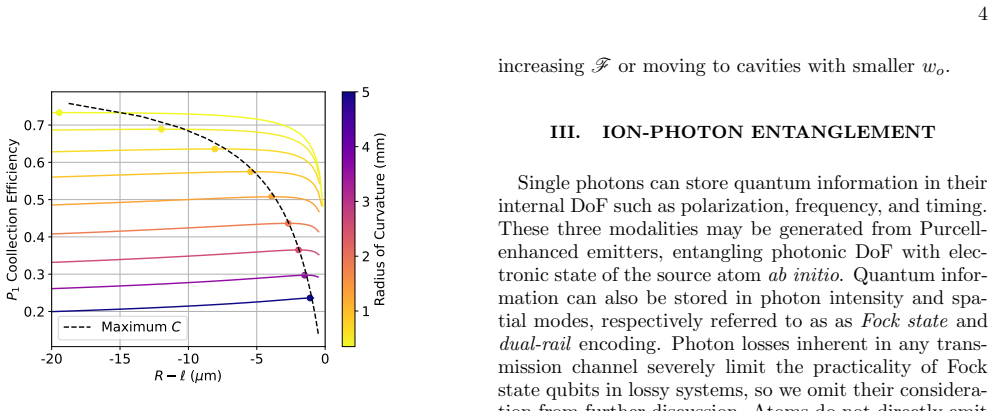
The central object is the cooperativity $C = g^2/(\kappa\gamma)$, the ratio of coherent atom-cavity coupling to cavity loss and spontaneous emission, together with the on-resonance transmission and reflection coefficients $t_i^\circ$ and $r_i^\circ$ for coupled and uncoupled atomic states. These coefficients carry both entanglement mechanisms: DIT discriminates atomic states by transmitting light through a balanced cavity, while CPF distinguishes them by a phase flip on reflection from an imbalanced cavity. The paper reduces each protocol's fidelity to a monotone function of $C$ and its success probability to a function of $C$ and the bad-loss fraction, which lets it map the design space of mirror radius and loss to a unique optimal cavity construction.
What would settle it
A direct experimental check: build the proposed sub-millimeter ion-cavity interface and measure the coherent coupling $g$ together with the bad-loss fraction. If $g$ falls short of roughly $2\pi\times65$ MHz or the loss exceeds about 60 ppm for DIT (10 ppm for CPF), the predicted rate advantage vanishes; a measurement of the receiver mode-matching efficiency $\xi$ below unity would likewise cap CPF fidelity directly.
Extended reading notes
Core claim
Starting from input-output theory for an ion-cavity system, the paper derives closed-form fidelity and success-probability expressions for the two strong-coupling protocols. In DIT, a balanced cavity acts as an atomic-state-dependent filter; postselecting on transmitted photons projects the two atoms into an odd-parity Bell state with fidelity $F_{\mathrm{DIT}}=(1+C)^2/((1+C)^2+1)$, where $C=g^2/(\kappa\gamma)$ is the cooperativity. In CPF, an imbalanced cavity imposes a $\pi$ phase shift on reflected photons when the receiver atom is in the coupled state, extending the emitter-photon entanglement to the receiver with unit protocol efficiency. Comparing all three schemes under the same mirror-fabrication constraints, the paper finds DIT gives a meaningful rate edge over type-II for losses below about 60 ppm and CPF more than doubles the per-attempt success probability when losses stay below about 10 ppm, with the caveat that CPF assumes perfect mode matching.
Load-bearing premise
The load-bearing premise is that a trapped ion can be coherently coupled to a sub-millimeter cavity at $g \sim 2\pi \times 65$ MHz with cavity leakage small enough, and that the receiver mode can be matched perfectly; if either fails, the CPF advantage degrades sharply and the paper itself notes that imperfect mode matching could make CPF infeasible.
Editorial extensions
If this is right
- If the assumed strong coupling is achieved, trapped-ion networks can use DIT receivers to cut entanglement generation time by roughly a third to three-quarters while keeping fidelity near 99%.
- DIT becomes the practical upgrade path once mirror non-transmissive loss is below about 60 ppm, a level the paper argues is within reach of laser-ablated sub-millimeter mirrors.
- CPF offers the highest per-attempt success probability, more than double the two-photon scheme, but only at very low loss and with near-perfect alignment of the incoming optical mode to the receiver cavity.
- Multiplexed long-haul designs benefit most from polarization and time-bin photons with the strong-coupling protocols, while frequency-bin qubits remain the weakest option because collection is paid twice in the two-photon baseline.
Reading between the lines
- A natural next step the paper leaves implicit is using photon waveform shaping as a third free parameter: elongating the emitted wavepacket can relax the perfect-resonance requirement and trade some CPF fidelity loss for rate, a regime their analytic formulas deliberately set aside.
- The perfect-mode-matching sensitivity of CPF suggests its practical niche may be solid-state nanophotonic cavities, where a single guided mode removes the fiber-to-free-space interface, rather than surface-trap ion cavities.
- If mirror fabrication reaches the stated loss levels, the rate comparison likely extends beyond trapped ions to neutral atoms and color centers, because the DIT and CPF fidelity formulas depend only on cooperativity and bad loss.
- The 30-75% range is computed with unit excitation, propagation, and detection efficiency; real systems with imperfect detectors would likely show an even larger relative advantage for the single-photon protocols, since the two-photon baseline pays these inefficiencies twice.
Editorial analysis
A structured set of objections, weighed in public.
Referee Report
Summary. This paper analyzes three protocols for remote entanglement generation between trapped-ion qubits in optical cavities: the conventional type-II two-photon interference scheme and two strong-coupling single-photon schemes based on dipole-induced transparency (DIT) and controlled phase-flip (CPF). It models Purcell-enhanced photon collection, derives scattering coefficients for DIT and CPF receiver cavities from input-output formalism, and compares per-attempt success probabilities and rates under common mirror-fabrication constraints (mirror radius R and non-transmissive loss LB) and for three photonic encodings (polarization, frequency, time-bin). The central claim is that adopting the strong-coupling protocols could provide substantial distribution rate improvements of 30–75% while maintaining fidelities above ~99%, conditional on currently undemonstrated device capabilities such as coherent coupling g≈2π×65 MHz in sub-mm cavities, perfect mode matching, and near-resonant photon spectra.
Significance. If the results hold, the paper provides a useful quantitative framework for comparing cavity-QED-based entanglement protocols and highlights the critical role of mirror losses and strong coupling in future trapped-ion quantum networks. The analytic formulas (Eqs. 8, 12, 13, 16) are derived transparently from standard input-output relations, and the authors are explicit about idealizations. The paper is valuable as a design tradeoff study, but the headline rate advantages rest on assumptions that are not fully validated experimentally and on an approximation whose validity is questionable for the proposed parameter regime. The authors explicitly acknowledge some limitations but do not resolve the most load-bearing one—the spectral validity of the perfect-resonance approximation—within the manuscript.
major comments (3)
- [Sec. V.B and VI.C, Table II] The perfect-resonance approximation replaces r(ω) and t(ω) with on-resonance values, requiring σω ≪ g for DIT and σω ≪ κ for CPF. The paper uses the detection bin width s (s_DIT = Sπ/g_r, s_CPF = Sπ/κ_r with S=10) to argue this condition is met. However, the spectral width of the emitted photon is set by the emitter cavity decay rate κ_e (for the optimal emitter, Eq. 17 gives κ_L* ≈ g, so κ_e ~ g), not by the post-selected bin width; enlarging s captures more of the wavepacket tail without narrowing its spectrum. For CPF at F=99.9% (C≈30.6), the receiver linewidth is κ_r ≈ 2π×14 MHz while the photon bandwidth is ~2π×65 MHz or larger, so σω ≪ κ_r is violated. The fidelity formulas (12) and (16) and the rate advantages in Figs. 6–9 are therefore optimistic; the authors acknowledge the need for a full-spectrum treatment at the end of Sec. VI.C and in the Conclusion, but do not provide one. The revision should include a spectral-domain calculation for realistic emitter parameters or a quantitatively justified filtering scheme whose added loss is included in the rate model.
- [Sec. VI.A and VI.C] The per-attempt success probabilities and rates assume Pex=Pdet=PL=ξ=1, and the CPF protocol assumes a lossless delay line and unit-efficiency time-bin to dual-rail conversion. Because the type-II scheme requires two photon emissions and two detections, lowering Pex or Pdet reduces type-II rates quadratically while the SCR protocols suffer only linearly, so the reported advantages (>150% for CPF, 30–75% in the abstract) are partly an artifact of these idealizations. The paper discusses non-unit efficiencies qualitatively but does not quantify how the advantages degrade with realistic parameters (e.g., Pdet≈0.5, ξ<1). A sensitivity analysis over these parameters would substantially strengthen the headline claim.
- [Sec. II.D and VI.A] The assumed coherent coupling g≈2π×65 MHz in a sub-mm cavity is presented as a fundamental limit but is not experimentally demonstrated; the Conclusion acknowledges this but does not translate it into a realistic range. Since the performance of both DIT and CPF depends sensitively on C=g^2/(κγ), a plot or discussion of the rate/fidelity advantages for realistic lower g values (e.g., 2π×30 or 50 MHz) would help assess robustness of the claimed advantage.
minor comments (7)
- [Sec. V.B heading] The heading 'Protocols with Strongly Coupled Recievers' contains a typo: 'Recievers' should be 'Receivers'.
- [Sec. II.C] In the sentence 'we note that the the optimal lengths for large-R cavities...' the article 'the' is duplicated.
- [Fig. 2 caption] The word 'coopertivity' in the caption should be 'cooperativity'.
- [Table II and Sec. VI.C] The minimum bin width is defined as s_o = N·K^{−1} in the text (where K is the averaged-linewidth decay constant from Sec. II.B) but as N·Γ^{−1} in Table II; Γ and K are different quantities, so the notation should be made consistent.
- [Sec. VI.B.1] 'vise versa' should be 'vice versa'.
- [Figs. 6 and 7 captions] The figures plot 'Success Probability Advantage,' which is not the same as rate advantage because attempt rates differ by protocol. The captions should clarify that rate comparisons appear later in Sec. VI.C.
- [Sec. V.B.2] The CPF model assumes unit-efficiency time-bin to dual-rail conversion and a lossless delay line; these assumptions should be stated explicitly in the figure captions and in the text near Eq. (14), not only in the body of Sec. V.
Circularity Check
No significant circularity: the rate/fidelity comparison is a parameter study built on standard input-output theory, not on fitted or self-referential constraints.
full rationale
The paper's central derivation chain is self-contained. The receiver coefficients r(omega) and t(omega) are obtained from the standard input-output formalism (Eqs. 5-7) with external references, and the DIT/CPF fidelity formulas (Eqs. 12 and 16) follow algebraically from those coefficients with explicit loss channels. The per-attempt success probabilities (Eq. 13 and the CPF analog) are likewise derived from the same coefficients. Section VI then optimizes cavity parameters against stated target fidelities (Fmin) and fabrication constraints (R, LB); these are inputs chosen by the authors, not parameters fitted to a data set and then relabeled as predictions. No uniqueness theorem is imported from the authors' prior work, and the few self-citations (e.g., Refs. [20,41] for integrated surface-trap cavities) are contextual device descriptions, not load-bearing premises. The acknowledged perfect-resonance and perfect-mode-matching assumptions (Secs. V.B and VI.C) are approximations whose quantitative failure would change the numbers, but they do not make any output equal to an input by construction. Therefore the circularity burden is negligible.
Assumptions & free parameters
free parameters (7)
- g = 2 pi x 65 MHz (assumed coherent coupling) =
2 pi x 65 MHz
- Fmin (minimum target fidelity) =
99.9%, with variants 99.0%, 99.5%, 99.8% in Fig. 8
- R (mirror radius of curvature) =
400 microns in rate examples; scanned from 300 to 1000 microns
- LB (non-transmissive mirror loss) =
0 to 140 ppm in contours; thresholds near 50 ppm for DIT and 10 ppm for CPF
- N (collection lifetimes for bin width) =
3
- S (bandwidth safety factor) =
10
- E1/E2 timing parameters =
t_pi = 1 us or 200 ns, t_P = 300 ns, t_L = 10 ns, t_E = 400 ns, t_S = 1 us
assumptions (6)
- standard math Jaynes-Cummings Hamiltonian with damped evolution under Lindblad collapse operators
- standard math Input-output relations for a two-port Fabry-Perot cavity
- domain assumption Perfect-resonance approximation
- domain assumption Unit excitation, transmission, detection, and perfect mode matching
- domain assumption Uncoupled receiver ground state with gu approximately 0
- domain assumption Barium atomic transition parameters from literature
Cite this review
Pith. "Pith review of Design Tradeoffs in Photonically Linked Qubit Networks." pith.science (2026). https://pith.science/paper/NCDFD7QQ
@misc{pith2026250606268,
  author       = {Pith},
  title        = {Pith review of: Design Tradeoffs in Photonically Linked Qubit Networks},
  year         = {2026},
  howpublished = {\url{https://pith.science/paper/NCDFD7QQ}},
  note         = {Machine review of arXiv:2506.06268}
}
abstract
Quantum networking can be realized by distributing pairs of entangled qubits between remote quantum processing nodes. Devoted communication qubits within each node can naturally interface with photons which bus quantum information between nodes. With the introduction of CQED to enhance interactions between communication qubits and photons, advanced protocols capable of achieving high entanglement distribution rates with high fidelity become feasible. In this paper, we consider two such protocols based on trapped ion communication qubits strongly coupled to small optical cavities. We study the rate and fidelity performance of these protocols as a function of critical device parameters and the photonic degree of freedom used to carry the quantum information. We compare the performance of these protocols with the traditional two-photon interference scheme, subjecting all protocols to the same experimentally relevant constraints. We find that adoption of the strong-coupling protocols could provide substantial distribution rate improvements of $30-75\%$ while maintaining the high-fidelities $\mathcal{F}\gtrsim99\%$ of the traditional scheme.
Figures


Figures from the paper (7 more)


Forward citations
Cited by 1 Pith paper
-
Remote entanglement need not be the bottleneck for modular trapped-ion quantum computing
A projected architecture for trapped-ion quantum modules combines single-photon heralding, integrated photonics, recoil correction, and one distillation round to deliver 99.9%-fidelity remote Bell pairs at 10^5 s^-1 cm^-2.
Reference graph
Works this paper leans on
-
[1]
By post selecting on trans- mission events, we exclusively project states where the emitter and receiver atoms occupy opposite qubit states
DIT Protocol In our first scheme, the receiver cavity implements state-dependent filtration based on DIT, rejecting (re- flecting) photons which do not imply a particular corre- lation between the atoms. By post selecting on trans- mission events, we exclusively project states where the emitter and receiver atoms occupy opposite qubit states. To create th...
-
[2]
A 50:50 non-polarizing beamsplitter (NPBS) maps photons in- put modes |a⟩ and |b⟩ to the output modes |c⟩ and |d⟩ via the beam-splitter transform |a⟩ →(|c⟩ + |d⟩)/ √ 2 , |a⟩ →(|c⟩ − |d⟩)/ √
-
[3]
This simple measurement only works if the wavepack- ets in either rail are identical in all DoF besides the spa- tial mode
This means that a photon detec- tion at output mode |c⟩ (|d⟩) implies a pre-NPBS state of |+⟩(DR) (|−⟩(DR)). This simple measurement only works if the wavepack- ets in either rail are identical in all DoF besides the spa- tial mode. Since the conversion techniques above seg- regate photons using differences in their polarization, frequency or time-bin DoF...
-
[4]
Local rotations recast this controlled-Z interaction into a CNOT gate which ex- tends the maximally entangled emitter-photon state into a GHZ state including the receiver as well
CPF Protocol In this scheme, originally proposed by Duan and Kim- ble, photonic qubits reflect from a receiver apparatus with a phase which depends on the receiver-photon state based on the CPF effect[24]. Local rotations recast this controlled-Z interaction into a CNOT gate which ex- tends the maximally entangled emitter-photon state into a GHZ state inc...
-
[5]
We claim that the emission cav- ity does not inherently limit heralding fidelity for any of the protocols for the following reasons
Emission Cavities Emission cavities are constructed to maximize out- coupling efficiency P1. We claim that the emission cav- ity does not inherently limit heralding fidelity for any of the protocols for the following reasons. For type-II pro- tocols, cavity g, κ, γdo not restrict heralded fidelity as long as the temporal profile of the photon wavepackets ...
-
[6]
Fidelity is monotonic in C, but naively re- ducing mirror transmission to boost C also suppresses transmission rates
Transmission Cavities In DIT protocols, properties of the transmission cav- ity affect both F ◦ DIT and P ◦ t , but neither quantity can be used directly as a reward function to optimize cavity parameters. Fidelity is monotonic in C, but naively re- ducing mirror transmission to boost C also suppresses transmission rates. Likewise, Pt reaches a maximum wh...
-
[7]
(16) and differentiating with respect to C
Reflection Cavities In the CPF protocol, F ◦ CP Fand Pr both reach a max- imum when C(2 + C) = Co, most easily shown by again replacing ratios of κi with ratios of C and Co in eq. (16) and differentiating with respect to C. By no coincidence, this is precisely the condition that r◦ c = |r◦ u| = 1 − 2 2+C , allowing for complete destructive interference of...
-
[8]
DIT Probability Advantage Receiver cavities for the DIT protocol are optimized for a specific target fidelity, set here to Fmin = 1 − 10−3, high enough not to be a limiting factor in any contempo- rary RE demonstrations, but low enough not to restrict success rates needlessly. Figure 6 compares the success probability advantage of the DIT protocol compare...
Show all 87 references
-
[9]
Perfect mode-matching is quite impractical in the cavity scheme considered in this paper, described in Figure 1
CPF Probability Advantage In the CPF protocol, the fidelity of the protocol is heavily dependent on the quality of mode-matching be- tween the incoming beam and the cavity mode. Perfect mode-matching is quite impractical in the cavity scheme considered in this paper, described...
-
[10]
L¨ oschnauer, J
C. L¨ oschnauer, J. M. Toba, A. Hughes, S. King, M. We- ber, R. Srinivas, R. Matt, R. Nourshargh, D. All- cock, C. Ballance, et al. , Scalable, high-fidelity all- electronic control of trapped-ion qubits, arXiv preprint arXiv:2407.07694 (2024)
2024
-
[11]
Simon and W
C. Simon and W. T. M. Irvine, Robust long-distance en- tanglement and a loophole-free bell test with ions and photons, Phys. Rev. Lett. 91, 110405 (2003). 17 FIG. 10. Ion-Photon entanglement schemes in various isotopes of Barium with Hyperfine splitting. Atomic states in these...
2003
-
[12]
D. L. Moehring, P. Maunz, S. Olmschenk, K. C. Younge, D. N. Matsukevich, L.-M. Duan, and C. Monroe, En- tanglement of single-atom quantum bits at a distance, Nature 449, 68 (2007)
2007
-
[13]
Ritter, C
S. Ritter, C. N¨ olleke, C. Hahn, A. Reiserer, A. Neuzner, M. Uphoff, M. M¨ ucke, E. Figueroa, J. Bochmann, and G. Rempe, An elementary quantum network of single atoms in optical cavities, Nature 484, 195 (2012)
2012
-
[14]
Bernien, B
H. Bernien, B. Hensen, W. Pfaff, G. Koolstra, M. S. Blok, L. Robledo, T. H. Taminiau, M. Markham, D. J. Twitchen, L. Childress, and R. Hanson, Heralded entan- glement between solid-state qubits separated by three metres, Nature 497, 86 (2013)
2013
-
[15]
H. K. Beukers, M. Pasini, H. Choi, D. Englund, R. Han- son, and J. Borregaard, Remote-entanglement proto- cols for stationary qubits with photonic interfaces, PRX Quantum 5, 010202 (2024)
2024
-
[16]
Y. Wang, M. Um, J. Zhang, S. An, M. Lyu, J.-N. Zhang, L.-M. Duan, D. Yum, and K. Kim, Single-qubit quan- tum memory exceeding ten-minute coherence time, Na- ture Photonics 11, 646 (2017)
2017
-
[17]
F. A. An, A. Ransford, A. Schaffer, L. R. Sletten, J. Gae- bler, J. Hostetter, and G. Vittorini, High fidelity state preparation and measurement of ion hyperfine qubits with i¿ 1 2, Physical Review Letters 129, 130501 (2022)
2022
-
[18]
Ransford, C
A. Ransford, C. Roman, T. Dellaert, P. McMillin, and W. C. Campbell, Weak dissipation for high-fidelity qubit- state preparation and measurement, Physical Review A 104, L060402 (2021)
2021
-
[19]
Harty, D
T. Harty, D. Allcock, C. J. Ballance, L. Guidoni, H. Janacek, N. Linke, D. Stacey, and D. Lucas, High- fidelity preparation, gates, memory, and readout of a trapped-ion quantum bit, Physical review letters 113, 220501 (2014)
2014
-
[20]
T. Kim, P. Maunz, and J. Kim, Efficient collection of single photons emitted from a trapped ion into a single- mode fiber for scalable quantum-information process- ing, Physical Review A—Atomic, Molecular, and Optical Physics 84, 063423 (2011)
2011
-
[21]
C. R. Clark, H. N. Tinkey, B. C. Sawyer, A. M. Meier, K. A. Burkhardt, C. M. Seck, C. M. Shappert, N. D. Guise, C. E. Volin, S. D. Fallek, et al., High-fidelity bell- state preparation with ca+ 40 optical qubits, Physical 18 Review Letters 127, 130505 (2021)
2021
-
[22]
Monroe and J
C. Monroe and J. Kim, Scaling the ion trap quantum processor, Science 339, 1164 (2013)
2013
-
[23]
Monroe, R
C. Monroe, R. Raussendorf, A. Ruthven, K. R. Brown, P. Maunz, L.-M. Duan, and J. Kim, Large-scale mod- ular quantum-computer architecture with atomic mem- ory and photonic interconnects, Physical Review A 89, 022317 (2014)
2014
-
[24]
L. Luo, D. Hayes, T. Manning, D. Matsukevich, P. Maunz, S. Olmschenk, J. Sterk, and C. Monroe, Proto- cols and techniques for a scalable atom–photon quantum network, Fortschritte der Physik 57, 1133 (2009)
2009
-
[25]
Stephenson, D
L. Stephenson, D. Nadlinger, B. Nichol, S. An, P. Dr- mota, T. Ballance, K. Thirumalai, J. Goodwin, D. Lucas, and C. Ballance, High-rate, high-fidelity entanglement of qubits across an elementary quantum network, Physical review letters 124, 110501 (2020)
2020
-
[26]
O’Reilly, G
J. O’Reilly, G. Toh, I. Goetting, S. Saha, M. Sha- laev, A. L. Carter, A. Risinger, A. Kalakuntla, T. Li, A. Verma, et al. , Fast photon-mediated entanglement of continuously cooled trapped ions for quantum network- ing, Physical Review Letters 133, 090802 (2024)
2024
-
[27]
S. Saha, M. Shalaev, J. O’Reilly, I. Goetting, G. Toh, A. Kalakuntla, Y. Yu, and C. Monroe, High-fidelity re- mote entanglement of trapped atoms mediated by time- bin photons, arXiv preprint arXiv:2406.01761 (2024)
2024 arXiv
-
[28]
Hankin, A
A. Hankin, A. Mahmoud, M. Hempstead, D. Brooks, and G.-Y. Wei, Velociti: An architecture-level performance modeling framework for trapped ion quantum comput- ers, in 2024 IEEE International Symposium on Workload Characterization (IISWC) (IEEE, 2024) pp. 156–168
2024
-
[29]
E. M. Purcell, Spontaneous emission probabilities at ra- dio frequencies, in Confined Electrons and Photons: New Physics and Applications (Springer, 1995) pp. 839–839
1995
-
[30]
M. O. Scully and M. S. Zubairy, Quantum optics (Cam- bridge university press, 1997)
1997
-
[31]
Sterk, L
J. Sterk, L. Luo, T. Manning, P. Maunz, and C. Mon- roe, Photon collection from a trapped ion-cavity sys- tem, Physical Review A—Atomic, Molecular, and Op- tical Physics 85, 062308 (2012)
2012
-
[32]
Schupp, V
J. Schupp, V. Krcmarsky, V. Krutyanskiy, M. Meraner, T. Northup, and B. Lanyon, Interface between trapped- ion qubits and traveling photons with close-to-optimal efficiency, PRX Quantum 2, 020331 (2021)
2021
-
[33]
A. L. Carter, J. O’Reilly, G. Toh, S. Saha, M. Shalaev, I. Goetting, and C. Monroe, Ion trap with in-vacuum high numerical aperture imaging for a dual-species mod- ular quantum computer, Review of Scientific Instruments 95 (2024)
2024
-
[34]
Duan and H
L.-M. Duan and H. Kimble, Scalable photonic quantum computation through cavity-assisted interactions, Physi- cal review letters 92, 127902 (2004)
2004
-
[35]
J. I. Cirac, P. Zoller, H. J. Kimble, and H. Mabuchi, Quantum state transfer and entanglement distribution among distant nodes in a quantum network, Physical Re- view Letters 78, 3221 (1997)
1997
-
[36]
Welte, B
S. Welte, B. Hacker, S. Daiss, S. Ritter, and G. Rempe, Cavity carving of atomic bell states, Physical review let- ters 118, 210503 (2017)
2017
-
[37]
Walther, B
H. Walther, B. T. H. Varcoe, B.-G. Englert, and T. Becker, Cavity quantum electrodynamics, Reports on Progress in Physics 69, 1325 (2006)
2006
-
[38]
Haroche and D
S. Haroche and D. Kleppner, Cavity Quan- tum Electrodynamics, Physics Today 42, 24 (1989), https://pubs.aip.org/physicstoday/article- pdf/42/1/24/8300663/24 1 online.pdf
1989
-
[39]
Jaynes and F
E. Jaynes and F. Cummings, Comparison of quantum and semiclassical radiation theories with application to the beam maser, Proceedings of the IEEE 51, 89 (1963)
1963
-
[40]
Law and H
C. Law and H. Kimble, Deterministic generation of a bit- stream of single-photon pulses, Journal of Modern Optics 44, 2067 (1997)
1997
-
[41]
B. E. Saleh and M. C. Teich, Fundamentals of photonics (john Wiley & sons, 2019)
2019
-
[42]
Weisskopf and E
V. Weisskopf and E. Wigner, Berechnung der nat¨ urlichen Linienbreite auf Grund der Diracschen Lichttheorie, Zeitschrift fur Physik 63, 54 (1930)
1930
-
[43]
Reiserer and G
A. Reiserer and G. Rempe, Cavity-based quantum net- works with single atoms and optical photons, Reviews of Modern Physics 87, 1379 (2015)
2015
-
[44]
Gorini, A
V. Gorini, A. Kossakowski, and E. C. G. Sudarshan, Completely positive dynamical semigroups of n-level sys- tems, Journal of Mathematical Physics 17, 821 (1976)
1976
-
[45]
D. F. V. James, Quantum dynamics of cold trapped ions with application to quantum computation, Applied Physics B 66, 181 (1997)
1997
-
[46]
King, Angular momentum coupling and rabi fre- quencies for simple atomic transitions, arXiv preprint arXiv:0804.4528 (2008)
B. King, Angular momentum coupling and rabi fre- quencies for simple atomic transitions, arXiv preprint arXiv:0804.4528 (2008)
2008 arXiv
-
[47]
Realistically, the pulse will not be instantaneous, however it must be much faster thanγ to avoid sick decays [76, 77]
-
[48]
Cui and M
G. Cui and M. G. Raymer, Quantum efficiency of single- photon sources in the cavity-qed strong-coupling regime, Optics express 13, 9660 (2005)
2005
-
[49]
W. L. Barnes, S. A. Horsley, and W. L. Vos, Classical an- tennas, quantum emitters, and densities of optical states, Journal of Optics 22, 073501 (2020)
2020
-
[50]
Brandst¨ atter, A
B. Brandst¨ atter, A. McClung, K. Sch¨ uppert, B. Casabone, K. Friebe, A. Stute, P. O. Schmidt, C. Deutsch, J. Reichel, R. Blatt, et al. , Integrated fiber-mirror ion trap for strong ion-cavity coupling, Review of scientific instruments 84 (2013)
2013
-
[51]
Van Rynbach, P
A. Van Rynbach, P. Maunz, and J. Kim, An integrated mirror and surface ion trap with a tunable trap location, Applied Physics Letters 109 (2016)
2016
-
[52]
M. C. Revelle, Phoenix and peregrine ion traps, arXiv preprint arXiv:2009.02398 (2020)
2020 arXiv
-
[53]
David, M
K. David, M. Bruff, J. Stuart, L. Sonderhouse, A. Wilson, D. Slichter, and D. Leibfried, Progress towards a quan- tum network of 40 ca+ ions trapped in a surface-electrode trap with an integrated fiber-based optical cavity, inAPS Division of Atomic, Molecular and Optical Physi...
2023
-
[54]
J. M. Bennett, Recent developments in surface roughness characterization, Measurement Science and Technology 3, 1119 (1992)
1992
-
[55]
J. E. Harvey, S. Schr¨ oder, N. Choi, and A. Duparr´ e, To- tal integrated scatter from surfaces with arbitrary rough- ness, correlation widths, and incident angles, Optical En- gineering 51, 013402 (2012)
2012
-
[56]
N. Jin, C. A. McLemore, D. Mason, J. P. Hendrie, Y. Luo, M. L. Kelleher, P. Kharel, F. Quinlan, S. A. Did- dams, and P. T. Rakich, Micro-fabricated mirrors with finesse exceeding one million, Optica 9, 965 (2022)
2022
-
[57]
Takahashi, J
H. Takahashi, J. Morphew, F. Oruˇ cevi´ c, A. Noguchi, E. Kassa, and M. Keller, Novel laser machining of opti- cal fibers for long cavities with low birefringence, Optics express 22, 31317 (2014). 19
2014
-
[58]
K. M. Nowak, H. J. Baker, and D. R. Hall, Efficient laser polishing of silica micro-optic components, Applied op- tics 45, 162 (2006)
2006
-
[59]
Hunger, T
D. Hunger, T. Steinmetz, Y. Colombe, C. Deutsch, T. W. H¨ ansch, and J. Reichel, A fiber fabry–perot cavity with high finesse, New Journal of Physics 12, 065038 (2010)
2010
-
[60]
A. D. Semenov, G. N. Gol’tsman, and A. A. Korneev, Quantum detection by current carrying superconducting film, Physica C: Superconductivity 351, 349 (2001)
2001
-
[61]
Ramaswami, K
R. Ramaswami, K. Sivarajan, and G. Sasaki, Optical net- works: a practical perspective (Morgan Kaufmann, 2009)
2009
-
[62]
G. P. Agrawal, Fiber-optic communication systems (John Wiley & Sons, 2012)
2012
-
[63]
J. M. Lukens and P. Lougovski, Frequency-encoded pho- tonic qubits for scalable quantum information processing, Optica 4, 8 (2016)
2016
-
[64]
H.-H. Lu, J. M. Lukens, N. A. Peters, O. D. Odele, D. E. Leaird, A. M. Weiner, and P. Lougovski, Electro-optic frequency beam splitters and tritters for high-fidelity photonic quantum information processing, Physical re- view letters 120, 030502 (2018)
2018
-
[65]
H.-H. Lu, M. Liscidini, A. L. Gaeta, A. M. Weiner, and J. M. Lukens, Frequency-bin photonic quantum informa- tion, Optica 10, 1655 (2023)
2023
-
[66]
Mizrahi, B
J. Mizrahi, B. Neyenhuis, K. Johnson, W. Campbell, C. Senko, D. Hayes, and C. Monroe, Quantum control of qubits and atomic motion using ultrafast laser pulses, Applied Physics B 114, 45 (2014)
2014
-
[67]
Campbell, J
W. Campbell, J. Mizrahi, Q. Quraishi, C. Senko, D. Hayes, D. Hucul, D. Matsukevich, P. Maunz, and C. Monroe, Ultrafast gates for single atomic qubits, Phys- ical review letters 105, 090502 (2010)
2010
-
[68]
Bersin, M
E. Bersin, M. Grein, M. Sutula, R. Murphy, Y. Q. Huan, M. Stevens, A. Suleymanzade, C. Lee, R. Riedinger, D. J. Starling, et al., Development of a boston-area 50-km fiber quantum network testbed, Physical Review Applied 21, 014024 (2024)
2024
-
[69]
P. Kok, W. J. Munro, K. Nemoto, T. C. Ralph, J. P. Dowling, and G. J. Milburn, Linear optical quantum computing with photonic qubits, Rev. Mod. Phys. 79, 135 (2007)
2007
-
[70]
E. D. Black, An introduction to pound–drever–hall laser frequency stabilization, American journal of physics 69, 79 (2001)
2001
-
[71]
Marsili, V
F. Marsili, V. B. Verma, J. A. Stern, S. Harrington, A. E. Lita, T. Gerrits, I. Vayshenker, B. Baek, M. D. Shaw, R. P. Mirin, et al., Detecting single infrared photons with 93% system efficiency, Nature Photonics 7, 210 (2013)
2013
-
[72]
Cahall, K
C. Cahall, K. L. Nicolich, N. T. Islam, G. P. Lafyatis, A. J. Miller, D. J. Gauthier, and J. Kim, Multi-photon detection using a conventional superconducting nanowire single-photon detector, Optica 4, 1534 (2017)
2017
-
[73]
Cheng, Y
R. Cheng, Y. Zhou, S. Wang, M. Shen, T. Taher, and H. X. Tang, A 100-pixel photon-number-resolving detec- tor unveiling photon statistics, Nature Photonics 17, 112 (2023)
2023
-
[74]
Transitioning to cryogenic trapping environments may be key to tackling the latter challenge
and increased motional heating rates also caused by these mirrors [75]. Transitioning to cryogenic trapping environments may be key to tackling the latter challenge. Beyond that, the standard prescription to improveg calls for reducing cavity R, embracing transitions with a la...
-
[75]
De Greve, L
K. De Greve, L. Yu, P. L. McMahon, J. S. Pelc, C. M. Natarajan, N. Y. Kim, E. Abe, S. Maier, C. Schnei- der, M. Kamp, et al. , Quantum-dot spin–photon entan- glement via frequency downconversion to telecom wave- length, Nature 491, 421 (2012)
2012
-
[76]
C. W. Gardiner and M. J. Collett, Input and output in damped quantum systems: Quantum stochastic differen- tial equations and the master equation, Physical Review A 31, 3761 (1985)
1985
-
[77]
H. J. Carmichael, Quantum trajectory theory for cas- caded open systems, Physical review letters 70, 2273 (1993)
1993
-
[78]
M. G. Raymer, C. Embleton, and J. H. Shapiro, The duan-kimble cavity-atom quantum memory loading scheme revisited, Physical Review Applied 22, 044013 (2024)
2024
-
[79]
Waks and J
E. Waks and J. Vuckovic, Dipole induced transparency in drop-filter cavity-waveguide systems, Physical review letters 96, 153601 (2006)
2006
-
[80]
C. Hu, W. Munro, and J. Rarity, Deterministic photon entangler using a charged quantum dot inside a micro- cavity, Physical Review B—Condensed Matter and Ma- terials Physics 78, 125318 (2008)
2008
-
[81]
Such cavities may also be called over-coupled, but we don’t use this terminology again to avoid confusion with coherent coupling g
-
[82]
Yao and S
P. Yao and S. Hughes, Controlled cavity qed and single- photon emission using a photonic-crystal waveguide cav- ity system, Phys. Rev. B 80, 165128 (2009)
2009
-
[83]
C. T. Nguyen, D. D. Sukachev, M. K. Bhaskar, B. Machielse, D. S. Levonian, E. N. Knall, P. Stroganov, R. Riedinger, H. Park, M. Lonˇ car, and M. D. Lukin, Quantum network nodes based on diamond qubits with an efficient nanophotonic interface, Phys. Rev. Lett.123, 183602 (2019)
2019
-
[84]
Harlander, M
M. Harlander, M. Brownnutt, W. H¨ ansel, and R. Blatt, Trapped-ion probing of light-induced charging effects on dielectrics, New Journal of Physics 12, 093035 (2010)
2010
-
[85]
Teller, D
M. Teller, D. A. Fioretto, P. C. Holz, P. Schindler, V. Messerer, K. Sch¨ uppert, Y. Zou, R. Blatt, J. Chi- averini, J. Sage, et al. , Heating of a trapped ion in- duced by dielectric materials, Physical Review Letters 126, 230505 (2021)
2021
-
[86]
W. Wang, C. Goham, A. Laugharn, and J. W. Britton, On the direct generation of ion-photon entanglement at telecom wavelengths in 171yb+, in Quantum 2.0 (Optica Publishing Group, 2020) pp. QW6A–12
2020
-
[87]
A. V. Gorshkov, R. Nath, and T. Pohl, Dissipative many- body quantum optics in rydberg media, Physical review letters 110, 153601 (2013)
2013
Reviewed August 7, 2026 · model on record in the stance chip above.
Discussion (0). Sign in to comment.