REVIEW 4 major objections 5 minor 95 references
A second-order renormalized Yukawa Hamiltonian in light-front coordinates produces finite bound-state masses and parton distributions, and block-encodes at roughly the same cost as the bare Hamiltonian.
Reviewed by Pith at T0; open to challenge. T0 means a machine referee read the full paper against a public rubric. the ladder, T0–T4 →
The renormalized light-front Yukawa Hamiltonian gives convergent bound-state masses and parton distributions, with quantum block-encoding costs only about 50% higher than the bare Hamiltonian.
T0 review reviewed 2026-08-05 challenge →
load-bearing objection A real step for the RGPEP program, but the headline spectrum fails the paper's own mass-renormalization condition. the 4 major comments →
The Renormalized Yukawa Hamiltonian: Spectrum, Parton Distribution Functions, and Resource Estimates for Quantum Simulation
The pith
A machine-rendered reading of the paper's core claim, the machinery that carries it, and where it could break.
The reading
Core claim
The paper's central claim is that the RGPEP-renormalized Yukawa Hamiltonian — truncated at O(g²) with counterterms fixed by mass renormalization conditions — produces a finite, convergent mass spectrum in the front form, where the bare DLCQ Hamiltonian gives eigenvalues that run away to negative M² as the harmonic resolution K grows. Solving the RGPEP flow perturbatively softens interaction vertices with the form factor exp(−(Q⁻/λ)²) and generates second-order exchange, loop, and counterterm contributions; the regulator Λ is then removable. Extrapolating to K→∞ yields M²_ff = 1.616 m² at g = 1 and 3.628 m² at g = 0.3, both below the free two-fermion threshold 4m², i.e., genuine binding, with
What carries the argument
The engine is the Renormalization Group Procedure for Effective Particles (RGPEP), a unitary similarity flow H(λ) = U†HU generated by G = [H₀, H], solved perturbatively order by order in the coupling g. To O(g) the flow multiplies each interaction vertex by a form factor exp(−(Q⁻/λ)²), exponentially damping large energy transfers; to O(g²) it produces fermion- and boson-exchange terms, loop integrals δm² and δµ², and counterterms Xδm² and Xδµ². The counterterms are fixed by renormalization conditions — the dressed single-fermion and single-boson masses equal the Lagrangian parameters — and this choice of finite parts, not the flow alone, is what cancels the Λ → ∞ divergences and makes the sp
Load-bearing premise
The O(g²) perturbative truncation of the RGPEP expansion is accurate at the couplings studied, including g = 1 — the paper's own numbers show the extrapolated single-fermion mass drifting to 0.33 m² instead of the 1.0 m² it is renormalized to, signaling that the truncation is breaking down at larger coupling.
What would settle it
Compute the O(g³) RGPEP Hamiltonian for the same Yukawa model and re-run the Q = 1 and Q = 2 extrapolations at g = 1: if M²_f moves back toward 1.0 m² and M²_ff = 1.616 m² shifts by more than the fit uncertainty, the second-order truncation — not the renormalization scheme — produced the reported binding. Repeating with a boost-invariant generator would distinguish generator artifacts from truncation effects.
If this is right
- Block-encoding the renormalized Hamiltonian costs, in the worst case, roughly 50% more than the bare one at fixed harmonic resolution, because renormalization adds terms without making individual terms more expensive.
- The renormalized spectrum extrapolates to finite masses below the 4m² threshold at both couplings studied, so binding survives the K→∞ limit and the model is usable as a testbed for light-front hadronic-structure simulation.
- The mass renormalization condition fixes counterterms without experimental input, making the procedure predictive for other sectors and observables of the same model, such as the computed parton distribution functions.
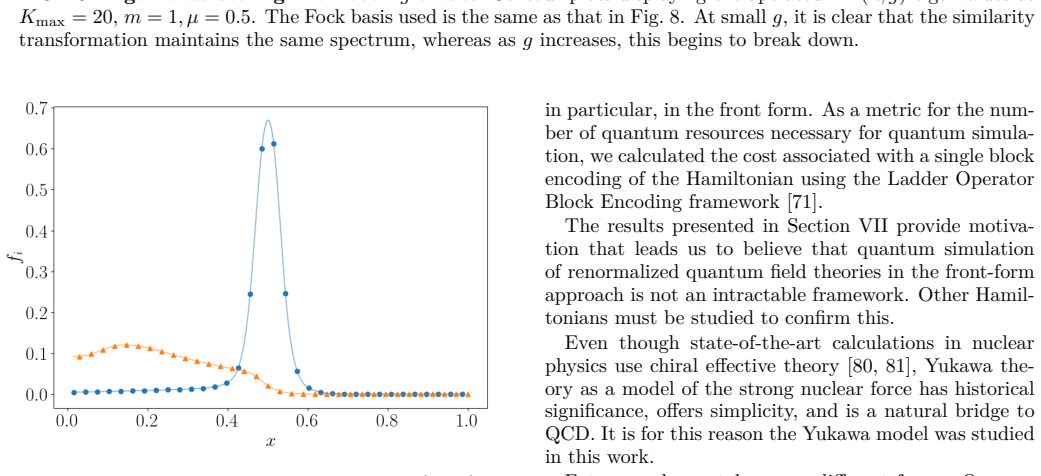
- Parton distribution functions from the lowest Q = 2 bound state show the two fermions sharing momentum near x = 0.5 with a small bosonic tail at low x, computable from the same renormalized Hamiltonian used for the spectrum.
Where Pith is reading between the lines
- If the RGPEP expansion were carried to O(g³), the coupling itself would renormalize and the single-fermion sector would likely return toward the M²_f = m² condition; the Q = 1 drift at g = 1 (0.33 m² versus 1.0 m²) is the most direct discriminator between truncation error and scheme error.
- The counterterm-fixing strategy used here — renormalization conditions on single-particle masses instead of fits to data — is model-agnostic and should transplant directly to gauge models such as the Schwinger model or SU(2) Yang-Mills, where the light-front vacuum is no longer trivial.
- The roughly 50% overhead is a term-count bound for block-encoding-based simulation; Trotter-style algorithms, whose cost depends on the Hamiltonian norm and locality structure rather than term count, could show a markedly different bare-versus-renormalized cost ratio.
Editorial analysis
A structured set of objections, weighed in public.
Referee Report
Summary. This paper applies the Renormalization Group Procedure for Effective Particles (RGPEP) to the front-form Yukawa Hamiltonian in 1+1 dimensions, truncated at O(g^2). The effective Hamiltonian is discretized with DLCQ, counterterms are fixed by mass renormalization conditions m^2(g)=m^2 and mu^2(g)=mu^2(0), and the resulting spectra, parton distribution functions, and LOBE block-encoding resource estimates are computed. The central claim is that the renormalized Hamiltonian yields finite, convergent mass spectra and that the cost of block-encoding the renormalized Hamiltonian is comparable to that of the bare Hamiltonian. The paper provides explicit formulas for the second-order effective vertices, the counterterms, and the discretized Hamiltonian, and it presents extrapolated fermion and fermion-fermion masses at g=1 and g=0.3.
Significance. If the numerical implementation were internally consistent, this would be a useful proof-of-principle: an explicit O(g^2) RGPEP Hamiltonian for a relativistic field theory, carried through to DLCQ spectra, PDFs, and quantum-resource estimates. The analytic expressions for the effective vertices and counterterms, and the LOBE resource comparison, are concrete and potentially reusable. However, the central validation of the renormalization scheme fails: the Q=1 eigenvalue that is supposed to equal the input fermion mass is not close to m^2 at the couplings used for the headline results. The paper's own convergence plot also indicates perturbative breakdown at large g. The significance of the paper therefore depends on whether these issues can be corrected or the claims restricted to accurately controlled couplings; as it stands, the quantitative spectrum claims are not supported.
major comments (4)
- [Section V, Fig. 8 and Appendix C, Eq. (C4)] The renormalization condition in Eq. (C4) is m^2(g)=m^2, with m=1 throughout. Appendix C explicitly states that this condition 'can be verified in the numerical results in Fig. 8.' But Fig. 8 reports extrapolated Q=1 eigenvalues M^2_f=0.33 m^2 at g=1 and 0.896 m^2 at g=0.3. The g=1 value deviates by 67% from the condition that the counterterms were designed to enforce. This is an internal inconsistency in the central numerical check, not a cosmetic issue. Since the Q=1 sector is the mass-renormalization probe, the failure implies that the O(g^2) truncation and/or the K to infinity extrapolation is not under control at the couplings used. The two-fermion binding energies, including the g=1 result M^2_ff=1.616 m^2, are therefore not supported by the computation as presented. The authors need to show the Q=1 eigenvalue at the same K values and with the same extrapolation used for the Q=2 se
- [Section V, Fig. 12] Fig. 12 shows M^2 decreasing as g increases, and the text states that this 'shows the perturbative solution to the RGPEP equation breaking down at higher g.' The largest coupling in that figure is g=1, which is also the coupling used for the primary g=1 spectrum and PDF results. This is a direct admission that the O(g^2) approximation is not reliable at the headline coupling. The paper needs a quantitative convergence test: for example, an estimate of the size of the omitted O(g^3) terms, a comparison of O(g^2) and lower-order predictions, or a clear statement of the maximum g for which the truncation error is controlled. Without such a test, the g=1 bound-state mass and its comparison with the non-relativistic Yukawa result are not justified.
- [Sections IV.D, V, VII] The renormalization scale lambda is treated as a free parameter, but no criterion is given for the choices lambda=10^6 in the spectrum calculations (Fig. 8) and lambda=10^{7/2} in the resource estimates (Figs. 15,16). Figs. 9 and 13 show that the spectrum depends strongly on lambda in the range shown, with only an apparent plateau at large lambda. Since physical observables in a fully renormalized theory should be lambda-independent, the residual lambda dependence is a systematic uncertainty of the truncated calculation. The paper should either explain how lambda is chosen (e.g., a plateau criterion), propagate the lambda dependence as an error bar on M^2, or demonstrate that the headline results are insensitive to lambda over a wide range.
- [Section V, Fig. 8] The extrapolation M^2 = a + b/K + c/K^2 is used to obtain the quoted infinite-resolution limits, but the figure shows only a handful of points (1/K up to about 0.4, so K as small as 2.5) and the uncertainties from the fit are not propagated into the final quoted binding energies. Given that the Q=1 extrapolation already fails the renormalization condition by a large margin at g=1, the extrapolation ansatz itself needs validation: e.g., a stability study with respect to the number of K values included, or a comparison with a different extrapolation form. This is load-bearing because all quantitative claims in Section V depend on these extrapolations.
minor comments (5)
- [References] The author name 'Glazek' is corrupted as 'G/suppress lazek' in several references (e.g., Refs. [50,52,59,61,64,67]).
- [Section VII, Figs. 15 and 16] The bosonic cutoff Omega is introduced in the figure captions but is never defined in the body of the paper. Its value (Omega=3) and its role in truncating the Hilbert space or the Hamiltonian should be specified, and the same applies to the spectrum calculations if Omega is used there.
- [Section IV.D, Eq. (41)] The notation for the contraction is unclear: the definition appears to identify AB with AB - :AB:, which is circular. A standard notation, e.g., an overline on the contracted pair, would be clearer.
- [Section V, Figs. 8 and 9] Fig. 9 uses Kmax=20 while Fig. 8 shows extrapolations to K to infinity. The relationship between Kmax, the smallest K used in the fits, and the reported extrapolated values should be stated explicitly.
- [Abstract and Section VII] The abstract says the cost to block-encode the renormalized Hamiltonian is 'comparable' to the bare Hamiltonian, while the body reports a 50% asymptotic increase in the number of terms and correspondingly higher resource counts in all metrics. 'Comparable' should be quantified to avoid overstating the result.
Circularity Check
No significant circularity: counterterms are fixed by on-shell mass conditions, while the ff binding energies, PDFs, and resource estimates are independent outputs of the fixed renormalized Hamiltonian.
full rationale
Walking the derivation chain: the renormalized Hamiltonian H(λ) is obtained by solving the RGPEP equations order by order; Appendix B states the ODEs and their solutions for f(s;Q−) and F2(s), so the effective Hamiltonian is not imported solely through self-citation. The counterterms Xδm2 and Xδµ2 are fixed by the on-shell renormalization conditions m^2(g)=m^2 and μ^2(g)=μ^2(0) (Appendix C, Eqs. C3–C4 and C12–C13), which is a standard renormalization scheme rather than a hidden fit. The Q=1 eigenvalue is explicitly described in the Fig. 8 caption as a check of the renormalization condition ('to show how well the renormalization condition has been satisfied'), not as a prediction, so no fitted input is renamed a prediction. The headline two-fermion masses (M^2_ff = 1.616 m^2 at g=1 and 3.628 m^2 at g=0.3) and the PDFs come from diagonalizing the same fixed Hamiltonian in the {|ff>,|ffb>} sector; no parameter is tuned to reproduce them, and they are benchmarked against an independent non-relativistic 1D Yukawa calculation. The resource estimates are internal comparisons between the bare and renormalized Hamiltonians using term-count scalings and LOBE circuits. There is heavy use of companion papers [62] and [71], but the load-bearing equations are reproduced in this manuscript, and no uniqueness theorem or ansatz is smuggled in via those citations. A separate, non-circular concern is that Fig. 8 reports extrapolated Q=1 eigenvalues of 0.33 m^2 (g=1) and 0.896 m^2 (g=0.3), which do not satisfy the imposed renormalization condition m^2(g)=m^2; this indicates that the O(g^2) truncation is not under quantitative control at these couplings. That is a validity/correctness risk, not a circularity of the derivation.
Axiom & Free-Parameter Ledger
free parameters (4)
- Renormalization scale lambda =
10^6 for spectrum and PDFs; 10^{7/2} for block-encoding metrics
- 1/K extrapolation coefficients (a,b,c) in M^2 = a + b/K + c/K^2 =
g=1: M^2_f=0.33, M^2_ff=1.616; g=0.3: M^2_f=0.896, M^2_ff=3.628
- Fock sector truncation =
sectors {|f>,|fb>} and {|ff>,|ffb>} for extrapolation; particle cutoff np=4
- Bosonic momentum cutoff Omega =
Omega = 3 (Figs. 15 and 16)
axioms (6)
- standard math The RGPEP flow with generator G=[H0,H(s)] defines a unitary transformation that preserves the spectrum of the Hamiltonian.
- domain assumption The effective Hamiltonian may be expanded perturbatively in the coupling and truncated at O(g^2).
- domain assumption With counterterms fixed by the mass renormalization conditions m^2(g)=m^2 and mu^2(g)=mu^2(g=0), the regulator Lambda can be removed and observables become finite.
- ad hoc to paper The low-lying spectrum is captured by a small set of Fock sectors and the particle-number cutoff np=4.
- ad hoc to paper The K to infinity limit can be estimated by fitting M^2 = a + b/K + c/K^2.
- domain assumption The non-relativistic equal-time eigenvalue E maps to the light-front eigenvalue via E = (M^2-(m1+m2)^2)/(2(m1+m2)).
Cite this review
Pith. "Pith review of The Renormalized Yukawa Hamiltonian: Spectrum, Parton Distribution Functions, and Resource Estimates for Quantum Simulation." pith.science (2026). https://pith.science/paper/DJLU53FL
@misc{pith2026250814837,
  author       = {Pith},
  title        = {Pith review of: The Renormalized Yukawa Hamiltonian: Spectrum, Parton Distribution Functions, and Resource Estimates for Quantum Simulation},
  year         = {2026},
  howpublished = {\url{https://pith.science/paper/DJLU53FL}},
  note         = {Machine review of arXiv:2508.14837}
}
read the original abstract
We apply the Renormalization Group Procedure for Effective Particles (RGPEP) to the front form Yukawa Hamiltonian, yielding a renormalized (effective) Hamiltonian, accurate up to second order in the coupling strength. Subsequently, we examine the spectrum and parton distribution functions produced by the renormalized Hamiltonian, and show that the addition of counterterms leads to finite results. Resource estimates for quantum simulation are calculated for a single `Ladder Operator Block Encoding' (LOBE), and show that the cost to block encode the renormalized Hamiltonian is comparable to block encoding the bare Hamiltonian.
Figures




Reference graph
Works this paper leans on
-
[1]
O ( g0) Solution AtO ( g0) , the solution to the RGPEP equation is: H(0)(λ) =H0, (34) showing that the free Hamiltonian is unaffected by the RGPEP unitary evolution
-
[2]
6, modified by a form factor : f(λ;Q−) =e−(Q−/λ) 2 (35) such that H(1)(λ) = ∫ 1,2,3 4πδ(Q+)f(λ;Q−)r(Λ;Q−) × : ¯ψ(−q1)ψ(q2)ϕ(q3) : ≡H ¯ψψϕ(λ)
O ( g1) Solution TheO (g) solution of the RGPEP equation is the same as the first order interaction term in the canonical Hamil- tonian, Eq. 6, modified by a form factor : f(λ;Q−) =e−(Q−/λ) 2 (35) such that H(1)(λ) = ∫ 1,2,3 4πδ(Q+)f(λ;Q−)r(Λ;Q−) × : ¯ψ(−q1)ψ(q2)ϕ(q3) : ≡H ¯ψψϕ(λ). (36) For a 3-point vertex, f(λ;Q−) =e−(q− 1 +q− 2 +q− 3 ) 2 /λ2 (37) is th...
-
[3]
The second order effective Hamiltonian can be written as: H(2)(λ) =H ¯ψϕϕψ (λ) +Hfe(λ) +Hbe(λ) +Hδm2(λ) +Hδµ2(λ) +Xδm2 +Xδµ2
O ( g2) Solution AtO ( g2) , the effective Hamiltonian has contributions from terms in the canonical Hamiltonian and new terms. The second order effective Hamiltonian can be written as: H(2)(λ) =H ¯ψϕϕψ (λ) +Hfe(λ) +Hbe(λ) +Hδm2(λ) +Hδµ2(λ) +Xδm2 +Xδµ2. (39) The first term in Eq. 39 is analogous to Eq. 36 in that the H ¯ψϕϕψ terms present in the canonical...
-
[4]
Nuclei and Hadrons with Quantum computers (NuHaQ)
:. (44) R is a function of the relevant momenta in the interaction 8 FIG. 5: Contracted Terms Two example exchange terms arising from solving the RGPEP equation at O ( g2) . (a) An example contraction of two external bo- son legs contributing toHbe(λ). Here,Q− =q− 1 +q− 2 +q− 3 andQ′− =q− 1′+q− 2′+q− 3′. The contraction leads to a Dirac delta δ ( q+ 3 +q+...
-
[5]
Gell-Mann and F
M. Gell-Mann and F. Low, Bound states in quantum field theory, Phys. Rev. 84, 350 (1951)
1951
-
[6]
Lin and H
H.-W. Lin and H. B. Meyer, eds., Lattice QCD for Nu- clear Physics (Springer, 2015)
2015
-
[7]
K. G. Wilson, Confinement of quarks, Phys. Rev. D 10, 2445 (1974)
1974
-
[8]
Lin, Overview of Lattice Results for Hadron Struc- ture, Few Body Syst
H.-W. Lin, Overview of Lattice Results for Hadron Struc- ture, Few Body Syst. 64, 58 (2023)
2023
-
[9]
Z. Davoudi, E. T. Neil, C. W. Bauer, T. Bhattacharya, T. Blum, P. Boyle, R. C. Brower, S. Catterall, N. H. Christ, V. Cirigliano, G. Colangelo, C. DeTar, W. Det- mold, R. G. Edwards, A. X. El-Khadra, S. Gottlieb, R. Gupta, D. C. Hackett, A. Hasenfratz, T. Izubuchi, W. I. Jay, L. Jin, C. Kelly, A. S. Kronfeld, C. Lehner, H.-W. Lin, M. Lin, A. T. Lytle, S. ...
Pith/arXiv arXiv 2021
-
[10]
A. S. Kronfeld, T. Bhattacharya, T. Blum, N. H. Christ, C. DeTar, W. Detmold, R. Edwards, A. Hasen- fratz, H.-W. Lin, S. Mukherjee, K. Orginos, R. Brower, V. Cirigliano, Z. Davoudi, B. J´ oo, C. Jung, C. Lehner, S. Meinel, E. T. Neil, P. Petreczky, D. G. Richards, A. Bazavov, S. Catterall, J. J. Dudek, A. X. El-Khadra, M. Engelhardt, G. T. Fleming, J. Gie...
Pith/arXiv arXiv 2022
-
[11]
Davoudi, W
Z. Davoudi, W. Detmold, P. Shanahan, K. Orginos, A. Parre˜ no, M. J. Savage, and M. L. Wagman, Nuclear matrix elements from lattice qcd for electroweak and beyond-standard-model processes, Physics Reports 900, 1–74 (2021)
2021
-
[12]
P. A. M. Dirac, Forms of relativistic dynamics, Rev. Mod. Phys. 21, 392 (1949)
1949
-
[13]
S. J. Brodsky, H.-C. Pauli, and S. S. Pinsky, Quantum chromodynamics and other field theories on the light cone, Physics Reports 301, 299 (1998)
1998
-
[14]
Pauli and S
H.-C. Pauli and S. J. Brodsky, Solving field theory in one space and one time dimension, Phys. Rev. D 32, 1993 (1985)
1993
-
[15]
Pauli and S
H.-C. Pauli and S. J. Brodsky, Discretized light-cone quantization: Solution to a field theory in one space and one time dimension, Physical Review D 32, 2001 (1985)
2001
-
[16]
J. P. Vary, H. Honkanen, J. Li, P. Maris, S. J. Brodsky, A. Harindranath, G. F. de Teramond, P. Sternberg, E. G. Ng, and C. Yang, Hamiltonian light-front field theory in a basis function approach, Phys. Rev. C81, 035205 (2010)
2010
-
[17]
Jia and J
S. Jia and J. P. Vary, Basis light front quantization for the charged light mesons with color singlet nambu–jona- lasinio interactions, Phys. Rev. C 99, 035206 (2019)
2019
-
[18]
W. Qian, S. Jia, Y. Li, and J. P. Vary, Light mesons within the basis light-front quantization framework, Phys. Rev. C 102, 055207 (2020)
work page 2020
-
[19]
Y. Li, P. Maris, and J. P. Vary, Quarkonium as a rela- tivistic bound state on the light front, Phys. Rev. D 96, 016022 (2017)
work page 2017
- [20]
-
[21]
Navas et al
S. Navas et al. (Particle Data Group), Review of particle physics, Phys. Rev. D 110, 030001 (2024)
2024
-
[22]
R. P. Feynman, Simulating physics with computers, International Journal of Theoretical Physics 21, 467 (1982)
work page 1982
-
[23]
R. P. Feynman, Quantum mechanical computers, Foun- dations of Physics 16, 507 (1986)
work page 1986
-
[24]
Lloyd, Universal quantum simulators, Science 273, 1073 (1996)
S. Lloyd, Universal quantum simulators, Science 273, 1073 (1996)
1996
-
[25]
D. A. Meyer, From quantum cellular automata to quan- tum lattice gases, Journal of Statistical Physics 85, 551–574 (1996)
work page 1996
-
[26]
B. M. Boghosian and W. Taylor, Quantum lattice-gas models for the many-body schr¨ odinger equation, Interna- tional Journal of Modern Physics C 08, 705–716 (1997)
work page 1997
-
[27]
D. S. Abrams and S. Lloyd, Quantum algorithm pro- viding exponential speed increase for finding eigenvalues and eigenvectors, Physical Review Letters 83, 5162–5165 18 (1999)
work page 1999
-
[28]
McArdle, S
S. McArdle, S. Endo, A. Aspuru-Guzik, S. C. Benjamin, and X. Yuan, Quantum computational chemistry, Rev. Mod. Phys. 92, 015003 (2020)
2020
-
[29]
M. Suzuki, Generalized trotter’s formula and systematic approximants of exponential operators and inner deriva- tions with applications to many-body problems, Commu- nications in Mathematical Physics 51, 183 (1976)
1976
-
[30]
N. Hatano and M. Suzuki, Finding exponential prod- uct formulas of higher orders, in Quantum annealing and other optimization methods (Springer, 2005) pp. 37–68
work page 2005
-
[31]
Lie, Theorie der transformationsgruppen, Vol
S. Lie, Theorie der transformationsgruppen, Vol. 3 (Teub- ner, 1893)
-
[32]
H. F. Trotter, On the product of semi-groups of opera- tors, Proceedings of the American Mathematical Society 10, 545 (1959)
1959
-
[33]
L. Lin, Lecture notes on quantum algorithms for scientific computation, arXiv preprint arXiv:2201.08309 (2022)
Pith/arXiv arXiv 2022
- [34]
-
[35]
G. H. Low and I. L. Chuang, Hamiltonian Simulation by Qubitization, Quantum 3, 163 (2019)
work page 2019
-
[36]
Aspuru-Guzik, A
A. Aspuru-Guzik, A. D. Dutoi, P. J. Love, and M. Head- Gordon, Simulated quantum computation of molecular energies, Science 309, 1704 (2005)
2005
-
[37]
Wiese, Towards quantum simulating qcd, Nuclear Physics A 931, 246 (2014)
U.-J. Wiese, Towards quantum simulating qcd, Nuclear Physics A 931, 246 (2014)
work page 2014
-
[38]
Y. Cao, J. Romero, J. P. Olson, M. Degroote, P. D. John- son, M. Kieferov´ a, I. D. Kivlichan, T. Menke, B. Per- opadre, N. P. D. Sawaya, S. Sim, L. Veis, and A. Aspuru- Guzik, Quantum chemistry in the age of quantum com- puting, Chemical Reviews 119, 10856–10915 (2019)
2019
-
[39]
C. W. Bauer, Z. Davoudi, A. B. Balantekin, T. Bhat- tacharya, M. Carena, W. A. de Jong, P. Draper, A. El-Khadra, N. Gemelke, M. Hanada, D. Kharzeev, H. Lamm, Y.-Y. Li, J. Liu, M. Lukin, Y. Meurice, C. Monroe, B. Nachman, G. Pagano, J. Preskill, E. Ri- naldi, A. Roggero, D. I. Santiago, M. J. Savage, I. Sid- diqi, G. Siopsis, D. Van Zanten, N. Wiebe, Y. Ya...
2023
-
[40]
S. P. Jordan, K. S. M. Lee, and J. Preskill, Quantum algorithms for quan- tum field theories, Science 336, 1130 (2012), https://www.science.org/doi/pdf/10.1126/science.1217069
-
[41]
A. P´ erez-Salinas, J. Cruz-Martinez, A. A. Alhajri, and S. Carrazza, Determining the proton content with a quantum computer, Physical Review D 103, 034027 (2021)
work page 2021
-
[42]
M. Echevarria, I. Egusquiza, E. Rico, and G. Schnell, Quantum simulation of light-front parton correlators, Physical Review D 104, 014512 (2021)
work page 2021
-
[43]
N. Mueller, A. Tarasov, and R. Venugopalan, Deeply in- elastic scattering structure functions on a hybrid quan- tum computer, Physical Review D 102, 016007 (2020)
work page 2020
-
[44]
T. Byrnes and Y. Yamamoto, Simulating lattice gauge theories on a quantum computer, Physical Review A—Atomic, Molecular, and Optical Physics 73, 022328 (2006)
work page 2006
-
[45]
Y. Y. Atas, J. Zhang, R. Lewis, A. Jahanpour, J. F. Haase, and C. A. Muschik, Su (2) hadrons on a quantum computer via a variational approach, Nature communi- cations 12, 6499 (2021)
work page 2021
-
[46]
M. J. Savage, Quantum simulations of fundamental physics (2025), arXiv:2503.23233 [nucl-th]
Pith/arXiv arXiv 2025
-
[47]
M. Kreshchuk, W. M. Kirby, G. Goldstein, H. Beau- chemin, and P. J. Love, Quantum simulation of quantum field theory in the light-front formulation, Phys. Rev. A 105, 032418 (2022)
work page 2022
-
[48]
Light-Front Field Theory on Current Quantum Computers
M. Kreshchuk, S. Jia, W. M. Kirby, G. Goldstein, J. P. Vary, and P. J. Love, Light-Front Field Theory on Current Quantum Computers, Entropy 23, 597 (2021), arXiv:2009.07885 [quant-ph]
work page internal anchor Pith review Pith/arXiv arXiv 2021
-
[49]
M. Kreshchuk, S. Jia, W. M. Kirby, G. Goldstein, J. P. Vary, and P. J. Love, Simulating Hadronic Physics on NISQ devices using Basis Light-Front Quantization, Phys. Rev. A 103, 062601 (2021), arXiv:2011.13443 [quant-ph]
Pith/arXiv arXiv 2021
-
[50]
K. G. Wilson, Ab initio quantum chemistry: A source of ideas for lattice gauge theorists, Nuclear Physics B - Proceedings Supplements 17, 82 (1990)
work page 1990
-
[51]
W. Qian, R. Basili, S. Pal, G. Luecke, and J. P. Vary, Solving hadron structures using the basis light-front quantization approach on quantum computers, Physical Review Research 4, 043193 (2022)
work page 2022
-
[52]
Yukawa, On the Interaction of Elementary Particles I, Proc
H. Yukawa, On the Interaction of Elementary Particles I, Proc. Phys. Math. Soc. Jap. 17, 48 (1935)
work page 1935
-
[53]
R. Machleidt, Phenomenology and Meson Theory of Nu- clear Forces, in Handbook of Nuclear Physics , edited by I. Tanihata, H. Toki, and T. Kajino (springer, 2022) pp. 1–53
work page 2022
-
[54]
S. D. G/suppress lazek, Renormalization group procedure for effec- tive particles in light-front hamiltonian dynamics, Nu- clear Physics B - Proceedings Supplements 90, 175 (2000), non-perturbative QCD and Hadron phenomenol- ogy
work page 2000
-
[55]
S. D. Glazek, Perturbative formulae for relativistic in- teractions of effective particles (2012), arXiv:1204.4760 [hep-th]
Pith/arXiv arXiv 2012
-
[56]
S. D. G/suppress lazek and K. G. Wilson, Renormalization of hamiltonians, Phys. Rev. D 48, 5863 (1993)
work page 1993
-
[57]
S. Szpigel and R. J. Perry, The similarity renormalization group, arXiv preprint hep-ph/0009071 (2000)
Pith/arXiv arXiv 2000
-
[58]
K. Serafin, M. G´ omez-Rocha, J. More, and S. D. G/suppress lazek, Approximate Hamiltonian for baryons in heavy-flavor QCD, Eur. Phys. J. C 78, 964 (2018), arXiv:1805.03436 [hep-ph]
Pith/arXiv arXiv 2018
-
[59]
M. G´ omez-Rocha, J. More, and K. Serafin, Baryon Masses Estimate in Heavy Flavor QCD: An Effective Par- ticle Approach to Hadron Spectra, Few Body Syst. 64, 44 (2023), arXiv:2305.06728 [hep-ph]
Pith/arXiv arXiv 2023
-
[60]
S. D. G/suppress lazek, M. G´ omez-Rocha, J. More, and K. Serafin, Renormalized quark–antiquark Hamiltonian induced by a gluon mass ansatz in heavy-flavor QCD, Phys. Lett. B 773, 172 (2017), arXiv:1705.07629 [hep-ph]
Pith/arXiv arXiv 2017
-
[61]
Z. Kuang, K. Serafin, X. Zhao, and J. P. Vary (BLFQ), All-charm tetraquark in front form dynamics, Phys. Rev. D 105, 094028 (2022), arXiv:2201.06428 [hep-ph]
Pith/arXiv arXiv 2022
-
[62]
K. Serafin, M. G´ omez-Rocha, J. More, and S. D. G/suppress lazek, Dynamics of heavy quarks in the fock space, Physical Review D 109, 016017 (2024)
work page 2024
-
[63]
B. H. Allen and R. J. Perry, Systematic renormalization in hamiltonian light-front field theory, Physical Review D 58, 10.1103/physrevd.58.125017 (1998)
-
[64]
R. D. Kylin, B. H. Allen, and R. J. Perry, System- atic renormalization in hamiltonian light-front field the- 19 ory: The massive generalization, Physical Review D 60, 10.1103/physrevd.60.067704 (1999)
-
[65]
B. H. Allen and R. J. Perry, Glueballs in a hamiltonian light-front approach to pure-glue qcd, Physical Review D 62, 10.1103/physrevd.62.025005 (2000)
-
[66]
K. Serafin, C. M. Gustin, and P. J. Love, Second- order renormalized hamiltonian of yukawa theory (2025), arXiv:2508.02972 [hep-ph]
arXiv 2025
-
[67]
K. G. Wilson, Model Hamiltonians for Local Quantum Field Theory, Phys. Rev. 140, B445 (1965)
work page 1965
-
[68]
S. D. G/suppress lazek, Elementary example of exact effective- hamiltonian computation, Phys. Rev. D 103, 014021 (2021)
work page 2021
-
[69]
Serafin, Bound states of heavy quarks in renormal- ization group procedure for QCD , Ph.D
K. Serafin, Bound states of heavy quarks in renormal- ization group procedure for QCD , Ph.D. thesis, Ph. D. thesis, University of Warsaw (2019)
work page 2019
-
[70]
Qian, Relativistic bound states within Basis Light- Front Quantization, Ph.D
W. Qian, Relativistic bound states within Basis Light- Front Quantization, Ph.D. thesis, Iowa State U. (main), Iowa State U. (main) (2020)
work page 2020
-
[71]
S. G/suppress lazek, A. Harindranath, S. Pinsky, J. Shigemitsu, and K. Wilson, Relativistic bound-state problem in the light-front yukawa model, Phys. Rev. D 47, 1599 (1993)
work page 1993
-
[72]
J. Collins, Foundations of Perturbative QCD, Cambridge Monographs on Particle Physics, Nuclear Physics and Cosmology (Cambridge University Press, 2011)
work page 2011
-
[73]
D. E. Soper, Parton distribution functions, Nuclear Physics B - Proceedings Supplements 53, 69–80 (1997)
work page 1997
-
[74]
K. Hornbostel, S. J. Brodsky, and H.-C. Pauli, Light- cone-quantized qcd in 1+1 dimensions, Phys. Rev. D 41, 3814 (1990)
work page 1990
-
[75]
W. A. Simon, C. M. Gustin, K. Serafin, A. Ralli, G. R. Goldstein, and P. J. Love, Ladder operator block- encoding (2025), arXiv:2503.11641 [quant-ph]
arXiv 2025
-
[76]
A. M. Childs, Universal computation by quantum walk, Physical review letters 102, 180501 (2009)
work page 2009
-
[77]
S. Chakraborty, A. Gily´ en, and S. Jeffery, The power of block-encoded matrix powers: Improved regression techniques via faster hamiltonian simulation, in 46th In- ternational Colloquium on Automata, Languages, and Programming (ICALP 2019) (Schloss Dagstuhl–Leibniz- Zentrum f¨ ur Informatik, 2019) pp. 33–1
work page 2019
-
[78]
A. Gily´ en, Y. Su, G. H. Low, and N. Wiebe, Quantum singular value transformation and beyond: exponential improvements for quantum matrix arithmetics, in Pro- ceedings of the 51st Annual ACM SIGACT Symposium on Theory of Computing (2019) pp. 193–204
work page 2019
-
[79]
J. M. Martyn, Z. M. Rossi, A. K. Tan, and I. L. Chuang, Grand unification of quantum algorithms, PRX Quan- tum 2, 040203 (2021)
2021
-
[80]
Babbush, C
R. Babbush, C. Gidney, D. W. Berry, N. Wiebe, J. Mc- Clean, A. Paler, A. Fowler, and H. Neven, Encoding elec- tronic spectra in quantum circuits with linear t complex- ity, Phys. Rev. X 8, 041015 (2018)
2018
This paper was first reviewed by deepseek-v4-flash on August 5, 2026.
discussion (0)
Sign in with ORCID, Apple, or X to comment. Anyone can read and Pith papers without signing in.