Relativistic QMD equations match exact mean-field forces
Density-dependent potentials now come from a variational derivation, not Monte-Carlo integration.

Nuclear Theory
Nuclear Theory Theory of nuclear structure covering wide area from models of hadron structure to neutron stars. Nuclear equation of states at different external conditions. Theory of nuclear reactions including heavy-ion reactions at low and high energies. It does not include problems of data analysis, physics of nuclear reactors, problems of safety, reactor construction
sort pith recommended most recent
Density-dependent potentials now come from a variational derivation, not Monte-Carlo integration.
An analytic Gubser-flow model shows the sign puzzle has a formulation-dependent answer, including an exact zero.

Outranks the usual color-octet shape functions by 1/v and depends on one well-measured constant.
· “The role of the soft scale for J/psi production in the transverse momentum dependent framework”
A renormalization-group treatment with quark self-energy fixes the pairing gap's coefficient, halving the standard value.
· “Renormalization group analysis of color superconductivity revisited”

An attractive spin interaction makes neutron matter self-polarize near 5.5n0, a possible magnetar seed.

Zero-sound resummation of the Kohn anomaly makes high-partial-wave pairing exponentially stronger.

The d-bar minus u-bar asymmetry falls exponentially at large transverse separation, something perturbative QCD cannot produce.

The mechanism could resolve the lithium problem by altering 7Be reaction rates in the early universe or in the lab.
· “Light nuclei under magnetic field and the lithium problem”

Shear and vorticity contributions cancel to a negative signal where data show positive, in every equilibrium scenario.
· “Hydrodynamic effects on spin polarization along the beam direction in Au+Au and p+Pb collisions”

Updated X-ray and gravitational-wave observations leave the 95% bound on the dense-matter pairing gap nearly unchanged.
· “Updated Astrophysical Equation-of-State Constraints on the Color-Superconducting Gap”
A 2.35-solar-mass pulsar and causality force a stiff first segment, then a soft second; phase transitions appear only at the top.

Loop-based widths put πN*(1535) on par with πN, making KπΣ final states a realistic search channel.

Quark onset and chiral restoration part ways when repulsion is shared by both phases.
· “Suppression of dynamical momentum-space shell by chiral symmetry”

Tuning the nuclear symmetry energy and dark-sector repulsion keeps 2-solar-mass neutron stars compatible with the decay channel.
· “Neutron Dark Decay in Neutron Stars: The Role of the Symmetry Energy”

In Pb+O and Pb+Ne collisions, v2/v3 in the 2<η<5 window best separates spherical, deformed, and alpha-clustered 16O and 20Ne.
· “A comparison study of collisions at relativistic energies involving light nuclei”

A helicity-amplitude analysis of one-gluon exchange revises which condensate forms when only one quark flavor pairs.

Mass–radius data from compact stars force the chiral-invariant mass above half the proton mass.
· “Implication of neutron star observations to the origin of nucleon mass”
If 1% of neutron decays emit an electron but no proton, compact stars would be mostly dark fermions.

At next-to-leading order, minimal nuclear forces match measured phase shifts in three charged-scattering channels.

The crust-core boundary shifts to about twice saturation density, multiplying crustal mass and moment of inertia.

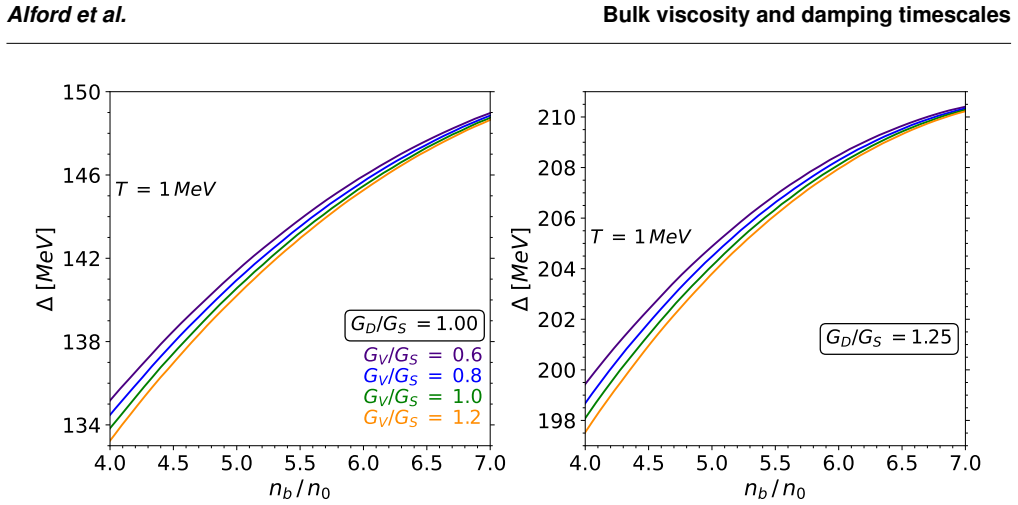
Doubling the vector interaction shifts quark-core damping 3-20x, yet it still mimics nuclear matter.
· “Bulk Viscosity of Two-Flavor Color Superconducting Quark Matter in Neutron Star Mergers”
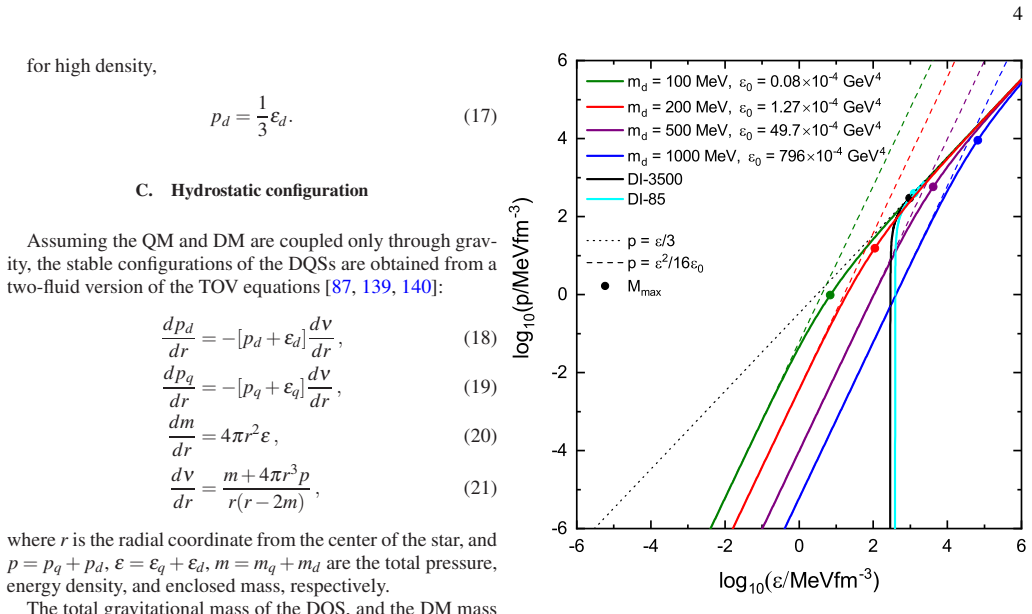
Light dark matter forms halos, heavy dark matter forms cores; both known objects fall in the allowed ranges.
· “Dark matter effects on the properties of quark stars and the implications for the peculiar objects”
Measure the Zc(3900) pole: it tells whether the three-hadron DDD* state is bound or not.
· “Constraining the DDD^* three-body bound state via the Z_c(3900) pole”

One GEVP solve is a single Lanczos step; further steps converge faster and give two-sided error bounds.
· “Block Lanczos algorithm for lattice QCD spectroscopy and matrix elements”

Discrete energies from standard many-body codes become phase shifts and resonances, including non-perturbative Coulomb
· “Constructing Effective Interactions via Projection-Based Inversion”

Kinetic-theory simulations show pre-equilibrium plasmas deflect jets more gently than equilibrium physics predicts.
· “Jet momentum broadening beyond the jet quenching parameter from QCD kinetic theory”

Bayesian fit of UrQMD to FOPI v1, v2, and stopping gives m*/m0 ≈ 0.78–0.88 and F ≈ 0.75–0.88.
· “Bayesian analysis of properties of nuclear matter with the FOPI experimental data”

It means under 15% of a proton's mass comes from spontaneous chiral symmetry breaking.
· “Origin of nucleon mass in the light of PSR J0614-3329 with quark-hadron crossover”
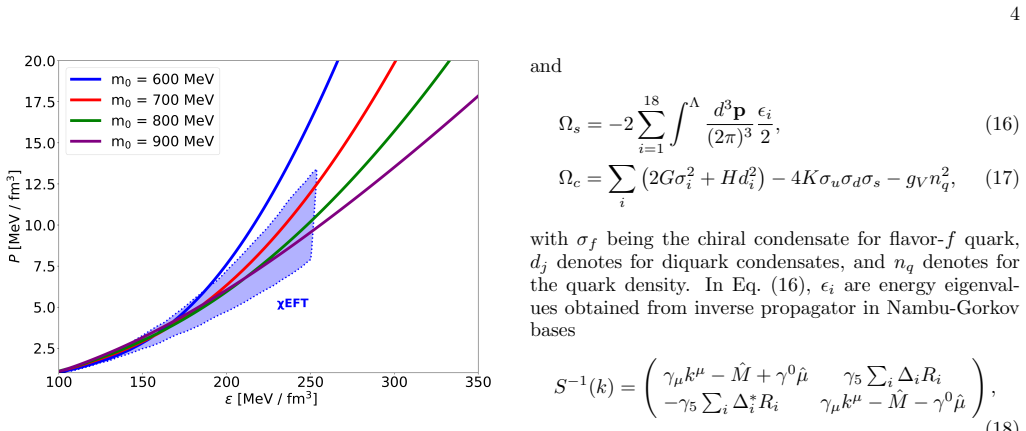
Strange quark stars with 100-150 MeV dark matter match pulsar and GW limits; 5 GeV dark matter fails.

Relativistic calculation finds HVP reaches 68% of muon-VP at high Z; spikes trace nuclear radii.

First lattice calculation of glueball gravitational form factors puts its mass radius below those of known hadrons.

One transport code explains flow, clusters, and dileptons across the heavy-ion energy scan.
· “SMASH: Results from hadronic transport for heavy-ion collisions at high densities”
A clean observable to constrain the uncertain Sigma hyperon potential, bridging heavy-ion flow and neutron-star physics.

A magnetic-field imprint survives in central collisions; annihilation dominates yield but decays carry the distinctive shape.
· “Dilepton Spectra and Even Flow Harmonics in a Magnetized QGP: An Ideal Hydrodynamic Study”
Counterterms make the spectrum and parton densities finite while block-encoding cost grows only ~50 percent.

A quantum-statistics effect would mimic a tetraquark: look for a dip, not a peak, near 6.4 GeV.
· “Di-J/psi structures from the quark Pauli-blocking effect”

Predicted masses 8.87–9.36 GeV and 12.13–12.45 GeV come with golden decay channels for experiments.
· “Triply heavy tetraquarks bar{b}cbar{q}c and bar{c}bbar{q}b in a constituent quark model”

If right, quarkonium diffusion coefficients are just Casimir multiples of the heavy-quark value.

Thermal widths grow with temperature and state size, reshaping how quarkonium melts in heavy-ion collisions.
· “In-medium bottomonium properties from lattice NRQCD calculations with extended meson operators”
Feeding DD-ME2's quadrupole deformation into pn-QRPA matches measured lifetimes across eight rp-process nuclei.
· “Reexamination of nuclear structure properties and shape coexistence of nuclei around A70”

Fitting the quark model's coupling to lattice data reverses rotation's effect and lifts the critical endpoint.
· “Chiral vortical catalysis constrained by LQCD simulations”

Precise isotope-shift calculations benchmark the corrections needed to extract Vud from superallowed beta decays.
At fields above 10^16 gauss, quantum electron levels create density resonances and lift Pauli blocking in merger ejecta.
· “Effects of Landau quantization on neutrino emission and absorption”

NLO QCD pins down the untouched hadron spectrum at 20–70 GeV, so LHC deviations signal quark-gluon plasma.
· “Energy loss baseline for light hadrons in oxygen-oxygen collisions at sqrt{s_NN}=5.36\,TeV”

Full anisotropic kernel from QCD kinetic theory says early-time jets undergo less jet quenching than thermal estimates.
· “Jet broadening and radiation in the early anisotropic plasma in heavy-ion collisions”

Betti curves reproduce flow and multiplicity physics, with no sensitivity gain over standard observables.
· “Towards a topological data analysis for heavy-ion collisions”

The same shear-induced polarization picture works for large collisions, so the similar p+Pb signal points to missing small-system physics.
· “Local spin polarization of Λ hyperons and its interaction corrections”

Exact Bethe-Ansatz calculation puts the proton's gluon growth at x^{-1/3}, a target the EIC can test.
· “Small x behavior in QCD from maximal entanglement and conformal invariance”
Topological patterns in hidden layers separate good from bad equation-of-state inference without needing the true answer.

Zero-point shape fluctuations of 58Ni and 208Pb produce distinct eccentricity distributions, so flow data cannot assume static deformation.
· “Probing surface vibration of spherical nuclei in relativistic heavy-ion collisions”
Proton scattering data below about 65 MeV prefer mixing neutron-matter and symmetric-matter nuclear forces.
First estimates for ppμ−μ− and ppτ−τ− give concrete energies that muon and tau facilities could search for.

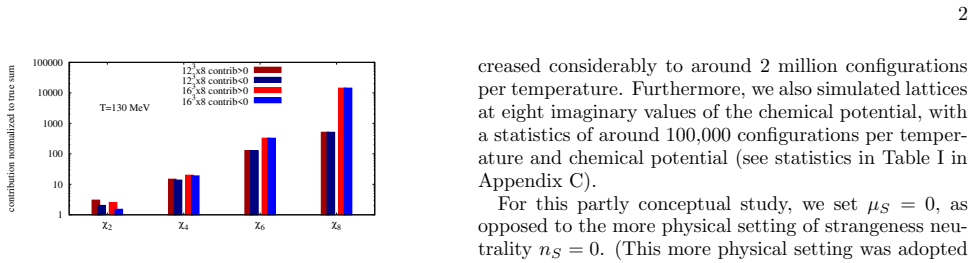
Baryon-number cumulants and Lee-Yang zeros put an 84% probability on the endpoint's temperature.
Dips and bumps in six pair-correlation spectra would fingerprint three Lambda* and two Sigma* states.

A general NJL model with charge and color neutrality identifies the dominant channels and a critical endpoint at 312 MeV.

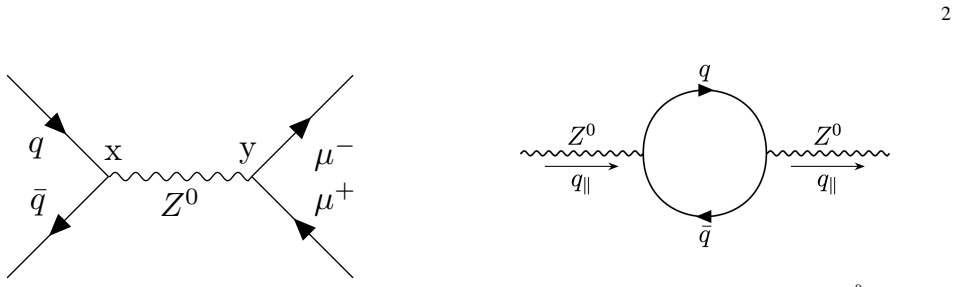
In strong fields, Z0 decay pairs could leave the reaction plane and push antimuons to higher momentum than muons.
A gapless superfluid adds a mass-carrying normal component at T=0 and shrinks the reservoir behind pulsar glitches.
· “Gapless superfluidity in neutron stars: Normal-fluid fraction”

First uncertainty-quantified EFT value for the elementary decay process could shrink nuclear matrix element errors.
· “Next-to-leading-order prediction for the neutrinoless double-beta decay”

A Gaussian mixture analysis of 7-alpha spectra finds peaks near 114 and 138 MeV in both disputed datasets.
· “AI-Assisted analysis of ²⁸Si^* rightarrow 7α break-up data”

With up to 23 coupled channels, the calculated ppp tail matches the measured one within about two standard deviations.
· “Convergence of the ppp correlation function within the hyperspherical adiabatic basis”

Blast-wave model with flow and temperature fluctuations explains the new v0(pT) data and yields hotter freeze-out than pT-spectra fits.
· “Study of p_T-differential radial flow in blast-wave model”

AstroSat, uGMRT, XPoSat and future detectors can probe dense matter and extreme gravity.
· “Astrophysics with Compact Objects: An Indian Perspective, Present Status and Future Vision”
At rational p/q, Dirac fermions cool to T/q; the chemical potential stays put.

Ignoring rotation skews dense-matter inference; with spin included, the star's true non-rotating mass drops to ~2.1 solar masses.
· “PSR J0952-0607: Probing the Stiffest Equations of State and r-Mode Suppression Mechanisms”

The same calculation predicts a low-energy 0+ pairing vibration that would test neutron pairing at N=152.
· “Low-energy spectra of nobelium isotopes: Skyrme random-phase-approximation analysis”

Even when a bound state sits on the pion-exchange cut, the HAL QCD pole converges to the exact binding momentum.

A status review shows pion-pion, nuclear, and Big Bang results all still need the chiral QCD framework.

Trained on random potentials, it matches Kohn-Sham deformation and energies without single-particle orbitals.

Local-equilibrium statistical operator gives ρ00=1/3 to first order; shear and vorticity act only at second order.
· “Spin alignment of vector mesons in local equilibrium by Zubarev's approach”
Distorted-wave theory plus CDCCIA maps measured cross sections to orbits, pairs, and alpha clusters.
· “Reaction mechanism of quasi-free knockout processes in exotic RI beam era”

Exact projections let first-principles lattice QCD reach all eight gluon GPDs.
3D simulations trace energetic explosions, late fallback, aborted blasts, and quiet collapse to stellar-mass black holes.

Review says final-state interactions set threshold shapes and vector-meson models set the continuum; the open problems are experimental.
· “Electromagnetic form factors of hyperons in the timelike region: A short review”

The usual two-scale uncertainty estimate works only if sum rules and coupling are corrected along the way.
· “What are the consequences of independent factorization and renormalization scales?”

One modest elastic-scattering run, three energies, constrains the 6.2 MeV 86Sr(α,n) cross section to a factor ~1.5.

A task-force report argues that hydrodynamics can emerge without scale separation, from few-fermion gases to hot quark-gluon plasmas.
· “Few is different: deciphering many-body dynamics in mesoscopic quantum gases”

A factor-of-four gap between rho-N and omega-N couplings that hadron-structure models will have to explain.
· “rho-Meson Nucleon Scattering Length from CLAS Threshold Photoproduction Measurements”

Down-quark absorption is blocked until heat or energy opens it, leaving strange quarks to trap neutrinos within meters.
· “Neutrino absorption in two-flavor color-superconducting quark matter”

CREX's calcium measurement plus a tight calcium-argon correlation gives CEvNS experiments a 1% coherence-loss baseline.

Same first-principles method maps an attractive nucleon-charmonium force and a charm dibaryon near unitarity.
· “Recent progress on charmed hadron interactions from lattice QCD”
