REVIEW 2 major objections 5 minor 63 references
The paper claims that including quark self-energy in the RG equation reproduces the known weak-coupling expansion of the color-superconducting gap through O(g^0), and that the RG method fixes the gap's overall coefficient—making the commonl
Reviewed by Pith at T0; open to challenge. T0 means a machine referee read the full paper against a public rubric. the ladder, T0–T4 →
An RG treatment with self-energy corrections reproduces the known O(g^0) color-superconducting gap and claims to fix its overall coefficient, implying a factor-two reduction.
T0 review reviewed 2026-08-05 challenge →
load-bearing objection Solid RG reformulation that reproduces the known O(g^0) gap; the factor-two coefficient claim is built on an angular-momentum-inconsistent single-channel equation and should not be taken at face value. the 2 major comments →
Renormalization group analysis of color superconductivity revisited
The pith
A machine-rendered reading of the paper's core claim, the machinery that carries it, and where it could break.
The reading
Core claim
The core discovery is that a single RG equation of the form dy/dt = -a y^2/(1 + g^2 t/(9 pi^2)) - b g^2/pi^2, with initial conditions fixed by matching to hard-dense-loop gluon exchange, yields a BCS singularity at t_BCS = pi^2/(2 sqrt(ab) g) + (pi^2+4)/(144 ab) - l. This translates into ln(Delta/mu) = -pi^2/(2 sqrt(ab) g) - (pi^2+4)/(144 ab) + l + ln(2 Omega). For the 1S0 channel of two-flavor quark matter the leading coefficient is -sqrt(3) pi^2/g, exactly the gap-equation result. When the author substitutes modified gluon propagators that mimic the J=0 gap equation, the RG gives ln(Delta_{J=0}/mu) = -3 pi^2/(sqrt(2) g) - (pi^2+4)/8 + ln(8/pi Omega^{-5}), whereas the oft-quoted gap-equatio
What carries the argument
The engine is the RG equation for the four-fermion coupling near the Fermi surface, written in definite helicity and orbital angular momentum channels. Its two new inputs are (i) a quark wave-function renormalization factor Z_psi(t) = (1 + g^2 t/(9 pi^2))^{-1} that replaces the bare density of states and encodes the quark self-energy, and (ii) a constant tree-level beta function c_R g^2/(6 mu^2) from the unscreened, Landau-damped magnetic gluon interaction. The equation is solved exactly in terms of Bessel functions, and the gap is identified with the scale where the solution develops a pole. The key feature is that the t-dependence of the self-energy changes the exponent structure, producin
Load-bearing premise
The factor-two conclusion rests on the assumption that the modified gluon propagators in Eqs. (134)–(135) are a valid stand-in for the J=0 gap equation inside the RG matching, even though the paper itself notes that the 1S0 and 3P0 channels should be coupled; if a consistent coupled-channel treatment changes the constant term, the conclusion would have to be revised.
What would settle it
Solve the full coupled-channel RG equations for the J=0 sector (1S0 together with 3P0) using the unmodified gluon propagator, and extract the O(g^0) constant term in ln(Delta/mu). If that constant is not ln(8/pi Omega^{-5}), or if the matching-scale factor X does not cancel once the channels are coupled, the paper's factor-two overestimate claim is falsified. A direct numerical solution of the original gap equation extracting the same constant would also settle it.
If this is right
- If correct, the RG result reproduces the known O(g^0) gap from the gap equation, making the RG a viable and simpler route to the same weak-coupling answer.
- The matching-scale factor X cancels in the RG solution, so the overall coefficient of the gap is claimed to be unambiguous, removing the usual order-one coefficient ambiguity in gap-equation calculations.
- The commonly used J=0 gap should have its constant term changed from ln(16/pi Omega^{-5}) to ln(8/pi Omega^{-5}), making the gap a factor of two smaller than the accepted value.
- For two-flavor quark matter, the pure 1S0 channel has a larger gap than the J=0 channel because J=0 mixes in the repulsive 3P0 channel; the RG decomposition makes this channel separation explicit.
- Higher-order O(g) corrections to the gap reduce to correcting the tree-level matching condition in the effective theory, potentially streamlining future perturbative computations; current lattice-isospin comparisons are inconclusive, with 1S0 fitting pressure better and J=0 fitting speed of sound better.
Where Pith is reading between the lines
- If the factor-two claim survives, phenomenological inputs that use the J=0 gap—such as neutron-star cooling and equation-of-state corrections—should be rescaled downward by a factor of two; however, the acknowledged angular-momentum inconsistency means the numeric coefficient should be treated as provisional until a coupled 1S0+3P0 RG treatment is done.
- A natural extension the paper gestures toward but does not carry out is a coupled-channel RG for the J=0 sector; that calculation would either confirm the cancellation of the matching scale or reveal that the factor-two conclusion was an artifact of the ad hoc propagator substitution.
- The same RG machinery, with small modifications, should be applicable to finite quark masses and to strange quarks; the paper states that helicity mixing from masses is under investigation, so the gaps computed here are best trusted in the massless, high-density limit.
- The explicit channel-by-channel formulas provide a testable grid: future weak-coupling calculations at O(g) or lattice calculations at very large isospin chemical potential can check whether the relative ordering of the 1S0, 3S1, 1P1, and 3P0 gaps follows the RG prediction.
Editorial analysis
A structured set of objections, weighed in public.
Referee Report
Summary. The paper revisits the weak-coupling renormalization-group (RG) analysis of color superconductivity in dense QCD. It re-derives the one-loop beta functions for the four-fermion coupling near the Fermi surface (Appendix A), introduces the quark self-energy through HDL-resummed propagators (Sec. III.B), and incorporates Son's tree-level beta function from the unscreened magnetic gluon (Sec. III.C). The resulting RG equations are solved analytically (Eqs. 109-117); the pole in the solution gives the gap. The paper reproduces the known leading coefficient -sqrt(3)π^2/g for the 1S0 channel and obtains an O(g^0) self-energy contribution. It then classifies gaps in several color/flavor/helicity/angular-momentum channels, compares with lattice-QCD thermodynamics at finite isospin density, and argues that the RG method fixes the overall coefficient of the gap unambiguously, concluding that the oft-quoted J=0 coefficient is overestimated by a factor of two.
Significance. If the factor-two claim were established, it would resolve a long-standing O(1) ambiguity in the weak-coupling gap and would affect phenomenological applications such as neutron-star constraints and comparisons with isospin-dense lattice QCD. The paper's strengths are its detailed re-derivation of the beta functions, the explicit analytic solution of the RG equation, and the transparent channel decomposition. The reproduction of the leading 1S0 coefficient is a useful cross-check. However, the factor-two conclusion is not supported by the calculation as presented, because it relies on an explicitly inconsistent single-channel matching. The manuscript is therefore a solid contribution to the RG formulation of color superconductivity, but its main new quantitative claim needs additional work.
major comments (2)
- [Sec. V.B–V.C (Eqs. 134–139)] The factor-two conclusion is not established. The modified propagators in Eqs. (134)-(135) are introduced specifically to reproduce the J=0 gap equation, and the text concedes that the resulting single-channel RG is 'inconsistent in terms of the angular momentum structure' because the J=0 channel mixes 1S0 and 3P0. The cancellation of the matching-scale factor X in Eq. (139) only shows that this particular single-channel combination is independent of X; it does not remove the channel-decomposition ambiguity. A coupled-channel RG treatment of 1S0 and 3P0 is required before one can claim that the J=0 coefficient is fixed unambiguously or that the oft-quoted ln(16/π Ω^{-5}) is overestimated by a factor of two. As it stands, Eq. (136) is an ansatz rather than a derivation, and Sec. V.C overstates the result.
- [Sec. V.C] The claim that 'the RG equation can set the coefficient of the gap unambiguously' should be qualified. Even within the single-channel 1S0 calculation, the identification of the RG pole scale t_BCS with the gap Δ defined in the gap-equation literature is not discussed. The comparison in Eq. (139) assumes that the two objects are the same; a mismatch in the definition of Δ (e.g., value at zero frequency vs. on-shell gap, or pole vs. expectation value) would shift the O(g^0) coefficient and could alter the factor-two comparison. The authors should either demonstrate this equivalence or state it as an assumption.
minor comments (5)
- [Sec. V.B, Eq. (138)] The notation in Eq. (138) hides the factor-of-two discrepancy that is the subject of Sec. V.C. Consider presenting the exact logarithmic arguments side by side in a table to make the comparison transparent.
- [Sec. VII.C] The statement that 'there are no new beta function coming in at higher order' is too strong without a systematic classification of irrelevant operators in the effective theory. A short argument or a reference to a complete operator analysis would strengthen the roadmap to higher-order corrections.
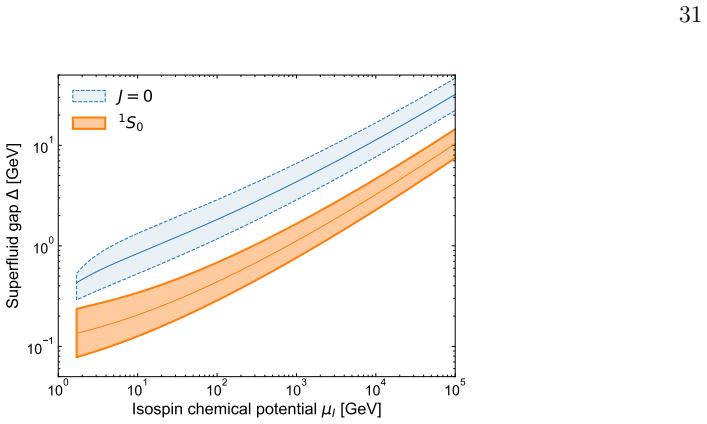
- [Fig. 5 and Sec. V.B] The distinction between the '1S0 channel' and the 'J=0 channel' is central to the paper, but the phrase 'J=0,RG' in Eq. (136) could mislead readers into thinking a J=0 RG was actually solved. Consider renaming this quantity, e.g., 'modified single-channel 1S0 result,' to avoid confusion.
- [Fig. 6] The caption states |μ_I|≡2μ while the axis label reads μ_I. Please clarify the convention in the figure itself to avoid ambiguity.
- [General] The manuscript contains several typesetting artifacts in the arXiv version (e.g., split words, unusual equation references). These should be cleaned in the journal version.
Circularity Check
No significant circularity: the RG reproduction of the known 1S0 gap is derived from independent ingredients; the factor-two J=0 claim relies on an admitted single-channel matching choice, which is a robustness caveat rather than a circular reduction.
full rationale
The central derivation is self-contained. The one-loop beta functions are re-derived in Appendix A from the tree-level amplitude; the quark self-energy is taken from external Refs. [27,43,44]; Son's tree-level beta function is re-derived in Sec. III C; and the RG equation (107) is solved analytically. The reproduction of the leading 1S0 coefficient -sqrt(3) pi^2/g (Eq. 118 vs Eq. 130) is a genuine cross-check with the gap-equation literature, not a fitted parameter. The self-citation to the companion paper [38] for the term-symbol classification (Eqs. 56-58) is not load-bearing, since the paper itself supplies the standard helicity decomposition (Eqs. 54-55). The only passage with a constructed-input flavor is Sec. V B: the propagators (134)-(135) are chosen 'to match with gluon propagators in Eq. (123)', i.e., the J=0 gap equation, and are then fed into the single-channel spin-singlet RG equation (92) to produce Eq. (136). The paper immediately concedes this derivation is 'inconsistent in terms of the angular momentum structure'. That makes the factor-two coefficient claim fragile, but it does not reduce to a circular identity: Eq. (136) is not forced to equal the known result (133) by construction—it differs in the logarithmic coefficient—and the X-cancellation in Eq. (139) is a genuine property of the RG solution. Thus no step meets the standard for circularity; the appropriate finding is a low score with a robustness caveat.
Axiom & Free-Parameter Ledger
axioms (5)
- domain assumption Kinematic constraint p1 = -p2, p3 = -p4 (BCS pairing with zero total momentum) is imposed to make the quartic coupling marginal.
- domain assumption HDL-resummed gluon propagators with Debye mass m_D for electric and Landau-damped magnetic self-energies are used in the matching condition.
- domain assumption The quark wave-function renormalization Z(k0) from Refs. [27,43,44] is inserted in the propagator, and the constant O(g^2) term in Z_psi(t) is dropped as higher order.
- ad hoc to paper The modified propagators in Eqs. (134)-(135) are chosen to reproduce the J=0 gap equation result.
- standard math Asymptotic expansions of Bessel functions for large argument are used to extract the pole location to O(g^0).
Cite this review
Pith. "Pith review of Renormalization group analysis of color superconductivity revisited." pith.science (2026). https://pith.science/paper/LOIU2MLT
@misc{pith2026250819728,
  author       = {Pith},
  title        = {Pith review of: Renormalization group analysis of color superconductivity revisited},
  year         = {2026},
  howpublished = {\url{https://pith.science/paper/LOIU2MLT}},
  note         = {Machine review of arXiv:2508.19728}
}
abstract
Color superconductivity in cold, dense quark matter is a key feature of the QCD phase diagram, whose present theoretical understanding relies predominantly on weak-coupling calculations. In this work, we revisit the evaluation of the color-superconducting gap using a renormalization group (RG) framework formulated in effective theory near the Fermi surface. By incorporating quark self-energy corrections into the RG equation, we reproduce the known weak-coupling results from the gap equation at the same perturbative order at $O(g^0)$. Within the RG approach, the angular momentum structure of the pairing channel becomes more transparent, allowing us to examine the size of the gap for various pairing patterns. We also compare our results with recent lattice QCD calculations at finite isospin density. Finally, we argue that the RG method potentially offers a simpler and more systematic route to higher-order computations of the gap, which are of order $O(g)$ and thus quantitatively important.
Figures



Reference graph
Works this paper leans on
-
[1]
This effect only appears through the integral I defined in Eq
Resummed quark propagator Now, we include the wave function renormalization effect up toO(g2) in the RG equation. This effect only appears through the integral I defined in Eq. (41). We replace I with I ′: I ′ = − 1 4 Z dΛ k2 dk 2π2 Z ∞ −∞ dk0 2π 1 [k0/Z(k0)]2 − ϵ2 k . (61) 14 We evaluate the k0-integral by performing the Wick rotation k0 → ik4: i Z ∞ −∞ ...
-
[2]
, (22) Due to the factor e−2t in front, this term is irrelevant unless the delta function scales as δ(4) e−tl′ 1 + e−tl′ 2 − e−tl′ 3 − e−tl′ 4 = e2tδ(4)(l′ 1 + l′ 2 − l′ 3 − l′
-
[3]
, (24) δL′ I = δGµν ¯ψ′(l′ 3)Γµψ′(l′
-
[4]
(23) This is only possible when the directions of the momenta fulfill the condition Eq. (7). Therefore, the quartic coupling remains marginal under the RG transformation only when ˆp1 + ˆp2 − ˆp3 − ˆp4 = 0, and it is irrelevant otherwise. Likewise, one can schematically write the one-loop correction piece δS ′ I as δS ′ I[ψ′] = 1 4 4Y i=1 Z l′<Λ d4l′ i (2...
-
[5]
, (25) The detailed computation will be shown in the next section. By comparing Eqs. (4, 18) and using Eqs. (8, 9, 21, 22, 24, 25), one finds the RG equation for the coupling function G(l1, l2, l3, l4) = G(e−tl1, e−tl2, e−tl3, e−tl4) + δG , (26) where we suppressed the Lorentz indices µν in Gµν. In terms of the differential equation dG dt = βtree + δβ , (...
-
[6]
The gap is given by the singularity in the solution of the RG equation
Role of quark self energy in the gap Let us now illustrate the role of the quark self energy in the pairing gap by the following simple argument. The gap is given by the singularity in the solution of the RG equation. Let us consider the simple RG equation without the tree-level beta function. dG dt = −N G2 . (66) Its solution at general t >0 is G(t) = G(...
-
[7]
Statically screened electric interaction The tree-level beta function vanishes for the interaction that is screened statically. From the chromoelectric gluon self-energy (34), the tree-level amplitude in the electric sector is G0(q) = − cRg2 q2 0 − q2 − m2 D + i0+ . (75) When one limits the mode near the Fermi surface |ϵp| < Λ, then the energy transfer ca...
-
[8]
Unscreened magnetic interaction The tree level amplitude of unscreened magnetic sector is Gi(q) = − cRg2 q2 0 − q2 + i0+ . (79) 17 Similar to the electric case, the tree-level amplitude at a given scale Λ is Gi(θ; Λ) ≃ − cRg2 Λ2 − 2µ2(1 − cos θ) + i0+ . (80) In the partial wave channel with angular momentum L, Gi L(Λ) = 1 2 Z π 0 dθ sin θ PL(cos θ)Gi(θ; Λ...
-
[9]
Dynamical screening from Landau damping In reality, magnetic interaction is also screened dynamically, depending on q0, due to the Landau damping. Therefore, the tree-level beta function, which is the rate of change in the magnetic interaction, of the dynamically screened interaction becomes smaller than that of the unscreened interaction. When evaluating...
work page 2017
-
[10]
One-loop beta function In this subsection, we show detailed calculation for Eqs. (41, 42) that leads to the one-loop RG equations (44, 45, 48, 49): I ≡ −1 4 Z ∞ −∞ dk0 2π Z dΛ k2 dk 2π2 1 k2 0 − ϵ2 k , (41) Tλ1λ2 ≡ Z dˆk 4π n Gµν;λ1λ2(ˆp1, ˆk)Gρσ;λ1λ2(ˆk, ˆp3) × ¯uλ3(p3)γρ γ0 + ˆkjγj γµuλ1(p1) × ¯uλ4(p4)γσ γ0 − ˆklγl γνuλ2(p2) o . (42) Let us first focus ...
-
[11]
Solution of the RG equation in perturbation theory Let us discuss the solution of the differential equation (108) and obtain the solution in perturbation theory up to the next-to-leading order in perturbation theory. The differential equation we consider is dy(t) dt = − a h2(t) y2(t) − c2 4a ¯g2 , (108) The solution for the initial condition y(t = 0) = −b...
-
[12]
M. G. Alford, A. Schmitt, K. Rajagopal, and T. Sch¨ afer, Color superconductivity in dense quark matter, Rev. Mod. Phys. 80, 1455 (2008), arXiv:0709.4635 [hep-ph]
Pith/arXiv arXiv 2008
-
[13]
G. Benfatto and G. Gallavotti, Perturbation theory of the fermi surface in a quantum liquid. a general quasiparticle formalism and one-dimensional systems, Journal of Statistical Physics 59, 541 (1990)
work page 1990
-
[14]
G. Benfatto and G. Gallavotti, Renormalization-group approach to the theory of the Fermi surface, Phys. Rev. B 42, 9967 (1990)
work page 1990
-
[15]
G. Benfatto and G. Gallavotti, Renormalization group (Princeton University Press, 1996)
work page 1996
-
[16]
J. J. Feldman and E. Trubowitz, Perturbation theory for many fermion systems, Helvetica Physica Acta 63, 156 (1990)
work page 1990
-
[17]
J. J. Feldman and E. Trubowitz, The flow of an electron-phonon system to the superconducing state, Helvetica Physica Acta 64, 213 (1991)
work page 1991
-
[18]
J. J. Feldman, J. L. Magnen, V. Rivasseau, and E. Trubowitz, An infinite volume expansion for many fermion green’s functions, Helvetica Physica Acta 65, 679 (1992)
work page 1992
-
[19]
J. Feldman, J. Magnen, V. Rivasseau, and E. Trubowitz, An Intrinsic 1/N expansion for many fermion systems, EPL 24, 437 (1993)
work page 1993
-
[20]
R. Shankar, Renormalization group for interacting fermions in d >1, Physica A: Statistical Mechanics and its Applications 177, 530 (1991)
work page 1991
-
[21]
Shankar, Renormalization group approach to interacting fermions, Rev
R. Shankar, Renormalization group approach to interacting fermions, Rev. Mod. Phys. 66, 129 (1994), arXiv:cond-mat/9307009. 44
Pith/arXiv arXiv 1994
-
[22]
J. Polchinski, Effective field theory and the Fermi surface, in Theoretical Advanced Study In- stitute (TASI 92): From Black Holes and Strings to Particles(1992) pp. 0235–276, arXiv:hep- th/9210046
-
[23]
N. J. Evans, S. D. H. Hsu, and M. Schwetz, An Effective field theory approach to color super- conductivity at high quark density, Nucl. Phys. B 551, 275 (1999), arXiv:hep-ph/9808444
Pith/arXiv arXiv 1999
-
[24]
N. J. Evans, S. D. H. Hsu, and M. Schwetz, Nonperturbative couplings and color supercon- ductivity, Phys. Lett. B 449, 281 (1999), arXiv:hep-ph/9810514
Pith/arXiv arXiv 1999
-
[25]
T. Sch¨ afer and F. Wilczek, High density quark matter and the renormalization group in QCD with two and three flavors, Phys. Lett. B 450, 325 (1999), arXiv:hep-ph/9810509
Pith/arXiv arXiv 1999
-
[26]
D. T. Son, Superconductivity by long range color magnetic interaction in high density quark matter, Phys. Rev. D 59, 094019 (1999), arXiv:hep-ph/9812287
Pith/arXiv arXiv 1999
-
[27]
S. D. H. Hsu and M. Schwetz, Magnetic interactions, the renormalization group and color superconductivity in high density QCD, Nucl. Phys. B572, 211 (2000), arXiv:hep-ph/9908310
Pith/arXiv arXiv 2000
-
[28]
R. D. Pisarski and D. H. Rischke, A First order transition to, and then parity violation in, a color superconductor, Phys. Rev. Lett. 83, 37 (1999), arXiv:nucl-th/9811104
work page internal anchor Pith review Pith/arXiv arXiv 1999
-
[29]
R. D. Pisarski and D. H. Rischke, Superfluidity in a model of massless fermions coupled to scalar bosons, Phys. Rev. D 60, 094013 (1999), arXiv:nucl-th/9903023
work page internal anchor Pith review Pith/arXiv arXiv 1999
-
[30]
R. D. Pisarski and D. H. Rischke, Gaps and critical temperature for color superconductivity, Phys. Rev. D 61, 051501 (2000), arXiv:nucl-th/9907041
Pith/arXiv arXiv 2000
-
[31]
R. D. Pisarski and D. H. Rischke, Color superconductivity in weak coupling, Phys. Rev. D 61, 074017 (2000), arXiv:nucl-th/9910056
Pith/arXiv arXiv 2000
-
[32]
Superconductivity from perturbative one-gluon exchange in high density quark matter
T. Sch¨ afer and F. Wilczek, Superconductivity from perturbative one gluon exchange in high density quark matter, Phys. Rev. D 60, 114033 (1999), arXiv:hep-ph/9906512
work page internal anchor Pith review Pith/arXiv arXiv 1999
-
[33]
D. K. Hong, An Effective field theory of QCD at high density, Phys. Lett. B 473, 118 (2000), arXiv:hep-ph/9812510
Pith/arXiv arXiv 2000
-
[34]
D. K. Hong, Aspects of high density effective theory in QCD, Nucl. Phys. B 582, 451 (2000), arXiv:hep-ph/9905523
Pith/arXiv arXiv 2000
-
[35]
D. K. Hong, V. A. Miransky, I. A. Shovkovy, and L. C. R. Wijewardhana, Schwinger-Dyson approach to color superconductivity in dense QCD, Phys. Rev. D61, 056001 (2000), [Erratum: Phys.Rev.D 62, 059903 (2000)], arXiv:hep-ph/9906478. 45
work page internal anchor Pith review Pith/arXiv arXiv 2000
-
[36]
How the quark self-energy affects the color-superconducting gap
Q. Wang and D. H. Rischke, How the quark selfenergy affects the color superconducting gap, Phys. Rev. D 65, 054005 (2002), arXiv:nucl-th/0110016
work page internal anchor Pith review Pith/arXiv arXiv 2002
-
[37]
W. E. Brown, J. T. Liu, and H.-c. Ren, On the perturbative nature of color superconductivity, Phys. Rev. D 61, 114012 (2000), arXiv:hep-ph/9908248
work page internal anchor Pith review Pith/arXiv arXiv 2000
-
[38]
W. E. Brown, J. T. Liu, and H.-c. Ren, The Transition temperature to the superconducting phase of QCD at high baryon density, Phys. Rev. D62, 054016 (2000), arXiv:hep-ph/9912409
work page internal anchor Pith review Pith/arXiv arXiv 2000
-
[39]
W. E. Brown, J. T. Liu, and H.-c. Ren, NonFermi liquid behavior, the BRST identity in the dense quark gluon plasma and color superconductivity, Phys. Rev. D 62, 054013 (2000), arXiv:hep-ph/0003199
work page internal anchor Pith review Pith/arXiv arXiv 2000
-
[40]
B. C. Barrois, NONPERTURBATIVE EFFECTS IN DENSE QUARK MATTER, Other the- sis (1979)
work page 1979
-
[41]
A. Kurkela, K. Rajagopal, and R. Steinhorst, Astrophysical Equation-of-State Constraints on the Color-Superconducting Gap, Phys. Rev. Lett. 132, 262701 (2024), arXiv:2401.16253 [astro-ph.HE]
Pith/arXiv arXiv 2024
-
[42]
O. Komoltsev and A. Kurkela, How Perturbative QCD Constrains the Equation of State at Neutron-Star Densities, Phys. Rev. Lett. 128, 202701 (2022), arXiv:2111.05350 [nucl-th]
Pith/arXiv arXiv 2022
-
[43]
R. Abbott, W. Detmold, F. Romero-L´ opez, Z. Davoudi, M. Illa, A. Parre˜ no, R. J. Perry, P. E. Shanahan, and M. L. Wagman (NPLQCD), Lattice quantum chromodynamics at large isospin density, Phys. Rev. D 108, 114506 (2023), arXiv:2307.15014 [hep-lat]
Pith/arXiv arXiv 2023
-
[44]
R. Abbott, W. Detmold, M. Illa, A. Parre˜ no, R. J. Perry, F. Romero-L´ opez, P. E. Shanahan, and M. L. Wagman (NPLQCD), QCD Constraints on Isospin-Dense Matter and the Nuclear Equation of State, Phys. Rev. Lett. 134, 011903 (2025), arXiv:2406.09273 [hep-lat]
Pith/arXiv arXiv 2025
-
[45]
Y. Fujimoto, Enhanced contribution of the pairing gap to the QCD equation of state at large isospin chemical potential, Phys. Rev. D 109, 054035 (2024), arXiv:2312.11443 [hep-ph]
Pith/arXiv arXiv 2024
-
[46]
Y. Fujimoto, Interplay between the weak-coupling results and the lattice data in dense QCD, (2024), arXiv:2408.12514 [hep-ph]
Pith/arXiv arXiv 2024
-
[47]
K. Fukushima and S. Minato, Speed of sound and trace anomaly in a unified treatment of the two-color diquark superfluid, the pion-condensed high-isospin matter, and the 2SC quark matter, Phys. Rev. D 111, 094006 (2025), arXiv:2411.03781 [hep-ph]
Pith/arXiv arXiv 2025
-
[48]
D. T. Son and M. A. Stephanov, QCD at finite isospin density, Phys. Rev. Lett. 86, 592 (2001), arXiv:hep-ph/0005225. 46
Pith/arXiv arXiv 2001
-
[49]
Y. Fujimoto, Classification of color superconductivity by one-gluon exchange helicity ampli- tudes and renormalization group equations, (2025), arXiv:2508.19222 [hep-ph]
work page internal anchor Pith review Pith/arXiv arXiv 2025
-
[50]
M. L. Bellac, Thermal Field Theory, Cambridge Monographs on Mathematical Physics (Cam- bridge University Press, 2011)
work page 2011
-
[51]
M. Laine and A. Vuorinen, Basics of Thermal Field Theory , Vol. 925 (Springer, 2016) arXiv:1701.01554 [hep-ph]
Pith/arXiv arXiv 2016
-
[52]
Jacob and G
M. Jacob and G. C. Wick, On the General Theory of Collisions for Particles with Spin, Annals Phys. 7, 404 (1959)
1959
-
[53]
S. U. Chung, SPIN FORMALISMS 10.5170/CERN-1971-008 (1971)
-
[54]
Lifetime Effects in Color Superconductivity at Weak Coupling
C. Manuel, Lifetime effects in color superconductivity at weak coupling, Phys. Rev. D 62, 114008 (2000), arXiv:hep-ph/0006106
work page internal anchor Pith review Pith/arXiv arXiv 2000
-
[55]
A. Gerhold and A. Rebhan, Fermionic dispersion relations in ultradegenerate relativistic plas- mas beyond leading logarithmic order, Phys. Rev. D71, 085010 (2005), arXiv:hep-ph/0501089
work page internal anchor Pith review Pith/arXiv arXiv 2005
-
[56]
Non-Fermi Liquid Effects in QCD at High Density
T. Sch¨ afer and K. Schwenzer, Non-Fermi liquid effects in QCD at high density, Phys. Rev. D 70, 054007 (2004), arXiv:hep-ph/0405053
work page internal anchor Pith review Pith/arXiv arXiv 2004
-
[57]
The Kohn-Luttinger Effect in Gauge Theories
T. Sch¨ afer, The Kohn-Luttinger effect in gauge theories, Phys. Rev. D 74, 054009 (2006), arXiv:hep-ph/0606026
work page internal anchor Pith review Pith/arXiv arXiv 2006
-
[58]
A. Kurkela, E. S. Fraga, J. Schaffner-Bielich, and A. Vuorinen, Constraining neutron star mat- ter with Quantum Chromodynamics, Astrophys. J. 789, 127 (2014), arXiv:1402.6618 [astro- ph.HE]
Pith/arXiv arXiv 2014
-
[59]
D. H. Rischke, Debye screening and Meissner effect in a two flavor color superconductor, Phys. Rev. D 62, 034007 (2000), arXiv:nucl-th/0001040
work page internal anchor Pith review Pith/arXiv arXiv 2000
-
[60]
D. H. Rischke and I. A. Shovkovy, Longitudinal gluons and Nambu-Goldstone bosons in a two flavor color superconductor, Phys. Rev. D 66, 054019 (2002), arXiv:nucl-th/0205080
work page internal anchor Pith review Pith/arXiv arXiv 2002
-
[61]
Y. Fujimoto, Renormalization-group approach to Kohn-Luttinger superconductivity: Ampli- fication of the pairing gap from ℓ4 to ℓ, Phys. Rev. B 111, 184510 (2025), arXiv:2502.01169 [cond-mat.supr-con]
work page internal anchor Pith review Pith/arXiv arXiv 2025
-
[62]
E. Braaten and R. D. Pisarski, Soft Amplitudes in Hot Gauge Theories: A General Analysis, Nucl. Phys. B 337, 569 (1990)
work page 1990
-
[63]
T. Gorda, A. Kurkela, R. Paatelainen, S. S¨ appi, and A. Vuorinen, Cold quark matter at N3LO: Soft contributions, Phys. Rev. D 104, 074015 (2021), arXiv:2103.07427 [hep-ph]
Pith/arXiv arXiv 2021
This paper was first reviewed by deepseek-v4-flash on August 5, 2026.
discussion (0)
Sign in with ORCID, Apple, or X to comment. Anyone can read and Pith papers without signing in.