Relativistic QMD equations match exact mean-field forces
Density-dependent potentials now come from a variational derivation, not Monte-Carlo integration.

High Energy Physics - Phenomenology
Theoretical particle physics and its interrelation with experiment. Prediction of particle physics observables: models, effective field theories, calculation techniques. Particle physics: analysis of theory through experimental results.
sort pith recommended most recent
Density-dependent potentials now come from a variational derivation, not Monte-Carlo integration.
A single advection equation, with collapse cut off at the Jeans scale, reproduces magnetized simulation spectra.
· “Forward cascade of large-scale primordial magnetic fields during structure formation”

If one crossed Earth in the last half-billion years, existing mica data already bound its strength.

An analytic Gubser-flow model shows the sign puzzle has a formulation-dependent answer, including an exact zero.

Outranks the usual color-octet shape functions by 1/v and depends on one well-measured constant.
· “The role of the soft scale for J/psi production in the transverse momentum dependent framework”
A six-form-factor pQCD calculation matched to lattice data yields SM predictions for branching fractions and angular observables.
· “Investigation of Λ_(b)to Λ_(c) ell^-overlineν_ell Decays in Perturbative QCD Approach”

A renormalization-group treatment with quark self-energy fixes the pairing gap's coefficient, halving the standard value.
· “Renormalization group analysis of color superconductivity revisited”

A b c anti-s anti-d molecule in Upsilon weak decay would leave a peak plus a tell-tale threshold dip.
· “T_(bcbar s) states in the process Upsilon to D⁻ bar B⁰ D_s⁺”

The narrow mass window still evaporating today is the key target for testing whether black hole information is recovered.
· “Page Time of Primordial Black Holes in the Standard Model and Beyond”

Zero-sound resummation of the Kohn anomaly makes high-partial-wave pairing exponentially stronger.

A source-count extrapolation from the LHAASO catalog closes the outer-Galaxy gap but leaves the inner Galaxy needing extra components.
· “Contribution of Unresolved Sources to Diffuse Gamma-Ray Emission from the Galactic Plane”

The d-bar minus u-bar asymmetry falls exponentially at large transverse separation, something perturbative QCD cannot produce.

The mechanism could resolve the lithium problem by altering 7Be reaction rates in the early universe or in the lab.
· “Light nuclei under magnetic field and the lithium problem”

With the shower fixed, switching string vs cluster hadronization now quantifies a key non-perturbative uncertainty.
· “Herwig 7 with the Lund String Model: Tuning and Comparative Hadronization Studies”

Two GNN branches separate stable kinematics from systematics; profiling keeps 68% coverage in 50,000 trials.
· “Higgs Signal Strength Estimation with Machine Learning under Systematic Uncertainties”

Small-scale inflation noise cannot shift long-wavelength gravitational waves: symmetry cancels the one-loop terms.
· “One-loop corrections to infrared GWs is forbidden by symmetries”

A spacetime chemical potential biases Hawking emission, and full numerical evolution reproduces the observed baryon excess.
· “Baryogenesis via Asymmetric Evaporation of Primordial Black Holes”
Updated X-ray and gravitational-wave observations leave the 95% bound on the dense-matter pairing gap nearly unchanged.
· “Updated Astrophysical Equation-of-State Constraints on the Color-Superconducting Gap”
Conventional quarkonia fit potential models below threshold; the charged, near-threshold XYZ states do not.

A pedagogical review connects the symmetry, operators, production, decay, lifetime, and current bounds on the ALP-photon coupling.

The same TeV-scale parameters that fix dark matter would be probed by LISA and a six-top search at the HL-LHC.
An exact inversion turns low-order coefficients into a Borel-summed tail, making alpha_s and quark masses precise.

The upgrade makes mixed QCD and electroweak corrections a standard, user-level step in collider simulations.

Loop-based widths put πN*(1535) on par with πN, making KπΣ final states a realistic search channel.

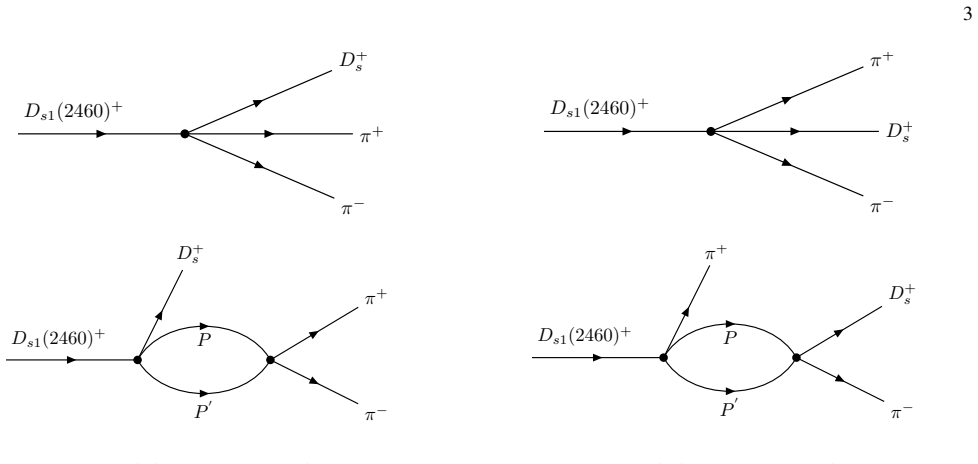
Coupled-channel fit reproduces the spectra with no Breit-Wigner states: both resonances appear as mesonic molecules.
· “Scalar resonance contributions in the D_(s1)(2460)⁺ rightarrow D_(s)⁺π⁺π⁻ reaction”
Long-range Coulomb acceleration forces universal retarded-time tails into the electromagnetic waveform in every dimension.
· “Logarithmic Soft Photon Theorem and Waveform Tails in Higher Dimensions”
Well-defined QCD mixing forces ALP masses into a factor-of-two ladder and leaves decay constants near f_a0 empty.

Free lowest-Landau-level pressure with running mass matches lattice data and caps magnetar masses.

Perturbativity caps the volume, so almost all 2-form axions get large masses—except one fibred corner.
Quark onset and chiral restoration part ways when repulsion is shared by both phases.
· “Suppression of dynamical momentum-space shell by chiral symmetry”

A 4-parsec dwarf pushes the dark matter mass floor past 8×10^-18 eV.
· “Updated bounds on ultra-light dark matter from the tiniest galaxies”

At 1 keV, realistic models exclude down to ~10^-40 cm^2, far below the flat-cross-section bound.

Masses near 4.1-4.7 GeV sit below meson-baryon thresholds, including clean triply charged signals.
· “Doubly charmed pentaquark states with strangeness S=0, -1”

Standard Model benchmarks for the excited Omega_b's b-to-c weak decay, testable at hadron colliders.
· “Semileptonic Ω_(b)^(*)rightarrowΩ_(c)^(*) ell bar{ν}_(ell) transition in QCD”

The predicted scale sets axion mass and suppresses gravity-induced PQ violation.

Tuning the nuclear symmetry energy and dark-sector repulsion keeps 2-solar-mass neutron stars compatible with the decay channel.
· “Neutron Dark Decay in Neutron Stars: The Role of the Symmetry Energy”

If right, they bind by only 0.1-33 MeV below kaon-baryon thresholds, with concrete quantum numbers for searches.
· “Prediction of QQqqbar{s} molecular pentaquarks within the extended local hidden gauge approach”

Because proton decay is doubly suppressed, the new scalars stay at TeV masses and the LHC can produce them.
· “A Baryon and Lepton Number Violation Model Testable at the LHC”

A helicity-amplitude analysis of one-gluon exchange revises which condensate forms when only one quark flavor pairs.

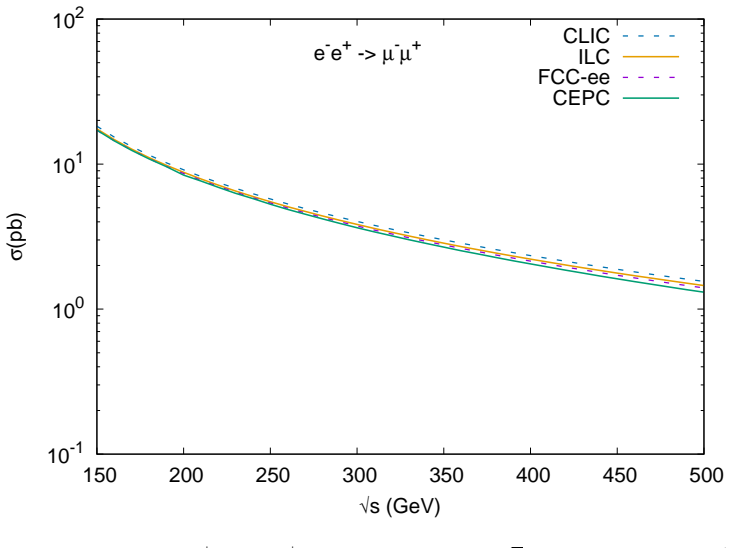
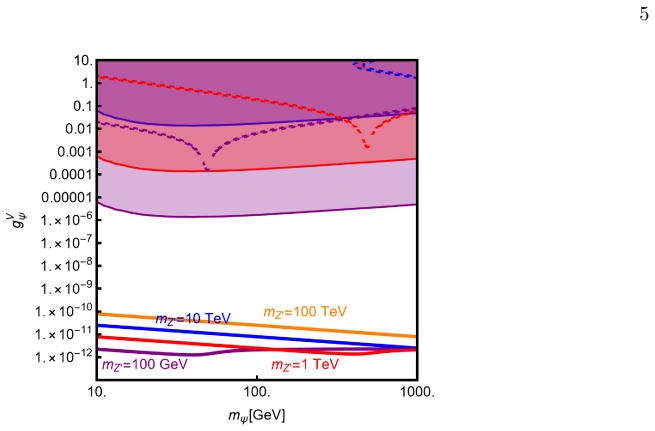
Circular machines like FCC-ee probe tiny couplings; CLIC extends the search to multi-TeV masses.
· “Searching for the Leptophilic Gauge Boson Z_(l) at Future e⁺e⁻ Colliders”
Future high-frequency cavity detectors could catch the UV freeze-in gravitational-wave background.
· “Gravitational Wave Spectrum from the Production of Dark Matter via the freeze-in Mechanism”
Remaining cross-section differences trace to baseline QCD fits, not photon modeling, sharpening LHC Higgs predictions.
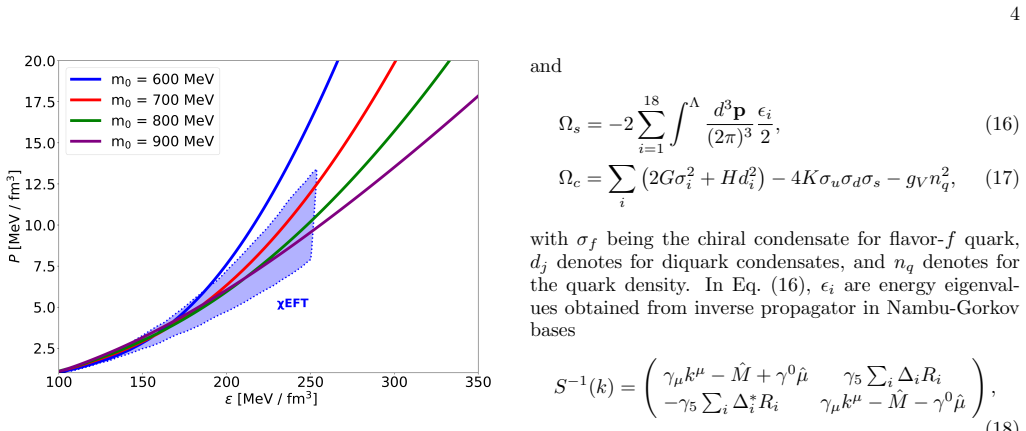
Mass–radius data from compact stars force the chiral-invariant mass above half the proton mass.
· “Implication of neutron star observations to the origin of nucleon mass”
If 1% of neutron decays emit an electron but no proton, compact stars would be mostly dark fermions.

A two-fluid model says dark matter fraction and quark anisotropy set the curves that X-ray and pulsar timing can test.
· “Exploring the Structural Properties of Anisotropic Dark Matter-Admixed Quark Stars”

A closed form now resums every half-odd post-Newtonian correction at arbitrary velocity.
· “Radiation-Reaction and Angular Momentum Loss at mathcal{O}(G⁴)”

Planar two-loop 2-to-4 master integrals shrink to a 202-integral pure basis with a 128-letter alphabet.
· “Planar Six-Point Feynman Integrals for Four-Dimensional Gauge Theories”
Measure the Zc(3900) pole: it tells whether the three-hadron DDD* state is bound or not.
· “Constraining the DDD^* three-body bound state via the Z_c(3900) pole”

The predicted rate is too small for today's data, but a super tau-charm factory could catch a few events per year.

Despite apparent singularities, this Calabi-Yau integral admits ε-factorized form.
· “Calabi-Yau Feynman integrals in gravity: varepsilon-factorized form for apparent singularities”
One GEVP solve is a single Lanczos step; further steps converge faster and give two-sided error bounds.
· “Block Lanczos algorithm for lattice QCD spectroscopy and matrix elements”

Exact pole cancellation plus finite-field coefficients deliver the NNLO cross-section grid.
· “Two-loop QCD amplitudes for tbar{t}W production at the LHC in the leading-colour approximation”

Kinetic-theory simulations show pre-equilibrium plasmas deflect jets more gently than equilibrium physics predicts.
· “Jet momentum broadening beyond the jet quenching parameter from QCD kinetic theory”

Best-fit masses match charmonium, bottomonium, and B_c states within ~70 MeV, preferring a gluon mass of 300–370 MeV.
· “Nonrelativistic meson masses from the Curci-Ferrari model”

A review extends the growing interior volume to charged, rotating, higher-dimensional and f(R) black holes.

It means under 15% of a proton's mass comes from spontaneous chiral symmetry breaking.
· “Origin of nucleon mass in the light of PSR J0614-3329 with quark-hadron crossover”
Strange quark stars with 100-150 MeV dark matter match pulsar and GW limits; 5 GeV dark matter fails.

A running Newton's constant replaces the Big Bang singularity with a bounce and may resolve the Hubble tension.
The mass-radius fit sets an astrophysical cap on the dark boson's mass.
· “XTE J1814-338 as a strange star admixed with bosonic dark matter”

First lattice calculation of glueball gravitational form factors puts its mass radius below those of known hadrons.

Two model-agnostic designs pick rare decays with up to 100% purity, enabling new-physics searches and upper limits.
· “AI-powered full-data set search for new physics in ultraperipheral and diffractive events”
For spin-1 and spin-3/2 hadrons, the quark-gluon force gains quadrupole terms that a single c-bar(t) cannot capture.
· “Quadrupole forces between quark/gluon subsystems inside higher-spin particles”

One predicts +3%, the other −3% in gravity's strength, with opposite signs in gravitational-wave damping.
· “Constraints on Logarithmic Model Extensions of Symmetric Teleparallel Gravity”

Fully analytic NNLO prediction matches B-factory data and explains the ln^3 r growth

A gamma-UPC + MadGraph5_aMC@NLO pipeline puts NLO QCD and EW corrections within reach of non-experts.
Nuclear-recoil tracks preserved for a billion years could record dark matter, neutrinos, and cosmic rays.
· “Mineral Detection of Neutrinos and Dark Matter 2025 Proceedings”

Spherocity-split EPOS-LHC runs tie the narrowing to radial flow, a candidate collective signal in small systems.

The slope of its gravitational form factor puts the Higgs's energy radius below its Compton wavelength.

Variational estimate gives 4 GeV binding; decays to three W bosons and three bottom quarks, but production is tiny.

The result closes part of a two-order gap between Standard Model and experiment.
Non-invertible symmetry forbids tree-level Majorana mass; one-loop breaking restores it, with a dark matter partner inside.
· “A natural realization of inverse seesaw model in a non-invertible selection rule”
The galaxy's unresolved cluster population cannot explain the excess diffuse light seen by Fermi-LAT and LHAASO.
· “Contribution of Globular Clusters to Diffuse Gamma-ray Emission from Galactic Plane”
A magnetic-field imprint survives in central collisions; annihilation dominates yield but decays carry the distinctive shape.
· “Dilepton Spectra and Even Flow Harmonics in a Magnetized QGP: An Ideal Hydrodynamic Study”
A single nearby evaporating black hole could flash a short, aimed neutrino burst that reveals its mass, spin, charge, and speed.
· “Anisotropic Neutrino Emission from Spinning, Moving, and Charged Primordial Black Holes”
Breaking SU(4) color to SU(3) only in the visible sector also yields half-integer charges and four-quark dark baryons.
A fifth-power scaling law ties formation to horizon-scale fluctuations and predicts small spins.
· “Primordial Black Hole Formation and Spin in Matter Domination Revisited”
A recursive multiplet-basis method beats trace-basis factorial scaling at moderate multiplicity.
· “All-gluon amplitudes with off-shell recursion in multiplet bases”

Freeze-in and early matter domination give viable WIMP targets that next-gen detectors could see.
· “Beyond the Veil: Charting WIMP Territories at the Neutrino Floor”
A quantum-statistics effect would mimic a tetraquark: look for a dip, not a peak, near 6.4 GeV.
· “Di-J/psi structures from the quark Pauli-blocking effect”

Predicted masses 8.87–9.36 GeV and 12.13–12.45 GeV come with golden decay channels for experiments.
· “Triply heavy tetraquarks bar{b}cbar{q}c and bar{c}bbar{q}b in a constituent quark model”
