REVIEW 4 major objections 5 minor 2 cited by
This proceedings argues that minerals preserve nuclear-recoil damage for geological timescales, so a gram of ancient rock carries the exposure of a 10-kiloton live detector.
Reviewed by Pith at T0; open to challenge. T0 means a machine referee read the full paper against a public rubric. the ladder, T0–T4 →
A workshop proceedings presenting 20 status reports on mineral detectors as passive, long-exposure nuclear recoil detectors for dark matter, neutrinos, and cosmic rays.
T0 review reviewed 2026-08-05 challenge →
load-bearing objection An honest, useful R&D snapshot in which the enabling readout gap is exactly where the volume is quiet—not a research claim, but worth a referee's time as a status report. the 4 major comments →
Mineral Detection of Neutrinos and Dark Matter 2025 Proceedings
The pith
A machine-rendered reading of the paper's core claim, the machinery that carries it, and where it could break.
The reading
Core claim
The central claim of these proceedings is that mineral detectors—synthetic or natural crystals that preserve the damage left by nuclear recoils—can extend particle detection to timescales no live experiment can reach. A recoiling nucleus leaves a linear trail of lattice defects, nanometers wide and up to millimeters long; in minerals such as mica, olivine, quartz, halite, diamond, and lithium fluoride these trails can survive for hundreds of millions to billions of years. Reading out those trails with emerging imaging techniques would make a 1 g, 1 Gyr sample equivalent in exposure to a 10 kt live detector operating for 10 years. The proceedings compile the first experimental steps: white-li
What carries the argument
The load-bearing object is the nuclear recoil damage track: a nanometre-wide linear defect structure left when an incoming neutrino, dark-matter particle, or neutron knocks a nucleus out of its lattice site. In a suitable mineral the track is preserved over geological time and can be enlarged by chemical etching or made visible through optically active defects, such as nitrogen-vacancy centers in diamond and F-aggregate centers in LiF. The argument runs on the equivalence between long passive exposure and enormous live-detector exposure, plus the readout techniques that convert stored tracks into countable data: high-speed optical profilers for etched mica, light-sheet fluorescence microscop
Load-bearing premise
The whole program rests on the assumption that nanometre-scale damage tracks can be read out efficiently from gram-scale volumes of mineral; no current technique demonstrates that combination of resolution, speed, and background rejection.
What would settle it
In the PRImuS scenario, a 10 g halite sample formed during the Messinian Salinity Crisis is predicted to contain a muon-induced track population orders of magnitude above all backgrounds; imaging such a sample and finding no excess, or an excess that does not match the predicted track-length spectrum, would refute the paleo-detector sensitivity claim. More generally, a surrogate neutron-irradiated crystal whose recoil energy is known must yield tracks of the predicted length and density at the claimed readout resolution.
If this is right
- A 1 g mineral sample aged about a billion years provides exposure equal to a 10 kt live detector running 10 years, so paleo-detectors could reach dark-matter and neutrino sensitivities beyond current experiments.
- Mineral detectors can be directional: the orientation and length of a recoil track encode the incoming particle's direction and energy, enabling separation of a dark-matter signal from the solar-neutrino background.
- A series of mineral samples of different ages could measure how solar, supernova, and atmospheric neutrino fluxes, and the cosmic-ray flux, have changed over Earth's history.
- Readouts demonstrated in the proceedings—etched mica with optical profiling, color centers in LiF, NV centers in diamond, and X-ray/electron microscopy of quartz and olivine—put laboratory-scale reactor-neutrino and dark-matter detectors within reach.
- Trace U/Th measurements in candidate minerals show that sample radiopurity is measurable and variable, allowing background budgets to be set for proposed paleo-detectors.
Where Pith is reading between the lines
- If any single readout technique achieves the target combination of nanometre resolution, gram-scale volume, and hours-scale scanning, the same platform could serve both reactor-neutrino monitoring and paleo-detection, letting one calibration program validate both applications.
- The directional information in fossil tracks could act as a paleo-telescope, reconstructing the arrival direction of a transient event such as a cosmic-wall passage or nearby supernova; the proceedings hint at this for walls but do not develop it as a general tool.
- The wide U/Th variability reported for olivine—sub-ng/g to tens of ng/g—suggests that sample selection and geological history, rather than detector physics, may set the practical background floor for early paleo-detectors.
- Assuming the roughly 50 cm^2/h scan speed projected for the fast optical scanning system, scanning about 500 cm^2 of mica—the area needed to reach monopole/Q-ball flux limits near 10^-20 cm^-2 s^-1 sr^-1—would take on the order of 10 hours, a concrete near-term milestone implied by the paper's numbers.
Editorial analysis
A structured set of objections, weighed in public.
Referee Report
Summary. This proceedings compiles 20 short contributions from the MDνDM'25 workshop held at JAMSTEC/Yokohama in May 2025. The overarching claim is that mineral detectors, which record nuclear-recoil damage tracks over laboratory or geological timescales, could serve as reactor-neutrino monitors, directional dark-matter detectors, and paleo-detectors for astrophysical neutrinos, cosmic rays, and exotic heavy particles. Individual contributions report preliminary progress on mica etching with white-light interferometry (DMICA), NV-center track imaging in diamond with light-sheet quantum diamond microscopy, LiF color-center imaging with mesoSPIM (PALEOCCENE), TEM/TXM imaging of quartz and olivine, ICP-MS radiopurity measurements, neutron-irradiation calibration, and several phenomenological proposals (Q-balls, cosmic walls, supernova neutrinos). The volume is explicitly framed around a central obstacle, stated in the Preface: efficient readout of nanoscale damage tracks from large mineral volumes. No contribution in these proceedings demonstrates a single instrument that simultaneously achieves nanometer-scale resolution, gram-scale volumetric throughput, and controlled background rejection.
Significance. If the readout obstacle is overcome, the paleo-detector program would open a genuinely new exposure regime: a 1 g sample with a 1 Gyr integration time is equivalent, in exposure bookkeeping, to a 10 kt live detector running for 10 years, and it would enable directional dark-matter detection and time-resolved astroparticle measurements over geological history. The proceedings is honest about the preliminary status of most results and contains falsifiable projections, such as the Messinian halite cosmic-ray signal (Sec. 3) and the supernova-neutrino track-length window (Sec. 16). It also usefully collects calibration, background, and microscopy results that are otherwise scattered. However, the paper does not establish the central enabling technology; its value is as a community status report and road map, not as a demonstration of paleo-detector sensitivity. The headline sensitivity claims must therefore be read as conditional on readout capabilities that remain to be shown.
major comments (4)
- [Sec. 14.1, 14.4] The statement that 'a 1 gram paleo-detector dated at 1 billion years old could offer the same exposure as a 10 kiloton live direct detection experiment operating for 10 years' is exposure bookkeeping, not a demonstrated sensitivity. It implicitly assumes unit-efficiency readout of every signal track and negligible readout background. The authors' own TXM proof-of-concept (Sec. 14.4) resolved FIB-milled tracks with radii of about 100 nm but could not resolve ion tracks with radii of about 3 nm, and the planned 15-nm voxel TXM is still coarse compared with a 3-nm track. TEM provides the needed resolution, but Sec. 14.4 notes that hours of TEM imaging cover only nanograms. Thus the projection in Sec. 14.1 rests on a readout capability that no reported instrument currently meets; this should be stated explicitly and the projections re-scoped or clearly conditioned on that capability.
- [Sec. 17.2] The PALEOCCENE contribution reports sensitivity to 'single digit numbers of color centers per voxel' and lists 'detect single color centers' as a planned hardware improvement, not a demonstrated capability. Since the technique's event sensitivity ultimately depends on reaching single-color-center readout with an acceptable false-positive rate, the statement that scan times of hours per cubic centimeter will provide 'single event sensitivity' is not supported by the presented data. In addition, the track-length histogram in Fig. 17.1(b) is compared with simulation only qualitatively; a quantitative goodness-of-fit or uncertainty estimate should be provided.
- [Sec. 6.2, 6.4] The diamond NV-track results are useful but preliminary: the 17(5) NV yield per 800 keV ion comes from about 300 sites, and the simulation validation is explicitly ongoing. The LS-QDM currently has a 9-µm light sheet and requires about 1-µm sheets for timely DM-track detection. These are milestones toward a directional detector, but they do not demonstrate readout of 3-nm-scale tracks in mm-scale diamond. The text should avoid implying that track detection in bulk diamond has already been achieved.
- [Sec. 7, Table 2] The ICP-MS U and Th concentrations in Table 2 are presented without measurement uncertainties, detection limits, blank values, or replicate information. The discussion concludes that pallasite olivine and the Minas Gerais muscovite are 'promising candidates for low-background dark matter detection' based on these numbers. Without uncertainties, this radiopurity claim is not yet quantitative. At minimum, approximate uncertainties and the analytical blank should be reported.
minor comments (5)
- [Sec. 4.2, Fig. 4.1] The axis labels in Fig. 4.1 appear garbled (e.g., '160 27"M284J 39'), and the caption does not define the plotted quantities or the meaning of the shaded region. Please fix the figure and caption.
- [Sec. 13.2, 13.5] Sec. 13.2 uses inconsistent flux units ('10−16cm−1sec−1sr−1' versus 'cm−2 s−1 sr−1' elsewhere), and Sec. 13.5 says 'yellow allow' instead of 'yellow arrows.'
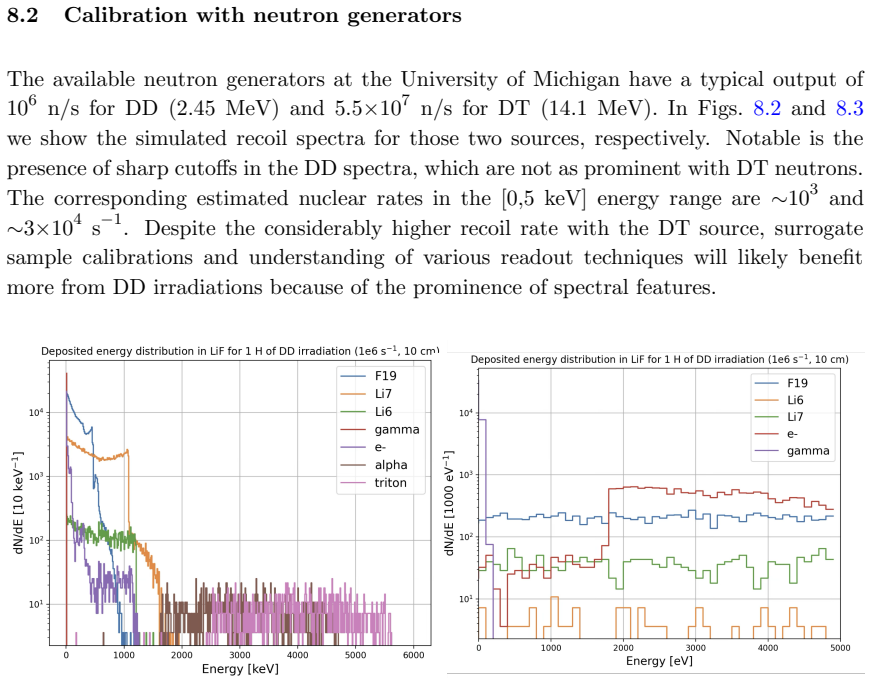
- [Sec. 8.3] The estimated recoil rate of 7×10^6 hr−1 in the [0,5 keV] range for LiF should state whether this is the total rate over all angles or a specific solid-angle acceptance, since the 7Li(p,n) reaction is strongly angle-dependent.
- [Sec. 14.3] The GitHub link for the paleo-background simulation workflow is welcome; for reproducibility, consider archiving a versioned release on Zenodo or a similar service.
- [Sec. 16] The forecast that supernova-neutrino tracks can be detected in 100 g of epsomite with 238U concentration of 10−11 g/g would be more useful with the assumed track-length binning, readout efficiency, and background rejection stated explicitly.
Circularity Check
No significant circularity found: the proceedings are a progress report with external calibrations and explicitly stated technological caveats.
full rationale
The volume is a collection of workshop progress reports rather than a derivation chain that reduces predictions to fitted inputs. The load-bearing experimental quantities are benchmarked against external data: DMICA's pit-depth-to-recoil-energy relation is taken from ion-irradiation experiments by Snowden-Ifft and Chan (Ref. [38]) and the bulk etch rate is compared with the independent direct measurement of Freeman and Snowden-Ifft (Ref. [39]); KIT validates its Geant4/TRIM track-length simulations against experimental alpha-track data digitized from Ref. [113]; PALEOCCENE validates its first-principles color-center calculations against LiF measurements (Ref. [112]) and compares imaged track morphology to SRIM simulations; the ICP-MS uranium/thorium measurements are checked against the GSJ reference sample JB-1 with recommended values from Imai et al. (Ref. [109]). The projected paleo-detector sensitivities, such as the 1 g, 1 Gyr exposure equivalence in Sec. 14.1, are explicitly conditional ('With the right characterization, background subtraction, and imaging technique') and are not presented as demonstrated measurements. The enabling-readout assumption is openly identified in the Preface as 'the longstanding central obstacle: the efficient readout of nano-scale damage tracks from large volumes of mineral,' and Sec. 14.4 candidly reports that current TXM could not resolve 3-nm ion tracks while TEM throughput is limited to nanograms. Self-citations of the community whitepaper [16] and prior proceedings [17] are used for background and meeting context, but they are not load-bearing in any calculation that is claimed to be a new prediction. No equation or fitted parameter is renamed as a prediction, and no uniqueness or ansatz is imported solely from the authors' prior work. The main scientific risk—unproven bulk nanoscale readout—is a technological feasibility limitation rather than a circularity.
Axiom & Free-Parameter Ledger
axioms (4)
- domain assumption Nuclear recoil tracks in minerals are preserved over geological timescales and can be amplified or imaged (e.g., by etching, fluorescence, or electron microscopy).
- domain assumption SRIM/TRIM and GEANT4 simulations accurately predict vacancy distributions and track ranges for the relevant ions and energies.
- domain assumption A hybrid functional (HSE06) matched to the experimental band gap predicts the optical properties of color centers well enough to screen minerals.
- domain assumption The geological history of candidate samples (burial depth, thermal history, exposure window) can be reconstructed well enough to model backgrounds.
Cite this review
Pith. "Pith review of Mineral Detection of Neutrinos and Dark Matter 2025 Proceedings." pith.science (2026). https://pith.science/paper/27AX33IH
@misc{pith2026250820482,
  author       = {Pith},
  title        = {Pith review of: Mineral Detection of Neutrinos and Dark Matter 2025 Proceedings},
  year         = {2026},
  howpublished = {\url{https://pith.science/paper/27AX33IH}},
  note         = {Machine review of arXiv:2508.20482}
}
abstract
The third ``Mineral Detection of Neutrinos and Dark Matter'' (MD$\nu$DM'25) meeting was held May 20-23, 2025 in Yokohama, Japan, hosted by the Yokohama Institute for Earth Sciences, Japan Agency for Marine-Earth Science and Technology (JAMSTEC). These proceedings compile contributions from the workshop and update the progress of mineral detector research. MD$\nu$DM'25 was the third such meeting, following the first in October of 2022 held at the IFPU in Trieste, Italy and the second in January of 2024 hosted by the Center for Neutrino Physics at Virginia Tech in Arlington, USA. Mineral detectors record and retain damage induced by nuclear recoils in synthetic or natural mineral samples. The damage features can then be read out by a variety of nano- and micro-scale imaging techniques. Applications of mineral detectors on timescales relevant for laboratory experiments include reactor neutrino monitoring and dark matter detection, with the potential to measure the directions as well as the energies of the induced nuclear recoils. For natural mineral detectors which record nuclear recoils over geological timescales, reading out even small mineral samples could be sensitive to rare interactions induced by astrophysical neutrinos, cosmic rays, dark matter and heavy exotic particles. A series of mineral detectors of different ages could measure the time evolution of these fluxes, offering a unique window into the history of our solar system and the Milky Way. Mineral detector research is highly multidisciplinary, incorporating aspects of high energy physics, condensed matter physics, materials science, geoscience, and AI/ML for data analysis. Although realizing the scientific potential of mineral detectors poses many challenges, the MD$\nu$DM community looks forward to the continued development of mineral detector experiments and the possible discoveries that mineral detectors could reveal.
Figures





Forward citations
Cited by 2 Pith papers
-
Searching for heavy charged relics in the Earth
Galactic CHAMPs of mass 1–10^{12} TeV can be discovered by mining their accumulation in monitored water/ice and ancient rocks, enriching via gravity or centrifuges, and identifying them with mass spectrometry down to ...
-
Multi-scale reconstruction of single-ion damage tracks in diamond via nitrogen-vacancy centers
Carbon-ion implantation in diamond produces NV centers whose spatial distribution and spin properties enable reconstruction of single-ion damage tracks at millimeter-to-nanoscale resolution, aided by simulation and ma...
Reference graph
Works this paper leans on
-
[1]
R. L. Fleischer, P. B. Price, R. M. Walker and E. L. Hubbard, Track registration in various solid-state nuclear track detectors , Phys. Rev. 133 (Mar, 1964) A1443–A1449
1964
-
[2]
R. L. Fleischer, P. B. Price and R. M. Walker, Tracks of charged particles in solids , Science 149 (1965) 383–393
1965
-
[3]
R. L. Fleischer, P. B. Price and R. M. Walker, Solid-state track detectors: applications to nuclear science and geophysics , Ann. Rev. Nucl. Part. Sci. 15 (1965) 1–28
1965
-
[4]
Guo, B.-L
S.-L. Guo, B.-L. Chen and S. Durrani, Chapter 4 - solid-state nuclear track detectors , in Handbook of Radioactivity Analysis (Third Edition) (M. F. L’Annunziata, ed.), pp. 233 –
-
[5]
B. K. Cogswell, A. Goel and P. Huber, Passive Low-Energy Nuclear-Recoil Detection with Color Centers , Phys. Rev. Applied 16 (2021) 064060, [ 2104.13926]
Pith/arXiv arXiv 2021
-
[6]
Passive low energy nuclear recoil detection with color centers -- PALEOCCENE
K. Alfonso et al., Passive low energy nuclear recoil detection with color centers – PALEOCCENE, in 2022 Snowmass Summer Study , 3, 2022, 2203.05525
work page internal anchor Pith review Pith/arXiv arXiv 2022
-
[7]
Directional Detection of Dark Matter using Spectroscopy of Crystal Defects
S. Rajendran, N. Zobrist, A. O. Sushkov, R. Walsworth and M. Lukin, A method for directional detection of dark matter using spectroscopy of crystal defects , Phys. Rev. D 96 (2017) 035009, [ 1705.09760]
work page internal anchor Pith review Pith/arXiv arXiv 2017
-
[8]
M. C. Marshall, M. J. Turner, M. J. H. Ku, D. F. Phillips and R. L. Walsworth, Directional detection of dark matter with diamond , Quantum Sci. Technol. 6 (2021) 024011, [2009.01028]
Pith/arXiv arXiv 2021
-
[9]
Ebadi, M
R. Ebadi, M. C. Marshall, D. F. Phillips, J. Cremer, T. Zhou, M. Titze et al., Directional detection of dark matter using solid-state quantum sensing , A VS Quantum Science 4 (Nov.,
-
[10]
Wagner and P
G. Wagner and P. Van den Haute, Fission-track Dating. Enke, Stuttgart, 1992
1992
-
[11]
M. G. Malus` a and P. G. Fitzgerald, eds., Fission-Track Thermochronology and its Application to Geology. Springer Cham, 2018, 10.1007/978-3-319-89421-8
-
[12]
G¨ ogen and G
K. G¨ ogen and G. Wagner,Alpha-recoil track dating of Quaternary volcanics , Chem. Geol. 166 (2000) 127–137
2000
-
[13]
Glasmacher, M
U. Glasmacher, M. Lang, S. Klemme, B. Moine, L. Barbero, R. Neumann et al., Alpha-Recoil-Tracks in natural dark mica: Dating geological samples by optical and scanning force microscopy, Nucl. Instrum. Meth. B 209 (2003) 351–356
2003
-
[14]
D. P. Snowden-Ifft, E. S. Freeman and P. B. Price, Limits on dark matter using ancient mica, Phys. Rev. Lett. 74 (1995) 4133–4136
1995
-
[15]
Price and M
P. Price and M. Salamon, Search for supermassive magnetic monopoles using mica crystals , Phys. Rev. Lett. 56 (1986) 1226–1229
1986
-
[16]
Baum et al., Mineral detection of neutrinos and dark matter
S. Baum et al., Mineral detection of neutrinos and dark matter. A whitepaper , Phys. Dark Univ. 41 (2023) 101245, [ 2301.07118]
Pith/arXiv arXiv 2023
-
[17]
S. Baum, P. Huber, P. Stengel et al., eds., Mineral Detection of Neutrinos and Dark Matter
-
[18]
S. Baum, A. K. Drukier, K. Freese, M. G´ orski and P. Stengel, Searching for Dark Matter with Paleo-Detectors, Phys. Lett. B 803 (2020) 135325, [ 1806.05991]
Pith/arXiv arXiv 2020
-
[19]
A. K. Drukier, S. Baum, K. Freese, M. G´ orski and P. Stengel, Paleo-detectors: Searching for Dark Matter with Ancient Minerals , Phys. Rev. D 99 (2019) 043014, [ 1811.06844]
Pith/arXiv arXiv 2019
-
[20]
T. D. P. Edwards, B. J. Kavanagh, C. Weniger, S. Baum, A. K. Drukier, K. Freese et al., Digging for dark matter: Spectral analysis and discovery potential of paleo-detectors , Phys. Rev. D 99 (2019) 043541, [ 1811.10549]
Pith/arXiv arXiv 2019
-
[21]
S. Baum, T. D. P. Edwards, K. Freese and P. Stengel, New Projections for Dark Matter Searches with Paleo-Detectors, Instruments 5 (2021) 21, [ 2106.06559]
Pith/arXiv arXiv 2021
-
[22]
A. Fung, T. Lucas, L. Balogh, M. Leybourne and A. C. Vincent, Refining the sensitivity of new physics searches with ancient minerals , 2504.08885
-
[23]
S. Baum, W. DeRocco, T. D. P. Edwards and S. Kalia, Galactic geology: Probing time-varying dark matter signals with paleodetectors , Phys. Rev. D 104 (2021) 123015, [2107.02812]
Pith/arXiv arXiv 2021
-
[24]
J. Bramante, B. J. Kavanagh and N. Raj, Scattering Searches for Dark Matter in Subhalos: Neutron Stars, Cosmic Rays, and Old Rocks , Phys. Rev. Lett. 128 (2022) 231801, [2109.04582]
Pith/arXiv arXiv 2022
-
[25]
X. Zhang, L. Necib and D. Erkal, Darkness in the Crust: Searching for the truly ”Dark” Subhalos with Paleo-detectors , 2504.13247
-
[26]
J. S. Sidhu, G. Starkman and R. Harvey, Counter-top search for macroscopic dark matter , Phys. Rev. D 100 (2019) 103015, [ 1905.10025]
Pith/arXiv arXiv 2019
-
[27]
Ebadi et al., Ultraheavy dark matter search with electron microscopy of geological quartz , Phys
R. Ebadi et al., Ultraheavy dark matter search with electron microscopy of geological quartz , Phys. Rev. D 104 (2021) 015041, [ 2105.03998]
Pith/arXiv arXiv 2021
-
[28]
J. F. Acevedo, J. Bramante and A. Goodman, Old rocks, new limits: excavated ancient mica searches for dark matter , JCAP 11 (2023) 085, [ 2105.06473]
Pith/arXiv arXiv 2023
-
[29]
B. V. Lehmann, C. Johnson, S. Profumo and T. Schwemberger, Direct detection of primordial black hole relics as dark matter , JCAP 10 (2019) 046, [ 1906.06348]
Pith/arXiv arXiv 2019
-
[30]
S. Baum, C. Little, P. Sala, J. Spitz and P. Stengel, The Final Frontier for Proton Decay , 2405.15845
-
[31]
N. Tapia-Arellano and S. Horiuchi, Measuring solar neutrinos over gigayear timescales with paleo detectors, Phys. Rev. D 103 (2021) 123016, [ 2102.01755]
Pith/arXiv arXiv 2021
-
[32]
S. Baum, T. D. P. Edwards, B. J. Kavanagh, P. Stengel, A. K. Drukier, K. Freese et al., Paleodetectors for Galactic supernova neutrinos , Phys. Rev. D 101 (2020) 103017, [1906.05800]
Pith/arXiv arXiv 2020
-
[33]
S. Baum, F. Capozzi and S. Horiuchi, Rocks, water, and noble liquids: Unfolding the flavor contents of supernova neutrinos , Phys. Rev. D 106 (2022) 123008, [ 2203.12696]
Pith/arXiv arXiv 2022
-
[34]
J. R. Jordan, S. Baum, P. Stengel, A. Ferrari, M. C. Morone, P. Sala et al., Measuring Changes in the Atmospheric Neutrino Rate Over Gigayear Timescales , Phys. Rev. Lett. 125 (2020) 231802, [ 2004.08394]
Pith/arXiv arXiv 2020
-
[35]
Caccianiga, L
L. Caccianiga, L. Apollonio, F. M. Mariani, P. Magnani, C. Galelli and A. Veutro, Sedimentary rocks from Mediterranean drought in the Messinian age as a probe of the past cosmic ray flux , Phys. Rev. D 110 (2024) L121301. – 62 –
2024
-
[37]
Hirose, P
S. Hirose, P. Z. Takacs, V. V. Yashchuk, K. Munechika, Y. Kawamura, K. Oguni et al., Topography restoration in white-light interferometry using an instrument transfer function evaluated with binary pseudo-random arrays , Appl. Opt. 64 (Jul, 2025) 5461–5477
2025
-
[38]
D. P. Snowden-Ifft and M. K. Y. Chan, A New track etch model for mica , Nucl. Instrum. Meth. B 101 (1995) 247–251
1995
-
[39]
Freeman and D
E. Freeman and D. Snowden-Ifft, A new technique to measure the etch rate of mica , Nuclear Instruments and Methods in Physics Research Section B: Beam Interactions with Materials and Atoms 108 (1996) 129–132
1996
-
[40]
S. R. Coleman, Q-balls, Nucl. Phys. B 262 (1985) 263
1985
-
[41]
S. P. Martin, A Supersymmetry primer , Adv. Ser. Direct. High Energy Phys. 18 (1998) 1–98, [hep-ph/9709356]
Pith/arXiv arXiv 1998
-
[42]
A. Kusenko and M. E. Shaposhnikov, Supersymmetric Q balls as dark matter , Phys. Lett. B 418 (1998) 46–54, [ hep-ph/9709492]
Pith/arXiv arXiv 1998
-
[43]
A. Kusenko, V. Kuzmin, M. E. Shaposhnikov and P. G. Tinyakov, Experimental signatures of supersymmetric dark matter Q balls , Phys. Rev. Lett. 80 (1998) 3185–3188, [hep-ph/9712212]
Pith/arXiv arXiv 1998
-
[44]
IceCube potential for detecting Q-ball dark matter in gauge mediation
S. Kasuya, M. Kawasaki and T. T. Yanagida, IceCube potential for detecting Q-ball dark matter in gauge mediation , PTEP 2015 (2015) 053B02, [ 1502.00715]
work page internal anchor Pith review Pith/arXiv arXiv 2015
-
[45]
Search for Neutral Q-balls in Super-Kamiokande II
Super-Kamiokande collaboration, Y. Takenaga et al., Search for neutral Q-balls in super-Kamiokande II, Phys. Lett. B 647 (2007) 18–22, [ hep-ex/0608057]
work page internal anchor Pith review Pith/arXiv arXiv 2007
-
[46]
Supersymmetric dark-matter Q-balls and their interactions in matter
A. Kusenko, L. Loveridge and M. Shaposhnikov, Supersymmetric dark matter Q-balls and their interactions in matter , Phys. Rev. D 72 (2005) 025015, [ hep-ph/0405044]
work page internal anchor Pith review Pith/arXiv arXiv 2005
- [47]
-
[48]
A. Kusenko, L. C. Loveridge and M. Shaposhnikov, Astrophysical bounds on supersymmetric dark-matter Q-balls , JCAP 08 (2005) 011, [ astro-ph/0507225]
Pith/arXiv arXiv 2005
-
[49]
D. Bakari, H. Dekhissi, J. Derkaoui, G. Giacomelli, G. Mandrioli, M. Ouchrif et al., Energy losses of Q balls , Astropart. Phys. 15 (2001) 137–147, [ hep-ex/0003003]
work page internal anchor Pith review Pith/arXiv arXiv 2001
-
[50]
Experimental Bounds on Masses and Fluxes of Nontopological Solitons
J. Arafune, T. Yoshida, S. Nakamura and K. Ogure, Experimental bounds on masses and fluxes of nontopological solitons , Phys. Rev. D 62 (2000) 105013, [ hep-ph/0005103]
work page internal anchor Pith review Pith/arXiv arXiv 2000
-
[51]
J.-P. Hong, M. Kawasaki and M. Yamada, Charged Q-ball Dark Matter from B and L direction, JCAP 08 (2016) 053, [ 1604.04352]
work page internal anchor Pith review Pith/arXiv arXiv 2016
-
[52]
New-Type Charged Q-ball Dark Matter in Gauge Mediated SUSY Breaking Models
J.-P. Hong and M. Kawasaki, New type of charged Q -ball dark matter in gauge mediated SUSY breaking models, Phys. Rev. D 95 (2017) 123532, [ 1702.00889]
work page internal anchor Pith review Pith/arXiv arXiv 2017
-
[53]
A. Meilijson et al., Chronology with a pinch of salt: Integrated stratigraphy of Messinian evaporites in the deep Eastern Mediterranean reveals long-lasting halite deposition during Atlantic connectivity, Earth-Sci. Rev. 194 (2019) 374–398
2019
-
[54]
Direct Detection of Cosmic Walls with Paleo Detectors
W. Yin, Direct Detection of Cosmic Walls with Paleo Detectors , 2505.15764. – 63 –
work page internal anchor Pith review Pith/arXiv arXiv
-
[55]
F. Takahashi and W. Yin, Kilobyte Cosmic Birefringence from ALP Domain Walls , JCAP 04 (2021) 007, [ 2012.11576]
Pith/arXiv arXiv 2021
-
[56]
N. Kitajima, J. Lee, K. Murai, F. Takahashi and W. Yin, Gravitational waves from domain wall collapse, and application to nanohertz signals with QCD-coupled axions , Phys. Lett. B 851 (2024) 138586, [ 2306.17146]
Pith/arXiv arXiv 2024
-
[57]
T. Sekiguchi and T. Takahashi, Early recombination as a solution to the H0 tension, Phys. Rev. D 103 (2021) 083507, [ 2007.03381]
Pith/arXiv arXiv 2021
-
[58]
Y. B. Zeldovich, I. Y. Kobzarev and L. B. Okun, Cosmological Consequences of the Spontaneous Breakdown of Discrete Symmetry , Zh. Eksp. Teor. Fiz. 67 (1974) 3–11
1974
-
[59]
GNOME collaboration, S. Afach et al., What Can a GNOME Do? Search Targets for the Global Network of Optical Magnetometers for Exotic Physics Searches , Annalen Phys. 536 (2024) 2300083, [ 2305.01785]
work page internal anchor Pith review Pith/arXiv arXiv 2024
-
[60]
D. Bodeker and G. D. Moore, Can electroweak bubble walls run away? , JCAP 05 (2009) 009, [0903.4099]
Pith/arXiv arXiv 2009
-
[61]
A. Azatov and M. Vanvlasselaer, Bubble wall velocity: heavy physics effects , JCAP 01 (2021) 058, [ 2010.02590]
Pith/arXiv arXiv 2021
-
[62]
A. Azatov, M. Vanvlasselaer and W. Yin, Dark Matter production from relativistic bubble walls, JHEP 03 (2021) 288, [ 2101.05721]
Pith/arXiv arXiv 2021
-
[63]
A. Azatov, X. Nagels, M. Vanvlasselaer and W. Yin, Populating secluded dark sector with ultra-relativistic bubbles, JHEP 11 (2024) 129, [ 2406.12554]
Pith/arXiv arXiv 2024
-
[64]
Arndt, Komatiite, in Encyclopedia of Astrobiology, pp
N. Arndt, Komatiite, in Encyclopedia of Astrobiology, pp. 1618–1619. Springer, 2023. 10.1007/978-3-662-65093-6_851
-
[65]
Nisbet, N
E. Nisbet, N. Arndt, M. Bickle, W. Cameron, C. Chauvel, M. Cheadle et al., Uniquely fresh 2.7 Ga komatiites from the Belingwe greenstone belt, Zimbabwe , Geology 15 (1987) 1147–1150
1987
-
[66]
McDonough and T
W. McDonough and T. Ireland, Intraplate origin of komatiites inferred from trace elements in glass inclusions , Nature 365 (1993) 432–434
1993
-
[67]
A. V. Sobolev, E. V. Asafov, A. A. Gurenko, N. T. Arndt, V. G. Batanova, M. V. Portnyagin et al., Komatiites reveal a hydrous Archaean deep-mantle reservoir , Nature 531 (2016) 628–632
2016
-
[68]
Asafov, A
E. Asafov, A. Sobolev, A. Gurenko, N. Arndt, V. Batanova, M. V. Portnyagin et al., Belingwe komatiites (2.7 Ga) originate from a plume with moderate water content, as inferred from inclusions in olivine , Chemical Geology 478 (2018) 39–59
2018
-
[69]
A. V. Sobolev, E. V. Asafov, A. A. Gurenko, N. T. Arndt, V. G. Batanova, M. V. Portnyagin et al., Deep hydrous mantle reservoir provides evidence for crustal recycling before 3.3 billion years ago , Nature 571 (2019) 555–559
2019
-
[70]
Vezinet, A
A. Vezinet, A. V. Chugunov, A. V. Sobolev, C. Jain, S. V. Sobolev, V. G. Batanova et al., Growth of continental crust and lithosphere subduction in the Hadean revealed by geochemistry and geodynamics, Nature Communications 16 (2025) 3850
2025
-
[71]
W. F. McDonough and R. L. Rudnick, Mineralogy and composition of the upper mantle , vol. 37, ch. 4, pp. 139–164. Mineralogical Society of America, 1998. http://www.minsocam.org/msa/rim/rim37.html. – 64 –
1998
-
[72]
B. D. Connolly, I. S. Puchtel, R. J. Walker, R. Arevalo Jr, P. M. Piccoli, G. Byerly et al., Highly siderophile element systematics of the 3.3 Ga Weltevreden komatiites, South Africa: Implications for early Earth history , Earth and Planetary Science Letters 311 (2011) 253–263
2011
-
[73]
Hofmann, C
A. Hofmann, C. Anhaeusser and X.-H. Li, Layered ultramafic complexes of the Barberton Greenstone Belt–age constraints and tectonic implications , South African Journal of Geology 2021 124 (2021) 7–16
2021
-
[74]
Fedynitch, W
A. Fedynitch, W. Woodley and M.-C. Piro, On the accuracy of underground muon intensity calculations, The Astrophysical Journal 928 (mar, 2022) 27
2022
-
[75]
W. Woodley, A. Fedynitch and M.-C. Piro, Cosmic ray muons in laboratories deep underground, Phys. Rev. D 110 (2024) 063006, [ 2406.10339]
Pith/arXiv arXiv 2024
-
[76]
Marino, J
M. Marino, J. Detwiler, R. Henning, R. Johnson, A. Schubert and J. Wilkerson, Validation of spallation neutron production and propagation within Geant4 , Nuclear Instruments and Methods in Physics Research Section A: Accelerators, Spectrometers, Detectors and Associated Equipment 582 (2007) 611–620
2007
-
[77]
Mei and A
D. Mei and A. Hime, Muon-induced background study for underground laboratories, Physical Review D 73 (12, 2005)
2005
-
[78]
Agostinelli, J
S. Agostinelli, J. Allison, K. Amako, J. Apostolakis, H. Araujo, P. Arce et al., Geant4—a simulation toolkit, Nuclear Instruments and Methods in Physics Research Section A: Accelerators, Spectrometers, Detectors and Associated Equipment 506 (2003) 250–303
2003
-
[79]
Koehne, K
J.-H. Koehne, K. Frantzen, M. Schmitz, T. Fuchs, W. Rhode, D. Chirkin et al., PROPOSAL: A tool for propagation of charged leptons , Computer Physics Communications 184 (2013) 2070–2090
2013
-
[80]
J. F. Ziegler, M. Ziegler and J. Biersack, SRIM – the stopping and range of ions in matter (2010), Nuclear Instruments and Methods in Physics Research Section B: Beam Interactions with Materials and Atoms 268 (2010) 1818–1823
2010
-
[81]
ˇSr´ amek, L
O. ˇSr´ amek, L. Stevens, W. F. McDonough, S. Mukhopadhyay and R. Peterson, Subterranean production of neutrons, 39Ar and 21Ne: Rates and uncertainties , Geochimica et Cosmochimica Acta 196 (2017) 370–387
2017
This paper was first reviewed by deepseek-v4-flash on August 5, 2026.
discussion (0)
Sign in with ORCID, Apple, or X to comment. Anyone can read and Pith papers without signing in.