REVIEW 3 major objections 5 minor 4 cited by
A leading-order pQCD calculation of the six Λb→Λc transition form factors, z-expanded with lattice anchoring, predicts R_Λc = 0.29^{+0.12}_{-0.11}.
Reviewed by Pith at T0; open to challenge. T0 means a machine referee read the full paper against a public rubric. the ladder, T0–T4 →
A leading-order pQCD calculation of all six Lambda_b to Lambda_c form factors, z-expanded and anchored to a lattice QCD point, predicts R_Lambda_c = 0.29+0.12-0.11, slightly above LHCb.
T0 review reviewed 2026-08-05 challenge →
load-bearing objection A solid, honest pQCD cross-check of Lambda_b -> Lambda_c form factors; the central value is fine, but the quoted uncertainty misses the dominant lattice-anchoring error. the 3 major comments →
Investigation of $\Lambda_{b}\to \Lambda_{c} \ell^-\overline\nu_\ell$ Decays in Perturbative QCD Approach
The pith
A machine-rendered reading of the paper's core claim, the machinery that carries it, and where it could break.
The reading
Core claim
Working in light-cone coordinates with the Λb at rest and treating the b and c quarks as massive, the authors evaluate the Λb→Λc vector and axial-vector matrix elements at q²=0 from sixteen leading-order factorizable diagrams, of which seven are independent. They obtain the six dimensionless form factors f1(0)=0.499^{+0.091}_{-0.110}, f2(0)=0.083^{+0.026}_{-0.027}, f3(0)=−0.086^{+0.029}_{-0.022}, g1(0)=0.504^{+0.076}_{-0.119}, g2(0)=0.091^{+0.027}_{-0.030}, g3(0)=−0.088^{+0.030}_{-0.020}. The form factors are extrapolated to the full q² range with a simplified z-series parameterization whose pole masses come from HQET, anchored to the lattice QCD results at maximum recoil. The resulting diff
What carries the argument
The central object is the factorized matrix element M ∼ Φ_Λb ⊗ H ⊗ Φ_Λc, where Φ are the leading-twist light-cone distribution amplitudes of the two baryons (modeled by the exponential form of Eq. (20) with shape parameter β_Q), and H is the hard-scattering kernel computed at order α_s² with Sudakov and threshold resummation factors. The six form factors f_{1,2,3} and g_{1,2,3} are read off the vector and axial-vector current decompositions, and the q² dependence is carried by the z-series parameterization of Eq. (31), which lets the authors splice pQCD results at low q² to lattice results at q²_max.
Load-bearing premise
Everything downstream rests on the phenomenological model of the two baryons' light-cone distribution amplitudes — Eq. (20) with a quark-model shape parameter and no higher-twist terms — so if those wave functions are inaccurate, the q²=0 form factors and every prediction built on them shift.
What would settle it
A lattice QCD calculation of the six Λb→Λc form factors at several q² values in the low-to-intermediate region (roughly 0 to 4 GeV²) with uncertainties near 5–10% would directly test the pQCD prediction f1(0)≈0.50 and the z-expansion interpolation; alternatively, a precision measurement of the τ-mode forward-backward asymmetry zero-crossing near q²≈8.5 GeV² would discriminate this form-factor set from competing models.
If this is right
- If the form factors are right, R_Λc = 0.29^{+0.12}_{-0.11}, about 0.35σ above the LHCb measurement of 0.242, giving an SM expectation slightly higher than current data.
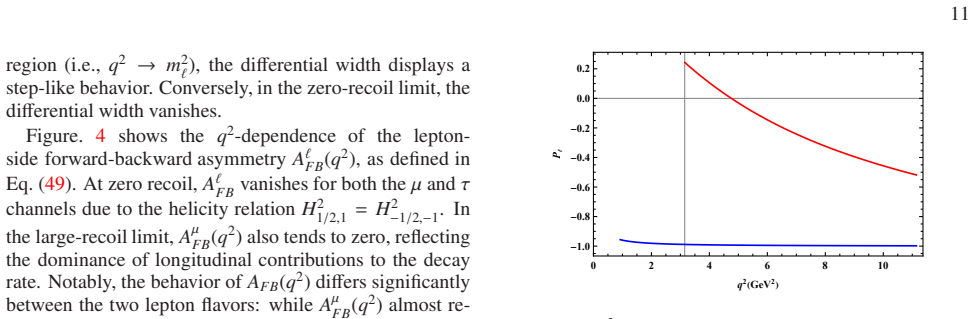
- The full set of angular observables — forward-backward asymmetry, lepton and baryon polarizations, and convexity parameter — is now predicted across the entire q² range for e, μ, and τ modes, with the τ-mode forward-backward asymmetry changing sign near q² ≈ 8.5 GeV².
- The predicted branching fractions are B(Λb→Λc μ ν̄) = (5.8^{+1.5}_{-2.0})×10⁻² and B(Λb→Λc τ ν̄) = (1.7^{+0.4}_{-0.5})×10⁻², consistent within uncertainties with other model predictions.
- f1 and g1 dominate the rates and grow with q², while f2,3 and g2,3 stay small, matching HQET expectations.
Where Pith is reading between the lines
- The same pQCD-plus-z-expansion matching recipe could be applied to other heavy-baryon semileptonic decays, such as Ξb→Ξc, where lattice data are sparser; the machinery transfers directly.
- The 0.35σ upward shift of R_Λc means the current central values are not discriminating; pinning the LCDA shape parameter β_Q with lattice moments would determine whether the mild excess over LHCb is real.
- A dedicated measurement of the τ-mode forward-backward asymmetry's zero-crossing would separate this form-factor set from quark-model sets that show different q² dependence.
Editorial analysis
A structured set of objections, weighed in public.
Referee Report
Summary. This paper presents a leading-order kT-factorized pQCD calculation of the six Λb→Λc form factors at q^2=0, using model light-cone distribution amplitudes for Λb and Λc, with Sudakov resummation and the simplification S_t=1. The low-q^2 results are extrapolated to the full kinematic range by a one-coefficient z-expansion whose endpoints are the pQCD values at q^2=0 and lattice QCD values at q^2_max quoted from Ref. [6]. The resulting form factors are then used to compute branching fractions, R_Λc = 0.29^{+0.12}_{-0.11}, and several angular observables, and the results are compared with LHCb and with quark-model, sum-rule, and lattice predictions.
Significance. The paper supplies a useful independent low-q^2 anchor for Λb→Λc form factors and a complete phenomenological prediction. It is transparent in reporting the amplitude decomposition, diagram symmetries, and analytic hard-scattering functions in the Appendix, and it explicitly acknowledges the dominant LCDA-model uncertainty. The main quantitative claim, R_Λc = 0.29, is not forced by construction, since the lattice anchor lies at q^2_max and the pQCD input comes from an independent calculation. However, the quoted uncertainty budget omits the sizable lattice endpoint uncertainties, and the two-point fit cannot validate the z-shape; these issues affect the headline number and need correction.
major comments (3)
- [IV, Eq. (33), Table II] The lattice values in Eq. (33) are quoted with asymmetric uncertainties (e.g., f1 +0.106/-0.163, g1 +0.074/-0.139), but Table II reports symmetric a1/b1 errors with no indication that these lattice uncertainties were propagated. The text says only that pQCD-side parameters (β_Q, m_c, t) are varied. Since the fit is anchored at q^2_max, treating the lattice point as exact necessarily underpredicts the error on the z-curve and hence on R_Λc and the branching fractions. Please propagate the lattice covariance, including the asymmetric errors, and state whether the central values also shift. This is load-bearing for the central prediction.
- [IV, Eq. (31)] The 'z-expansion' uses a single free coefficient per form factor, with pole masses m_Bc*(1-)=6.336 GeV and m_Bc*(1+)=6.745 GeV fixed from Ref. [7]. The fit therefore has exactly two effective constraints per form factor (q^2=0 and q^2_max) and cannot detect an inconsistency in the assumed pole factors or in the linear z-term. Ref. [6] provides lattice form factors across the kinematic range; using a subset of interior points, or at least testing the fit against one additional point, would turn the model-independent claim into a checkable statement. At present the predicted R_Λc central value rests on an unchecked interpolation between two endpoints.
- [III, Eq. (20); IV parameter-variation text] The numerical analysis is not reproducible as written: no central values are given for the LCDA shape parameters β_b in Eq. (20) and the analogous β_c, nor for m_c, and the phrase 'varying β_Q and m_c within a 10% range' is the only prescription. Since the authors identify the LCDA shape parameter as the dominant form-factor uncertainty (up to 23%), a table with the adopted central values and their provenance (quark model, sum rules, previous pQCD fits) is needed. This is also necessary for the reader to judge whether a 10% variation brackets the actual model uncertainty.
minor comments (5)
- [IV, Eq. (31)] The notation z(q^2,0)-z(0,t0) is ambiguous because z is defined with two arguments. It should be written z(q^2,t0)-z(0,t0), and the numerical value of t0 should be specified.
- [Summary] 'Lepton flavor violating ratio' should read 'lepton flavor universality ratio'.
- [Figs. 3-7] Figure captions use color labels such as 'pink (solid)' while the plotted curves appear red; adding a legend and consistent color names would improve clarity.
- [Throughout] There are several typographical and grammatical issues, e.g., 'In additional', 'C hina' in the author block, and the phrase 'the final state hadron polarization'.
- [Table IV] The caption lists ⟨Γ⟩ in units of 10^-15 GeV without stating the q^2 integration range used for each lepton mode; this should be stated explicitly.
Circularity Check
No significant circularity: the pQCD form factors and the z-expansion anchored to external lattice data are self-contained; self-citations are not load-bearing.
full rationale
The derivation chain is not circular. The six q^2=0 form factors are computed from the explicit factorization formula in Eq. (25), using the stated hard-scattering amplitudes, Sudakov factors, and the phenomenological LCDA model of Eq. (20); no target observable such as R_Lambda_c or the branching fractions is used to fix anything in this step. The q^2 dependence is then obtained through the z-series parameterization in Eq. (31), where the single coefficient (a1 or b1) per form factor is determined by the pQCD value at q^2=0 and the lattice values at q^2_max quoted in Eq. (33). This is a two-point interpolation using an external lattice input (Detmold et al.) and external pole masses from Ref. [7]; it is not a fit to the branching fractions or to R_Lambda_c. The predicted R_Lambda_c = 0.29^{+0.12}_{-0.11} is an integral over the interpolated form factors and is therefore not equal to any fitted input by construction. The author self-citations (Refs. [9], [16], [22]) are background/framework citations; the central pQCD calculation is carried out in this paper rather than imported from those works. The acknowledged limitations—LCDA model dependence, neglected higher-twist and NLO corrections, and the concern that lattice uncertainties at q^2_max are not propagated into the quoted errors—are accuracy and robustness issues, not circularity: the paper does not claim to predict the lattice endpoint, and no equation reduces the headline result to its own inputs.
Axiom & Free-Parameter Ledger
free parameters (10)
- LCDA shape parameter beta_Q (for Lambda_b and Lambda_c) =
central values not quoted; varied within 10%
- Charm quark mass m_c =
central value not quoted; varied within 10%
- a1 for f1 =
-9.73 (+1.98/-2.32)
- a1 for f2 =
-17.37 (+3.75/-5.21)
- a1 for f3 =
-15.96 (+5.04/-5.49)
- b1 for g1 =
-8.34 (+1.83/-3.28)
- b1 for g2 =
-18.91 (+5.49/-6.09)
- b1 for g3 =
-16.35 (+4.61/-5.37)
- Pole masses m_{B_c^*}(1-) and m_{B_c^*}(1+) =
6.336 GeV and 6.745 GeV
- Sudakov parameter kappa =
1.14
axioms (5)
- domain assumption pQCD factorization for the Lambda_b to Lambda_c matrix element (Eq. 8)
- ad hoc to paper Leading-twist LCDA model in Eq. (20) with no higher-twist terms
- ad hoc to paper S_t(x) = 1 simplification for the threshold resummation
- ad hoc to paper Single-pole plus one-coefficient z-expansion (Eq. 31)
- standard math Sudakov and resummation formulas from standard pQCD (Eqs. 9-17)
Cite this review
Pith. "Pith review of Investigation of $\Lambda_{b}\to \Lambda_{c} \ell^-\overline\nu_\ell$ Decays in Perturbative QCD Approach." pith.science (2026). https://pith.science/paper/QLMKL4RN
@misc{pith2026250902257,
  author       = {Pith},
  title        = {Pith review of: Investigation of $\Lambda_b\to \Lambda_c \ell^-\overline\nu_\ell$ Decays in Perturbative QCD Approach},
  year         = {2026},
  howpublished = {\url{https://pith.science/paper/QLMKL4RN}},
  note         = {Machine review of arXiv:2509.02257}
}
abstract
We investigate the semileptonic decays $\Lambda_{b} \to \Lambda_{c} \ell^- \bar{\nu}_\ell$ (with $\ell = e, \mu, \tau$) within the framework of perturbative QCD (pQCD). The six independent $\Lambda_b \to \Lambda_c$ transition form factors are first calculated in the low-$q^2$ region using the $k_T$ factorization approach. These are then extrapolated to the full physical $q^2$ range via the model-independent $z$-expansion, incorporating recent lattice QCD results at high $q^2$. Based on the obtained form factors, we compute the branching fractions of $\Lambda_b \to \Lambda_c \ell^- \bar{\nu}_\ell$ decays. Our prediction for the lepton flavor universality ratio, $\mathcal{R}_{\Lambda_c} = 0.29^{+0.12}_{-0.11}$, is slightly larger than the latest experimental measurement. In addition, we analyze several angular observables, including forward-backward asymmetries, lepton-side convexity parameters, and polarization asymmetries. These results offer valuable theoretical input for current and future experimental investigations of semileptonic heavy-to-heavy baryon transitions.
Figures




Forward citations
Cited by 4 Pith papers
-
Heavy quark mass dependence of the $\Lambda_Q$ light-cone distribution amplitude in QCD
The Lambda_Q baryon LCDA at mass m_Q equals (m_Q/m_Q^0)^2 times the LCDA at m_Q^0 evaluated at rescaled fractions x_i*m_Q/m_Q^0, times an exponentiated anomalous dimension, plus renormalon-model power corrections.
-
Analysis of the semileptonic decays $\Sigma_b\to\Sigma_cl\bar{\nu}_l$, $\Xi'_b\to\Xi'_cl\bar{\nu}_l$ and $\Omega_b\to\Omega_cl\bar{\nu}_l$ in QCD sum rules
QCD sum-rule calculations predict Σ_b→Σ_c, Ξ'_b→Ξ'_c and Ω_b→Ω_c semileptonic widths that differ by less than 13%, supporting approximate SU(3) flavor symmetry.
-
Analysis of the semileptonic decays $\Lambda_b\to\Lambda_cl\bar{\nu}_l$ and $\Xi_b\to\Xi_cl\bar{\nu}_l$ in QCD sum rules
A QCD sum rule analysis that includes negative parity baryon states and condensates up to dimension 8 obtains Lambda_b semileptonic branching ratios near 8 percent and predicts Xi_b rates near 14 percent.
-
Analysis of the semileptonic decays $\Sigma_b\to\Sigma_cl\bar{\nu}_l$, $\Xi'_b\to\Xi'_cl\bar{\nu}_l$ and $\Omega_b\to\Omega_cl\bar{\nu}_l$ in QCD sum rules
Electroweak form factors for Σ_b→Σ_c, Ξ'_b→Ξ'_c and Ω_b→Ω_c transitions are computed in QCD sum rules, producing decay widths that approximately obey SU(3) flavor symmetry along with branching ratios and new-physics p...
Reference graph
Works this paper leans on
-
[1]
m2 Λb (1 − x1)x′ 3 m2 Λb (1 − x′ 1) T2 m2 Λb x3 x′ 3 m2 Λb (1 − x1)(1 − x′
-
[2]
(29) and the angular integration over the relative orientations in transverse (b-)space is given by [Dθ] = dθ1dθ2dθ3. (30) The hard function BTi originates from the Fourier trans- formation of denominators of the internal propagators in diagram Ti, while HTi FJ denotes the hard scattering ampli- tude, which depends on the spinor structures of the valence ...
-
[3]
correspond to the spectator u (d) quarks in the Λb and Λc baryons, respectively. The xi and x′ i denote the lon- gitudinal momentum fractions of the valence quarks,and kiT, k′ iT represent their transverse momenta. These mo- menta satisfy the following conservation relations: x1 + x2 + x3 = 1, k1T + k2T + k3T = 0, (7) and the same conditions hold for the ...
-
[4]
f1(q2) and g1(q2) show sim- ilar q2 dependence and dominate over other four form fac- tors
As it is expected from weak decays, the form factors demonstrate a good behavior that their magnitudes grow gradually with increasing q2. f1(q2) and g1(q2) show sim- ilar q2 dependence and dominate over other four form fac- tors. V . ANALYSIS OF Λb → Λcℓ− ¯νℓ In the section, we shall explore the phenomenological applications of the obtained Λb → Λc form f...
-
[5]
Aaij et al., Observation of the decay Λ0 b → Λ+ cτ− ντ, Phys
LHCb Collaboration, R. Aaij et al., Observation of the decay Λ0 b → Λ+ cτ− ντ, Phys. Rev. Lett. 128 (2022), no. 19 191803, [arXiv:2201.03497]
arXiv 2022
-
[6]
m2 Λb (1 − x1)x′ 3 m2 Λb (1 − x′ 1) T3 m2 Λb x3 x′ 3 m2 Λb x2 x′ 2 m2 Λb (x2 + x′ 3 − x2 x′
-
[7]
m2 Λb (1 − x′ 1) T5 m2 Λb x3 x′ 3 m2 Λb x2 x′ 2 m2 Λb (x′ 2 + x3 − x′ 2 x3) m2 Λb [ r2 c + (1 − x′ 2)(x3 − r2) ] T6 m2 Λb x3 x′ 3 m2 Λb (1 − x1)(1 − x′
-
[8]
m2 Λb (1 − x1)x′ 3 m2 Λb ( 1 + r2 c − r2 − x1 ) T7 m2 Λb x3 x′ 3 m2 Λb (1 − x1)(1 − x′
-
[9]
m2 Λb (1 − x′ 1)x3 m2 Λb ( 1 + r2 c − r2 − x1 ) T9 m2 Λb x3 x′ 3 m2 Λb x2 x′ 2 m2 Λb ( 1 + r2 c − r2 − x1 ) m2 Λb [ r2 c + x2 + r2(x′ 3 − 1) − x2 x′ 3 ] TABLE VI: The expressions of BTi for diagrams T1, T2, T3, T5, T6, T7, T9 in Fig.1. Ti BTi T1 1 (2π)4 K0( √tA|b2 − b3|)K0( √tB|b3 + b′ 3 − b′ 2|)K0( √ tC|b2 − b3 + b′ 2 − b′ 3|)K0( √ tD|b3 + b′ 3|) T2 1 (2...
-
[10]
(A15) The formulas of the hard scatter function Hk(xi, x′ i) from the Feynman diagrams are as below HT1 f1 =HT1 g1 = 8m2 Λb { x′ 3 (2r − 1) − (x1 − 1) x′ 1 (r − 2) r } , (A16) HT1 f2 =HT1 f3 = 8m4 Λb (r2 − 1){(x′ 1 − 1)(1 − x1) (r − 2) r}, (A17) 14 HT1 g2 =HT1 g3 = 8m4 Λb (r2 − 1){(x′ 1 − 1)(x1 − 1) (r − 2) r}, (A18) HT2 f1 =HT2 g1 = −8m4 Λb { x′ 1 ( r2 −...
-
[11]
(rc + 2))+ (x′ 2 − 1)(x′ 2 − 2 (rc + 1))r + x′ 2rc } , (A25) HT5 f2 = 4m4 Λb (r2 − 1)2 { (r − 1) r ( r2 + 1 ) x′2 2 − rcx′ 2 + 2r ( −r2 + x3 + 1 ) (r − rc) + r (−3r + (r − 1) (r (r − rc) − 2x3) + 3rc + 1) x′ 2 } , (A26) HT5 f3 = −4m4 Λb (1 − r2)2 (r − 1) { − 2 ( r2 + 1 ) x2 3 + 2r ( (r + 1) ( r2 − rcr + 2rc + 2 ) − x′ 2 (r + 1)2) x3 + x′2 2 r ( r2 + 1 )2 ...
-
[12]
Heavy Flavor Averaging Group (HFLA V)Collaboration, S. Banerjee et al., Averages of b-hadron, c-hadron, and τ-lepton properties as of 2023 , [arXiv:2411.18639]
Pith/arXiv arXiv 2023
-
[13]
F. U. Bernlochner, Z. Ligeti, M. Papucci, and D. J. Robinson, Combined analysis of semileptonic B decays to D and D ∗: R (D(∗)), |Vcb|, and new physics , Phys. Rev. D 95 (2017), no. 11 115008, [ arXiv:1703.05330]. [Erratum: Phys.Rev.D 97, 059902 (2018)]
Pith/arXiv arXiv 2017
-
[14]
B. Capdevila, A. Crivellin, and J. Matias, Review of semileptonic B anomalies, Eur . Phys. J. ST1 (2023) 20, [arXiv:2309.01311]
Pith/arXiv arXiv 2023
-
[15]
S. Bifani, S. Descotes-Genon, A. Romero Vidal, and M.-H. Schune, Review of Lepton Universality tests in B decays , J. Phys. G 46 (2019), no. 2 023001, [ arXiv:1809.06229]
Pith/arXiv arXiv 2019
-
[16]
J.-J. Han, Y . Li, H.-n. Li, Y .-L. Shen, Z.-J. Xiao, and F.-S. Y u,Λb → p transition form factors in perturbative QCD , Eur . Phys. J. C82 (2022), no. 8 686, [arXiv:2202.04804]
work page internal anchor Pith review Pith/arXiv arXiv 2022
-
[17]
W. Detmold, C. Lehner, and S. Meinel, Λb → pℓ− ¯νℓ and Λb → Λcℓ− ¯νℓ form factors from lattice QCD with relativistic heavy quarks, Phys. Rev. D 92 (2015), no. 3 034503, [arXiv:1503.01421]
Pith/arXiv arXiv 2015
-
[18]
F. U. Bernlochner, Z. Ligeti, D. J. Robinson, and W. L. Sutcliffe, Precise predictions for Λb → Λc semileptonic decays, Phys. Rev. D 99 (2019), no. 5 055008, [arXiv:1812.07593]
Pith/arXiv arXiv 2019
-
[19]
H.-H. Duan, Y .-L. Liu, and M.-Q. Huang, Light-cone sum rule analysis of semileptonic decays Λ0 b →Λ+ cℓ− νℓ, Eur . Phys. J. C 82 (2022), no. 10 951, [ arXiv:2204.00409]
work page internal anchor Pith review Pith/arXiv arXiv 2022
-
[20]
X.-L. Mu, Y . Li, Z.-T. Zou, and B. Zhu, Investigation of effects of new physics in Λb → Λcτ¯ντ decay, Phys. Rev. D 100 (2019), no. 11 113004, [ arXiv:1909.10769]
work page internal anchor Pith review Pith/arXiv arXiv 2019
-
[21]
M. Fedele, M. Blanke, A. Crivellin, S. Iguro, T. Kitahar a, U. Nierste, and R. Watanabe, Impact of Λb → Λcτν measurement on new physics in b → clν transitions, Phys. Rev. D 107 (2023), no. 5 055005, [ arXiv:2211.14172]
Pith/arXiv arXiv 2023
-
[22]
S. Nandi, S. Sahoo, and R. Sain, An imperative study of the angular observables in Λb → Λ+ c (→ Λπ+)ℓ− νℓ decay and probing the footprint of new physics , JHEP 11 (2024) 053, [arXiv:2403.12155]
Pith/arXiv arXiv 2024
-
[23]
Li, QCD aspects of exclusive B meson decays , Prog
H.-n. Li, QCD aspects of exclusive B meson decays , Prog. Part. Nucl. Phys. 51 (2003) 85–171, [ hep-ph/0303116]
Pith/arXiv arXiv 2003
-
[24]
Y .-Y . Keum, H.-n. Li, and A. I. Sanda, Fat penguins and imaginary penguins in perturbative QCD , Phys. Lett. B 504 (2001) 6–14, [ hep-ph/0004004]
Pith/arXiv arXiv 2001
-
[25]
C.-D. Lu, K. Ukai, and M.-Z. Yang, Branching ratio and CP violation of B →ππ decays in perturbative QCD approach, Phys. Rev. D 63 (2001) 074009, [hep-ph/0004213]
Pith/arXiv arXiv 2001
-
[26]
The $\Lambda_b\to pl{\bar\nu}$ decay in perturbative QCD
H.-H. Shih, S.-C. Lee, and H.-n. Li, The Λb → pℓ¯ν decay in perturbative QCD , Phys. Rev. D 59 (1999) 094014, [hep-ph/9810515]
work page internal anchor Pith review Pith/arXiv arXiv 1999
-
[27]
Y .-M. Wang and Y .-L. Shen,Perturbative Corrections to Λb → ΛF orm Factors from QCD Light-Cone Sum Rules, JHEP 02 (2016) 179, [ arXiv:1511.09036]
Pith/arXiv arXiv 2016
-
[28]
J.-J. Lei Yang, Q. C. Han, and F.-S. Y u, The Λb → Λ transition form factors in perturbative QCD approach , [arXiv:2508.18069]
-
[29]
Applicability of perturbative QCD to $\Lambda_b \to \Lambda_c$ decays
H.-H. Shih, S.-C. Lee, and H.-n. Li, Applicability of perturbative QCD to Λb → Λc decays, Phys. Rev. D 61 (2000) 114002, [hep-ph/9906370]
work page internal anchor Pith review Pith/arXiv arXiv 2000
-
[30]
C.-D. Lu, Y .-M. Wang, H. Zou, A. Ali, and G. Kramer, Anatomy of the PQCD approach to the Baryonic Decays Λb → pπ, pK, Phys. Rev. D 80 (2009) 034011, [ arXiv:0906.1479]
Pith/arXiv arXiv 2009
-
[31]
\Lambda_b \to \Lambda J/\psi decay in perturbative QCD
C.-H. Chou, H.-H. Shih, S.-C. Lee, and H.-n. Li, Λb → ΛJ/ψ decay in perturbative QCD , Phys. Rev. D 65 (2002) 074030, [hep-ph/0112145]
work page internal anchor Pith review Pith/arXiv arXiv 2002
-
[32]
C.-Q. Zhang, J.-M. Li, M.-K. Jia, and Z. Rui, Nonleptonic two-body decays of Λb → Λcπ, Λb → ΛcK in the perturbative QCD approach, Phys. Rev. D 105 (2022), no. 7 073005, [ arXiv:2202.09181]
work page internal anchor Pith review Pith/arXiv arXiv 2022
-
[33]
Z. Rui, Z.-T. Zou, Y . Li, and Y . Li, Semileptonic baryon decays Ξb → Ξcℓ− ¯νℓ in perturbative QCD, Phys. Rev. D 111 (2025), no. 11 113006, [ arXiv:2503.23920]
Pith/arXiv arXiv 2025
- [34]
-
[35]
T. Kurimoto, H.-n. Li, and A. I. Sanda, Leading power contributions to B →π,ρ transition form-factors, Phys. Rev. D 65 (2002) 014007, [ hep-ph/0105003]
Pith/arXiv arXiv 2002
-
[36]
Y .-M. Wang, Y .-L. Shen, and C.-D. Lu,Λb → p, Λ transition form factors from QCD light-cone sum rules , Phys. Rev. D 80 (2009) 074012, [arXiv:0907.4008]
Pith/arXiv arXiv 2009
-
[37]
A. Khodjamirian, C. Klein, T. Mannel, and Y . M. Wang, F orm Factors and Strong Couplings of Heavy Baryons from QCD Light-Cone Sum Rules , JHEP 09 (2011) 106, [ arXiv:1108.2971]
Pith/arXiv arXiv 2011
-
[38]
$\Lambda_b \to p l^- \bar{\nu}$ form factors from lattice QCD with static b quarks
W. Detmold, C. J. D. Lin, S. Meinel, and M. Wingate, Λb → pl− ¯νℓ form factors from lattice QCD with static b quarks, Phys. Rev. D 88 (2013), no. 1 014512, [arXiv:1306.0446]
work page internal anchor Pith review Pith/arXiv arXiv 2013
-
[39]
Y . Miao, H. Deng, K.-S. Huang, J. Gao, and Y .-L. Shen, Λb → Λc form factors from QCD light-cone sum rules* , Chin. Phys. C 46 (2022), no. 11 113107, [arXiv:2206.12189]
work page internal anchor Pith review Pith/arXiv arXiv 2022
-
[40]
J. Botts and G. F. Sterman, Hard Elastic Scattering in QCD: Leading Behavior, Nucl. Phys. B 325 (1989) 62–100
work page 1989
-
[41]
The perturbative proton form factor reexamined
B. Kundu, H.-n. Li, J. Samuelsson, and P . Jain, The Perturbative proton form-factor reexamined, Eur . Phys. J. C 8 (1999) 637–642, [ hep-ph/9806419]
work page internal anchor Pith review Pith/arXiv arXiv 1999
-
[42]
Exclusive Semi-Leptonic Decays of b-Baryons into Protons
W. Loinaz and R. Akhoury, Exclusive semileptonic decays of b baryons into protons , Phys. Rev. D 53 (1996) 1416–1424, [ hep-ph/9505378]
work page internal anchor Pith review Pith/arXiv arXiv 1996
-
[43]
Relativistic Constituent Quark Model for Baryons
F. Schlumpf, Relativistic constituent quark model for baryons, [hep-ph/9211255]
work page internal anchor Pith review Pith/arXiv arXiv
-
[44]
X.-G. He, T. Li, X.-Q. Li, and Y .-M. Wang, Calculation of BR( ¯B → Λ+ c + ¯p) in the PQCD approach , Phys. Rev. D 75 (2007) 034011, [ hep-ph/0607178]
work page internal anchor Pith review Pith/arXiv arXiv 2007
-
[45]
P . Ball, V . M. Braun, and E. Gardi, Distribution Amplitudes of the Lambda(b) Baryon in QCD , Phys. Lett. B 665 (2008) 197–204, [ arXiv:0804.2424]
Pith/arXiv arXiv 2008
-
[46]
G. Bell, T. Feldmann, Y .-M. Wang, and M. W. Y . Yip, Light-Cone Distribution Amplitudes for Heavy-Quark Hadrons, JHEP 11 (2013) 191, [ arXiv:1308.6114]
Pith/arXiv arXiv 2013
-
[47]
A. Ali, C. Hambrock, and A. Y . Parkhomenko, Light-cone wave functions of heavy baryons , Theor . Math. Phys.170 (2012) 2–16. 16
work page 2012
-
[48]
Y .-S. Li, X. Liu, and F.-S. Y u,Revisiting semileptonic decays of Λb(c) supported by baryon spectroscopy, Phys. Rev. D 104 (2021), no. 1 013005, [ arXiv:2104.04962]
work page internal anchor Pith review Pith/arXiv arXiv 2021
-
[49]
Effects of vector leptoquarks on $ \Lambda_b \rightarrow \Lambda_c~\ell ~ \overline{\nu}_\ell$ decay
K. Azizi, A. T. Olgun, and Z. Tavuko˘ glu, Effects of vector leptoquarks on Λb → Λcℓ¯νℓ decay, Chin. Phys. C 45 (2021), no. 1 013113, [ arXiv:1912.03007]
work page internal anchor Pith review Pith/arXiv arXiv 2021
-
[50]
Meinel, Λc → Λl+νl form factors and decay rates from lattice QCD with physical quark masses , Phys
S. Meinel, Λc → Λl+νl form factors and decay rates from lattice QCD with physical quark masses , Phys. Rev. Lett. 118 (2017), no. 8 082001, [ arXiv:1611.09696]
Pith/arXiv arXiv 2017
-
[51]
T. Gutsche, M. A. Ivanov, J. G. K¨ orner, V . E. Lyubovitskij, and P . Santorelli,Heavy-to-light semileptonic decays of Λb and Λc baryons in the covariant confined quark model , Phys. Rev. D 90 (2014), no. 11 114033, [arXiv:1410.6043]. [Erratum: Phys.Rev.D 94, 059902 (2016)]
Pith/arXiv arXiv 2014
-
[52]
T. Gutsche, M. A. Ivanov, J. G. K¨ orner, V . E. Lyubovitskij, P . Santorelli, and N. Habyl, Semileptonic decay Λb → Λc +τ− + ¯ντ in the covariant confined quark model , Phys. Rev. D 91 (2015), no. 7 074001, [arXiv:1502.04864]. [Erratum: Phys.Rev.D 91, 119907 (2015)]
Pith/arXiv arXiv 2015
-
[53]
Z.-X. Zhao, R.-H. Li, Y .-L. Shen, Y .-J. Shi, and Y .-S. Yang, The semi-leptonic form factors of Λb → Λc and Ξb → Ξc in QCD sum rules , Eur . Phys. J. C80 (2020), no. 12 1181, [arXiv:2010.07150]
Pith/arXiv arXiv 2020
-
[54]
J. Zhu, Z.-T. Wei, and H.-W. Ke, Semileptonic and nonleptonic weak decays of Λ0 b, Phys. Rev. D 99 (2019), no. 5 054020, [ arXiv:1803.01297]
Pith/arXiv arXiv 2019
-
[55]
R. N. Faustov and V . O. Galkin, Semileptonic decays of Λb baryons in the relativistic quark model , Phys. Rev. D 94 (2016), no. 7 073008, [ arXiv:1609.00199]
Pith/arXiv arXiv 2016
-
[56]
and Eq.( 45). Over the full q2 range accessible in the τ mode, Cτ F remains small, indicating that the cos θℓ distribution is nearly linear. In contrast, for the µ-mode, Cµ F can become significantly negative, corresponding to a strongly parabolic angular distribution characterized by a downward-opening curvature. 0 2 4 6 8 10 -0.4 -0.3 -0.2 -0.1 0.0 0.1 0...
-
[57]
H.-W. Ke, X.-Q. Li, and Z.-T. Wei, Diquarks and Λb → Λc weak decays, Phys. Rev. D 77 (2008) 014020, [arXiv:0710.1927]
Pith/arXiv arXiv 2008
-
[58]
Zhao, W eak decays of heavy baryons in the light-front approach, Chin
Z.-X. Zhao, W eak decays of heavy baryons in the light-front approach, Chin. Phys. C 42 (2018), no. 9 093101, [arXiv:1803.02292]
Pith/arXiv arXiv 2018
-
[59]
Color-allowed Bottom Baryon to $s$-wave and $p$-wave Charmed Baryon non-leptonic Decays
C.-K. Chua, Color-allowed bottom baryon to s-wave and p-wave charmed baryon nonleptonic decays , Phys. Rev. D 100 (2019), no. 3 034025, [ arXiv:1905.00153]
work page internal anchor Pith review Pith/arXiv arXiv 2019
-
[60]
H.-W. Ke, N. Hao, and X.-Q. Li, Revisiting Λb → Λc and Σb → Σc weak decays in the light-front quark model , Eur . Phys. J. C 79 (2019), no. 6 540, [ arXiv:1904.05705]
work page internal anchor Pith review Pith/arXiv arXiv 2019
-
[61]
Semileptonic $\Lambda_{b}\rightarrow \Lambda_{c}{\ell}\bar\nu_{\ell}$ Transition in Full QCD
K. Azizi and J. Y . S¨ ung¨ u,Semileptonic Λb → Λcℓ¯νℓ Transition in Full QCD, Phys. Rev. D 97 (2018), no. 7 074007, [arXiv:1803.02085]
work page internal anchor Pith review Pith/arXiv arXiv 2018
-
[62]
$\Lambda_b \to \Lambda_c \tau \bar{\nu}_{\tau}$ Decay in the Standard Model and with New Physics
S. Shivashankara, W. Wu, and A. Datta, Λb → Λcτ¯ντ Decay in the Standard Model and with New Physics , Phys. Rev. D 91 (2015), no. 11 115003, [ arXiv:1502.07230]. [Erratum: Phys.Rev.D 109, 119904 (2024)]
work page internal anchor Pith review Pith/arXiv arXiv 2015
-
[63]
$\Lambda_b \to (\Lambda_c,\,p)\,\tau\,\nu$ decays within standard model and beyond
R. Dutta, Λb → (Λc, p)τν decays within standard model and beyond, Phys. Rev. D 93 (2016), no. 5 054003, [arXiv:1512.04034]
work page internal anchor Pith review Pith/arXiv arXiv 2016
-
[64]
Endpoint Symmetries of Helicity Amplitudes
R. Zwicky, Endpoint symmetries of helicity amplitudes , Nucl. Phys. B 975 (2022) 115673, [arXiv:1309.7802]
work page internal anchor Pith review Pith/arXiv arXiv 2022
-
[65]
G. Hiller and R. Zwicky, Endpoint relations for baryons , JHEP 11 (2021) 073, [ arXiv:2107.12993]
Pith/arXiv arXiv 2021
-
[66]
M. A. Ivanov, J. G. K¨ orner, and C.-T. Tran, Analyzing new physics in the decays ¯B0 → D(∗)τ− ¯ντ with form factors obtained from the covariant quark model , Phys. Rev. D 94 (2016), no. 9 094028, [ arXiv:1607.02932]
Pith/arXiv arXiv 2016
This paper was first reviewed by deepseek-v4-flash on August 5, 2026.
discussion (0)
Sign in with ORCID, Apple, or X to comment. Anyone can read and Pith papers without signing in.