REVIEW 2 major objections 4 minor 1 cited by
Sub-GeV dark matter, not heavy dark matter, may be what quark stars need to fit every astrophysical constraint.
Reviewed by Pith at T0; open to challenge. T0 means a machine referee read the full paper against a public rubric. the ladder, T0–T4 →
A model of quark stars with a variable dark matter density profile claims sub-GeV dark matter can satisfy all current compact star constraints.
T0 review reviewed 2026-08-05 challenge →
load-bearing objection Fresh idea for DM in quark stars, but the dark-sector EoS is undefined in the core because k_Fχ exceeds Λ_SD, which sinks the main astrophysical claim. the 2 major comments →
Role of density profile of sub-GeV dark matter in the properties of dark matter admixed quark stars with Bayesian analysis of dark-NJL model
The pith
A machine-rendered reading of the paper's core claim, the machinery that carries it, and where it could break.
The reading
Core claim
The central claim is that in quark stars built from NJL strange quark matter with contact-type four-Fermi interactions in the dark sector, only sub-GeV dark matter masses (100-150 MeV) yield equations of state compatible with current compact-star observations. The dark-matter density is not constant but follows the parameterized profile ρχ = ρsc α (e^{ρ/ρsc} - 1), which makes the dark-matter Fermi momentum density-dependent and avoids the thermodynamic inconsistency of constant-density treatments. With the dark-sector couplings fixed by relic abundance, self-interaction bounds, and direct-detection exclusions, the authors find massive 5 GeV dark matter softens the EoS and cannot reach the ob
What carries the argument
The dark-NJL Lagrangian combines the NJL quark model with scalar and vector four-Fermi terms in the dark sector and between dark matter and quarks. The density-profile ansatz ρχ = ρsc α (e^{ρ/ρsc} − 1) is the mechanism that makes the dark-matter fraction grow toward the core and sets the density dependence of the dark-matter Fermi momentum k_Fχ = (6π² ρχ / γχ)^{1/3}. The benchmark parameters mχ, Λ_SD, Λ_VD, Λ_SqD, and Λ_VqD are fixed by relic density, self-interaction, and direct-detection constraints, and the f-mode frequencies are obtained from the Regge-Wheeler perturbed metric with both Cowling approximation and full general-relativistic treatment.
Load-bearing premise
The dark-matter self-interaction cutoff Λ_SD must stay above the dark-matter Fermi momentum k_Fχ at every density inside the star; if k_Fχ exceeds the cutoff, the integrals defining the dark-matter equation of state have a lower limit above their upper limit and are undefined.
What would settle it
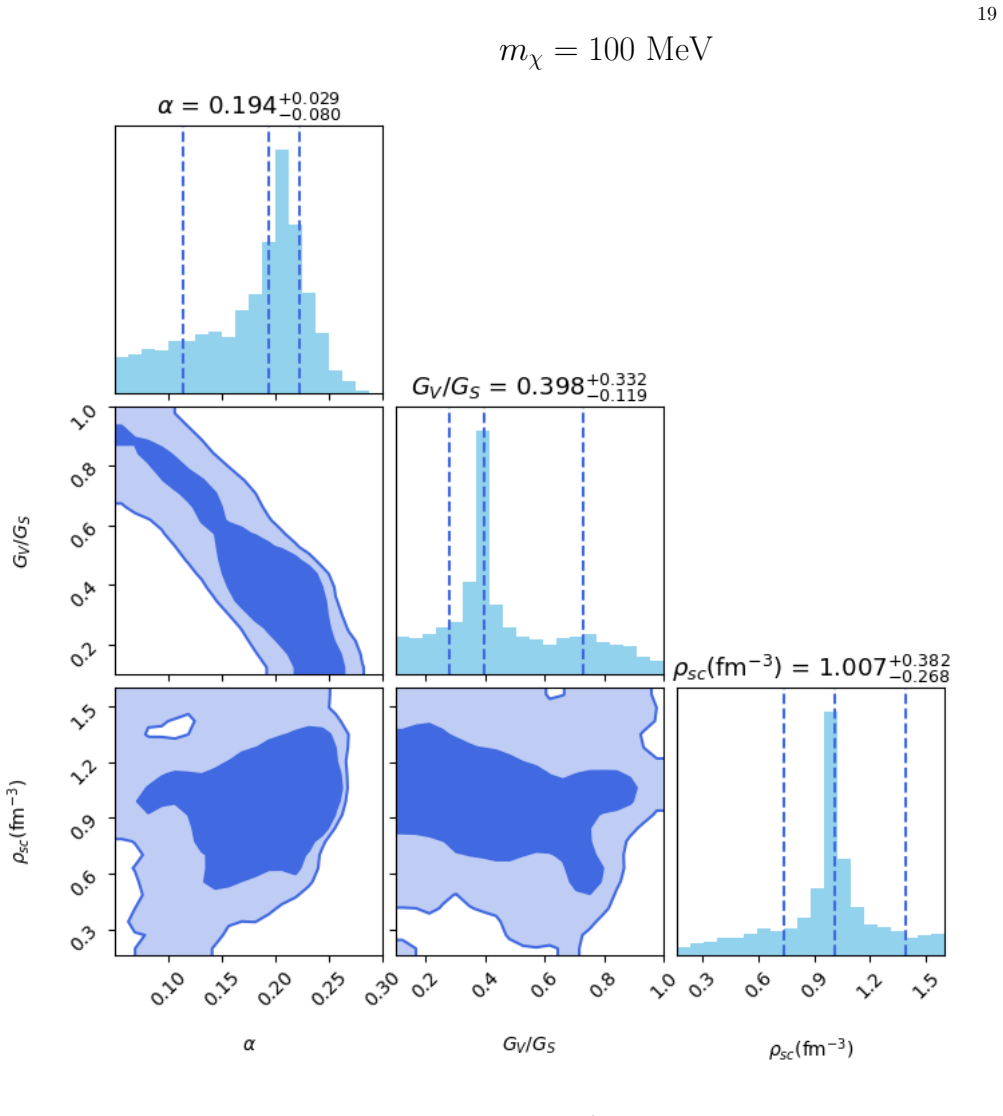
Evaluate k_Fχ = (6π² ρχ / γχ)^{1/3} with ρχ from Eq. (18) using the Bayesian best-fit α ≈ 0.194 and ρsc ≈ 1.0 fm⁻³ at baryon densities of 0.5-1 fm⁻³, and compare the result with Λ_SD = 0.041 GeV for mχ = 100 MeV. If k_Fχ exceeds Λ_SD anywhere in the star, the claimed equation of state is not evaluated in its valid domain and the structural and oscillation results need to be recomputed.
If this is right
- If correct, contact-interacting GeV-scale dark matter is disfavored in strange quark stars not only by direct-detection experiments but also by the observed pulsar masses, since it softens the equation of state below the 2.08 solar-mass maximum.
- Sub-GeV dark matter with a density profile concentrated toward the core can rescue the NJL quark-star model, which alone is too soft to satisfy the maximum-mass constraint.
- The f-mode frequency of dark-matter-admixed quark stars is tied to compactness, mean density, and tidal deformability through universal relations that are insensitive to the dark-matter mass, the coupling ratio, and the profile parameter α.
- Gravitational waves from f-mode oscillations of such stars, powered by glitch energies of 10^42-10^44 erg at distances of 1-10 kpc, would be within reach of next-generation detectors.
- The Bayesian posteriors constrain α ≈ 0.19-0.20, GV/GS ≈ 0.40-0.41, and ρsc ≈ 1.0 fm⁻³, with the optimized set almost independent of dark-matter mass in the 100-150 MeV window.
Where Pith is reading between the lines
- A quark-star candidate with mass near 2.1 solar masses and radius near 12 km would, under this model, point toward a non-negligible sub-GeV dark-matter component, since the NJL sector alone cannot reach that mass.
- The density-profile ansatz is one of several possible accretion-motivated profiles; substituting an isothermal or diffusion-based dark-matter distribution within the same Bayesian framework would test how robust the α ≈ 0.2 and ρsc ≈ 1 fm⁻³ posteriors are.
- The model assumes contact interactions, which correspond to heavy mediators; repeating the analysis with light-mediator or velocity-dependent self-interactions would change the momentum cutoffs and likely shift the allowed dark-matter mass window.
- A direct validity check is to compute k_Fχ from Eq. (18) at core densities and compare it with Λ_SD from Table II; if k_Fχ exceeds Λ_SD, the integrals in Eqs. (16) and (21) are evaluated outside their stated domain, and the equation of state needs recomputation.
Editorial analysis
A structured set of objections, weighed in public.
Referee Report
Summary. The paper constructs a 'dark-NJL' model of strange quark stars admixed with self-interacting fermionic dark matter. The quark sector is described by the NJL model; the dark sector has contact four-Fermi self-interactions and DM-quark interactions, with the DM number density tied to the baryon density through an assumed exponential profile with parameters (α, ρ_sc). The authors compute the EoS, solve the TOV equations for masses and radii, calculate tidal deformability, f-mode frequencies in both Cowling approximation and full general relativity, and perform a Bayesian analysis of (α, ρ_sc, G_V/G_S) against current pulsar and GW170817 constraints. They conclude that sub-GeV DM (mχ = 100–150 MeV) admixed strange quark stars satisfy all available astrophysical constraints, that 5 GeV DM cannot, and that the associated f-mode oscillations would be detectable by future gravitational-wave detectors.
Significance. If the calculation were well defined, the paper would be a useful contribution: it is among the first to treat contact-type four-Fermi interactions between DM and strange quark matter in a combined DNJL framework, it introduces a density-dependent DM profile intended to cure thermodynamic inconsistency, and it provides full GR f-mode results together with extensive comparisons with universal relations and projected detector sensitivities. The Bayesian pipeline with KDE likelihoods from multiple NICER and GW170817 data sets is also a strength. However, the central EoS calculation is invalid for the benchmark parameters: the dark-sector momentum cutoff is smaller than the DM Fermi momentum throughout the stellar interior, so the integrals defining the DM condensate and the DNJL energy density are undefined. Since every structural and oscillation result is built on this EoS, the main claims of the paper do not follow from the model as presented.
major comments (2)
- [Secs. III and VII; Eqs. (16), (18), (19), (21); Table II] The dark-sector EoS is not defined for the benchmark parameters. For mχ = 100 MeV, Table II gives Λ_SD = 0.041 GeV. At the MAP values α ≈ 0.2, ρ_sc ≈ 1 fm⁻³, and already at baryon density ρ ≈ ρ₀ ≈ 0.16 fm⁻³, Eq. (18) gives ρχ ≈ 0.035 fm⁻³, and Eq. (19) gives k_Fχ ≈ 200 MeV; at ρ ≈ 1 fm⁻³, k_Fχ ≈ 428 MeV. Thus k_Fχ exceeds Λ_SD by roughly a factor of five to ten over the entire density range used to construct the star. The integrals in Eqs. (16) and (21), whose lower limit is k_Fχ and upper limit is Λ_SD, therefore have a lower limit greater than their upper limit; the DM scalar condensate and the dark contribution to the energy density are undefined. The paper states no validity condition k_Fχ ≤ Λ_SD and offers no analytic continuation or alternative cutoff prescription. Because ε_DNJL and P_DNJL feed directly into the TOV equations, the mass–radius curves, tidal deformabilities, and f-m
- [Secs. V, VII.B, VII.D; Eqs. (29)–(34)] The statement that sub-GeV DM 'successfully concurs' with astrophysical constraints is a post-fit statement, not an independent prediction. The same M–R and tidal-deformability data listed in Table III are used as the likelihood to determine α, ρ_sc, and G_V/G_S, and the prior ranges in Sec. VII.D are themselves informed by the preliminary comparison with these data in Sec. VII.B. The agreement is therefore a parameter-estimation/viability result. This is not by itself a fatal flaw, but the abstract and conclusions should be reframed: the data exclude some parameter choices and select others, but they do not independently validate the model. In particular, the phrase 'successfully concur' overstates the evidential weight of the Bayesian analysis.
minor comments (4)
- [Eq. (7) and following text] The text says 'γq = γe = 2' after Eq. (7), but for the quark sum γq should be 6, as used in Eq. (5). This appears to be a typo, but it should be corrected to avoid confusion.
- [Fig. 9 and Eq. (36)] The polynomial fit coefficients for the Cowling case list a2 = 2.693 and a3 = 2.693 simultaneously; one of these is likely a typographical error. Please verify and correct.
- [Throughout] There are several naming/typographical issues: 'Nambu-Jona-Lasino' should be 'Nambu-Jona-Lasinio'; ''t Hooft' is typeset inconsistently; 'DMASQM' appears in Sec. III without definition. These are cosmetic but should be fixed.
- [Sec. III, Eq. (18)] The exponential DM density profile is introduced ad hoc. The paper should justify this functional form more explicitly and ideally compare it with profiles derived from accretion/thermalization models, and state what DM mass fraction it implies for the benchmark stars.
Circularity Check
Sub-GeV DM 'successful concurrence' is partly an in-sample fit because the Bayesian priors were set using the same M-R/Λ data; no definitional, self-citation, or uniqueness circularity.
specific steps
-
other
[Abstract; Sec. VII B; Sec. VII D]
"On the other hand, we find sub-GeV DM to successfully concur with such observational constraints. ... The results obtained in Sec. VII A and VII B guide us to set proper prior distributions for the three free parameters of our DNJL model, viz. GV/GS, α, and ρsc."
In Sec. VII B the authors scan α=0.1–0.3 and identify α=0.2 as the only value satisfying the same PSR/GW170817 M-R and Λ constraints for both GV/GS values. Sec. VII D then uses those results to set the uniform priors (α in 0.1–0.3, ρ_sc=0.16–1.6 fm^-3, GV/GS=0.3–0.5). The Bayesian posterior returns MAP α≈0.20, ρ_sc≈1.0, and the abstract reports that sub-GeV DM 'successfully concurs' with the constraints. Thus the reported agreement is in-sample: the successful parameter region was selected on the basis of the very data whose agreement is then presented as a finding. This is a fitted-parameter result, not an independent prediction. The exclusion of 5 GeV DM and the f-mode calculations are not circular, so the circularity is partial rather than total.
full rationale
The main derivation (NJL quark EoS + four-Fermi DM sector -> TOV -> M-R/Λ -> f-mode) is self-contained and not circular: the EoS integrals, TOV equations, and oscillation codes are standard and do not encode the target constraints. No load-bearing self-citation or imported uniqueness theorem was found. The only notable circularity is statistical: the priors for the Bayesian analysis are informed by the same observational constraints that are later used to claim that sub-GeV DM 'successfully concurs'. This double use of the data makes the positive sub-GeV result partly in-sample, but it does not force the massive-DM exclusion or the f-mode detection prospects. A separate validity concern (not scored as circularity) is that for mχ=100 MeV the quoted Λ_SD≈0.041 GeV is much smaller than the DM Fermi momentum reached in the core, which would make the integrals in Eqs. (16) and (21) undefined; this is a correctness issue rather than a circularity.
Axiom & Free-Parameter Ledger
free parameters (6)
- alpha =
MAP 0.201 (m_chi=100 MeV), 0.212 (m_chi=150 MeV)
- rho_sc =
MAP 0.998 to 0.999 fm^-3
- G_V/G_S =
MAP 0.346 to 0.351
- m_chi =
100, 125, 150 MeV
- Lambda_SD, Lambda_VD =
0.041 to 0.045 GeV, 0.050 to 0.056 GeV
- Lambda_SqD, Lambda_VqD =
3.06 to 50.5 GeV depending on m_chi and channel
axioms (5)
- standard math NJL Lagrangian Eq. (1) with Hatsuda-Kunihiro parameters describes strange quark matter.
- ad hoc to paper The DM density profile rho_chi = rho_sc alpha (e^{rho/rho_sc} - 1) holds inside the star.
- domain assumption Contact four-Fermi EFT remains valid when the DM Fermi momentum is below the cutoff.
- domain assumption DM self-interaction cross section sigma/m = 1 cm^2/g.
- domain assumption The DM-quark couplings satisfy the relic density via MicrOMEGAs.
invented entities (1)
-
Variable DM density profile rho_chi = rho_sc alpha (e^{rho/rho_sc} - 1)
no independent evidence
Cite this review
Pith. "Pith review of Role of density profile of sub-GeV dark matter in the properties of dark matter admixed quark stars with Bayesian analysis of dark-NJL model." pith.science (2026). https://pith.science/paper/53TJF3B4
@misc{pith2026250902325,
  author       = {Pith},
  title        = {Pith review of: Role of density profile of sub-GeV dark matter in the properties of dark matter admixed quark stars with Bayesian analysis of dark-NJL model},
  year         = {2026},
  howpublished = {\url{https://pith.science/paper/53TJF3B4}},
  note         = {Machine review of arXiv:2509.02325}
}
abstract
We investigate the structural and oscillation properties of dark matter (DM) admixed strange quark stars (DMSQSs). The strange quark matter (SQM) is described with the well-known Nambu-Jona-Lasino (NJL) model and the self-interacting fermionic DM is included in a systematic manner. The self-interaction of DM is of four-Fermi type and the overall DM density is considered as a function of the baryon density of SQM with two free parameters ($\alpha$, $\rho_{sc}$). This work is the first to consider four-Fermi interactions between fermionic DM and SQM in DMSQSs. Certain experiments like LZ, XENON, DarkSide, CRESST, and LHC have almost ruled out the possibility of contact interaction between SQM and massive DM (in GeV order). Recently, the quest for sub-GeV DM has garnered significant attention. We show that recent astrophysical constraints on the structural properties of compact stars also do not support the presence of massive DM in DMSQSs. On the other hand, we find sub-GeV DM to successfully concur with such observational constraints. We also calculate the fundamental $f$-mode frequency ($f_f$) of the DMSQSs, which shows universality with compactness, mean density, and tidal deformability. Further, we investigate the prospect of detection of $f_f$ with respect to the projected sensitivity of upcoming gravitational wave detectors like aLIGO, A+, Cosmic Explorer, and Einstein Telescope. In our DMSQS model, the three free parameters are $\alpha$, $\rho_{sc}$, and the ratio of repulsive to attractive interaction in SQM ($G_V/G_S$), which are optimized by Bayesian analysis in light of various recent astrophysical data.
Figures



Forward citations
Cited by 1 Pith paper
-
Bayesian analysis of density profile of light dark matter elucidating the properties of dark matter admixed neutron stars in the presence of hyperons
Bayesian analysis finds that the likely ranges of light dark-matter fermion mass and exponential density-profile parameter in hyperon-containing neutron stars are nearly independent of the hadronic model for symmetry-...
Reference graph
Works this paper leans on
-
[1]
Once the TOV Eqs
Cowling approximation In order to calculate the oscillation frequencies of the non-radial oscillation of compact stars, a widely used approx- imation is known as the Cowling approximation which ignores the metric perturbations. Once the TOV Eqs. (24 -
-
[2]
(A5) Here, H0, H1, and K are the metric perturbation functions; ω is the complex oscillation frequency
General relativistic approach The line element for the perturbed Regge-Wheeler metric is given as ds2 = − e2Φ(1 + rlH0Y l meiωt)dt2 − 2iωrl+1H1Y l meiωtdtdr + e2λ(1 − rlH0Y l meiωt)dr2 + r2(1 − rlKY l meiωt)(dθ2 + sin2 θdϕ2). (A5) Here, H0, H1, and K are the metric perturbation functions; ω is the complex oscillation frequency. On the other hand, the pert...
-
[3]
T. E. Riley et al., Astrophys. J. Lett. 918, L27 (2021), arXiv:2105.06980 [astro-ph.HE]
Pith/arXiv arXiv 2021
-
[4]
E. Fonseca et al., Astrophys. J. Lett. 915, L12 (2021), arXiv:2104.00880 [astro-ph.HE]
Pith/arXiv arXiv 2021
-
[5]
M. C. Miller et al., Astrophys. J. Lett. 918, L28 (2021), arXiv:2105.06979 [astro-ph.HE]
Pith/arXiv arXiv 2021
-
[6]
M. C. Miller et al., Astrophys. J. Lett. 887, L24 (2019), arXiv:1912.05705 [astro-ph.HE]
Pith/arXiv arXiv 2019
-
[7]
B. P. Abbott et al. (LIGO Scientific, Virgo), Phys. Rev. Lett. 121, 161101 (2018), arXiv:1805.11581 [gr-qc]
Pith/arXiv arXiv 2018
-
[8]
T. E. Riley et al., Astrophys. J. Lett. 887, L21 (2019), arXiv:1912.05702 [astro-ph.HE]
Pith/arXiv arXiv 2019
-
[9]
V. Doroshenko, V. Suleimanov, G. P¨ uhlhofer, and A. Santangelo, Nature Astronomy 6, 1444 (2022), arXiv:2303.10264 [astro-ph.HE]
Pith/arXiv arXiv 2022
-
[10]
D. Choudhury et al., Astrophys. J. Lett. 971, L20 (2024), arXiv:2407.06789 [astro-ph.HE]
Pith/arXiv arXiv 2024
-
[11]
T. Salmi et al., Astrophys. J. 976, 58 (2024), arXiv:2409.14923 [astro-ph.HE]
Pith/arXiv arXiv 2024
-
[12]
Nambu and G
Y. Nambu and G. Jona-Lasinio, Phys. Rev. 124, 246 (1961)
1961
-
[13]
A. V. Olinto, Phys. Lett. B 192, 71 (1987)
1987
-
[14]
Nambu and G
Y. Nambu and G. Jona-Lasinio, Phys. Rev. 122, 345 (1961)
1961
-
[15]
Li, Z.-F
B.-L. Li, Z.-F. Cui, Z.-H. Yu, Y. Yan, S. An, and H.-S. Zong, Phys. Rev. D 99, 043001 (2019)
2019
-
[16]
Chodos, R
A. Chodos, R. L. Jaffe, K. Johnson, C. B. Thorn, and V. F. Weisskopf, Phys. Rev. D 9, 3471 (1974)
1974
-
[17]
G. Lugones and A. G. Grunfeld, Phys. Rev. D 107, 043025 (2023), arXiv:2209.03455 [nucl-th]
Pith/arXiv arXiv 2023
-
[18]
Hatsuda and T
T. Hatsuda and T. Kunihiro, Phys. Lett. B 198, 126 (1987)
1987
-
[19]
Z. H. Luo, J. B. Wei, G. Chen, H. Chen, and H. J. Schulze, Mod. Phys. Lett. A 34, 1950202 (2019). 25
2019
-
[20]
Kumari and A
M. Kumari and A. Kumar, Eur. Phys. J. C 81, 791 (2021)
2021
-
[21]
T. Hatsuda and T. Kunihiro, Phys. Rept. 247, 221 (1994), arXiv:hep-ph/9401310
Pith/arXiv arXiv 1994
-
[22]
Vogl and W
U. Vogl and W. Weise, Prog. Part. Nucl. Phys. 27, 195 (1991)
1991
-
[23]
S. P. Klevansky, Rev. Mod. Phys. 64, 649 (1992)
1992
-
[24]
K. Masuda, T. Hatsuda, and T. Takatsuka, PTEP 2013, 073D01 (2013), arXiv:1212.6803 [nucl-th]
Pith/arXiv arXiv 2013
-
[25]
M. Kitazawa, T. Koide, T. Kunihiro, and Y. Nemoto, Prog. Theor. Phys. 108, 929 (2002), [Erratum: Prog.Theor.Phys. 110, 185–186 (2003)], arXiv:hep-ph/0207255
Pith/arXiv arXiv 2002
-
[26]
(A2) For solving the Eqs
are solved, we obtain the oscillation mode frequencies by solving the two following coupled differential equations: dW (r) dr = dε(r) dP (r) " ω2r2eλ(r)−2Φ(r)V (r) + dΦ(r) dr W (r) # − l(l + 1)eλ(r)V (r), (A1) dV (r) dr = 2 dΦ(r) dr V (r) − eλ(r) W (r) r2 . (A2) For solving the Eqs. (A1) and (A2), the two boundary conditions are imposed at the center ( r ...
-
[27]
L. L. Lopes and D. P. Menezes, Nucl. Phys. A 1009, 122171 (2021), arXiv:2004.07909 [astro-ph.HE]
Pith/arXiv arXiv 2021
- [28]
-
[29]
A. Guha, D. Sen, and C. H. Hyun, Eur. Phys. J. C 85, 442 (2025), arXiv:2412.18569 [hep-ph]
Pith/arXiv arXiv 2025
-
[30]
S. H. Yang and C. M. Pi, JCAP 09, 052 (2024), arXiv:2402.14262 [astro-ph.HE]
Pith/arXiv arXiv 2024
-
[31]
Z. Rezaei, Mon. Not. Roy. Astron. Soc. 524, 2015 (2023), arXiv:2306.17665 [astro-ph.HE]
arXiv 2015
-
[32]
G. Panotopoulos and I. Lopes, Phys. Rev. D 96, 083013 (2017), arXiv:1709.06643 [gr-qc]
Pith/arXiv arXiv 2017
-
[33]
H. Zheng and L.-W. Chen, Astrophys. J. 831, 127 (2016), arXiv:1603.07518 [nucl-th]
Pith/arXiv arXiv 2016
-
[34]
P. Mukhopadhyay and J. Schaffner-Bielich, Phys. Rev. D 93, 083009 (2016), arXiv:1511.00238 [astro-ph.HE]
Pith/arXiv arXiv 2016
-
[35]
J. C. Jim´ enez and E. S. Fraga, Universe8, 34 (2022), arXiv:2111.00091 [hep-ph]
Pith/arXiv arXiv 2022
-
[36]
S.-H. Yang, C.-M. Pi, and X.-P. Zheng, Phys. Rev. D 104, 083016 (2021), arXiv:2103.05159 [astro-ph.HE]
Pith/arXiv arXiv 2021
-
[37]
Mafa Takisa, L
P. Mafa Takisa, L. L. Leeuw, and S. D. Maharaj, Astrophys. Space Sci. 365, 164 (2020)
2020
-
[38]
Panotopoulos and I
G. Panotopoulos and I. Lopes, Phys. Rev. D 98, 083001 (2018)
2018
-
[39]
G. Panotopoulos and I. Lopes, Int. J. Mod. Phys. D 27, 1850093 (2018), arXiv:1804.05023 [gr-qc]
Pith/arXiv arXiv 2018
-
[40]
Exotic Compact Objects with Two Dark Matter Fluids
M. Cassing, A. Brisebois, M. Azeem, and J. Schaffner-Bielich, Astrophys. J. 944, 130 (2023), arXiv:2210.13697 [gr-qc]
work page internal anchor Pith review Pith/arXiv arXiv 2023
-
[41]
Strange magnetars admixed with fermionic dark matter
O. Ferreira and E. S. Fraga, JCAP 04, 012 (2023), arXiv:2209.10959 [hep-ph]
work page internal anchor Pith review Pith/arXiv arXiv 2023
- [42]
-
[43]
Exploring the Structural Properties of Anisotropic Dark Matter-Admixed Quark Stars
G. Panotopoulos, ´A. Rinc´ on, and I. Lopes, Phys. Dark Univ. 49, 101972 (2025), arXiv:2505.20545 [gr-qc]
work page internal anchor Pith review Pith/arXiv arXiv 2025
-
[44]
Dark matter effects on the properties of quark stars and the implications for the peculiar objects
H.-M. Liu, P.-C. Chu, H. Liu, X.-H. Li, and Z.-H. Li, (2025), arXiv:2501.04382 [nucl-th]
work page internal anchor Pith review Pith/arXiv arXiv 2025
-
[45]
O. P. Jyothilakshmi, L. J. Naik, D. Sen, A. Guha, and V. Sreekanth, Eur. Phys. J. C 85, 461 (2025), arXiv:2410.20923 [hep-ph]
Pith/arXiv arXiv 2025
-
[46]
Zhen, T.-T
Y. Zhen, T.-T. Sun, J.-B. Wei, Z.-Y. Zheng, and H. Chen, Symmetry 16, 807 (2024)
2024
-
[47]
D. Sen and A. Guha, Mon. Not. Roy. Astron. Soc. 517, 518 (2022), arXiv:2209.09021 [hep-ph]
Pith/arXiv arXiv 2022
-
[48]
L. L. Lopes and H. C. Das, JCAP 05, 034 (2023), arXiv:2301.00567 [astro-ph.HE]
work page internal anchor Pith review Pith/arXiv arXiv 2023
-
[49]
L. L. Lopes, Astrophys. Space Sci. 370, 79 (2025), arXiv:2501.06379 [astro-ph.HE]
Pith/arXiv arXiv 2025
- [50]
-
[51]
D. Sen and A. Guha, Mon. Not. Roy. Astron. Soc. 504, 3354 (2021), arXiv:2104.06141 [hep-ph]
Pith/arXiv arXiv 2021
-
[52]
A. Guha and D. Sen, Phys. Rev. D 109, 043038 (2024), arXiv:2401.14419 [astro-ph.HE]
Pith/arXiv arXiv 2024
-
[53]
D. Sen and A. Guha, Phys. Rev. D 110, 103013 (2024), arXiv:2409.18890 [hep-ph]
Pith/arXiv arXiv 2024
-
[54]
G. Panotopoulos and I. Lopes, Phys. Rev. D 96, 083004 (2017), arXiv:1709.06312 [hep-ph]
Pith/arXiv arXiv 2017
-
[55]
A. Kumar and H. Sotani, Phys. Rev. D 111, 043016 (2025), arXiv:2501.07052 [astro-ph.HE]
Pith/arXiv arXiv 2025
-
[56]
G. Baym, D. H. Beck, P. Geltenbort, and J. Shelton, Phys. Rev. Lett. 121, 061801 (2018), arXiv:1802.08282 [hep-ph]
Pith/arXiv arXiv 2018
-
[57]
W. Husain and A. W. Thomas, J. Phys. G 50, 015202 (2023), arXiv:2206.11262 [hep-ph]
Pith/arXiv arXiv 2023
-
[58]
Hajkarim, J
F. Hajkarim, J. Schaffner-Bielich, and L. Tolos, Journal of Cosmology and Astroparticle Physics 2025, 070 (2025)
2025
-
[59]
J. Aalbers et al. (LZ), Phys. Rev. Lett. 134, 241801 (2025), arXiv:2503.18158 [hep-ex]
Pith/arXiv arXiv 2025
-
[60]
X. Cui et al. (PandaX-II), Phys. Rev. Lett. 128, 171801 (2022), arXiv:2112.08957 [hep-ex]
Pith/arXiv arXiv 2022
-
[61]
D. S. Akerib et al. (LUX), Phys. Rev. Lett. 122, 131301 (2019), arXiv:1811.11241 [astro-ph.CO]
Pith/arXiv arXiv 2019
-
[62]
A. Guha and J.-C. Park, JCAP 07, 074 (2024), arXiv:2401.07750 [hep-ph]
Pith/arXiv arXiv 2024
-
[63]
R. K. Leane and J. F. Beacom, (2025), arXiv:2503.09685 [hep-ph]
arXiv 2025
-
[64]
B. Dutta, W.-C. Huang, D. Kim, J. L. Newstead, J.-C. Park, and I. S. Ali, Phys. Rev. Lett. 133, 161801 (2024), arXiv:2402.04184 [hep-ph]
Pith/arXiv arXiv 2024
-
[65]
D. Lee et al., Commun. Phys. 8, 135 (2025), arXiv:2409.15748 [hep-ex]
Pith/arXiv arXiv 2025
-
[66]
J. H. Kim, K. Kong, S. H. Lim, and J.-C. Park, JCAP 04, 016 (2025), arXiv:2410.05382 [hep-ph]
Pith/arXiv arXiv 2025
-
[67]
H. Alhazmi, D. Kim, K. Kong, G. Mohlabeng, J.-C. Park, and S. Shin, (2025), arXiv:2503.13598 [hep-ph]
Pith/arXiv arXiv 2025
-
[68]
A. K. Mishra, N. Liu, and C.-T. Lu, Phys. Dark Univ. 49, 102050 (2025), arXiv:2504.03409 [hep-ph]
Pith/arXiv arXiv 2025
-
[69]
J. Aalbers et al. (LZ), Phys. Rev. Lett. 131, 041002 (2023), arXiv:2207.03764 [hep-ex]
Pith/arXiv arXiv 2023
-
[70]
E. Aprile et al. (XENON), Phys. Rev. Lett. 122, 141301 (2019), arXiv:1902.03234 [astro-ph.CO]
Pith/arXiv arXiv 2019
-
[71]
P. Agnes et al. (DarkSide), Phys. Rev. Lett. 121, 081307 (2018), arXiv:1802.06994 [astro-ph.HE]
Pith/arXiv arXiv 2018
-
[72]
A. H. Abdelhameed et al. (CRESST), Phys. Rev. D 100, 102002 (2019), arXiv:1904.00498 [astro-ph.CO]
Pith/arXiv arXiv 2019
-
[73]
A. Roy, B. Dasgupta, and M. Guchait, JHEP 08, 095 (2024), arXiv:2402.17265 [hep-ph]
Pith/arXiv arXiv 2024
-
[74]
S. Tulin, H.-B. Yu, and K. M. Zurek, Phys. Rev. D 87, 115007 (2013), arXiv:1302.3898 [hep-ph]
Pith/arXiv arXiv 2013
-
[75]
S. Tulin and H.-B. Yu, Phys. Rept. 730, 1 (2018), arXiv:1705.02358 [hep-ph]
Pith/arXiv arXiv 2018
-
[76]
G. Belanger, F. Boudjema, A. Pukhov, and A. Semenov, Comput. Phys. Commun. 185, 960 (2014), arXiv:1305.0237 [hep-ph]
Pith/arXiv arXiv 2014
-
[77]
K. D. Kokkotas and B. G. Schmidt, Living Rev. Rel. 2, 2 (1999), arXiv:gr-qc/9909058
Pith/arXiv arXiv 1999
-
[78]
T. M. Belloni, M. M´ endez, and C. Zhang, eds., Timing Neutron Stars: Pulsations, Oscillations and Explosions, Vol. 461 26 (Springer, 2020)
2020
-
[79]
B. P. Abbott et al. (KAGRA, LIGO Scientific, Virgo), Living Rev. Rel. 19, 1 (2016), arXiv:1304.0670 [gr-qc]
Pith/arXiv arXiv 2016
-
[80]
“A+,” https://dcc.ligo.org/LIGO-T1800042/public
This paper was first reviewed by deepseek-v4-flash on August 5, 2026.
discussion (0)
Sign in with ORCID, Apple, or X to comment. Anyone can read and Pith papers without signing in.