General Relativity and Quantum Cosmology Areas of gravitational physics, including experiments and observations related to the detection and interpretation of gravitational waves, experimental tests of gravitational theories, computational general relativity, relativistic astrophysics, solutions to Einstein's equations and their properties, alternative theories of gravity, classical and quantum cosmology, and quantum gravity.
We initiate the study of gravitational-wave lensing in the wave-optics regime within modified gravity. We consider a phenomenological setup in which the gravitational-wave amplitude obeys a curvature-coupled propagation equation. This framework reproduces the standard GR behaviour in the geometric-optics regime, while leading to qualitatively different infrared dynamics. In particular, the usual argument implying that the amplification factor approaches unity in the zero-frequency limit no longer applies. This is due to the persistence of curvature-induced interactions in the infrared, which modify the natural propagation basis itself. As a result, the standard Fresnel treatment ceases to be valid at sufficiently low frequency. The correct infrared regime is instead controlled by an interacting static Green function, with a finite-frequency completion provided by a partial-wave formulation. We show that this structure admits an equivalent distorted-wave interpretation, in which the curvature interaction is absorbed into a dressed reference propagation basis, while the residual lensing effect is encoded in finite-frequency phase shifts. We further demonstrate that these phenomena admit a natural interpretation in the language of scattering amplitudes. Wave-optics lensing can therefore probe propagation-level departures from GR that remain entirely invisible in geometric optics.
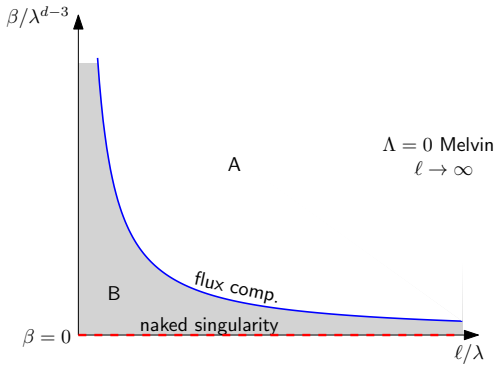
This is the first part of a series of papers proving the nonlinear stability of a one-parameter family of continuously self-similar $C^{1,\alpha}$ naked singularity solutions, with $0<\alpha\ll1$, to the spherically symmetric Einstein-scalar field equations. The stability holds for initial perturbations lying in a small open neighborhood of the data generating these naked singularity solutions, measured in a localized H\"older topology.
These continuously self-similar naked singularity spacetimes were previously constructed by Christodoulou [D. Christodoulou, Examples of naked singularity formation in the gravitational collapse of a scalar field, Ann. of Math. 140 (1994), 607--653], who also proved their instability to black hole formation under sufficiently rough perturbations [D. Christodoulou, The instability of naked singularities in the gravitational collapse of a scalar field, Ann. of Math. 149 (1999), 183--217], thereby verifying weak cosmic censorship within a rough functional framework.
In complete contrast, in this paper, we obtain the first nonlinear stability of these naked singularity spacetimes under general perturbations of the same regularity as the background. We rely on the linearized stability result established in the companion paper [J. Singh and W. Zheng, Nonlinear stability of continuously self-similar naked singularities for the Einstein--scalar field equations II: linearized stability]. Our result underscores the decisive role of the functional framework in formulating the Weak Cosmic Censorship conjecture.
GW240925 and GW250207 are two loud gravitational-wave signals from binary black hole coalescences observed with network signal-to-noise ratios $\sim 32$ and $\sim 69$, respectively, by the LIGO Hanford--LIGO Livingston--Virgo network. Gravitational-wave signals from coalescing binaries have characteristic phase and amplitude evolution predicted by general relativity. These signal waveforms, together with measured instrumental calibration uncertainties, are used to infer source parameters. However, for sufficiently loud detections it is possible to constrain the calibration of the detectors directly using the signals themselves. We present the first informative astrophysical measurements of gravitational-wave detector calibration. For GW240925, we verify the inference of Hanford calibration from the astrophysical signal through cross-checks with known calibration errors obtained from in-situ measurements. At the time of GW250207, the Hanford detector was not fully stabilized, leading to elevated calibration uncertainties; thus, astrophysical calibration is essential to obtain accurate data and to enable source localization. These well-localized, high signal-to-noise observations have the potential to offer precise measurements of source properties, stringent tests of general relativity, and informative dark siren measurements, provided that calibration uncertainties are properly incorporated. As detector sensitivity improves, astrophysical calibration will become an increasingly valuable complement to in-situ calibration measurements. Obtaining accurate calibration will be essential for precision gravitational-wave science.
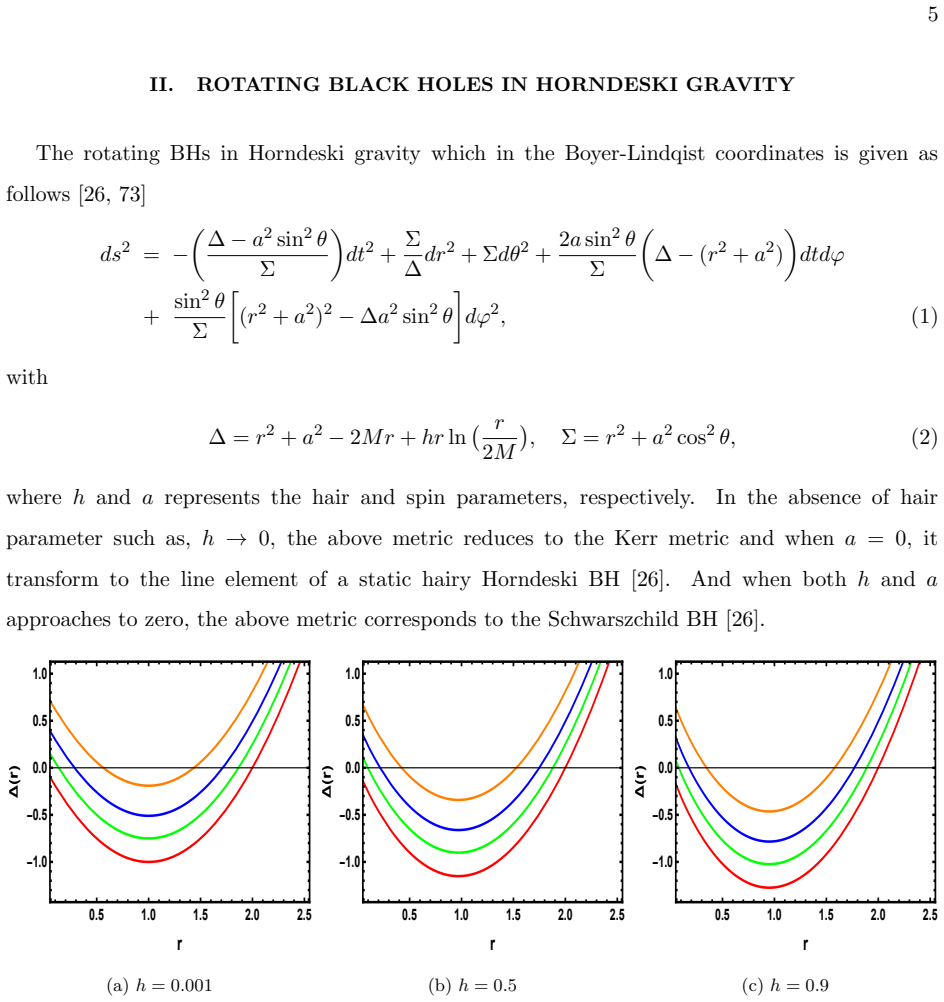
We construct two families of regular hairy black holes within gravitational decoupling using a fixed exponential deformation profile for an effective tensor-vacuum sector. The first family is generated from a Bardeen-type seed and produces a de Sitter-like core. The second family is generated from a hollow seed with an asymptotically Minkowski core so that the central density vanishes and no de Sitter core is produced. For each branch we determine the critical deformation strengths separating horizonless, extremal, and two-horizon geometries in the static case, and we obtain the corresponding Kerr-like rotating extension by promoting the mass parameter to the deformed mass function. Representative parameter choices are used to illustrate the horizon structure and to verify the weak energy condition in the exterior region.
Thanks to feeble interactions, neutrinos show special advantages in the field of quantum information (QM). The properties of quantum correlations (QCs) are fundamental for neutrino-based QM. In this paper, we investigate the influence of the Kerr--Newman metric on QCs by varying the metric parameters, namely the mass $M$, angular momentum per unit mass $a$, and charge $Q$. Both radial and non-radial neutrino propagation are considered under the weak-field approximation. The results show that, for inward propagation in the Kerr--Newman metric, the oscillation probabilities and QCs differ significantly from those obtained in the Schwarzschild metric. In the case of radial outward propagation, the angular momentum $a$ increases the oscillation period of the neutrino survival probability $P_{ee}$, entanglement, and nonlocality, whereas the charge $Q$ decreases the corresponding periods. For non-radial propagation, the modulation effects of $M$ and $a$ on the oscillation patterns of both probabilities and QCs become more pronounced. As $M$ increases, the oscillation probability remains within a higher-value range, whereas tripartite entanglement exhibits the opposite trend. Furthermore, our results reveal that, despite differences in their variation ranges, entanglement and coherence exhibit highly consistent oscillation behaviors in both radial and non-radial propagation cases. These findings provide broader quantitative support for the potential use of neutrinos as quantum information resources.
We study axial gravitational perturbations of the asymptotically flat Bardeen spacetime interpreted as a string-T-duality-inspired quantum-corrected Schwarzschild black hole. Starting from the anisotropic-fluid background, we derive the Regge--Wheeler-type master equation and the corresponding effective potential, and compute quasinormal modes with high-order WKB--Pad\'e and time-domain methods. We show that increasing the quantum-correction scale $\ell_0$ raises and shifts the barrier inward, causing the black hole to ring at higher frequencies and decay more slowly. The same deformation suppresses low-frequency transmission, shifts the onset of grey-body factors to larger frequencies, and reorganizes the partial and total absorption cross-sections. Overall, the results identify a clear and consistent imprint of short-distance regularization on both ringdown and scattering observables.