REVIEW 4 major objections 5 minor 64 references
Two interacting scalar-torsion models realize the matter bounce: the Hubble rate crosses zero at t=0, the co-moving Hubble radius diverges, and the null energy condition is violated at the bounce.
Reviewed by Pith at T0; open to challenge. T0 means a machine referee read the full paper against a public rubric. the ladder, T0–T4 →
Two interacting scalar-torsion models are shown, by tuned numerical construction, to host a matter bounce with phantom equation of state and NEC violation at the bounce epoch.
T0 review reviewed 2026-08-05 challenge →
load-bearing objection A scalar-torsion bounce reconstruction whose central energy-condition claim is undercut by the unanalyzed matter sector and by malformed, unreproducible Klein-Gordon equations. the 4 major comments →
Bouncing Cosmology in Interacting Scalar-Torsion Gravity
The pith
A machine-rendered reading of the paper's core claim, the machinery that carries it, and where it could break.
The reading
Core claim
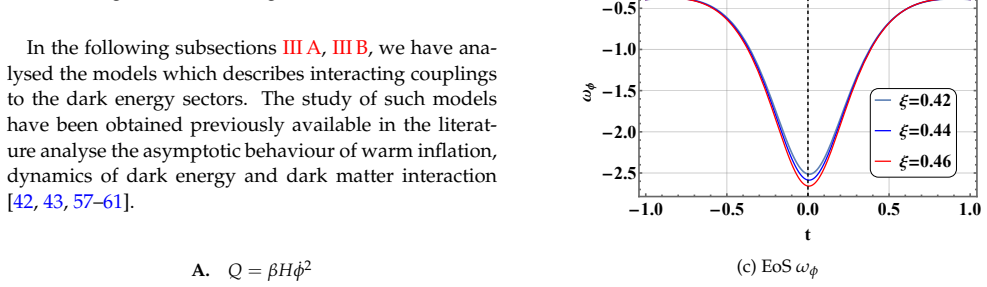
The paper's central claim is that both interacting models, Q=βHφdot² and Q=τHρφφdot², give a matter bounce in the scalar-torsion framework. With exponential potential V=γe^{-λφ}, nonminimal coupling ξf(φ)T (f(φ)=αφdot²), and the bounce scale factor a(t)=(1+3ηt²/4)^{1/3}, it solves the Klein-Gordon equation numerically for each coupling. The resulting H crosses zero at t=0, the co-moving Hubble radius diverges, the scalar pressure is negative, the EoS is phantom near the bounce, and the null and strong energy conditions are violated while the dominant condition holds. These results are offered as two concrete bouncing realizations in teleparallel gravity.
What carries the argument
The central object is the interacting scalar-torsion action: a teleparallel theory (gravity carried by torsion rather than curvature) with a canonical scalar field, exponential potential, and nonminimal coupling ξf(φ)T. The controlling mechanism is the interaction Q in the Klein-Gordon/continuity equations. For f(φ)=αφdot² and the matter-bounce scale factor a(t)=(1+3ηt²/4)^{1/3}, each chosen Q makes the scalar pressure negative and drives the equation of state into the phantom regime, which is the step that violates the null energy condition at the bounce.
Load-bearing premise
The central claim relies on the scalar-field sector alone testifying to the bounce: the coupled matter density and pressure are never solved for or added to the energy conditions, and the numerical Klein-Gordon solutions cannot be reproduced from the printed equations, so both the null-energy-condition violation and the plotted equation of state depend on unverified input.
What would settle it
A single calculation would settle the NEC claim: solve Eq. (14) for the matter density, add ρm+pm to the scalar-sector null energy condition, and check its sign near t=0; if the total is positive there, the claimed NEC violation fails. The numerical plots should also be reproducible from Eqs. (15)-(16) once explicit initial conditions are supplied.
If this is right
- Both couplings become concrete matter-bounce realizations in teleparallel gravity without invoking an inflationary phase.
- The first model is nearly symmetric around the bounce; the second is clearly asymmetric, and the small density bump at the bounce persists in both.
- The phantom equation of state at the bounce matches the violation of the null energy condition, satisfying the standard background diagnostics for nonsingular bouncing cosmologies.
- The divergence of the co-moving Hubble radius confirms that the chosen scale factor has the standard matter-bounce kinematics.
Where Pith is reading between the lines
- A direct extension would be to integrate the coupled matter continuity equation and plot ρm+pm alongside the scalar terms; the null-energy-condition statement would then apply to the total fluid rather than only the scalar sector.
- The same two couplings could be carried into linear perturbation theory; a viable nonsingular bounce also needs bounded perturbations, not just a background bounce.
- The asymmetry of the second model around t=0 is a distinguishing feature one could connect to observable differences between the contracting and expanding phases.
Editorial analysis
A structured set of objections, weighed in public.
Referee Report
Summary. The manuscript studies two interacting scalar-torsion dark-energy models, Q = βH φdot² and Q = τHρφ φdot², in a flat FLRW background. It posits the matter-bounce scale factor a(t) = (1 + 3ηt²/4)^(1/3), solves the Klein-Gordon equation numerically, and uses the resulting scalar-field density and pressure to plot the EoS parameter and the NEC, SEC, and DEC. The authors conclude that both models are suitable descriptions of the matter bounce, with the NEC violated near the bounce and the EoS parameter in the phantom regime there.
Significance. Bouncing cosmologies in teleparallel gravity are a timely topic, and the two interaction couplings are borrowed from existing dynamical-system studies, which gives the paper a plausible starting point. If the claims were supported by a correct and reproducible derivation, the paper would add two explicit interacting models to the scalar-torsion bounce literature. However, the manuscript as submitted does not provide reproducible numerics: the Klein-Gordon equations are malformed, the initial conditions are absent, and the energy-condition analysis omits the matter sector that is part of the same coupled system. These are not cosmetic issues; they directly affect the headline result.
major comments (4)
- [Sec. IV, Eqs. (13)–(14), Fig. 6] The energy-condition analysis uses only ρφ and pφ. But Q appears in both continuity equations, so ρm and pm evolve with the scalar field and enter the Friedmann constraint. Since H(0)=0 for the assumed scale factor, consistency requires ρm(0) = −ρφ(0); with ρφ(0) > 0 as shown in Fig. 3b, the matter density must be negative at the bounce. The paper never solves Eq. (14), never specifies an equation of state for matter, and never computes the total ρ+p or ρ+3p. The conclusion that the NEC is violated and that a NEC-violating fluid sources the bounce is therefore not established.
- [Sec. II, Eqs. (15)–(16)] The Klein-Gordon equations used for the numerics are not derivable from Eq. (12). Eq. (15) contains a term 24αηξ tφ whose origin is unclear; if f(φ)=α φdot², then f,φ is not a standard partial derivative, and the term is dimensionally inconsistent with the other terms. Eq. (16) is malformed: it has a stray uppercase Φ, a term (1/2)τφ² that does not follow from V(φ)=γe^{−λφ}, and γ(τ−λ)e^{−λφ} where Eq. (12) gives V,φ = −γλe^{−λφ}. As written, the numerical solutions in Figs. 3–5 cannot be reproduced or trusted.
- [Sec. III] The bounce is assumed through the ansatz a(t) = (1 + 3ηt²/4)^(1/3) and H(t) = 2ηt/(3ηt²+4). Consequently H=0 at t=0, the comoving Hubble radius 1/(aH) diverges, and the phantom EoS and NEC violation are inherited from the chosen kinematics. The paper should clearly frame this as a reconstruction on a fixed background, not as a derivation that the models dynamically produce the bounce. As it stands, the claim that these models are 'suitable' to describe the matter bounce rests on checking that a scalar-field solution exists for hand-picked parameters, not on the models predicting the bounce.
- [Sec. III A, III B] The numerical solutions are unreproducible because the initial conditions for φ(t0) and φdot(t0) are never stated, nor are the integration interval or solver. With free parameters η, α, γ, β, λ, ξ and two initial conditions left unspecified, the plots of φ, ρφ, pφ, ωφ, and the energy conditions cannot be checked by a reader.
minor comments (5)
- [Sec. II] The notation f(φ)=α φdot² is inconsistent: f is written as a function of φ but is defined through φdot. This should be clarified, since it affects the derivation of f,φ in Eqs. (11)–(12).
- [Abstract and throughout] There are numerous typographical and grammatical errors: 'equivalant', 'grater', 'summerised', 'behaiour', and the abstract's phrase 'one of the crucial result to establish bouncing behaviour is found to be obeyed'. These should be corrected.
- [Fig. 2] The horizontal axis label is missing (presumably t), and the y-axis label '1/(aH)' is placed awkwardly. Also, the divergence at t=0 is a property of the assumed scale factor, not a new result.
- [References] References [28] and [50] are the same paper and should be merged; several entries have incomplete page or article numbers.
- [Sec. IV] The energy conditions are defined for a perfect fluid with total ρ and p. The paper should state explicitly which energy-momentum tensor is used for the plots; currently the text implies, but does not state, that only the scalar sector is used.
Circularity Check
Bounce kinematics are assumed, phantom/NEC behavior is parameter-tuned, then presented as demonstrated; matter sector is omitted from the energy-condition sums.
specific steps
-
self definitional
[Sec. II (choice of scale factor) and Sec. III / Fig. 2]
"In this study we choose the matter bounce scale factor a(t) = [1 + 3ηt2/4 ]^1/3 to analyse the rate of evolution of the Universe. The Hubble parameter in this case will take the form H(t) = 2ηt/(3ηt2+4) ... The bouncing cosmological models, the Hubble parameter vanishes at the bounce, causing the co-moving Hubble radius rh = 1/(aH ) to diverge."
The scale factor and Hubble parameter are inserted as kinematic inputs, not derived from the field equations. The claimed 'demonstration' that H(t) crosses zero at t=0 and that 1/(aH) diverges is a direct differentiation of those assumed functions. The co-moving Hubble radius plot therefore validates exactly what was already posited; it is a restatement of the ansatz, not an independent check of the bounce.
-
fitted input called prediction
[Sec. III A (parameter choice) and Sec. IV / Fig. 6]
"within the parameter range ξ ∈ (0.42, 0.46), the EoS parameter demonstrates the most suitable behavior consistent with the requirements of a bouncing cosmological scenario [9–13]. ... It is observed from Fig. 6 that the NEC and the SEC are violated in the vicinity of the bounce epoch, while the DEC remains satisfied throughout the entire cosmic evolution."
The coupling ξ is not fixed by independent data or equations; the text explicitly scans it over a range selected because it yields the desired phantom EoS. The same tuned parameters then appear as the 'finding' that the NEC is violated at the bounce. At t=0, H=0 and Hdot=η/2, so the scalar-sector combination ρφ+pφ is controlled by the chosen signs and magnitudes of ξ, α, and η; the plotted NEC violation is therefore a consequence of the parameter choice, not a prediction.
-
other
[Sec. II Eqs. (13)–(14); Sec. IV Fig. 6]
"Q = ˙ρm + 3Hρm(1 + ωm). (14) ... It is observed from Fig. 6 that the NEC and the SEC are violated in the vicinity of the bounce epoch"
The energy-condition figures use only the scalar-field components ρφ and pφ. The matter sector obeys Eq. (14), but ρm and pm are never solved for, plotted, or added to ρφ and pφ. With the assumed H(t), the Friedmann constraint at t=0 gives ρm(0)=−ρφ(0); since the paper plots ρφ>0 at the bounce, consistency forces a negative matter energy density that is never discussed. The claimed total NEC violation is therefore not established by the provided derivation; it rests on an unstated assumption about the omitted matter sector.
full rationale
The paper is a reconstruction exercise: a specific matter-bounce scale factor is chosen, the Klein-Gordon equation is solved numerically, and the resulting scalar-field energy density and pressure are used to exhibit bounce diagnostics. This is a legitimate method in modified-gravity cosmology, but several of the advertised 'results' coincide by construction with the inputs. Specifically, H(t)=0 at t=0 and the divergence of 1/(aH) are immediate properties of the assumed a(t) and H(t), so Fig. 2 does not check the bounce scenario; it plots the ansatz. Likewise, the phantom EoS and NEC violation near the bounce are obtained after the text scans ξ over the interval that produces the 'most suitable' behavior, so the reported violation is a selected outcome rather than an independent consequence. The derivation chain is also incomplete: the interaction Q couples the scalar and matter sectors through Eqs. (13)–(14), but the energy-condition analysis in Fig. 6 includes only the scalar sector, leaving the total NEC undetermined unless the matter density and pressure are specified. There is no evidence of a load-bearing self-citation chain or imported uniqueness theorem; prior work by the authors is cited for the scale factor and the scalar-torsion framework, but those elements are not the source of the circularity. Overall, the central bounce and NEC-violation claims reduce, in large part, to the chosen kinematics and tuned parameters, warranting a score of 6.
Axiom & Free-Parameter Ledger
free parameters (8)
- η =
3.1
- α =
-0.44
- γ =
0.2
- λ =
-2.4
- β =
1.3
- ξ =
0.42-0.46 (scan, 'most suitable' range)
- τ =
0.2, 0.4, 0.6 (scan)
- Initial conditions φ(0), φdot(0) =
not stated
axioms (5)
- ad hoc to paper Matter bounce scale factor a(t) = (1 + 3ηt²/4)^(1/3) is assumed as the flat FLRW background.
- domain assumption Exponential potential V(φ) = γe^{-λφ} and coupling f(φ) = αφdot² give the relevant physics.
- domain assumption Interaction forms Q = βHφdot² and Q = τHρφφdot² are appropriate dark-sector couplings.
- standard math TEGR equivalence: T = -R + B and the tetrad diag(1,a,a,a) give the standard FLRW teleparallel background.
- ad hoc to paper NEC violation in the scalar sector alone suffices to establish the bounce sourcing.
Cite this review
Pith. "Pith review of Bouncing Cosmology in Interacting Scalar-Torsion Gravity." pith.science (2026). https://pith.science/paper/WWWQ5PQQ
@misc{pith2026250900308,
  author       = {Pith},
  title        = {Pith review of: Bouncing Cosmology in Interacting Scalar-Torsion Gravity},
  year         = {2026},
  howpublished = {\url{https://pith.science/paper/WWWQ5PQQ}},
  note         = {Machine review of arXiv:2509.00308}
}
read the original abstract
In this study we demonstrate the interacting teleparallel gravity models, to describe the matter bounce scenario. We discussed two interacting models and find both are suitable choice to describe the bouncing phenomena. The co-moving Hubble radius, is demonstrated to check the establishment of the matter bounce scenario. All the energy conditions and the behaviour of EoS parameter is analysed. The violation of NEC at bounce epoch is one of the crucial result to establish bouncing behaviour is found to be obeyed. The other energy conditions behaviour is in agreement with the EoS parameter which lies in the phantom region at the bounce epoch in both the models.
Figures




Reference graph
Works this paper leans on
-
[1]
Weinberg, Cosmology
S. Weinberg, Cosmology. Oxford University Press, U. K., 2008
2008
-
[2]
S. M. Carroll, W. H. Press, and E. L. Turner, “The cosmological constant,” Annual Review of Astronomy and Astrophysics 30 (1992) 499–542, arXiv:astro-ph/0004075 [astro-ph]
Pith/arXiv arXiv 1992
-
[3]
Inflationary universe: A possible solution to the horizon and flatness problems,
A. H. Guth, “Inflationary universe: A possible solution to the horizon and flatness problems,” Phys. Rev. D 23 (1981)
work page 1981
-
[4]
A. Linde, “A new inflationary universe scenario: A possible solution of the horizon, flatness, homogeneity, isotropy and primordial monopole problems,” Phys. Lett. B 108 (1982)
work page 1982
-
[5]
Eternal inflation and the initial singularity,
A. Borde and A. Vilenkin, “Eternal inflation and the initial singularity,” Phys. Rev. Lett. 72 (1994) , arXiv:gr-qc/9312022v1 [gr-qc]
Pith/arXiv arXiv 1994
-
[6]
Quantum nature of the big bang,
A. Ashtekar, T. Pawlowski, and P . Singh, “Quantum nature of the big bang,” Phys. Rev. Lett. 96 (2006) no. 14, , arXiv:gr-qc/0602086 [gr-qc]
Pith/arXiv arXiv 2006
-
[7]
Bounce cosmology in $f(\mathcal{R})$ gravity
M. Ilyas and W. U. Rahman, “Bounce cosmology in f (R) gravity,” Eur. Phys. J. C 81 (2021) no. 2, , arXiv:2102.03612v1 [gr-qc]
work page internal anchor Pith review Pith/arXiv arXiv 2021
-
[8]
Primordial perturbations in a nonsingular bouncing universe model,
P . Peter and N. Pinto-Neto, “Primordial perturbations in a nonsingular bouncing universe model,” Phys. Rev. D 66 (2002) no. 6, , arXiv:hep-th/0203013 [hep-th]
Pith/arXiv arXiv 2002
-
[9]
Matter bounce scenario and the dynamical aspects in f (Q, T) gravity,
A. Agrawal, L. Pati, S. Tripathy, and B. Mishra, “Matter bounce scenario and the dynamical aspects in f (Q, T) gravity,” Phys. Dark Univ. 33 (2021) 100863, arXiv:2108.02575 [gr-qc]
Pith/arXiv arXiv 2021
-
[10]
Bouncing cosmology in extended gravity and its reconstruction as a dark energy model,
A. Agrawal, F. Tello-Ortiz, B. Mishra, and S. Tripathy, “Bouncing cosmology in extended gravity and its reconstruction as a dark energy model,” Fortschritte der Physik 70 (2022) no. 1, 2100065, arXiv:2111.02894 [gr-qc]
Pith/arXiv arXiv 2022
-
[11]
Role of Extended Gravity Theory in Matter Bounce Dynamics
A. Agrawal, S. Tripathy, S. Pal, and B. Mishra, “Role of extended gravity theory in matter bounce dynamics,” Physica Scripta 97 (2022) no. 2, 025002, arXiv:2201.03783 [gr-qc]
work page internal anchor Pith review Pith/arXiv arXiv 2022
-
[12]
Bouncing cosmological models in a functional form of F(R) gravity
A. Agrawal, S. Mishra, S. Tripathy, and B. Mishra, “Bouncing Cosmological Models in a Functional form of F(R) Gravity,” Gravitation and Cosmology 29 (2023) no. 3, 294–304, arXiv:2210.09726 [gr-qc]
work page internal anchor Pith review Pith/arXiv arXiv 2023
-
[13]
Matter Bounce Scenario in Extended Symmetric Teleparallel Gravity
A. Agrawal, B. Mishra, and P . Agrawal, “Matter bounce scenario in extended symmetric teleparallel gravity,”Eur. Phys. J. C 83 (2023) no. 2, 113, arXiv:2206.02783 [gr-qc]
work page internal anchor Pith review Pith/arXiv arXiv 2023
-
[14]
Matter bounce cosmology with the f (T) gravity,
Y.-F. Cai, S.-H. Chen, J. B. Dent, S. Dutta, and E. N. Saridakis, “Matter bounce cosmology with the f (T) gravity,” Class. Quan. Grav. 28 (2011) , arXiv:1104.434 [astro-ph]
work page 2011
-
[15]
Bouncing cosmology in modified gauss–bonnet gravity,
K. Bamba, A. N. Makarenko, A. N. Myagky, and S. D. Odintsov, “Bouncing cosmology in modified gauss–bonnet gravity,” Phys. Lett. B 732 (2014) , arXiv:1403.3242 [hep-th]
Pith/arXiv arXiv 2014
-
[16]
The bouncing cosmology with f (R) gravity and its reconstructing,
A. R. Amani, “The bouncing cosmology with f (R) gravity and its reconstructing,” Int. J. Mod. Phys. D 25 (2016) no. 06, , arXiv:1512.03475 [gr-qc]
Pith/arXiv arXiv 2016
-
[17]
Cosmological bouncing solutions in extended teleparallel gravity theories,
A. de la Cruz-Dombriz, G. Farrugia, J. L. Said, and D. S´aez-Chill´on G´omez, “Cosmological bouncing solutions in extended teleparallel gravity theories,” Phys. Rev. D 97 (2018) no. 10, 104040, arXiv:1801.10085 [gr-qc]
Pith/arXiv arXiv 2018
-
[18]
Cosmological bouncing solutions in f (T, B) gravity,
M. Caruana, G. Farrugia, and J. Levi Said, “Cosmological bouncing solutions in f (T, B) gravity,” Euro. Phys. J. C 80 (2020) no. 7, 640, arXiv:2007.09925 [gr-qc]
Pith/arXiv arXiv 2020
-
[19]
Scalar field induced dynamical evolution in teleparallel gravity
B. Mishra, S. A. Kadam, and S. K. Tripathy, “Scalar field induced dynamical evolution in teleparallel gravity,” Phys. Lett. B 857 (2024) 138968, arXiv:2406.15896 [gr-qc]
work page internal anchor Pith review Pith/arXiv arXiv 2024
-
[20]
M. G. Ganiou, M. J. S. Houndjo, C. A ¨ınamon, L. Ayivi, and A. Kanfon, “Reconstruction method applied to bounce cosmology and inflationary scenarios in cosmological f (G) gravity,” Eur. Phys. J. P .137 (2022) no. 2,
work page 2022
-
[21]
Correction to Lagrangian for bouncing cosmologies in 8 f (Q) gravity,
G. N. Gadbail, A. Kolhatkar, S. Mandal, and P . K. Sahoo, “Correction to Lagrangian for bouncing cosmologies in 8 f (Q) gravity,” Eur. Phys. J. C 83 (2023) , arXiv:2304.10245 [gr-qc]
Pith/arXiv arXiv 2023
-
[22]
Viability of reconstructed bouncing cosmologies in f (T, τ) gravity,
N. Azhar, “Viability of reconstructed bouncing cosmologies in f (T, τ) gravity,” Inter. J. Geom. Meth. Mod. Phys. 22 (2025) no. 04, 2450304
work page 2025
-
[23]
The teleparallel equivalent of general relativity,
J. W. Maluf, “The teleparallel equivalent of general relativity,” Annalen Phys. 525 (2013) 339–357, arXiv:1303.3897 [gr-qc]
Pith/arXiv arXiv 2013
-
[24]
J. G. Pereira, T eleparallelism: A New Insight Into Gravity, pp. 197–212. Springer Berlin Heidelberg, 2014. arXiv:1302.6983 [gr-qc]
Pith/arXiv arXiv 2014
-
[25]
On Born-Infeld Gravity in Weitzenbock spacetime,
R. Ferraro and F. Fiorini, “On Born-Infeld Gravity in Weitzenbock spacetime,” Phys. Rev. D 78 (2008) 124019, arXiv:0812.1981 [gr-qc]
Pith/arXiv arXiv 2008
-
[26]
Weitzenb ¨oock, ‘Invariantentheorie’
R. Weitzenb ¨oock, ‘Invariantentheorie’. Noordhoff, Gronningen, 1923
work page 1923
-
[27]
R. Aldrovandi and J. G. Pereira, T eleparallel Gravity: An Introduction. Springer, 2013
work page 2013
-
[29]
E. Di Valentino et al., “The cosmoverse white paper: Addressing observational tensions in cosmology with systematics and fundamental physics,” Phys. Dark Univ. 49 (2025) , arXiv:2504.01669 [astro-ph]
Pith/arXiv arXiv 2025
-
[30]
Y. Zhang, H. Li, Y. Gong, and Z.-H. Zhu, “Notes on f (T) theories,” J. Cosmology Astropart. Phys. 2011 (2011) no. 7, 015, arXiv:1103.0719 [astro-ph.CO]
Pith/arXiv arXiv 2011
-
[31]
Attractor behaviour of $f(T)$ modified gravity and the cosmic acceleration
L. K. Duchaniya and Kanika Gandhi and B. Mishra, “Attractor behavior of f (T) modified gravity and the cosmic acceleration,” Phys. Dark Univ. 44 (2024) 101461, arXiv:2303.09076 [gr-qc]
work page internal anchor Pith review Pith/arXiv arXiv 2024
-
[32]
Modified teleparallel theories of gravity,
S. Bahamonde, C. G. B ¨ohmer, and M. Wright, “Modified teleparallel theories of gravity,” Phys. Rev. D 92 (2015) no. 10, 104042, arXiv:1508.05120 [gr-qc]
Pith/arXiv arXiv 2015
-
[33]
Can f (T) gravity resolve H0 the tension?,
D. Wang and D. Mota, “Can f (T) gravity resolve H0 the tension?,” Phys. Rev. D 102 (2020) , arXiv:2003.10095 [astro-ph]
Pith/arXiv arXiv 2020
-
[34]
Solving both $H_0$ and $\sigma_8$ tensions in $f(T)$ gravity
E. N. Saridakis, “Solving both H0 and σ8 tensions in f (T) gravity,” The Sixteenth Marcel Grossmann Meeting (2023) 1783–1791, arXiv:2301.06881 [gr-qc]
work page internal anchor Pith review Pith/arXiv arXiv 2023
-
[35]
Dark torsion as the cosmic speed-up,
G. R. Bengochea and R. Ferraro, “Dark torsion as the cosmic speed-up,” Phys. Rev. D 79 (2009) 124019, arXiv:0812.1205 [astro-ph]
Pith/arXiv arXiv 2009
-
[36]
Solar system constraints on f (T) gravity,
L. Iorio and E. N. Saridakis, “Solar system constraints on f (T) gravity,” Mon. Not. Roy. Astron. Soc. 427 (2012) 1555, arXiv:1203.5781 [gr-qc]
Pith/arXiv arXiv 2012
-
[37]
Solar System tests in f (T) gravity,
G. Farrugia, J. Levi Said, and M. L. Ruggiero, “Solar System tests in f (T) gravity,” Phys. Rev. D 93 (2016) no. 10, 104034, arXiv:1605.07614 [gr-qc]
Pith/arXiv arXiv 2016
-
[38]
Violation of the first law of black hole thermodynamics in $f(T)$ gravity
R.-X. Miao, M. Li, and Y.-G. Miao, “Violation of the first law of black hole thermodynamics in f (T) gravity,” JCAP 2011 (2011) no. 11, , arXiv:1107.0515 [hep-th]
work page internal anchor Pith review Pith/arXiv arXiv 2011
-
[39]
Noether symmetries and analytical solutions in f(T)-cosmology: A complete study
S. Basilakos, S. Capozziello, M. De Laurentis, A. Paliathanasis, and M. Tsamparlis, “Noether symmetries and analytical solutions in f (T)-cosmology: A complete study,” Phys. Rev. D 88 (2013) 103526, arXiv:1311.2173 [gr-qc]
work page internal anchor Pith review Pith/arXiv arXiv 2013
-
[40]
S. Odintsov, V . Oikonomou, and E. N. Saridakis, “Superbounce and loop quantum ekpyrotic cosmologies from modified gravity: F(R), F(G) and F(T) theories,” Annals of Physics 363 (2015) 141–163, arXiv:1501.06591 [gr-qc]
Pith/arXiv arXiv 2015
-
[41]
within two specific interacting scalar field mod- els. These models have been reconstructed and stud- ied within the dynamical system framework as outlined in Ref. [42, 43]. This work represents one of the earli- est attempts to study bouncing cosmology using these models. The action formulation utilized in this research is detailed in [44–47]. The work i...
-
[42]
Exponential potentials and cosmological scaling solutions,
E. J. Copeland, A. R. Liddle, and D. Wands, “Exponential potentials and cosmological scaling solutions,” Phys. Rev. D 57 (1998) , arXiv:gr-qc/9711068 [gr-qc]
Pith/arXiv arXiv 1998
-
[43]
Constructing Viable Interacting Dark Matter and Dark Energy Models: A Dynamical Systems Approach
Ashmita, K. Banerjee, and P . K. Das, “Constructing viable interacting dark matter and dark energy models: a dynamical systems approach,” JCAP 2024 (2024) , arXiv:2410.02261 [gr-qc]
work page internal anchor Pith review Pith/arXiv arXiv 2024
-
[44]
N. Roy, “Exploring the possibility of interacting quintessence model as an alternative to the ΛCDM model,” Gen. Rel. Grav. 55 (2023) no. 10, 115, arXiv:2302.10509 [astro-ph.CO]
work page internal anchor Pith review Pith/arXiv arXiv 2023
-
[45]
Scaling attractors in interacting teleparallel dark energy,
G. Otalora, “Scaling attractors in interacting teleparallel dark energy,” JCAP 2013 (2013) , arXiv:1305.0474 [gr-qc]
Pith/arXiv arXiv 2013
-
[46]
Dynamics of teleparallel dark energy,
H. Wei, “Dynamics of teleparallel dark energy,” Phys. Lett. B 712 (2012) , arXiv:1109.6107 [gr-qc]
Pith/arXiv arXiv 2012
-
[47]
Phase-space analysis of teleparallel dark energy,
C. Xu, E. N. Saridakis, and G. Leon, “Phase-space analysis of teleparallel dark energy,” JCAP 2012 (2012) , arXiv:1202.3781 [gr-qc]
Pith/arXiv arXiv 2012
-
[48]
C.-Q. Geng, C.-C. Lee, E. N. Saridakis, and Y.-P . Wu, “Teleparallel dark energy,”Phys. Lett. B 704 (2011) 384–387, arXiv:1109.1092v2 [hep-th]
Pith/arXiv arXiv 2011
-
[49]
Gravitational waves in modified teleparallel theories,
G. Farrugia, J. Levi Said, V . Gakis, and E. N. Saridakis, “Gravitational waves in modified teleparallel theories,” Phys. Rev. D 97 (2018) no. 12, 124064, arXiv:1804.07365 [gr-qc]
Pith/arXiv arXiv 2018
-
[50]
The covariant formulation of f (T) gravity,
M. Kr ˇsˇs´ak and E. N. Saridakis, “The covariant formulation of f (T) gravity,” Class. Quant. Grav. 33 (2016) no. 11, 115009, arXiv:1510.08432 [gr-qc]
Pith/arXiv arXiv 2016
-
[51]
Teleparallel gravity: from theory to cosmology,
S. Bahamonde et al., “Teleparallel gravity: from theory to cosmology,” Rep. Prog. Phys. 86 (2023) , arXiv:2106.13793 [gr-qc]
Pith/arXiv arXiv 2023
-
[52]
Dynamical systems analysis of phantom models
N. Roy and N. Bhadra, “Dynamical systems analysis of phantom dark energy models,” JCAP 2018 (2018) 002, arXiv:1710.05968 [gr-qc]
work page internal anchor Pith review Pith/arXiv arXiv 2018
-
[53]
Coupled dark energy: towards a general description of the dynamics,
B. Gumjudpai, T. Naskar, M. Sami, and S. Tsujikawa, “Coupled dark energy: towards a general description of the dynamics,” JCAP 2005 (2005) no. 06, , arXiv:hep-th/0502191 [hep-th]
Pith/arXiv arXiv 2005
-
[54]
Bouncing cosmology in modified gravity with higher-order gauss–bonnet curvature term,
S. Lohakare, F. Tello-Ortiz, S. Tripathy, and B. Mishra, “Bouncing cosmology in modified gravity with higher-order gauss–bonnet curvature term,” Universe 8 (2022) no. 12, , arXiv:2211.03609 [gr-qc]
Pith/arXiv arXiv 2022
-
[55]
Future singularity avoidance in phantom dark energy models
J. d. Haro, “Future singularity avoidance in phantom dark energy models,” JCAP 2012 (2012) no. 07, , arXiv:1204.5604 [gr-qc]
work page internal anchor Pith review Pith/arXiv arXiv 2012
-
[56]
Viability of the Matter Bounce Scenario
J. de Haro and J. Amor ´os, “Viability of the matter bounce scenario,” J Phys.: Conf. Ser. 600 (2015) , arXiv:1411.7611 [gr-qc] . 9
work page internal anchor Pith review Pith/arXiv arXiv 2015
-
[57]
Bottom-up reconstruction of non-singular bounce in F(R) gravity from observational indices
S. Odintsov, V . Oikonomou, and T. Paul, “Bottom-up reconstruction of non-singular bounce in F(R) gravity from observational indices,” Nucl. Phys. B 959 (2020) 115159, arXiv:2008.13201 [gr-qc]
work page internal anchor Pith review Pith/arXiv arXiv 2020
-
[58]
Fixed points in interacting dark energy models,
X.-m. Chen and Y. Gong, “Fixed points in interacting dark energy models,” Phys. Lett. B 675 (2009) no. 1, , arXiv:0811.1698 [gr-qc]
Pith/arXiv arXiv 2009
-
[59]
Dynamics of dark energy with a coupling to dark matter,
C. G. B ¨ohmer, G. Caldera-Cabral, R. Lazkoz, and R. Maartens, “Dynamics of dark energy with a coupling to dark matter,” Phys. Rev. D 78 (2008) no. 2, , arXiv:0801.1565 [gr-qc]
Pith/arXiv arXiv 2008
-
[60]
Asymptotic behavior of the warm inflation scenario with viscous pressure
J. P . Mimoso, A. Nunes, and D. Pav´on, “Asymptotic behavior of the warm inflation scenario with viscous pressure,” Phys. Rev. D 73 (2006) no. 2, , arXiv:gr-qc/0512057 [gr-qc]
work page internal anchor Pith review Pith/arXiv arXiv 2006
-
[61]
The arbitrariness of potentials in interacting quintessence models
N. Roy and K. Bamba, “Arbitrariness of potentials in interacting quintessence models,” Phys. Rev. D 99 (2019) no. 12, , arXiv:1811.03234 [astro-ph]
work page internal anchor Pith review Pith/arXiv arXiv 2019
-
[62]
Dark sector interaction: a remedy of the tensions between cmb and lss data,
S. Kumar, R. C. Nunes, and S. K. Yadav, “Dark sector interaction: a remedy of the tensions between cmb and lss data,” Europ. Phys. J. C 79 (2019) , arXiv:1903.04865 [astro-ph]
Pith/arXiv arXiv 2019
-
[63]
A. Raychaudhuri, “Relativistic Cosmology. I,” Phys. Rev. 98 (1955) 1123–1126
work page 1955
-
[64]
S. M. Carroll, Spacetime and geometry: An introduction to general relativity. Cambridge University Press, 2019
work page 2019
-
[65]
Curiel, A primer on energy conditions
E. Curiel, A primer on energy conditions . Springer New York, New York, 2017. arXiv:1405.0403 [physics]
Pith/arXiv arXiv 2017
This paper was first reviewed by deepseek-v4-flash on August 5, 2026.
discussion (0)
Sign in with ORCID, Apple, or X to comment. Anyone can read and Pith papers without signing in.