REVIEW 4 major objections 5 minor 2 cited by
The initial geometry of a neutron star's magnetic field, not just its strength, controls how much the field amplifies at merger and how magnetised the ejected matter becomes.
Reviewed by Pith at T0; open to challenge. T0 means a machine referee read the full paper against a public rubric. the ladder, T0–T4 →
Initial magnetic field topology, especially anti-aligned poloidal fields, strongly controls post-merger field amplification and ejecta magnetisation in neutron star merger simulations.
T0 review reviewed 2026-08-05 challenge →
load-bearing objection Careful, honest simulation study that makes a plausible case that initial field topology drives post-merger magnetisation and ejecta properties, but the ordering is provisional because key runs lack high-resolution counterparts and the GW dephasing result is error-dominated. the 4 major comments →
Magnetic Field Configurations in Binary Neutron Star Mergers II: Inspiral, Merger and Ejecta
The pith
A machine-rendered reading of the paper's core claim, the machinery that carries it, and where it could break.
The reading
Core claim
The paper's central claim is that the topology of the initial magnetic field, not just its strength, controls how strongly the field is amplified during a neutron-star merger and how magnetised the ejected matter becomes. In simulations differing only in field geometry—aligned or anti-aligned poloidal fields, toroidal fields, and mixed poloidal-toroidal fields—the amplification during the Kelvin-Helmholtz instability ranges from a factor of roughly two (aligned toroidal) to roughly one hundred (anti-aligned poloidal), and the average field strength in the ejecta varies by more than an order of magnitude. The paper also reports that the magnetic field in the ejecta is essentially randomly ori
What carries the argument
The central mechanism is the Kelvin-Helmholtz instability at the shearing contact layer formed where the two stars first touch at merger. The instability creates small vortices that wind and stretch magnetic field lines, amplifying field energy; anti-aligned fields increase the current and magnetic tension across the shear layer, enhancing growth, while toroidal fields are weakest in the equatorial region where the shear layer first forms and therefore amplify least. A second, winding-driven phase then grows a toroidal field roughly linearly in time from the remnant's rotation and radial field, with growth suppressed by toroidal initial data and enhanced by asymmetry or by a poloidal-toroida
Load-bearing premise
The ordering of amplification across initial field configurations is physical rather than a numerical artifact: higher-resolution runs amplify about twice as much, but if they or a different reconstruction scheme reversed the hierarchy between anti-aligned, aligned, and toroidal fields, the central claim would collapse.
What would settle it
A resolution or reconstruction study that reverses the amplification ordering—for example high-resolution runs where aligned poloidal fields amplify as much as or more than anti-aligned ones—would falsify the topology-driven amplification claim; so would a local shearing-box simulation of relativistic ideal MHD showing no growth-rate difference when the magnetic field direction flips across the shear layer.
If this is right
- Post-merger field amplification and ejecta magnetisation are functions of initial topology, so simulations and population models that vary only field strength undersample the outcome space.
- Binaries with anti-aligned poloidal fields produce the most magnetised remnants and ejecta at fixed initial field strength, making them the most promising candidates for magnetar-like jets and highly magnetised kilonova ejecta.
- Toroidal-dominated initial fields suppress both Kelvin-Helmholtz and winding amplification, implying weaker electromagnetic outflows and less magnetised ejecta unless a poloidal component is also present.
- The random field orientation found in the ejecta supports the 'random' thermalisation model for kilonova light curves, with consequences for predicted luminosity if a coherent radial or toroidal field were instead assumed.
- Bitant-symmetric simulations miss the spontaneous symmetry breaking of the magnetic field, so full-grid evolution is required to capture polar magnetised ejecta and the associated Poynting flux.
Where Pith is reading between the lines
- Editorial extension: if the topology dependence is generic, the population fraction of binaries with anti-aligned fields could dominate the rate of bright electromagnetic counterparts, since the same initial field strength yields roughly a hundred times more amplification; the paper does not estimate this population fraction.
- Editorial extension: the measured power-law exponents in B ∝ ρ^α and β^-1 ∝ ρ^α, which vary with initial topology, could be used as a subgrid prescription for ejecta magnetisation in simulations that cannot resolve the Kelvin-Helmholtz instability; the paper stops at reporting the fits.
- Editorial extension: because these ideal-MHD runs access reconnection only through numerical dissipation, a local shearing-box study with explicit resistivity would directly test the proposed mechanism that anti-aligned fields enhance amplification through reconnection-facilitated magnetic tension.
Editorial analysis
A structured set of objections, weighed in public.
Referee Report
Summary. This paper presents GRMHD simulations of binary neutron star mergers with different initial magnetic field topologies (aligned/anti-aligned poloidal, toroidal, mixed, asymmetric), together with variations in EOS, mass ratio, and initial field strength. The authors analyze the post-merger GW signal, the magnetic-field amplification during the Kelvin-Helmholtz and winding phases, the Poynting flux, the development of bitant-symmetry breaking, and the magnetic properties of the ejecta. The main claims are that anti-aligned fields can strongly enhance KHI amplification, toroidal fields suppress it, the initial topology affects the magnetic field strength and magnetization of the ejecta by more than an order of magnitude, the ejecta field is largely randomly oriented, and the growth of asymmetry is consistent with a spontaneous symmetry-breaking bifurcation. The paper is the companion to Paper I (arXiv:2506.18995), which focuses on the remnant and disk.
Significance. If correct, the paper would establish that the initial magnetic field topology, not just its strength, is a primary driver of post-merger magnetization and of the magnetic properties of the ejecta. This is relevant for kilonova modeling, jet-launching timescales, and possible magnetic signatures in post-merger GWs. The study is valuable because it uses a consistent code (GR-Athena++), evolves ideal GRMHD with constrained transport, and includes several complementary diagnostics (energy amplification, max|B|, current, tension, Poynting flux, ejecta 2D histograms). The direct comparison of PPM and WENOZ reconstruction in Appendix A is a notable strength: it quantifies numerical scheme effects rather than ignoring them. The paper is also candid about resolution limitations, noting that HR runs amplify about twice as much as SR runs and that the KHI amplification is not converged in absolute terms.
major comments (4)
- [Sec. III B 1 and Fig. 3] The central hierarchy of KHI amplification (POL-UD ~100x, POL-UU ~5x, TOR-PP ~2x) is anchored by SR-only runs for the two extremal configurations POL-UD and TOR-PP/TOR-PM. Only POL-UU and MIX have HR (123 m) counterparts, and those HR runs amplify ~2x more than SR. Since the POL-UD enhancement is attributed to current-sheet/tension effects in an ideal-MHD code where reconnection is numerical and resolution-dependent, the ordering could change at higher resolution. Please provide at least medium- or high-resolution runs for POL-UD and for one toroidal configuration, or explicitly restrict the central claim to 'at fixed resolution'.
- [Sec. III A and Appendix A] The GW dephasing claim is not robust to the choice of reconstruction scheme. Appendix A reports that PPM vs WENOZ changes Delta-phi_21 by 12 rad and Delta-phi_33 by 18 rad, i.e. about 70% and 123% of the maximal configuration-to-configuration spread quoted in Sec. III A. Thus the (3,3)-mode dephasing differences between magnetic configurations are smaller than the numerical scheme uncertainty. The paper acknowledges this, but the abstract and conclusion still state that the initial field configuration may 'strongly impact' post-merger dephasing. Please either demonstrate that the same-scheme ordering is stable under a second scheme-controlled comparison, or substantially soften the GW claim.
- [Table I and Sec. II C] The reconstruction scheme is confounded with the field topology: POL-UU, MIX, TOR-PP, TOR-PM, and B0 use WENOZ, while BITANT, LOWB, POL-UD, POL-90D, POL-ASYM, STIFF, and POL-Q12 use PPM. Appendix A shows that the scheme changes the merger time by ~0.9 ms, the early ejecta magnetic field by a factor of ~4, and the GW dephasing by tens of radians. Since the topology comparison in Sec. III D and Sec. III A is partly a cross-scheme comparison, the apparent topology dependence could be contaminated. The KHI amplification appears less sensitive in the single POL-UU check, but the ejecta and GW quantities are not. Please add scheme-controlled runs for at least the key topology pairs (e.g., POL-UD and TOR-PP) or otherwise justify why the confound does not affect the conclusions.
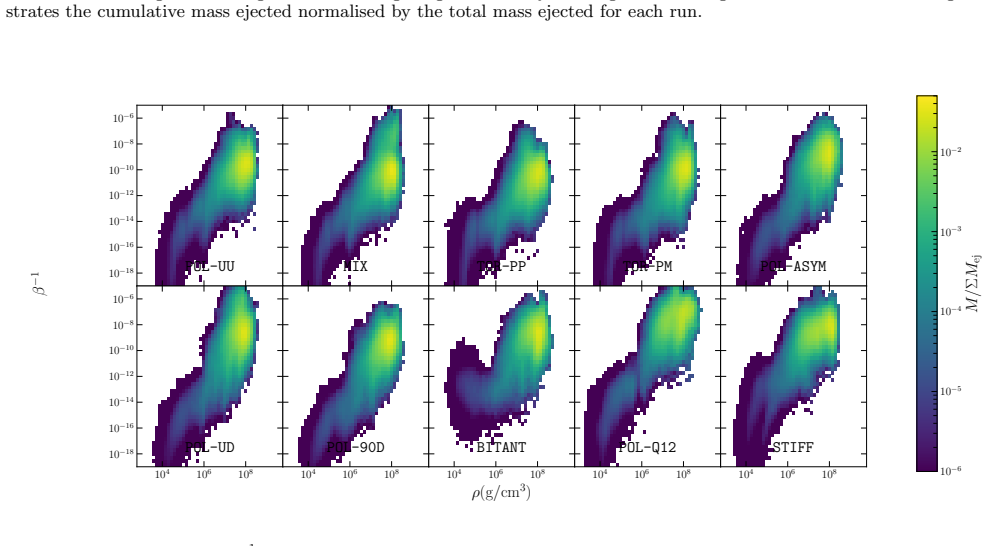
- [Sec. III D, Fig. 15] The power-law fits B = A1 rho^alpha1 and beta^{-1} = A2 rho^alpha2 are least-squares descriptions of the simulations' own ejecta, not independent predictions, and no fit uncertainties are reported. The fits are contaminated by unphysical pre-merger ejecta before ~5 ms, and alpha drifts with time. Given that Appendix A shows the early ejecta B can differ by a factor of ~4 between reconstruction schemes, the claim that alpha ranges from ~1 (TOR-PP) to ~0.75 (POL-UD) needs error bars and a clearly stated fitting window. Without these, the quantitative statement of 'weaker dependence on density' is not supported beyond a visual trend.
minor comments (5)
- [Sec. II C, Eqs. (1)-(3)] The parameters pcut, ns, and the 85/15 poloidal/toroidal split are only referenced to Paper I. Please list their numerical values in this paper for self-containedness.
- [Fig. 2] The dephasing scatter plot would benefit from symbols or colors encoding the reconstruction scheme, since Appendix A shows a clear scheme dependence.
- [Fig. 3] The lower panel y-axis label 'max |B|' is ambiguous; it should read 'max|B| / max|B(0)|' as in the text.
- [Sec. III C] The interpretation of the universal asymmetry growth as a 'spontaneous symmetry breaking bifurcation' is plausible but not proven; numerical noise and the finite set of runs offer alternative explanations. Consider softening 'suggests the presence' to 'is consistent with' and discussing how a convergence study would distinguish these.
- [Appendix A] The statement that the PPM configuration has 'marginally more mass ejected' is followed by a 7% difference; it would be useful to state whether this is within the expected numerical error of the mass-flux estimator.
Circularity Check
No significant circularity: all central claims are direct comparisons from self-contained simulations; self-citations set initial conditions or code details but are not load-bearing.
full rationale
The paper's central claims are comparisons of outcomes across differing initial magnetic field configurations, all obtained from the same self-contained GR-Athena++ simulations. None of the reported results (KHI amplification ordering, ejecta field strengths, GW dephasing, symmetry breaking) is defined in terms of an input parameter, and no fitted parameter is renamed as a prediction. The B=A rho^alpha fits in Sec. III D 3 and Fig. 15 are explicitly least-squares descriptions of the simulations' own ejecta, used to compare configurations, rather than independent predictions. The anti-aligned-field enhancement is diagnosed post hoc through current and magnetic-tension hierarchies and compared with an external local-simulation result [107]; the ideal-MHD/numerical-reconnection caveat is openly discussed. The GW dephasing result is accompanied by a quantified reconstruction-scheme control in Appendix A, which the paper itself reports can alter the effect by more than the spread across configurations; this is a stated limitation, not circular reasoning. Self-citations appear in the choice of initial data parameters from Paper I and in the 85/15 poloidal/toroidal MIX construction motivated by [50], but these are initial-condition/modeling choices, explicitly described as approximate, and the topology ordering does not reduce to them: the key comparisons (POL-UD vs POL-UU, TOR-PP vs TOR-PM, MIX vs POL-UU) are simulation outputs, not analytic consequences of the initial data definitions. No uniqueness theorem from the authors' prior work is invoked to forbid alternatives, and no ansatz is smuggled in as an external fact. The paper is self-contained against its own simulation ensemble, so no circular step reaches the load-bearing threshold.
Axiom & Free-Parameter Ledger
free parameters (5)
- B0 initial field strength =
5e15 G (5e8 G for LOWB)
- Vector potential parameters pcut, ns =
set in Paper I
- Atmosphere density and temperature =
1.8e3 g/cm3, 0.1 MeV
- Poloidal/toroidal mix ratio =
85% poloidal / 15% toroidal
- Ejecta power-law exponents alpha1, alpha2 =
0.55-1.0 (B-rho), 0.5-2.0 (beta^-1-rho)
axioms (5)
- domain assumption Ideal MHD approximation (infinite conductivity)
- domain assumption Z4c formulation with moving puncture gauge and 6th-order finite differencing
- domain assumption Tabulated EOS SFHo and DD2 from Compose database
- domain assumption Initial data from Lorene (conformally flat, quasi-equilibrium)
- domain assumption Atmosphere treatment and primitive recovery via PrimitiveSolver/RePrimAnd
Cite this review
Pith. "Pith review of Magnetic Field Configurations in Binary Neutron Star Mergers II: Inspiral, Merger and Ejecta." pith.science (2026). https://pith.science/paper/E5CLUU6A
@misc{pith2026250819342,
  author       = {Pith},
  title        = {Pith review of: Magnetic Field Configurations in Binary Neutron Star Mergers II: Inspiral, Merger and Ejecta},
  year         = {2026},
  howpublished = {\url{https://pith.science/paper/E5CLUU6A}},
  note         = {Machine review of arXiv:2508.19342}
}
abstract
We perform a series of simulations of magnetised Binary Neutron Star mergers, with varying magnetic field topologies in the initial data, as well as varying Equations of State, and mass ratios. In this paper, a companion paper to arXiv:2506.18995, we analyse the impact of the initial field configuration on the gravitational wave signal, the amplification of the magnetic field, and the ejected material. We investigate the dependence of the phase evolution of the gravitational wave in the post-merger on the initial magnetic field, finding that dephasing between the $(\ell=2,m=2)$ mode of the gravitational wave, and the $(2,1)$ and $(3,3)$ modes may be strongly impacted by the numerical reconstruction scheme. The magnetic field amplification during the Kelvin-Helmholtz dominated phase may be considerably enhanced by anti-aligned fields, or suppressed by toroidal fields. The post-merger amplification of the field due to winding may be suppressed by toroidal fields, and enhanced by asymmetries or mixtures of poloidal and toroidal fields. The field strength in the ejecta may be impacted by the initial magnetic field, with configurations which lead to large amplifications and those with mixtures of poloidal and toroidal fields preferentially emitting highly magnetised material in the polar regions, showing a weaker dependence of the magnetic field on the density of the ejecta than in cases that amplify the magnetic field less. We find that the magnetic field is largely randomly oriented in the ejected material, supporting such models used to estimate thermalisation timescales of ejected material. We find that configurations which begin with an initial bitant symmetry break this symmetry uniformly, independent of the initial configuration, when evolved without an enforced symmetry. This behaviour suggests the presence of a spontaneous symmetry breaking bifurcation in the solution.
Figures




Forward citations
Cited by 2 Pith papers
-
Subgrid Modelling for Relativistic Magnetohydrodynamics with Machine Learning
First neural-network subgrid model for special relativistic MHD reproduces 4x-higher-resolution magnetic field amplification in 3D Kelvin-Helmholtz tests at 44x speedup.
-
Hadronic Processes, Plasma Evolution and Neutrino Emission in Magnetic Towers of Neutron-Star Merger Remnants
Hadronic pp collisions dominate pair loading via pion cascades in magnetar-like outflows from neutron star mergers, channeling magnetic energy into e± and seeding neutrinos up to ~300 MeV.
Reference graph
Works this paper leans on
-
[1]
Overview We first discuss the overall evolution of the ejected material. In Fig. 7 and Fig. 8 we show the evolution of the ejected material at large distances at two time slices, ∼ 6.5ms post-merger, and the final time in the simu- lation. We note that the final time of each run is not the same, we refer the reader to Table 1 in Paper I for the duration o...
-
[2]
We first demonstrate the mass weighted compo- sition of the ejecta at the end of our simulations in the histograms in Fig
Impact of magnetic field configuration on ejecta We now discuss the composition of the ejected mate- rial, and the impact of the magnetic field configuration on it. We first demonstrate the mass weighted compo- sition of the ejecta at the end of our simulations in the histograms in Fig. 9. To complement this discussion with a measure of the time evolution...
-
[3]
We calcu- late the luminosity associated to the radial Poynting flux, −10 0 10 20 30 t − tmrg (ms) 0.0 0.2 0.4 0.6 0.8 1.0 bφbφ/b2 Star 1 POL-UU MIX TOR-PP TOR-PM FIG
Poynting Flux After the merger, energy is radiated through the elec- tromagnetic field through the Poynting flux. We calcu- late the luminosity associated to the radial Poynting flux, −10 0 10 20 30 t − tmrg (ms) 0.0 0.2 0.4 0.6 0.8 1.0 bφbφ/b2 Star 1 POL-UU MIX TOR-PP TOR-PM FIG. 4. The toroidal magnetic energy as a proportion of the total magnetic energ...
-
[4]
random” configuration; finding that a toroidal field may “trap
Magnetic field structure We now discuss the magnetic field orientation in the ejected material, by demonstrating the proportion of the magnetic field strength in the radial and toroidal com- ponents, respectively Br/|B| and Bϕ/|B|. The average of the radial and toroidal components oscillate around zero, with the magnitude of the oscillations, especially f...
-
[5]
D. M. Siegel, R. Ciolfi, and L. Rezzolla, Astrophys. J. 785, L6 (2014), arXiv:1401.4544 [astro-ph.HE]
Pith/arXiv arXiv 2014
-
[6]
In the left panel, third row of Fig
Magnetic field in the ejecta We now consider the impact of the magnetic field con- figuration on the magnetic field itself in the ejecta. In the left panel, third row of Fig. 10 we demonstrate the average magnetic field strength. We note that the hi- erarchy of this strength shares some features with, but does not identically match that of the global magn...
-
[7]
D. M. Siegel and B. D. Metzger, Phys. Rev. Lett. 119, 231102 (2017), arXiv:1705.05473 [astro-ph.HE]
Pith/arXiv arXiv 2017
-
[8]
E. M. Guti´ errez, W. Cook, D. Radice, S. Bernuzzi, J. Fields, P. Hammond, B. Daszuta, H. Bandyopadhyay, and M. Jacobi, (2025), arXiv:2506.18995 [astro-ph.HE]
arXiv 2025
-
[9]
F. A. Rasio and S. L. Shapiro, Classical and Quantum Gravity 16, R1 (1999), arXiv:gr-qc/9902019 [gr-qc]
Pith/arXiv arXiv 1999
-
[10]
Here ut is the timelike covariant com- ponent of the fluid 4-velocity, while h = 1 + ϵ + p ρ is the fluid enthalpy
In this discussion we classify as ejecta, material that is unbound according to the Bernoulli criterion, that is material, as extracted on a sphere of radius 295km, for which hut < −1. Here ut is the timelike covariant com- ponent of the fluid 4-velocity, while h = 1 + ϵ + p ρ is the fluid enthalpy. ϵ is the fluid specific internal energy. In the simulati...
-
[11]
D. Price and S. Rosswog, Science 312, 719 (2006), arXiv:astro-ph/0603845 [astro-ph]
Pith/arXiv arXiv 2006
-
[12]
K. Kiuchi, P. Cerd´ a-Dur´ an, K. Kyutoku, Y. Sekiguchi, and M. Shibata, Phys. Rev. D 92, 124034 (2015), arXiv:1509.09205 [astro-ph.HE]
Pith/arXiv arXiv 2015
-
[13]
K. Kiuchi, K. Kyutoku, Y. Sekiguchi, M. Shi- bata, and T. Wada, Phys.Rev. D90, 041502 (2014), arXiv:1407.2660 [astro-ph.HE]
Pith/arXiv arXiv 2014
-
[14]
E. R. Most, J. Peterson, L. Scurto, H. Pais, and V. Dex- heimer, (2025), arXiv:2506.21696 [astro-ph.HE]
Pith/arXiv arXiv 2025
-
[15]
P. M¨ osta, D. Radice, R. Haas, E. Schnetter, and S. Bernuzzi, Astrophys. J. Lett. 901, L37 (2020), arXiv:2003.06043 [astro-ph.HE]
Pith/arXiv arXiv 2020
-
[16]
S. Curtis, P. M¨ osta, Z. Wu, D. Radice, L. Roberts, G. Ricigliano, and A. Perego, Mon. Not. Roy. Astron. Soc. 518, 5313 (2022), arXiv:2112.00772 [astro-ph.HE]
Pith/arXiv arXiv 2022
-
[17]
L. Combi and D. M. Siegel, Astrophys. J. 944, 28 (2023), arXiv:2206.03618 [astro-ph.HE]
Pith/arXiv arXiv 2023
-
[18]
S. de Haas, P. Bosch, P. M¨ osta, S. Curtis, and N. Schut, (2022), arXiv:2208.05330 [astro-ph.HE]
Pith/arXiv arXiv 2022
-
[19]
K. Kiuchi, S. Fujibayashi, K. Hayashi, K. Kyutoku, Y. Sekiguchi, and M. Shibata, Phys. Rev. Lett. 131, 011401 (2023), arXiv:2211.07637 [astro-ph.HE]
Pith/arXiv arXiv 2023
-
[20]
L. Combi and D. M. Siegel, Phys. Rev. Lett. 131, 231402 (2023), arXiv:2303.12284 [astro-ph.HE]
Pith/arXiv arXiv 2023
-
[21]
D. A. Coulter et al., Science 358, 1556 (2017), arXiv:1710.05452 [astro-ph.HE]
Pith/arXiv arXiv 2017
-
[22]
Pian et al., Nature (2017), 10.1038/nature24298, arXiv:1710.05858 [astro-ph.HE]
E. Pian et al., Nature (2017), 10.1038/nature24298, arXiv:1710.05858 [astro-ph.HE]
Pith/arXiv arXiv 2017
-
[23]
D. Kasen, B. Metzger, J. Barnes, E. Quataert, and E. Ramirez-Ruiz, Nature (2017), 10.1038/nature24453, [Nature551,80(2017)], arXiv:1710.05463 [astro-ph.HE]
Pith/arXiv arXiv 2017
-
[24]
L.-X. Li and B. Paczynski, Astrophys.J. 507, L59 (1998), arXiv:astro-ph/9807272 [astro-ph]
Pith/arXiv arXiv 1998
-
[25]
S. R. Kulkarni, (2005), arXiv:astro-ph/0510256 [astro- ph]
Pith/arXiv arXiv 2005
-
[26]
B. Metzger, G. Martinez-Pinedo, S. Darbha, E. Quataert, A. Arcones, et al., Mon.Not.Roy.Astron.Soc. 406, 2650 (2010), arXiv:1001.5029 [astro-ph.HE]
Pith/arXiv arXiv 2010
-
[27]
B. P. Abbott et al. (GROND, SALT Group, Oz- Grav, DFN, INTEGRAL, Virgo, Insight-Hxmt, MAXI Team, Fermi-LAT, J-GEM, RATIR, IceCube, CAAS- TRO, L W A, ePESSTO, GRA WITA, RIMAS, SKA South Africa/MeerKAT, H.E.S.S., 1M2H Team, IKI- GW Follow-up, Fermi GBM, Pi of Sky, DWF (Deeper Wider Faster Program), Dark Energy Survey, MAS- TER, AstroSat Cadmium Zinc Telluri...
Pith/arXiv arXiv 2017
-
[28]
R. Narayan, B. Paczynski, and T. Piran, Astrophys. J. 395, L83 (1992), arXiv:astro-ph/9204001
Pith/arXiv arXiv 1992
-
[29]
M. Soares-Santos et al. (DES), Astrophys. J. 848, L16 (2017), arXiv:1710.05459 [astro-ph.HE]
Pith/arXiv arXiv 2017
-
[30]
Arcavi et al., Nature 551, 64 (2017), arXiv:1710.05843 [astro-ph.HE]
I. Arcavi et al., Nature 551, 64 (2017), arXiv:1710.05843 [astro-ph.HE]
Pith/arXiv arXiv 2017
-
[31]
S. I. Blinnikov, I. D. Novikov, T. V. Perevodchikova, and A. G. Polnarev, Soviet Astronomy Letters 10, 177 (1984), arXiv:1808.05287 [astro-ph.HE]
Pith/arXiv arXiv 1984
-
[32]
Paczynski, Astrophys
B. Paczynski, Astrophys. J. 308, L43 (1986)
1986
-
[33]
Goodman, Astrophys
J. Goodman, Astrophys. J. Lett. 308, L47 (1986)
1986
-
[34]
Eichler, M
D. Eichler, M. Livio, T. Piran, and D. N. Schramm, Nature 340, 126 (1989)
1989
-
[35]
C. T. Y. Chung and A. Melatos, mnras 411, 2471 (2011), arXiv:1010.2816 [astro-ph.SR]
Pith/arXiv arXiv 2011
-
[36]
B. P. Abbott et al. (Virgo, LIGO Scientific), Phys. Rev. Lett. 119, 161101 (2017), arXiv:1710.05832 [gr-qc]
Pith/arXiv arXiv 2017
-
[37]
A. Goldstein et al., Astrophys. J. 848, L14 (2017), arXiv:1710.05446 [astro-ph.HE]
Pith/arXiv arXiv 2017
-
[38]
V. Savchenko et al., Astrophys. J. 848, L15 (2017), arXiv:1710.05449 [astro-ph.HE]
Pith/arXiv arXiv 2017
- [39]
-
[40]
P. Kumar and B. Zhang, Phys. Rept. 561, 1 (2014), arXiv:1410.0679 [astro-ph.HE]
Pith/arXiv arXiv 2014
-
[41]
Short gamma-ray burst central engines
R. Ciolfi, Int. J. Mod. Phys. D 27, 1842004 (2018), arXiv:1804.03684 [astro-ph.HE]
work page internal anchor Pith review Pith/arXiv arXiv 2018
-
[42]
K. Kiuchi, M. Shibata, and S. Yoshida, Phys. Rev. D78, 024029 (2008), arXiv:0805.2712 [astro-ph]
Pith/arXiv arXiv 2008
-
[43]
C. T. Y. Chung and A. Melatos, mnras 415, 1703 (2011), arXiv:1104.1016 [astro-ph.SR]
Pith/arXiv arXiv 2011
-
[44]
A. V. Bilous, A. L. Watts, A. K. Harding, T. E. Riley, Z. Arzoumanian, S. Bogdanov, K. C. Gendreau, P. S. Ray, S. Guillot, W. C. G. Ho, and D. Chakrabarty, The Astrophysical Journal Letters 887, L23 (2019)
2019
-
[45]
T. E. Riley et al., Astrophys. J. Lett. 918, L27 (2021), arXiv:2105.06980 [astro-ph.HE]
Pith/arXiv arXiv 2021
-
[46]
D. Choudhury, T. Salmi, S. Vinciguerra, T. E. Riley, Y. Kini, A. L. Watts, B. Dorsman, S. Bogdanov, S. Guil- lot, P. S. Ray, D. J. Reardon, R. A. Remillard, A. V. Bilous, D. Huppenkothen, J. M. Lattimer, N. Ruther- ford, Z. Arzoumanian, K. C. Gendreau, S. M. Morsink, 26 and W. C. G. Ho, Astrophys. J. Lett. 971, L20 (2024), arXiv:2407.06789 [astro-ph.HE]
Pith/arXiv arXiv 2024
-
[47]
T. Salmi, J. S. Deneva, P. S. Ray, A. L. Watts, D. Choudhury, Y. Kini, S. Vinciguerra, H. T. Cro- martie, M. T. Wolff, Z. Arzoumanian, S. Bogdanov, K. Gendreau, S. Guillot, W. C. G. Ho, S. M. Morsink, I. Cognard, L. Guillemot, G. Theureau, and M. Kerr, Astrophys. J. 976, 58 (2024), arXiv:2409.14923 [astro- ph.HE]
Pith/arXiv arXiv 2024
-
[48]
J. A. Pons and D. Vigan` o, (2019), 10.1007/s41115-019- 0006-7, arXiv:1911.03095 [astro-ph.HE]
Pith/arXiv arXiv 2019
-
[49]
W. Cook, B. Daszuta, J. Fields, P. Hammond, S. Al- banesi, F. Zappa, S. Bernuzzi, and D. Radice, Astro- phys. J. Suppl. 277, 3 (2025), arXiv:2311.04989 [gr-qc]
Pith/arXiv arXiv 2025
-
[50]
R. Ciolfi, S. K. Lander, G. M. Manca, and L. Rezzolla, Astrophys.J. 736, L6 (2011), arXiv:1105.3971 [gr-qc]
Pith/arXiv arXiv 2011
-
[51]
R. Ciolfi and L. Rezzolla, Mon. Not. Roy. Astron. Soc. 435, L43 (2013), arXiv:1306.2803 [astro-ph.SR]
Pith/arXiv arXiv 2013
-
[52]
P. D. Lasky, B. Zink, K. D. Kokkotas, and K. Glampedakis, Astrophys. J. Lett. 735, L20 (2011), arXiv:1105.1895 [astro-ph.SR]
Pith/arXiv arXiv 2011
-
[53]
A. G. Pili, N. Bucciantini, and L. Del Zanna, Mon. Not. Roy. Astron. Soc. 439, 3541 (2014), arXiv:1401.4308 [astro-ph.HE]
Pith/arXiv arXiv 2014
-
[54]
A. G. Pili, N. Bucciantini, and L. Del Zanna, Mon. Not. Roy. Astron. Soc. 470, 2469 (2017), arXiv:1705.03795 [astro-ph.HE]
Pith/arXiv arXiv 2017
-
[55]
A. Sur, W. Cook, D. Radice, B. Haskell, and S. Bernuzzi, Mon. Not. Roy. Astron. Soc. 511, 3983 (2022), arXiv:2108.11858 [astro-ph.HE]
Pith/arXiv arXiv 2022
-
[56]
Flowers and M
E. Flowers and M. A. Ruderman, Astrophys. J. 215, 302 (1977)
1977
-
[57]
W. Cook, R. K. Joshi, S. Bernuzzi, B. Haskell, and J. Fields, (2025), arXiv:2506.08037 [astro-ph.HE]
Pith/arXiv arXiv 2025
-
[58]
R. J. Tayler, Proceedings of the Physical Society B 70, 31 (1957)
1957
-
[59]
R. J. Tayler, Mon. Not. R. Astron. Soc. 161, 365 (1973)
1973
-
[60]
G. A. E. Wright, Mon. Not. R. Astron. Soc. 162, 339 (1973)
1973
-
[61]
Markey and R
P. Markey and R. J. Tayler, Mon. Not. R. Astron. Soc. 163, 77 (1973)
1973
-
[62]
Markey and R
P. Markey and R. J. Tayler, Mon. Not. R. Astron. Soc. 168, 505 (1974)
1974
-
[63]
A. Sur, B. Haskell, and E. Kuhn, Mon. Not. Roy. As- tron. Soc. 495, 1360 (2020), arXiv:2002.10357 [astro- ph.HE]
Pith/arXiv arXiv 2020
-
[64]
J. Braithwaite and H. C. Spruit, Astron. Astrophys. 450, 1097 (2006), arXiv:astro-ph/0510287
Pith/arXiv arXiv 2006
-
[65]
T. Kawamura, B. Giacomazzo, W. Kastaun, R. Ciolfi, A. Endrizzi, L. Baiotti, and R. Perna, Phys. Rev. D94, 064012 (2016), arXiv:1607.01791 [astro-ph.HE]
work page internal anchor Pith review Pith/arXiv arXiv 2016
-
[66]
M. Ruiz, A. Tsokaros, and S. L. Shapiro, Phys. Rev. D 101, 064042 (2020), arXiv:2001.09153 [astro-ph.HE]
Pith/arXiv arXiv 2020
-
[67]
R. Aguilera-Miret, C. Palenzuela, F. Carrasco, S. Ross- wog, and D. Vigan` o, Phys. Rev. D110, 083014 (2024), arXiv:2407.20335 [astro-ph.HE]
Pith/arXiv arXiv 2024
-
[68]
J. Bamber, A. Tsokaros, M. Ruiz, and S. L. Shapiro, (2024), arXiv:2411.00943 [gr-qc]
Pith/arXiv arXiv 2024
-
[69]
A. Tsokaros, J. Bamber, M. Ruiz, and S. L. Shapiro, (2024), arXiv:2411.00939 [gr-qc]
Pith/arXiv arXiv 2024
-
[70]
Effects of Landau quantization on neutrino emission and absorption
M. Kumamoto and C. Welch, Phys. Rev. D 111, 063009 (2025), arXiv:2412.02925 [nucl-th]
work page internal anchor Pith review Pith/arXiv arXiv 2025
-
[71]
R. Aguilera-Miret, D. Vigan` o, and C. Palenzuela, As- trophys. J. Lett. 926, L31 (2022), arXiv:2112.08406 [gr- qc]
Pith/arXiv arXiv 2022
-
[72]
R. Aguilera-Miret, C. Palenzuela, F. Carrasco, and D. Vigan` o, (2023), arXiv:2307.04837 [astro-ph.HE]
Pith/arXiv arXiv 2023
-
[73]
M. Chabanov, S. D. Tootle, E. R. Most, and L. Rezzolla, Astrophys. J. Lett. 945, L14 (2023), arXiv:2211.13661 [astro-ph.HE]
work page internal anchor Pith review Pith/arXiv arXiv 2023
-
[74]
R. Aguilera-Miret, J.-E. Christian, S. Rosswog, and C. Palenzuela, (2025), arXiv:2504.10604 [astro-ph.HE]
arXiv 2025
-
[75]
Nuclear Reaction Screening, Weak Interactions, and r-Process Nucleosynthesis in High Magnetic Fields
M. Famiano, A. B. Balantekin, T. Kajino, M. Kusakabe, K. Mori, and Y. Luo, Astrophys. J. 898, 163 (2020), arXiv:2006.14148 [astro-ph.HE]
work page internal anchor Pith review Pith/arXiv arXiv 2020
-
[76]
P. Tambe, D. Chatterjee, M. Alford, and A. Haber, (2024), arXiv:2409.09423 [nucl-th]
Pith/arXiv arXiv 2024
-
[77]
M. Ruiz, D. Hilditch, and S. Bernuzzi, Phys. Rev. D83, 024025 (2011), arXiv:1010.0523 [gr-qc]
work page internal anchor Pith review Pith/arXiv arXiv 2011
-
[78]
J. Barnes, D. Kasen, M.-R. Wu, and G. Martinez-Pinedo, Astrophys. J. 829, 110 (2016), arXiv:1605.07218 [astro-ph.HE]
Pith/arXiv arXiv 2016
-
[79]
B. Daszuta, F. Zappa, W. Cook, D. Radice, S. Bernuzzi, and V. Morozova, Astrophys. J. Supp. 257, 25 (2021), arXiv:2101.08289 [gr-qc]
Pith/arXiv arXiv 2021
-
[80]
GR-Athena++: Magnetohy- drodynamical Evolution with Dynamical Space-Time,
B. Daszuta and W. Cook, “GR-Athena++: Magnetohy- drodynamical Evolution with Dynamical Space-Time,” (2025) arXiv:2406.05126 [gr-qc]
Pith/arXiv arXiv 2025
This paper was first reviewed by deepseek-v4-flash on August 5, 2026.
discussion (0)
Sign in with ORCID, Apple, or X to comment. Anyone can read and Pith papers without signing in.