REVIEW 3 major objections 5 minor 5 cited by
Magnetically arrested disks around binaries can shrink the orbit, simulations show.
Reviewed by Pith at T0; open to challenge. T0 means a machine referee read the full paper against a public rubric. the ladder, T0–T4 →
Circumbinary accretion disks can enter a magnetically arrested state, and in weakly cooled or adiabatic regimes the resulting magnetic flux eruptions may drive the binary orbit to shrink.
T0 review reviewed 2026-08-05 challenge →
load-bearing objection Solid, useful BMAD parameter survey whose headline hardening claim needs a sink-sensitivity test before it can be trusted. the 3 major comments →
$\textit{BMAD}$-Circumbinary Magnetically Arrested Disks around Stellar or Black Hole Binaries: Hot Accretion Flows, Disk Properties, and Angular Momentum Transfer
The pith
A machine-rendered reading of the paper's core claim, the machinery that carries it, and where it could break.
The reading
Core claim
This paper uses 3D MHD simulations to show that circumbinary disks around equal-mass circular binaries pass into a magnetically arrested 'BMAD' state whenever the initial field is strong enough. In this state, the cavity fills with vertical magnetic flux that erupts quasi-periodically, launches magnetic tower outflows, and regulates accretion. Cooling controls the outcome: with strong cooling, erupted flux tubes collapse and angular momentum transport stays advective; with weak or no cooling, flux tubes propagate outward and magnetic transport dominates. In this weakly cooled limit the measured specific torque lies near or below the hardening threshold, so the binary shrinks rather than expa
What carries the argument
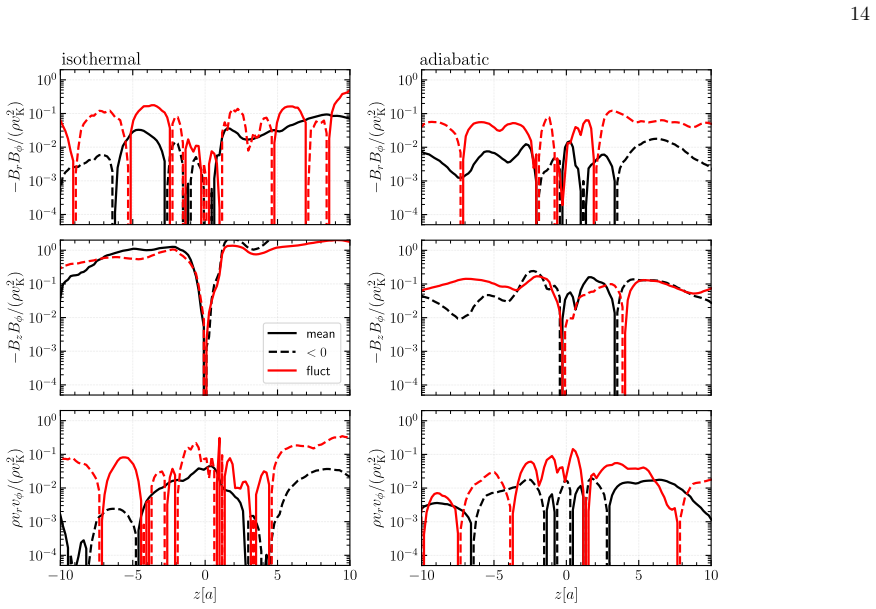
The central mechanism is the flux eruption cycle: the cavity gradually accumulates vertical magnetic flux until its wall becomes unstable to interchange instability, triggering accretion through Rayleigh-Taylor fingers and ejecting coherent magnetic flux tubes into the disk, while magnetic tower outflows are launched from the sinks. The quantitative carrier is the angular momentum budget integrated over cylindrical shells, split into advective, radial Maxwell, vertical/wind, and gravitational torques. The binary hardens when the total torque per accreted mass, l0, falls below 3/8 Ω_B a_B², the threshold separating inward from outward orbital migration.
Load-bearing premise
The hardening conclusion rests on the sink prescription: mass, momentum, and energy are drained at the local Keplerian rate inside 0.07 of the binary separation and state variables are reset to floors within half that radius, and the paper does not quantify how much the measured angular momentum flux changes if that prescription is altered.
What would settle it
Repeat the adiabatic BMAD run with an alternative sink prescription designed to avoid anomalous torques — for example, one that conserves angular momentum at the sink or follows the reference prescription flagged as problematic — and compare the sign of l0 minus 3/8 Ω_B a_B² over several hundred orbits. If the binary moves back above the hardening threshold, the central claim fails. A complementary observational test would be a population of supermassive black hole binaries whose orbital decay cannot be explained by stellar dynamical friction or gravitational radiation while their disks are in
If this is right
- If the BMAD state is robust, gas-rich binaries with strongly magnetized disks will commonly have magnetically regulated cavities rather than hydrodynamic ones, changing estimates of accretion rates, cavity sizes, and stream morphologies.
- In weakly cooled or adiabatic BMAD flows, magnetic flux eruptions transport angular momentum outward efficiently, placing the binary at or below the hardening threshold, so the orbit shrinks instead of expanding.
- Cooling is decisive: strong (isothermal-like) cooling suppresses flux-tube propagation and keeps angular momentum transport mostly advective, while weak or no cooling allows magnetic transport to dominate.
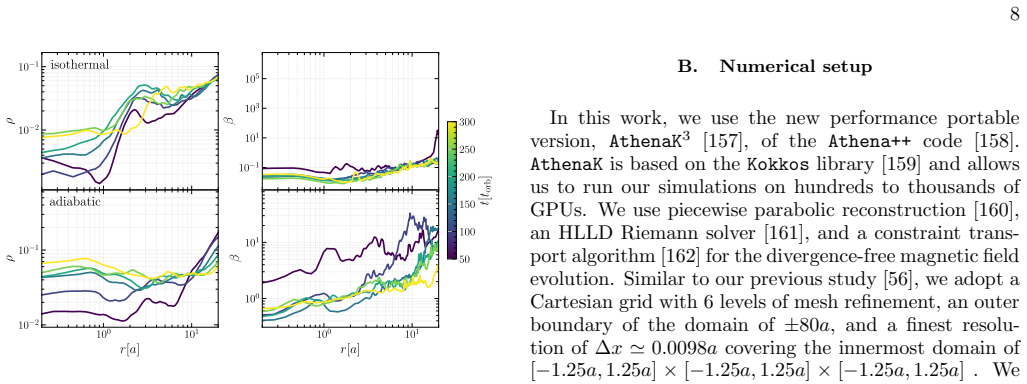
- The cavity truncation radius grows from about 3 times the binary separation in the isothermal case to about 6 times in the adiabatic case, which changes how strongly the disk couples to the binary.
- Flux eruptions and magnetic tower outflows produce time-variable electromagnetic and Poynting output correlated with angular momentum transfer, offering potential observational tracers of the shrinking state.
Where Pith is reading between the lines
- I infer that the hardening result is likely sensitive to the sink prescription; a dedicated study varying sink radius and drain rate would determine whether the sub-threshold torque survives.
- I infer that real disks with radiative cooling will fall between the isothermal and adiabatic limits, so predicting merger rates requires radiative MHD rather than idealized cooling prescriptions.
- I infer that the same flux-eruption torque mechanism should extend to stellar-mass and intermediate-mass binaries embedded in strongly magnetized disks, because the Newtonian simulations are scale-free.
- I infer that longer-duration runs are needed to confirm that the sub-threshold torque is secular and not a slow oscillation around the threshold over the 150 orbits analyzed.
Editorial analysis
A structured set of objections, weighed in public.
Referee Report
Summary. The paper presents AthenaK 3D ideal MHD simulations of equal-mass circular binaries in Newtonian gravity with strong seed magnetic fields (initial plasma beta ~20), systematically comparing isothermal, adiabatic, and beta-cooling equations of state, and poloidal versus toroidal initial field topologies. It argues that a magnetically arrested circumbinary disk (BMAD) state is robustly established in all runs, that the cavity size and flux-eruption propagation depend strongly on the cooling efficiency, and that in weakly cooled or adiabatic regimes the specific angular momentum flux onto the binary lies at or below the hardening threshold, potentially favoring binary shrinking, in contrast to pure hydrodynamic circumbinary disks. The central diagnostic is l0 = <Jdot>/<Mdot> compared with 3 Omega_B a^2/8 (Eq. 19). The binary-shrinking claim is explicitly described as tentative in the abstract, but stated more firmly in Section V.
Significance. If the main result holds, it identifies a physically motivated regime in which strong magnetic fields change the structure of circumbinary disks and can accelerate rather than stall supermassive black hole binary orbital decay, with implications for gravitational-wave backgrounds and electromagnetic counterparts. The paper's strengths are its broad parameter survey (six configurations, 300-orbit runs), the clear demonstration that the BMAD state is attained across different cooling prescriptions and field topologies, the detailed characterization of flux eruption cycles and cavity morphology, and the use of a standard external hardening criterion (Eq. 19) without fitting to produce the threshold crossing. The cooling-dependent cavity and flux-tube behavior is convincing. The weaker point is the orbital-evolution conclusion, which relies on a short time average of an oscillating l0 and on a sink treatment whose magnetic-field behavior is not tested.
major comments (3)
- [Sec. III A 2; Sec. IV D and Fig. 15] The binary-hardening conclusion rests on l0 = <Jdot>/<Mdot> (Eq. 20) measured at R=2,3,4a. Section III A 2 resets density, momentum, and energy to floors inside r_dep=0.5r_s but does not reset or remove the magnetic field, creating an artificial magnetically dominated region adjacent to each sink, exactly where tower outflows and flux eruptions are anchored. Magnetic stress/Poynting flux from that region can contaminate the measured l0, and the paper cites Ref. [156] for anomalous sink torques without quantifying their magnitude here. No sensitivity test to r_s, r_dep, or the treatment of B is provided. Please add such a test (or a B-floor variant), or give a quantitative argument that the R=2-4a extraction is unaffected.
- [Sec. IV D, Fig. 15; Sec. V] The claim that weakly cooled/adiabatic BMADs put the binary at or below the hardening threshold is based on ~150 orbits (and ~100 for the beta-cooling runs), during which l0 oscillates around the cyan threshold. This is acknowledged as tentative, but Section V states it more strongly. Please report time-averaged l0 with statistical uncertainties (e.g., block averages over eruption cycles), test whether the mean is significantly below 3 Omega_B a^2/8, and demonstrate that l0 is not still secularly evolving (Fig. 4 cautions that beta is not fully time-converged in the adiabatic disk). Without this, the shrinking signal is not distinguishable from noise.
- [Sec. III A, Eq. (12)] The beta-cooling term is written as Lambda = -Sigma/(gamma-1)(T-T_iso) Omega_K/beta, using the surface density Sigma, whereas the governing equations (1)-(4) are in terms of volumetric energy density and local cell variables. In a 3D cell-based code this is dimensionally inconsistent unless Sigma is defined differently or a vertical integral is evaluated; neither is stated. If the implemented cooling uses local rho, please correct the notation and confirm. This matters because the cooling-dependence of flux-tube propagation and angular-momentum transport (Figs. 9 and 14) relies on runs adi-p-c0.6 and adi-p-c10.
minor comments (5)
- [Abstract; Table I; Sec. IV B] Typos and small inconsistencies: 'ultilizing' (Abstract), 'toloidal' (Table I), 'started based the isothermal configuration, adi-p' in the Table I caption should presumably read 'adiabatic configuration,' and 'bee reach' in Sec. IV B.
- [Fig. 15 caption] The statement that 'All extraction radii are in good agreement' is only visual; please include a quantitative spread or time-averaged values with errors, especially since the extraction radii bracket the sink-affected region.
- [Sec. III A, Eq. (13)] Please state explicitly once that eta=0 gives a purely poloidal field and eta=1 a purely toroidal field, and that all runs have eta<1. The current wording is easy to misread.
- [Sec. IV C, Fig. 8] The turbulent pressure P_turb is not defined. Please define how it is computed from fluctuating velocity or magnetic components.
- [Sec. V] The phrase 'unlike hydrodynamical systems [50]' is stronger than the evidence presented because Ref. [50] uses different viscosity and sink prescriptions. Consider softening the wording or citing recent systematic comparisons.
Circularity Check
No significant circularity: the binary-hardening claim is driven by measured angular momentum flux l0 against an externally derived threshold, not by a fitted parameter or self-citation.
full rationale
The paper's load-bearing orbital-evolution claim rests on Eq. (19), the standard secular hardening condition cited from the Lai & Munoz review, and on l0 = <Jdot>/<Mdot>, which is measured from the simulations at radii 2a, 3a, and 4a rather than fitted to reproduce the threshold crossing. The BMAD concept and the specific seed-field normalization are taken from the authors' prior paper [56], but the simulations in the present work use new initial conditions, equations of state, cooling prescriptions, and field topologies, and the hardening conclusion is an empirical output of those runs, not an input. The self-citations to [56] and [112] are contextual rather than load-bearing: no uniqueness theorem is imported, no ansatz is smuggled in through a citation, and no result is defined in terms of the target conclusion. The sink prescription (Sec. III A 2) does not reset the magnetic field inside r_dep, and the paper only cites Refs. [155, 156] for the general non-uniqueness of sink treatments without quantifying the effect on l0; this is a genuine numerical/correctness sensitivity concern, but it is not circular, because no equation in the paper defines l0, Jdot, or the hardening condition in terms of the sink radius or depletion-zone field treatment. The derivation chain is therefore self-contained with respect to circularity.
Axiom & Free-Parameter Ledger
free parameters (8)
- initial plasma beta =
20
- sonic Mach number =
10
- gravitational softening length =
0.05a
- sink radius and depletion radius =
r_s = 0.07a, r_dep = 0.035a
- initial surface density profile =
R_edge = 2.5a, Sigma_0 = 1
- cooling coefficients =
beta_cool = 3/5 and 10
- initial magnetic topology =
eta = 0 (poloidal) or 0.9 (toroidal dominated)
- adiabatic index =
gamma = 4/3
axioms (8)
- domain assumption Newtonian gravity with softened point masses on a fixed circular orbit (Eq. 7)
- standard math Ideal MHD equations with no explicit resistivity or viscosity (Eqs. 1-4)
- domain assumption Locally isothermal EoS for iso runs: P = rho c_s^2 with c_s^2 = |Phi_mid|/M^2, M=10
- domain assumption Adiabatic/polytropic EoS for adi runs: P = kappa rho^gamma with gamma = 4/3
- domain assumption Beta-cooling prescription from Gammie 2001 (Eq. 12)
- ad hoc to paper Sink prescription: mass, momentum, and energy drained at the local Keplerian rate within r_s, with floors within 0.5 r_s
- ad hoc to paper Initial magnetic field vector potential A=(1-eta)A_phi + eta A_z with A_phi=A_z=R^2 A0 max(rho-0.04 rho_max,0)^2 and beta_ini=20
- domain assumption Quasi-steady state reached by 300 binary orbits
Cite this review
Pith. "Pith review of $\textit{BMAD}$-Circumbinary Magnetically Arrested Disks around Stellar or Black Hole Binaries: Hot Accretion Flows, Disk Properties, and Angular Momentum Transfer." pith.science (2026). https://pith.science/paper/KBJTWG22
@misc{pith2026250816855,
  author       = {Pith},
  title        = {Pith review of: $\textitBMAD$-Circumbinary Magnetically Arrested Disks around Stellar or Black Hole Binaries: Hot Accretion Flows, Disk Properties, and Angular Momentum Transfer},
  year         = {2026},
  howpublished = {\url{https://pith.science/paper/KBJTWG22}},
  note         = {Machine review of arXiv:2508.16855}
}
abstract
Binary systems surrounded by a circumbinary accretion flow can be subject to strong magnetic fields, potentially altering the character of the accretion flow itself, the evolution of the orbital dynamics, and outflow properties from the system. Here we focus on a regime where magnetic fields become so strong that the outer circumbinary flow becomes magnetically arrested, establishing a (circum)binary magnetically arrested disk ($\textit{BMAD}$) state. Such flows feature quasi-periodic magnetic flux eruptions, power jet-like magnetic tower outflows, and consequently alter the predominant contribution to angular momentum transfer inside the circumbinary disk. In this work, we provide a comprehensive analysis of the properties of these flows around equal-mass binary systems on circular orbits ultilizing massively parallel three-dimensional Newtonian magnetohydrodynamics simulations. We investigate the impact of the equation of state and of dynamical cooling, as well as that of the (large-scale) magnetic field topology. Our findings are as follows: (1) A magnetically arrested accretion flow through the cavity can generally be achieved, so long as the initial seed field is strong enough. (2) The cavity, and magnetic flux tube properties and their subsequent propagation are subject to the choice of equation of state/cooling physics. (3) We find tentative evidence that in some regimes the BMAD state, particularly during a flux eruption cycle, can aid shrinking of the binary's orbit. The regimes we explore have implications for multi-messenger transients to stars, supermassive and stellar black hole binaries and their orbital evolution in gaseous environments.
Figures






Forward citations
Cited by 5 Pith papers
-
Dynamics and detectability of long-lived non-accretion phases for massive black hole binaries in cold, thermally regulating disks
Self-consistently heated and cooled thin circumbinary disks still drive massive black hole binaries into long-lived non-accreting phases, producing X-ray-weak, optically variable sources that LSST and Roman could find.
-
The Distinctive Evolution and Spectral Energy Distribution of Binary Massive Black Hole Accretion
Combining three accretion disk states for binary massive black holes, the paper predicts a spectrum 'notch' and a mass-ratio evolution attractor at q~1e-3 for extreme-mass-ratio binaries.
-
GRACE: An Open-Source Framework for GPU-Accelerated Numerical Relativity
GRACE is a validated, open-source, Kokkos+p4est GPU-portable framework that evolves ideal GRMHD with constrained transport self-consistently coupled to Z4c Einstein equations on fixed or adaptive meshes.
-
Dynamics and detectability of long-lived non-accretion phases for massive black hole binaries in cold, thermally regulating disks
Self-consistent thermal regulation in circumbinary disks permits long-lived non-accretion phases that suppress binary feeding rates toward the Eddington limit while leaving optical/near-IR detectability intact.
-
Thick Disks, Thin Hopes: Suppressed Capture and Merger Rates in AGN
AGN disk capture and merger rates scale as (H/R)^{-8} and drop by 10-20 orders of magnitude in thick magnetically supported disks compared to thin thermal disks.
Reference graph
Works this paper leans on
-
[1]
Impact of dynamical cooling Having described the cavity dynamics in the magnet- ically arrested regime for two thermodynamic limiting 15 FIG. 12. Magnetically driven angular momentum transport in the circumbinary magnetically arrested (BMAD) state for different models. Shown is the ratio between the magnetic contribution, ˙Jmag, and the advective contribu...
-
[2]
Sink Prescription Since our binary gravitational sources accrete matter, we need to provide an effective mass sink prescription. However, the orbital separation is much larger than the size of the event horizons of the supermassive black hole binaries, so that an effective sink prescription is neither trivial or unique (see, e.g., Refs. [155, 156] for a d...
-
[3]
K. M. Kratter, C. D. Matzner, and M. R. Krumholz, Global Models for the Evolution of Embedded, Accret- ing Protostellar Disks, Astrophys. J. 681, 375 (2008), arXiv:0709.4252 [astro-ph]
Pith/arXiv arXiv 2008
-
[4]
Locally Isothermal When adopting a locally isothermal equation of state, P = ρT = ρc2 s, the vertical profile of the disk in the cylindrical coordinates is, ρ(R, z) = ρ(R, 0) exp − 1 c2s (Φ(R, z) − Φ(R, 0)) , (A3) = ρ(R, 0) exp GM c2s 1√ R2 + z2 − 1 R . (A4)
-
[5]
1 − 1 c2 s,0 γ − 1 γ (Φ(R, z) − Φ(R, 0)) #1/(γ−1) , (A5) = ρ0 exp
Adiabatic/Polytropic Relation When adopting a polytropic equation of state, P = Kρ γ, the vertical profile of the disk is (see, e.g., [183]), ρ(R, z) = ρ(R, 0) " 1 − 1 c2 s,0 γ − 1 γ (Φ(R, z) − Φ(R, 0)) #1/(γ−1) , (A5) = ρ0 exp " − R Redge −6# " 1 + GM c2 s,0 γ − 1 γ 1√ R2 + z2 − 1 R #1/(γ−1) , (A6) 21 where the constant K in the equation of state is dete...
-
[6]
D. Lai and D. J. Mu˜ noz, Circumbinary Accretion: From Binary Stars to Massive Binary Black Holes, Ann. Rev. Astron. Astrophys. 61, 517 (2023), arXiv:2211.00028 [astro-ph.HE]
Pith/arXiv arXiv 2023
-
[7]
J. P. Williams and L. A. Cieza, Protoplanetary Disks and Their Evolution, Ann. Rev. Astron. Astrophys. 49, 67 (2011), arXiv:1103.0556 [astro-ph.GA]
Pith/arXiv arXiv 2011
-
[8]
G. Agazie et al. (NANOGrav), The NANOGrav 15 yr Data Set: Evidence for a Gravitational-wave Background, Astrophys. J. Lett. 951, L8 (2023), arXiv:2306.16213 [astro-ph.HE]
Pith/arXiv arXiv 2023
-
[9]
T. Matsumoto, Angular Momentum Transport in Bi- nary Star Formation: The Enhancement of Magnetoro- tational Instability and Role of Outflows, Astrophys. J. 964, 133 (2024), arXiv:2402.03212 [astro-ph.SR]
Pith/arXiv arXiv 2024
-
[10]
This is a direct result of the cavity accumulating so much ver- tical magnetic flux, β ∼ 10−3, that the dynamics are largely magnetospheric (see Sec
The morphologies of the mini-disks (mini-spheres), the cavities, and the disks now all drastically differ. This is a direct result of the cavity accumulating so much ver- tical magnetic flux, β ∼ 10−3, that the dynamics are largely magnetospheric (see Sec. II). As a result, the morphology of the cavity is fundamentally altered. In the isothermal case, the...
-
[11]
Y.-P. Li, A. M. Dempsey, S. Li, H. Li, and J. Li, Orbital Evolution of Binary Black Holes in Active Galactic Nucleus Disks: A Disk Channel for Binary Black Hole Mergers?, Astrophys. J. 911, 124 (2021), arXiv:2101.09406 [astro-ph.HE]
Pith/arXiv arXiv 2021
-
[12]
Y.-P. Li, A. M. Dempsey, H. Li, S. Li, and J. Li, Hot Circumsingle Disks Drive Binary Black Hole Mergers in Active Galactic Nucleus Disks, Astrophys. J. Lett. 928, L19 (2022), arXiv:2112.11057 [astro-ph.HE]
Pith/arXiv arXiv 2022
-
[13]
L. Mayer, S. Kazantzidis, P. Madau, M. Colpi, T. R. Quinn, and J. Wadsley, Rapid Formation of Supermas- sive Black Hole Binaries in Galaxy Mergers with Gas, Science 316, 1874 (2007), arXiv:0706.1562 [astro-ph]
Pith/arXiv arXiv 2007
-
[14]
G. Agazie et al. (NANOGrav), The NANOGrav 15 yr Data Set: Constraints on Supermassive Black Hole Bi- naries from the Gravitational-wave Background, Astro- phys. J. Lett. 952, L37 (2023), arXiv:2306.16220 [astro- ph.HE]
Pith/arXiv arXiv 2023
-
[15]
G. Agazie et al. (International Pulsar Timing Array), Comparing Recent Pulsar Timing Array Results on the Nanohertz Stochastic Gravitational-wave Background, Astrophys. J. 966, 105 (2024), arXiv:2309.00693 [astro- ph.HE]
Pith/arXiv arXiv 2024
-
[16]
G. Agazie et al. (NANOGrav), The NANOGrav 15 yr Data Set: Bayesian Limits on Gravitational Waves from Individual Supermassive Black Hole Binaries, Astro- phys. J. Lett. 951, L50 (2023), arXiv:2306.16222 [astro- ph.HE]
Pith/arXiv arXiv 2023
-
[17]
G. Agazie et al. (NANOGrav), The NANOGrav 12.5 yr Data Set: Search for Gravitational Wave Memory, Astrophys. J. 963, 61 (2024), arXiv:2307.13797 [gr-qc]
Pith/arXiv arXiv 2024
-
[18]
G. Agazie et al. (NANOGrav), The NANOGrav 15 yr Data Set: Observations and Timing of 68 Mil- 23 lisecond Pulsars, Astrophys. J. Lett. 951, L9 (2023), arXiv:2306.16217 [astro-ph.HE]
Pith/arXiv arXiv 2023
-
[19]
G. Agazie et al. (NANOGrav), The NANOGrav 15 yr Data Set: Detector Characterization and Noise Budget, Astrophys. J. Lett. 951, L10 (2023), arXiv:2306.16218 [astro-ph.HE]
Pith/arXiv arXiv 2023
-
[20]
G. Agazie et al. (NANOGrav), The NANOGrav 15 yr Data Set: Search for Anisotropy in the Gravitational- wave Background, Astrophys. J. Lett. 956, L3 (2023), arXiv:2306.16221 [astro-ph.HE]
Pith/arXiv arXiv 2023
-
[21]
H. Xu et al., Searching for the Nano-Hertz Stochas- tic Gravitational Wave Background with the Chinese Pulsar Timing Array Data Release I, Res. Astron. As- trophys. 23, 075024 (2023), arXiv:2306.16216 [astro- ph.HE]
Pith/arXiv arXiv 2023
-
[22]
P. A. Seoane et al. (LISA), Astrophysics with the Laser Interferometer Space Antenna, Living Rev. Rel. 26, 2 (2023), arXiv:2203.06016 [gr-qc]
Pith/arXiv arXiv 2023
-
[23]
Li et al., Gravitational wave astronomy with TianQin, Rept
E.-K. Li et al., Gravitational wave astronomy with TianQin, Rept. Prog. Phys. 88, 056901 (2025), arXiv:2409.19665 [astro-ph.GA]
Pith/arXiv arXiv 2025
-
[24]
J. E. Barnes and L. E. Hernquist, Fueling starburst galaxies with gas-rich mergers, Astrophys. J. Lett. 370, L65 (1991)
1991
-
[25]
J. E. Barnes and L. E. Hernquist, Dynamics of inter- acting galaxies, Ann. Rev. Astron. Astrophys. 30, 705 (1992)
1992
-
[26]
J. C. Mihos and L. Hernquist, Gasdynamics and star- bursts in major mergers, Astrophys. J. 464, 641 (1996), arXiv:astro-ph/9512099
Pith/arXiv arXiv 1996
-
[27]
J. E. Barnes, Formation of gas disks in merging galax- ies, Mon. Not. Roy. Astron. Soc. 333, 481 (2002), arXiv:astro-ph/0201250
Pith/arXiv arXiv 2002
-
[28]
T. Di Matteo, V. Springel, and L. Hernquist, Energy input from quasars regulates the growth and activity of black holes and their host galaxies, Nature 433, 604 (2005), arXiv:astro-ph/0502199
Pith/arXiv arXiv 2005
-
[29]
P. F. Hopkins, L. Hernquist, T. J. Cox, T. Di Mat- teo, B. Robertson, and V. Springel, A Unified, merger- driven model for the origin of starbursts, quasars, the cosmic x-ray background, supermassive black holes and galaxy spheroids, Astrophys. J. Suppl. 163, 1 (2006), arXiv:astro-ph/0506398
Pith/arXiv arXiv 2006
-
[30]
P. F. Hopkins, T. J. Cox, L. Hernquist, D. Narayanan, C. C. Hayward, and N. Murray, Star Formation in Galaxy Mergers with Realistic Models of Stellar Feed- back & the Interstellar Medium, Mon. Not. Roy. Astron. Soc. 430, 1901 (2013), arXiv:1206.0011 [astro-ph.CO]
Pith/arXiv arXiv 1901
-
[31]
T. J. Cox, P. B. Jonsson, R. S. Somerville, J. R. Pri- mack, and A. Dekel, The effect of galaxy mass ratio on merger-driven starbursts, Mon. Not. Roy. Astron. Soc. 384, 386 (2008), arXiv:0709.3511 [astro-ph]
Pith/arXiv arXiv 2008
-
[32]
P. H. Johansson, T. Naab, and A. Burkert, Equal- and unequal-mass mergers of disk and elliptical galaxies with black holes: The M BH-sigma and M BH-M * relations, Astrophys. J. 690, 802 (2009), arXiv:0802.0210 [astro- ph]
Pith/arXiv arXiv 2009
-
[33]
P. R. Capelo, M. Volonteri, M. Dotti, J. M. Bellovary, L. Mayer, and F. Governato, Growth and activity of black holes in galaxy mergers with varying mass ra- tios, Mon. Not. Roy. Astron. Soc. 447, 2123 (2015), arXiv:1409.0004 [astro-ph.GA]
Pith/arXiv arXiv 2015
-
[34]
P. R. Capelo and M. Dotti, Shocks and angular momen- tum flips: a different path to feeding the nuclear regions of merging galaxies, Mon. Not. Roy. Astron. Soc. 465, 2643 (2017), arXiv:1610.08507 [astro-ph.GA]
Pith/arXiv arXiv 2017
-
[35]
A. Dunhill, R. Alexander, C. Nixon, and A. King, Mis- aligned accretion on to supermassive black hole bina- ries, Mon. Not. Roy. Astron. Soc. 445, 2285 (2014), arXiv:1409.3842 [astro-ph.HE]
Pith/arXiv arXiv 2014
-
[36]
F. G. Goicovic, J. Cuadra, A. Sesana, F. Stasyszyn, P. Amaro-Seoane, and T. L. Tanaka, Infalling clouds on to supermassive black hole binaries – I. Formation of discs, accretion and gas dynamics, Mon. Not. Roy. Astron. Soc. 455, 1989 (2016), arXiv:1507.05596 [astro- ph.HE]
Pith/arXiv arXiv 1989
-
[37]
F. G. Goicovic, A. Sesana, J. Cuadra, and F. Stasyszyn, Infalling clouds on to supermassive black hole bina- ries – II. Binary evolution and the final parsec prob- lem, Mon. Not. Roy. Astron. Soc. 472, 514 (2017), arXiv:1602.01966 [astro-ph.HE]
Pith/arXiv arXiv 2017
-
[38]
F. G. Goicovic, C. Maureira-Fredes, A. Sesana, P. Amaro-Seoane, and J. Cuadra, Accretion of clumpy cold gas onto massive black hole binaries: a possible fast route to binary coalescence, Mon. Not. Roy. Astron. Soc. 479, 3438 (2018), arXiv:1801.04937 [astro-ph.HE]
Pith/arXiv arXiv 2018
-
[39]
H.-Y. Wang, M. Guo, E. R. Most, P. F. Hop- kins, and A. Lalakos, Galactic-scale Feeding Reveals Warped Hypermagnetized Multiphase Circumbinary Accretion Around Supermassive Black Hole Binaries, arxiv (2025), arXiv:2504.03874 [astro-ph.HE]
Pith/arXiv arXiv 2025
-
[40]
G. D. Quinlan, The dynamical evolution of massive black hole binaries - I. hardening in a fixed stellar background, New Astron. 1, 35 (1996), arXiv:astro- ph/9601092
arXiv 1996
-
[41]
M. Milosavljevic and D. Merritt, Formation of galac- tic nuclei, Astrophys. J. 563, 34 (2001), arXiv:astro- ph/0103350
arXiv 2001
-
[42]
M. Milosavljevi´ c and D. Mer- ritt, The Final Parsec Problem, in The Astrophysics of Gravitational Wave Sources, American Institute of Physics Conference Series, Vol. 686, edited by J. M. Centrella (2003) pp. 201–210, arXiv:astro-ph/0212270 [astro-ph]
Pith/arXiv arXiv 2003
-
[43]
P. Berczik, D. Merritt, R. Spurzem, and H.-P. Bischof, Efficient merger of binary supermassive black holes in non-axisymmetric galaxies, Astrophys. J. Lett.642, L21 (2006), arXiv:astro-ph/0601698
Pith/arXiv arXiv 2006
-
[44]
Sesana, F
A. Sesana, F. Haardt, and P. Madau, Interaction of mas- sive black hole binaries with their stellar environment
-
[45]
Ejection of hypervelocity stars, Astrophys. J. 651, 392 (2006), arXiv:astro-ph/0604299
Pith/arXiv arXiv 2006
-
[46]
A. Rantala, P. Pihajoki, P. H. Johansson, T. Naab, N. Lah´ en, and T. Sawala, Post-Newtonian dynami- cal modeling of supermassive black holes in galactic- scale simulations, Astrophys. J. 840, 53 (2017), arXiv:1611.07028 [astro-ph.GA]
Pith/arXiv arXiv 2017
-
[47]
N. Chen, Y. Ni, M. Tremmel, T. Di Matteo, S. Bird, C. DeGraf, and Y. Feng, Dynamical friction modelling of massive black holes in cosmological simulations and effects on merger rate predictions, MNRAS 510, 531 (2022), arXiv:2104.00021 [astro-ph.GA]
Pith/arXiv arXiv 2022
-
[48]
N. Chen, Y. Ni, A. M. Holgado, T. Di Matteo, M. Trem- mel, C. DeGraf, S. Bird, R. Croft, and Y. Feng, Mas- sive black hole mergers with orbital information: predic- tions from the ASTRID simulation, MNRAS 514, 2220 (2022), arXiv:2112.08555 [astro-ph.GA]
Pith/arXiv arXiv 2022
-
[49]
P. C. Peters, Gravitational Radiation and the Motion 24 of Two Point Masses, Phys. Rev. 136, B1224 (1964)
1964
-
[51]
Artymowicz and S
P. Artymowicz and S. H. Lubow, Dynamics of binary- disk interaction. 1: Resonances and disk gap sizes, As- trophys. J. 421, 651 (1994)
1994
-
[52]
Artymowicz and S
P. Artymowicz and S. H. Lubow, Mass Flow through Gaps in Circumbinary Disks, Astrophys. J. Lett. 467, L77 (1996)
1996
-
[53]
E. R. Most, J. Noronha, and A. A. Philippov, Mod- elling general-relativistic plasmas with collisionless mo- ments and dissipative two-fluid magnetohydrodynam- ics, Mon. Not. Roy. Astron. Soc. 514, 4989 (2022), arXiv:2111.05752 [astro-ph.HE]
Pith/arXiv arXiv 2022
-
[54]
X.-N. Bai and J. M. Stone, Non-turbulent Accretion in Protoplanetary Disks. I: Suppression of the Mag- netorotational Instability and Launching of the Mag- netocentrifugal Wind, Astrophys. J. 769, 76 (2013), arXiv:1301.0318 [astro-ph.EP]
Pith/arXiv arXiv 2013
-
[55]
Y.-F. Jiang, J. M. Stone, and S. W. Davis, A Global Three Dimensional Radiation Magneto-hydrodynamic Simulation of Super-Eddington Accretion Disks, As- trophys. J. 796, 106 (2014), arXiv:1410.0678 [astro- ph.HE]
Pith/arXiv arXiv 2014
-
[56]
D. J. Mu˜ noz, R. Miranda, and D. Lai, Hydrodynamics of circumbinary accretion: Angular momentum trans- fer and binary orbital evolution, Astrophys. J. 871, 84 (2019), arXiv:1810.04676 [astro-ph.HE]
Pith/arXiv arXiv 2019
-
[57]
R. Miranda and D. Lai, Tidal truncation of inclined circumstellar and circumbinary discs in young stellar binaries, Mon. Not. Roy. Astron. Soc. 452, 2396 (2015), arXiv:1504.02917 [astro-ph.EP]
Pith/arXiv arXiv 2015
-
[58]
R. Miranda, D. J. Mu˜ noz, and D. Lai, Viscous hydro- dynamics simulations of circumbinary accretion discs: variability, quasi-steady state and angular momentum transfer, Mon. Not. Roy. Astron. Soc. 466, 1170 (2017), arXiv:1610.07263 [astro-ph.SR]
Pith/arXiv arXiv 2017
-
[60]
J. Teyssandier and G. I. Ogilvie, Growth of eccen- tric modes in disc-planet interactions, Monthly Notices of the Royal Astronomical Society 458, 3221 (2016), arXiv:1603.00653 [astro-ph.EP]
Pith/arXiv arXiv 2016
-
[61]
D. J. Mu˜ noz and Y. Lithwick, Long-Lived Eccentric Modes in Circumbinary Disks, Astrophys. J. 905, 106 (2020), arXiv:2008.08085 [astro-ph.HE]
Pith/arXiv arXiv 2020
-
[62]
E. R. Most and H.-Y. Wang, Magnetically Arrested Cir- cumbinary Accretion Flows, Astrophys. J. Lett. 973, L19 (2024), arXiv:2408.00757 [astro-ph.HE]
Pith/arXiv arXiv 2024
-
[63]
J.-M. Shi, J. H. Krolik, S. H. Lubow, and J. F. Haw- ley, Three Dimensional MHD Simulation of Circumbi- nary Accretion Disks: Disk Structures and Angular Momentum Transport, Astrophys. J. 749, 118 (2012), arXiv:1110.4866 [astro-ph.HE]
Pith/arXiv arXiv 2012
-
[64]
S. C. Noble, B. C. Mundim, H. Nakano, J. H. Krolik, M. Campanelli, Y. Zlochower, and N. Yunes, Circumbi- nary MHD Accretion into Inspiraling Binary Black Holes, Astrophys. J. 755, 51 (2012), arXiv:1204.1073 [astro-ph.HE]
Pith/arXiv arXiv 2012
-
[65]
S. C. Noble, J. H. Krolik, M. Campanelli, Y. Zlochower, B. C. Mundim, H. Nakano, and M. Zilh˜ ao, Mass-ratio and Magnetic Flux Dependence of Modulated Accre- tion from Circumbinary Disks, Astrophys. J. 922, 175 (2021), arXiv:2103.12100 [astro-ph.HE]
Pith/arXiv arXiv 2021
-
[66]
M. J. Avara, J. H. Krolik, M. Campanelli, S. C. Noble, D. Bowen, and T. Ryu, Accretion onto a Supermassive Black Hole Binary before Merger, ApJ 974, 242 (2024), arXiv:2305.18538 [astro-ph.HE]
Pith/arXiv arXiv 2024
-
[67]
D. N. C. Lin and J. Papaloizou, Tidal torques on accre- tion discs in binary systems with extreme mass ratios., Mon. Not. Roy. Astron. Soc. 186, 799 (1979)
1979
-
[68]
P. M. Goldreich and S. Tremaine, The excitation of den- sity waves at the Lindblad and corotation resonances by an external potential, Astrophys. J. 233, 857 (1979)
1979
-
[69]
Goldreich and S
P. Goldreich and S. Tremaine, Disk - satellite interac- tions, Astrophys. J. 241, 425 (1980)
1980
-
[70]
Papaloizou and D
J. Papaloizou and D. N. C. Lin, On the tidal interaction between protoplanets and the primordial solar nebula. I - Linear calculation of the role of angular momentum exchange, ApJ 285, 818 (1984)
1984
-
[72]
A. Derdzinski, D. D’Orazio, P. Duffell, Z. Haiman, and A. MacFadyen, Evolution of gas disc–embedded intermediate mass ratio inspirals in the LISA band, Mon. Not. Roy. Astron. Soc. 501, 3540 (2021), arXiv:2005.11333 [astro-ph.HE]
Pith/arXiv arXiv 2021
-
[74]
M. Siwek, R. Weinberger, D. J. Mu˜ noz, and L. Hern- quist, Preferential accretion and circumbinary disc pre- cession in eccentric binary systems, Mon. Not. Roy. As- tron. Soc. 518, 5059 (2023), arXiv:2203.02514 [astro- ph.HE]
Pith/arXiv arXiv 2023
-
[75]
J. Zrake, C. Tiede, A. MacFadyen, and Z. Haiman, Equilibrium Eccentricity of Accreting Binaries, Astro- phys. J. Lett. 909, L13 (2021), arXiv:2010.09707 [astro- ph.HE]
Pith/arXiv arXiv 2021
-
[77]
C. Tiede, J. Zrake, A. MacFadyen, and Z. Haiman, Gas-driven Inspiral of Binaries in Thin Accretion Disks, Astrophys. J. 900, 43 (2020), arXiv:2005.09555 [astro- ph.GA]
Pith/arXiv arXiv 2020
-
[79]
C. Tiede, J. Zrake, A. MacFadyen, and Z. Haiman, Sup- pressed Accretion onto Massive Black Hole Binaries Sur- rounded by Thin Disks, Astrophys. J. 984, 144 (2025), arXiv:2410.03830 [astro-ph.GA]
Pith/arXiv arXiv 2025
-
[80]
A. J. Dittmann, G. Ryan, and M. C. Miller, The Decou- pling of Binaries from Their Circumbinary Disks, Astro- phys. J. Lett. 949, L30 (2023), arXiv:2303.16204 [astro- ph.HE]
Pith/arXiv arXiv 2023
-
[81]
A. B. T. Penzlin, R. A. Booth, R. P. Nelson, C. M. Sch¨ afer, and W. Kley, Viscous circumbinary protoplan- 25 etary discs - I. Structure of the inner cavity, MNRAS 532, 3166 (2024), arXiv:2407.07243 [astro-ph.EP]
Pith/arXiv arXiv 2024
-
[82]
A. B. T. Penzlin, R. A. Booth, R. P. Nelson, C. M. Sch¨ afer, and W. Kley, Viscous circumbinary protoplan- etary discs - II. Disc effects on the binary orbit, MNRAS 537, 2422 (2025), arXiv:2501.17055 [astro-ph.EP]
Pith/arXiv arXiv 2025
-
[83]
P. Sudarshan, A. B. T. Penzlin, A. Ziampras, W. Kley, and R. P. Nelson, How cooling influences circumbi- nary discs, arXiv e-prints , arXiv:2206.07749 (2022), arXiv:2206.07749 [astro-ph.EP]
Pith/arXiv arXiv 2022
-
[84]
H.-Y. Wang, X.-N. Bai, and D. Lai, On the Role of Dynamical Cooling in the Dynamics of Circumbinary Disks, Astrophys. J. 943, 175 (2023), arXiv:2212.04199 [astro-ph.HE]
Pith/arXiv arXiv 2023
-
[85]
H.-Y. Wang, X.-N. Bai, D. Lai, and D. N. C. Lin, Hydro- dynamical simulations of circumbinary accretion: bal- ance between heating and cooling, Mon. Not. Roy. As- tron. Soc. 526, 3570 (2023), arXiv:2212.07416 [astro- ph.HE]
Pith/arXiv arXiv 2023
-
[86]
A. Pierens and R. P. Nelson, Three-dimensional evo- lution of radiative circumbinary discs: The size and shape of the inner cavity, A&A 670, A112 (2023), arXiv:2211.03816 [astro-ph.EP]
Pith/arXiv arXiv 2023
This paper was first reviewed by deepseek-v4-flash on August 5, 2026.
discussion (0)
Sign in with ORCID, Apple, or X to comment. Anyone can read and Pith papers without signing in.