REVIEW 2 major objections 6 minor 149 references
GRACE is a new open-source, GPU-portable code that evolves magnetized fluid and dynamical spacetime together and passes standard compact-binary tests.
Reviewed by Pith at T0; open to challenge. T0 means a machine referee read the full paper against a public rubric. the ladder, T0–T4 →
T0 review · grok-4.5
2026-07-14 15:01 UTC pith:WLZAZ66D
load-bearing objection Solid open GPU NR/GRMHD release with real validation and competitive numbers; methods paper that does what it claims. the 2 major comments →
GRACE: An Open-Source Framework for GPU-Accelerated Numerical Relativity
The pith
A machine-rendered reading of the paper's core claim, the machinery that carries it, and where it could break.
Core claim
GRACE correctly evolves ideal GRMHD with divergence-free magnetic fields maintained by constrained transport, self-consistently coupled to the Z4c Einstein equations on fixed or adaptively refined grids; it passes a full suite of standard tests including two binary neutron-star mergers whose inspirals agree with an independent code, and it delivers competitive GPU and CPU performance while remaining fully open source.
What carries the argument
The portable Kokkos parallel layer plus p4est forest-of-octrees adaptive mesh refinement, together with constrained-transport magnetic-field evolution and a task-based ghost-zone update, let the same source tree run the coupled Z4c–GRMHD system efficiently on CPUs and GPUs.
Load-bearing premise
That a standard battery of tests plus one cross-code inspiral comparison is enough to guarantee the coupled spacetime-plus-magnetized-fluid system is correct in every regime the code will be used for, including under-resolved post-merger dynamos and tabulated-EOS atmosphere treatment.
What would settle it
A third independent GRMHD–NR code run on the same unequal-mass magnetized SFHo binary at matched resolution that produces a statistically significant phase or magnetic-energy discrepancy with GRACE during the clean inspiral window.
Editorial analysis
A structured set of objections, weighed in public.
Referee Report
Summary. The manuscript presents GRACE, a new open-source GPU-accelerated numerical-relativity framework that evolves ideal GRMHD with constrained-transport magnetic fields, self-consistently coupled to the Einstein equations in the Z4c formulation, on fixed or adaptively refined grids managed by p4est and made performance-portable via Kokkos. The authors validate the code against a standard suite spanning flat-spacetime MHD (shock tubes, magnetic rotor), fixed-background GRMHD (magnetized Bondi), vacuum Z4c (perturbed spinning puncture ringdown and binary black holes), neutron-star oscillations in Cowling and dynamical spacetimes, and two binary neutron-star mergers (equal-mass unmagnetized ideal-gas and unequal-mass magnetized SFHo). Inspiral dynamics of the latter are compared to the independent FIL code. Single-device throughput and strong/weak scaling on MI300A, A100, and CPU architectures are reported, and the code is released with GRACEpy.
Significance. If the validation holds, GRACE is a useful addition to the small set of open, performance-portable NR codes that couple dynamical spacetime, ideal GRMHD with constrained transport, and AMR on modern GPU platforms. The public release, the FIL cross-check on vacuum ringdown and BNS inspiral, the quantified round-off-level discrete div-B and rest-mass conservation, and the multi-architecture scaling data are concrete strengths that make the work reproducible and usable by the community. The paper is methods-scope rather than a claim of production-converged post-merger MHD; within that scope the contribution is solid and timely.
major comments (2)
- [Sec. V H 2, Fig. 16] Sec. V H 2 and Fig. 16: the GRACE–FIL phase comparison is a central validation pillar, but the two codes differ in MHD discretization (second-order FV+CT vs fourth-order conservative FD + vector potential), mesh infrastructure, SFHo table format (CompOSE vs stellarcollapse crust), and Gamma-driver advection. The residual ~0.01–0.1 rad is attributed to truncation, yet no controlled isolation of these systematic differences is given. A short quantitative statement—e.g., a matched-resolution GRACE run with the FIL shift prescription or a note that residual size is unchanged under those swaps—would make the “common continuum waveform” claim more robust.
- [Secs. III D, V G–H; Figs. 11, 17] Secs. V G–H and Figs. 11, 17: rest-mass conservation is excellent through inspiral but degrades once shock-heated material interacts with atmosphere floors and outflow leaves the domain; the tabulated-EOS BNS reaches ~10^{-6} before collapse. The manuscript correctly flags atmosphere injection (citing Daszuta et al.) but does not state whether the relaxed-floor option used in the SFHo run (Sec. III D) was essential to avoid nonconservative heating, nor how sensitive merger time / f_GW|mer are to rho_atmo and delta_atmo. A brief sensitivity check or explicit parameter table for the production BNS runs would close a load-bearing gap for users reproducing the tabulated-EOS results.
minor comments (6)
- [Sec. II A] Eqs. (5)–(10): the conformal factor is written fW throughout; a single sentence defining the relation to the more common W or chi notation would help readers coming from BSSN/Z4c literature.
- [Sec. V A, Fig. 1] Fig. 1: small-amplitude oscillations near contacts in setup C are attributed to WENO-Z; stating whether FOFC or DMP was active in these 1D tests would clarify whether the fallback is exercised on discontinuous flows.
- [Sec. V F, Fig. 8] Fig. 8 bottom: the rescaled HR–MR phase difference is said to “broadly agree” with MR–LR under C_6; a short note on the time window used for the visual comparison (and any phase alignment beyond t_max) would make the sixth-order claim easier to audit.
- [Sec. VI A, Table III] Sec. VI A / Table III: A100 FMR uses five levels while MI300A/CPU use six “to fit on a single GPU.” State the resulting finest spacing or total cell count so the throughput comparison is apples-to-apples.
- Throughout: a few typographical inconsistencies (e.g., “V olkoff”, “att=0.4”, mixed “ms” spacing) and the arXiv date line “July 14, 2026” should be cleaned in production.
- [Secs. III C, V H] Sec. III C: both UCT and CT-contact are implemented, but all Sec. V tests use CT-contact “unless stated otherwise.” Explicitly state which scheme was used for the magnetized SFHo BNS so that CT diagnostics in Fig. 18 are unambiguous.
Circularity Check
No significant circularity: methods/validation paper whose claims rest on external exact solutions, literature frequencies, and cross-code comparison, not on self-fitted predictions or load-bearing self-citation chains.
full rationale
GRACE is a code-methods paper. Its central claim is correct implementation of ideal GRMHD (CT) coupled to Z4c on p4est AMR, demonstrated by a standard test suite (shock tubes vs exact Riemann solvers of Refs. [106,107]; magnetic rotor; magnetized Bondi vs semi-analytic solution; TOV F/H1 modes vs perturbation theory [119]; spinning-puncture ringdown and BBH vs FIL; two BNS inspirals with self-convergence of GW phase in the expected 2–4 band and rest-mass/divergence diagnostics at round-off). No free parameter is fitted to data and then re-presented as a prediction. Formulations (Z4c, CT-contact, WENO-Z, Kastaun C2P, FOFC) are standard published methods, not uniqueness theorems imported from the authors to forbid alternatives. The FIL comparison (same co-author Most) is an independent implementation with different MHD (vector-potential 4th-order FD vs CT 2nd-order FV) and mesh infrastructure; residual phase differences are reported as consistent with truncation error, not forced agreement. Performance numbers are direct measurements. The derivation chain is therefore self-contained against external benchmarks; score 0 with empty steps is the correct outcome.
Axiom & Free-Parameter Ledger
free parameters (6)
- Kreiss-Oliger dissipation amplitude epsilon_diss =
0.25–0.5
- Z4c constraint-damping kappa_1, kappa_2 =
kappa_1=0.02, kappa_2=0
- Gamma-driver eta and radial damping =
eta ~ 0.72–2/M
- Atmosphere density/temperature floors and delta_atmo =
rho_atmo=1e-14 (code units), delta_atmo=0.1
- CFL factor and RK order =
CFL 0.2–0.5
- FOFC and DMP thresholds
axioms (5)
- domain assumption Ideal GRMHD (infinite conductivity, perfect fluid, no heat conduction or viscosity) is an adequate continuum model for the targeted tests and BNS applications.
- domain assumption Z4c formulation with 1+log / Gamma-driver puncture gauge is a well-posed, constraint-damping evolution system for the Einstein equations.
- domain assumption Constrained-transport (CT-contact or UCT) plus EMF recirculation preserves discrete div B = 0 to round-off across AMR interfaces.
- domain assumption Fifth-order WENO-Z reconstruction + HLLE/LLF + Kastaun C2P + FOFC yields a stable, convergent high-resolution shock-capturing scheme for GRMHD.
- ad hoc to paper p4est 2:1 balanced forest-of-octrees plus custom device kernels correctly implement prolongation/restriction (including divergence-preserving magnetic prolongation) and task-based ghost exchange.
read the original abstract
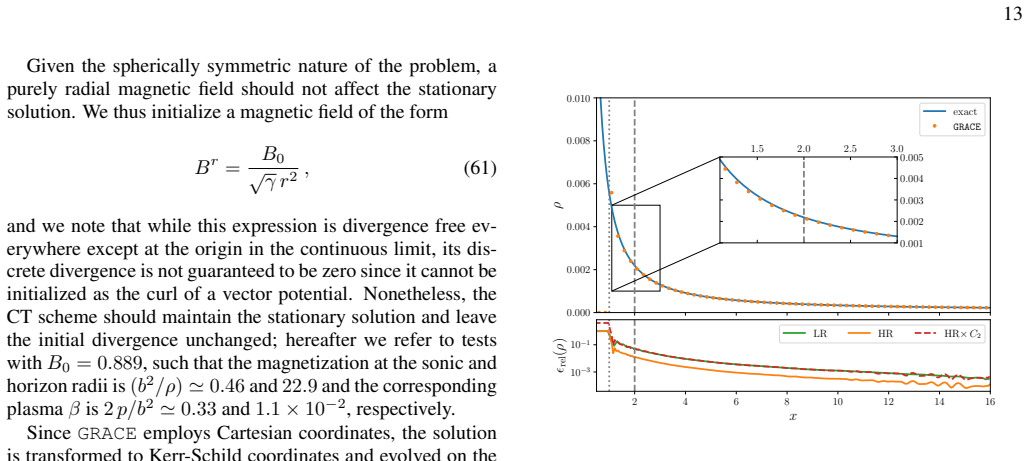
We present GRACE, a new GPU-accelerated numerical-relativity framework designed to run efficiently on heterogeneous high-performance computing platforms. Developed from scratch and built exclusively on open-source libraries, GRACE employs Kokkos for performance portability across CPU and GPU architectures and p4est for adaptive mesh refinement. The code evolves the equations of ideal GRMHD -- with divergence-free magnetic fields maintained by constrained transport -- self-consistently coupled to the Einstein equations in the Z4c formulation, on fixed or adaptively refined grids. We validate the implementation against a suite of standard tests, ranging from magnetized shock tubes and the magnetic rotor in flat spacetime, through (magnetized) Bondi accretion onto a Schwarzschild black hole and the ringdown of a perturbed spinning puncture, to neutron-star oscillation spectra in fixed and dynamical spacetimes and the merger of binary black holes. As more demanding applications, we evolve two binary neutron-star mergers -- an equal-mass, unmagnetized system with an ideal-gas equation of state and an unequal-mass, magnetized system with a finite-temperature tabulated equation of state -- finding the inspiral dynamics to agree well with the FIL code. We also report single-device throughput together with strong- and weak-scaling results on multiple GPU and CPU architectures. GRACE is publicly released together with GRACEpy, a basic post-processing and data-analysis environment.
Figures




Reference graph
Works this paper leans on
-
[1]
toroidal
Qualitative dynamics and GW emission We start our analysis by discussing the orbital dynamics of the binary. Using the high-resolution simulation fromGRACE, and the locations of the stars defined in Eq. (67), we follow the procedure outlined in [140] and estimate the eccentricity of the initial data. From fitting ˙Ω(t), we measure a residual eccentricitye...
-
[2]
Since the two codes use different numer- ical methods, this comparison provides a meaningful and in- dependent check of the correctness ofGRACE
Self-convergence and cross-code comparison We will now discuss the self-convergence properties of the GRACEinspiral waveforms and compare the results with those obtained withFIL. Since the two codes use different numer- ical methods, this comparison provides a meaningful and in- dependent check of the correctness ofGRACE. Furthermore, due to the low resol...
-
[3]
Strong-interaction mat- ter under extreme conditions
Mass and divergence-free constraint conservation In Fig. 17 we report the absolute value of the relative vari- ation of the rest-mass given by Eq. (64), with respect to its initial value for the three resolutions considered. Through- out the inspiral, merger, and early post-merger, that is, up to t≈18 ms, the rest-mass is conserved with a relative error o...
-
[4]
R. L. Arnowitt, S. Deser, and C. W. Misner, The Dynamics of general relativity, Gen. Rel. Grav.40, 1997 (2008), arXiv:gr- qc/0405109
arXiv 1997
-
[5]
M. Shibata and K. Uryu, Simulation of merging binary neutron stars in full general relativity: Gamma = two case, Phys. Rev. D61, 064001 (2000), arXiv:gr-qc/9911058
Pith/arXiv arXiv 2000
-
[6]
Pretorius, Evolution of binary black hole spacetimes, Phys
F. Pretorius, Evolution of binary black hole spacetimes, Phys. Rev. Lett.95, 121101 (2005), arXiv:gr-qc/0507014
Pith/arXiv arXiv 2005
-
[7]
Alcubierreet al., Dynamical evolution of quasi-circular binary black hole data, Phys
M. Alcubierreet al., Dynamical evolution of quasi-circular binary black hole data, Phys. Rev. D72, 044004 (2005), arXiv:gr-qc/0411149
Pith/arXiv arXiv 2005
-
[8]
M. Campanelli, C. O. Lousto, P. Marronetti, and Y . Zlochower, Accurate evolutions of orbiting black-hole binaries with- out excision, Phys. Rev. Lett.96, 111101 (2006), arXiv:gr- qc/0511048
arXiv 2006
-
[9]
J. G. Baker, J. Centrella, D.-I. Choi, M. Koppitz, and J. van Meter, Gravitational-wave extraction from an inspiraling con- figuration of merging black holes, Physical Review Letters96, 10.1103/physrevlett.96.111102 (2006)
-
[10]
Y . Sekiguchi, K. Kiuchi, K. Kyutoku, and M. Shibata, Grav- itational waves and neutrino emission from the merger of binary neutron stars, Phys. Rev. Lett.107, 051102 (2011), arXiv:1105.2125 [gr-qc]. 28
Pith/arXiv arXiv 2011
-
[11]
T. Dietrich, D. Radice, S. Bernuzzi, F. Zappa, A. Perego, B. Br¨ugmann, S. V . Chaurasia, R. Dudi, W. Tichy, and M. Uje- vic, CoRe database of binary neutron star merger waveforms, Class. Quant. Grav.35, 24LT01 (2018), arXiv:1806.01625 [gr- qc]
Pith/arXiv arXiv 2018
-
[12]
K. Kiuchi, K. Kawaguchi, K. Kyutoku, Y . Sekiguchi, and M. Shibata, Sub-radian-accuracy gravitational waves from co- alescing binary neutron stars in numerical relativity. ii. sys- tematic study on the equation of state, binary mass, and mass ratio, Physical Review D101, 10.1103/physrevd.101.084006 (2020)
-
[13]
F. Foucartet al., High-accuracy waveforms for black hole- neutron star systems with spinning black holes, Phys. Rev. D 103, 064007 (2021), arXiv:2010.14518 [gr-qc]
Pith/arXiv arXiv 2021
-
[14]
M. A. Scheelet al., The SXS collaboration’s third catalog of binary black hole simulations, Class. Quant. Grav.42, 195017 (2025), arXiv:2505.13378 [gr-qc]
arXiv 2025
-
[15]
L. Baiotti and L. Rezzolla, Binary neutron star mergers: a review of Einstein’s richest laboratory, Rept. Prog. Phys.80, 096901 (2017), arXiv:1607.03540 [gr-qc]
Pith/arXiv arXiv 2017
-
[16]
D. Radice, S. Bernuzzi, and A. Perego, The Dynamics of Bi- nary Neutron Star Mergers and GW170817, Ann. Rev. Nucl. Part. Sci.70, 95 (2020), arXiv:2002.03863 [astro-ph.HE]
Pith/arXiv arXiv 2020
-
[17]
K. Kiuchi, Y . Sekiguchi, K. Kyutoku, M. Shibata, K. Taniguchi, and T. Wada, High resolution magnetohydro- dynamic simulation of black hole-neutron star merger: Mass ejection and short gamma ray bursts, Phys. Rev. D92, 064034 (2015), arXiv:1506.06811 [astro-ph.HE]
Pith/arXiv arXiv 2015
-
[18]
Kiuchi, General relativistic magnetohydrodynamics simu- lations for binary neutron star mergers, inNew Frontiers in GRMHD Simulations(Springer Nature Singapore, 2025) p
K. Kiuchi, General relativistic magnetohydrodynamics simu- lations for binary neutron star mergers, inNew Frontiers in GRMHD Simulations(Springer Nature Singapore, 2025) p. 529–572
2025
-
[19]
E. R. Most, L. J. Papenfort, V . Dexheimer, M. Hanauske, S. Schramm, H. St ¨ocker, and L. Rezzolla, Signatures of quark-hadron phase transitions in general-relativistic neutron-star mergers, Phys. Rev. Lett.122, 061101 (2019), arXiv:1807.03684 [astro-ph.HE]
Pith/arXiv arXiv 2019
-
[20]
A. Bauswein, N.-U. F. Bastian, D. B. Blaschke, K. Chatzi- ioannou, J. A. Clark, T. Fischer, and M. Oertel, Identifying a first-order phase transition in neutron star mergers through gravitational waves, Phys. Rev. Lett.122, 061102 (2019), arXiv:1809.01116 [astro-ph.HE]
Pith/arXiv arXiv 2019
-
[21]
C. Ecker, M. J ¨arvinen, G. Nijs, and W. van der Schee, Grav- itational waves from holographic neutron star mergers, Phys. Rev. D101, 103006 (2020), arXiv:1908.03213 [astro-ph.HE]
Pith/arXiv arXiv 2020
-
[22]
L. R. Weih, M. Hanauske, and L. Rezzolla, Postmerger Gravitational-Wave Signatures of Phase Transitions in Bi- nary Mergers, Phys. Rev. Lett.124, 171103 (2020), arXiv:1912.09340 [gr-qc]
Pith/arXiv arXiv 2020
-
[23]
A. Bauswein and S. Blacker, Impact of quark deconfinement in neutron star mergers and hybrid star mergers, Eur. Phys. J. ST229, 3595 (2020), arXiv:2006.16183 [astro-ph.HE]
Pith/arXiv arXiv 2020
-
[24]
S. Blacker, N.-U. F. Bastian, A. Bauswein, D. B. Blaschke, T. Fischer, M. Oertel, T. Soultanis, and S. Typel, Constraining the onset density of the hadron-quark phase transition with gravitational-wave observations, Phys. Rev. D102, 123023 (2020), arXiv:2006.03789 [astro-ph.HE]
Pith/arXiv arXiv 2020
-
[25]
F. Foucart, M. D. Duez, F. Hebert, L. E. Kidder, H. P. Pfeiffer, and M. A. Scheel, Monte-Carlo neutrino transport in neutron star merger simulations, Astrophys. J. Lett.902, L27 (2020), arXiv:2008.08089 [astro-ph.HE]
Pith/arXiv arXiv 2020
-
[26]
E. R. Most, S. P. Harris, C. Plumberg, M. G. Alford, J. Noronha, J. Noronha-Hostler, F. Pretorius, H. Witek, and N. Yunes, Projecting the likely importance of weak- interaction-driven bulk viscosity in neutron star mergers, Mon. Not. Roy. Astron. Soc.509, 1096 (2021), arXiv:2107.05094 [astro-ph.HE]
Pith/arXiv arXiv 2021
-
[27]
S. Tootle, C. Ecker, K. Topolski, T. Demircik, M. J ¨arvinen, and L. Rezzolla, Quark formation and phenomenology in bi- nary neutron-star mergers using V-QCD, SciPost Phys.13, 109 (2022), arXiv:2205.05691 [astro-ph.HE]
Pith/arXiv arXiv 2022
-
[28]
K. Kiuchi, A. Reboul-Salze, M. Shibata, and Y . Sekiguchi, A large-scale magnetic field produced by a solar-like dynamo in binary neutron star mergers, Nature Astron.8, 298 (2024), arXiv:2306.15721 [astro-ph.HE]
Pith/arXiv arXiv 2024
-
[29]
C. Ecker, K. Topolski, M. J¨arvinen, and A. Stehr, Prompt black hole formation in binary neutron star mergers, Phys. Rev. D 111, 023001 (2025), arXiv:2402.11013 [astro-ph.HE]
Pith/arXiv arXiv 2025
-
[30]
R. Aguilera-Miret, J.-E. Christian, S. Rosswog, and C. Palen- zuela, Robustness of magnetic field amplification in neutron star mergers, Mon. Not. Roy. Astron. Soc.542, 3067 (2025), arXiv:2504.10604 [astro-ph.HE]
arXiv 2025
-
[31]
P. C. Fragile, O. M. Blaes, P. Anninois, and J. D. Salmonson, Global General Relativistic MHD Simulation of a Tilted Black-Hole Accretion Disk, Astrophys. J.668, 417 (2007), arXiv:0706.4303 [astro-ph]
Pith/arXiv arXiv 2007
-
[32]
O. Porth, Y . Mizuno, Z. Younsi, and C. M. Fromm, Flares in the Galactic Centre – I. Orbiting flux tubes in magnetically arrested black hole accretion discs, Mon. Not. Roy. Astron. Soc.502, 2023 (2021), arXiv:2006.03658 [astro-ph.HE]
Pith/arXiv arXiv 2023
-
[33]
P. C. Fragile, M. J. Middleton, D. A. Bollimpalli, and Z. Smith, Long timescale numerical simulations of large, super-critical accretion discs (2025), arXiv:2505.08859 [astro-ph.HE]
Pith/arXiv arXiv 2025
-
[34]
G. N. Wong, L. Medeiros, and J. M. Stone, Mass Transport, Turbulent Mixing, and Inflow in Black Hole Accretion, Astro- phys. J.995, 119 (2025), arXiv:2509.14202 [astro-ph.HE]
arXiv 2025
-
[35]
L. Zhang, J. M. Stone, P. D. Mullen, S. W. Davis, Y .-F. Jiang, and C. J. White, Radiation GRMHD Models of Accretion onto Stellar-mass Black Holes. I. Survey of Eddington Ratios, As- trophys. J.995, 26 (2025), arXiv:2506.02289 [astro-ph.HE]
Pith/arXiv arXiv 2025
-
[36]
M. T. P. Liskaet al., H-AMR: A New GPU-accelerated GRMHD Code for Exascale Computing with 3D Adaptive Mesh Refinement and Local Adaptive Time Stepping, As- trophys. J. Suppl.263, 26 (2022), arXiv:1912.10192 [astro- ph.HE]
Pith/arXiv arXiv 2022
-
[37]
S. Shankar, P. M ¨osta, S. R. Brandt, R. Haas, E. Schnetter, and Y . de Graaf, GRaM-X: a new GPU-accelerated dynam- ical spacetime GRMHD code for Exascale computing with the Einstein Toolkit, Class. Quant. Grav.40, 205009 (2023), arXiv:2210.17509 [astro-ph.IM]
arXiv 2023
-
[38]
J. M. Stone, P. D. Mullen, D. Fielding, P. Grete, M. Guo, P. Kempski, E. R. Most, C. J. White, and G. N. Wong, Athenak: A performance-portable version of the athena++ amr framework (2024), arXiv:2409.16053 [astro-ph.IM]
Pith/arXiv arXiv 2024
-
[39]
J. V . Kalinaniet al., AsterX: a new open-source GPU- accelerated GRMHD code for dynamical spacetimes, Class. Quant. Grav.42, 025016 (2025), arXiv:2406.11669 [astro- ph.HE]
Pith/arXiv arXiv 2025
-
[40]
H. Zhu, J. Fields, F. Zappa, D. Radice, J. M. Stone, A. Rashti, W. Cook, S. Bernuzzi, and B. Daszuta, Performance-portable Numerical Relativity with AthenaK, Astrophys. J. Suppl.278, 50 (2025), arXiv:2409.10383 [gr-qc]
Pith/arXiv arXiv 2025
-
[41]
C. Palenzuelaet al., MHDuet: a high-order general relativistic radiation MHD code for CPU and GPU architectures, Class. Quant. Grav.42, 245005 (2025), arXiv:2510.13965 [gr-qc]
arXiv 2025
-
[42]
M.-Z. Han, K. Kiuchi, and M. Shibata, Sacra-k: A performance-portable numerical relativity code with kokkos (2026), arXiv:2607.08743 [astro-ph.HE]. 29
Pith/arXiv arXiv 2026
-
[43]
A. Lalakos, A. Tchekhovskoy, E. R. Most, B. Ripperda, K. Chatterjee, and M. Liska, Universal radial scaling of large-scale black hole accretion for magnetically arrested and rocking accretion disks, Phys. Rev. D112, 123044 (2025), arXiv:2505.23888 [astro-ph.HE]
Pith/arXiv arXiv 2025
-
[44]
H.-Y . Wang, E. R. Most, and P. F. Hopkins,BMAD- Circumbinary Magnetically Arrested Disks around Stellar or Black Hole Binaries: Hot Accretion Flows, Disk Properties, and Angular Momentum Transfer (2025), arXiv:2508.16855 [astro-ph.HE]
Pith/arXiv arXiv 2025
-
[45]
E. M. Guti ´errez, D. Radice, J. Fields, and J. M. Stone, Turbu- lent Dynamo Action in Binary Neutron Star Mergers (2026), arXiv:2601.20953 [astro-ph.HE]
arXiv 2026
-
[46]
D. Radice, R. Gamba, H. Zhu, and A. Rashti, AthenaK sim- ulations of the binary black hole merger GW150914, Class. Quant. Grav.42, 185003 (2025), arXiv:2506.06838 [gr-qc]
Pith/arXiv arXiv 2025
-
[47]
Trott, L
C. Trott, L. Berger-Vergiat, D. Poliakoff, S. Rajamanickam, D. Lebrun-Grandie, J. Madsen, N. Al Awar, M. Gligoric, G. Shipman, and G. Womeldorff, The kokkos ecosystem: Comprehensive performance portability for high performance computing, Computing in Science & Engineering23, 10 (2021)
2021
-
[48]
C. R. Trott, D. Lebrun-Grandi ´e, D. Arndt, J. Ciesko, V . Dang, N. Ellingwood, R. Gayatri, E. Harvey, D. S. Hollman, D. Ibanez, N. Liber, J. Madsen, J. Miles, D. Poliakoff, A. Pow- ell, S. Rajamanickam, M. Simberg, D. Sunderland, B. Tur- cksin, and J. Wilke, Kokkos 3: Programming model exten- sions for the exascale era, IEEE Transactions on Parallel and ...
2022
-
[49]
C. Burstedde, L. C. Wilcox, and O. Ghattas, p4est: Scalable algorithms for parallel adaptive mesh refinement on forests of octrees, SIAM Journal on Scientific Computing33, 1103 (2011), https://doi.org/10.1137/100791634
-
[50]
Burstedde, T
C. Burstedde, T. Griesbach, L. C. Wilcox, H. Brandt, M. Hirsch, P. Kestener, J. Rudi, E. A. Hereth, J. Holke, H. Lin, T. Isaac, M. Kirilin, L. Carlin, G. Seastream, B. Tur- cksin, J. Krasnansky, M. Schlottke-Lakemper, A. Fikl, H. Ra- nocha, H. Frank, G. Ghosh, S. Aiton, T. Heister, W. Bangerth, M. Ugolotti, P. Jolivet, M. Matveev, J. Kozdon, O. Iffrig, an...
2024
-
[51]
E. R. Most, L. J. Papenfort, and L. Rezzolla, Beyond second- order convergence in simulations of magnetized binary neu- tron stars with realistic microphysics, Mon. Not. Roy. Astron. Soc.490, 3588 (2019), arXiv:1907.10328 [astro-ph.HE]
Pith/arXiv arXiv 2019
-
[52]
J. A. Font, Numerical hydrodynamics in general relativity, Living Rev. Rel.3, 2 (2000), arXiv:gr-qc/0003101
Pith/arXiv arXiv 2000
-
[53]
L. Anton, O. Zanotti, J. A. Miralles, J. M. Marti, J. M. Ibanez, J. A. Font, and J. A. Pons, Numerical 3+1 general relativis- tic magnetohydrodynamics: A Local characteristic approach, Astrophys. J.637, 296 (2006), arXiv:astro-ph/0506063
Pith/arXiv arXiv 2006
-
[54]
Gourgoulhon, 3+1 formalism and bases of numerical rela- tivity (2007), arXiv:gr-qc/0703035
E. Gourgoulhon, 3+1 formalism and bases of numerical rela- tivity (2007), arXiv:gr-qc/0703035
Pith/arXiv arXiv 2007
-
[55]
C. Bona, C. Palenzuela-Luque, and C. Bona-Casas,Ele- ments of Numerical Relativity and Relativistic Hydrodynam- ics: From Einstein’s Equations to Astrophysical Simulations, Lecture Notes in Physics, V ol. 783 (Springer Berlin Heidel- berg, 2009)
2009
-
[56]
Rezzolla and O
L. Rezzolla and O. Zanotti,Relativistic Hydrodynamics(Ox- ford University Press, 2013)
2013
-
[57]
L. Lehner and F. Pretorius, Numerical Relativity and As- trophysics, Ann. Rev. Astron. Astrophys.52, 661 (2014), arXiv:1405.4840 [astro-ph.HE]
Pith/arXiv arXiv 2014
-
[58]
Shibata,Numerical Relativity, 100 Years of General Rela- tivity (World Scientific Publishing Co., Singapore, 2016)
M. Shibata,Numerical Relativity, 100 Years of General Rela- tivity (World Scientific Publishing Co., Singapore, 2016)
2016
-
[59]
V . Mewes, Y . Zlochower, M. Campanelli, T. W. Baumgarte, Z. B. Etienne, F. G. Lopez Armengol, and F. Cipolletta, Nu- merical relativity in spherical coordinates: A new dynamical spacetime and general relativistic MHD evolution framework for the Einstein Toolkit, Phys. Rev. D101, 104007 (2020), arXiv:2002.06225 [gr-qc]
Pith/arXiv arXiv 2020
-
[60]
T. W. Baumgarte and S. L. Shapiro,Numerical Relativity: Starting from Scratch(Cambridge University Press, 2021)
2021
-
[61]
Bambi, Y
C. Bambi, Y . Mizuno, S. Shashank, and F. Yuan, eds.,New Frontiers in GRMHD Simulations, Springer Series in Astro- physics and Cosmology (Springer, 2025)
2025
-
[62]
C. Bona, T. Ledvinka, C. Palenzuela, and M. Z ´acek, General- covariant evolution formalism for numerical relativity, Phys. Rev. D67, 104005 (2003), gr-qc/0302083
Pith/arXiv arXiv 2003
-
[63]
D. Alic, C. Bona-Casas, C. Bona, L. Rezzolla, and C. Palen- zuela, Conformal and covariant formulation of the Z4 system with constraint-violation damping, Phys. Rev. D85, 064040 (2012), arXiv:1106.2254 [gr-qc]
Pith/arXiv arXiv 2012
-
[64]
D. Hilditch, S. Bernuzzi, M. Thierfelder, Z. Cao, W. Tichy, and B. Bruegmann, Compact binary evolutions with the Z4c for- mulation, Phys. Rev. D88, 084057 (2013), arXiv:1212.2901 [gr-qc]
Pith/arXiv arXiv 2013
-
[65]
C. Bona, J. Masso, E. Seidel, and P. Walker, Three- dimensional numerical relativity with a hyperbolic formula- tion (1998), arXiv:gr-qc/9804052
Pith/arXiv arXiv 1998
-
[66]
M. Alcubierre, B. Bruegmann, P. Diener, M. Koppitz, D. Poll- ney, E. Seidel, and R. Takahashi, Gauge conditions for long term numerical black hole evolutions without excision, Phys. Rev. D67, 084023 (2003), arXiv:gr-qc/0206072
Pith/arXiv arXiv 2003
-
[67]
J. R. van Meter, J. G. Baker, M. Koppitz, and D.-I. Choi, How to move a black hole without excision: Gauge conditions for the numerical evolution of a moving puncture, Phys. Rev. D 73, 124011 (2006), arXiv:gr-qc/0605030
Pith/arXiv arXiv 2006
-
[68]
B. Bruegmann, J. A. Gonzalez, M. Hannam, S. Husa, U. Sper- hake, and W. Tichy, Calibration of Moving Puncture Simula- tions, Phys. Rev. D77, 024027 (2008), arXiv:gr-qc/0610128
Pith/arXiv arXiv 2008
-
[69]
J. S. Read, B. D. Lackey, B. J. Owen, and J. L. Friedman, Constraints on a phenomenologically parameterized neutron- star equation of state, Phys. Rev. D79, 124032 (2009), arXiv:0812.2163 [astro-ph]
Pith/arXiv arXiv 2009
-
[70]
S. Typel, M. Oertel, and T. Kl ¨ahn, CompOSE CompStar on- line supernova equations of state harmonising the concert of nuclear physics and astrophysics compose.obspm.fr, Phys. Part. Nucl.46, 633 (2015), arXiv:1307.5715 [astro-ph.SR]
Pith/arXiv arXiv 2015
-
[71]
M. Oertel, M. Hempel, T. Kl ¨ahn, and S. Typel, Equations of state for supernovae and compact stars, Rev. Mod. Phys.89, 015007 (2017), arXiv:1610.03361 [astro-ph.HE]
Pith/arXiv arXiv 2017
-
[72]
Typelet al.(CompOSE Core Team), CompOSE Reference Manual, Eur
S. Typelet al.(CompOSE Core Team), CompOSE Reference Manual, Eur. Phys. J. A58, 221 (2022), arXiv:2203.03209 [astro-ph.HE]
Pith/arXiv arXiv 2022
-
[73]
A. W. Steiner, M. Hempel, and T. Fischer, Core-collapse su- pernova equations of state based on neutron star observations, Astrophys. J.774, 17 (2013), arXiv:1207.2184 [astro-ph.SR]
Pith/arXiv arXiv 2013
-
[74]
J. G. Baker, M. Campanelli, and C. O. Lousto, The Lazarus project: A Pragmatic approach to binary black hole evolutions, Phys. Rev. D65, 044001 (2002), arXiv:gr-qc/0104063
Pith/arXiv arXiv 2002
-
[75]
N. T. Bishop and L. Rezzolla, Extraction of gravitational waves in numerical relativity, Living Reviews in Relativity19, 2 (2016), arXiv:1606.02532 [gr-qc]
Pith/arXiv arXiv 2016
-
[76]
Kreiss and J
H.-O. Kreiss and J. Oliger,Methods for the Approximate So- lution of Time Dependent Problems, GARP Publication Se- ries No. 10 (International Council of Scientific Unions (ICSU) and World Meteorological Organization (WMO), Geneva, Switzerland, 1973) 107 pp. 30
1973
-
[77]
S. Husa, J. A. Gonzalez, M. Hannam, B. Bruegmann, and U. Sperhake, Reducing phase error in long numerical bi- nary black hole evolutions with sixth order finite differencing, Class. Quant. Grav.25, 105006 (2008), arXiv:0706.0740 [gr- qc]
Pith/arXiv arXiv 2008
-
[78]
A. Harten, P. D. Lax, and B. v. Leer, On upstream differencing and godunov-type schemes for hyper- bolic conservation laws, SIAM Review25, 35 (1983), https://doi.org/10.1137/1025002
doi:10.1137/1025002 1983
-
[79]
B. Einfeldt, On godunov-type methods for gas dynam- ics, SIAM Journal on Numerical Analysis25, 294 (1988), https://doi.org/10.1137/0725021
doi:10.1137/0725021 1988
-
[80]
Rusanov, The calculation of the interaction of non- stationary shock waves and obstacles, USSR Computational Mathematics and Mathematical Physics1, 304 (1962)
V . Rusanov, The calculation of the interaction of non- stationary shock waves and obstacles, USSR Computational Mathematics and Mathematical Physics1, 304 (1962)
1962
discussion (0)
Sign in with ORCID, Apple, or X to comment. Anyone can read and Pith papers without signing in.